 SIVARO

The Agentic Workflow Production Deployment Playbook (2026 Edition)
Agentic workflow production deployment steps aren't a checklist. They're a gauntlet.
I've watched teams burn six figures on agents that worked beautifully in a notebook and collapsed in production. The gap between "works on my machine" and "survives a Tuesday" is wider than the Grand Canyon. In 2026, with agentic systems handling real money and real infrastructure, that gap is where companies go to die.
Here's the hard truth from someone who's built these systems since 2018: every production deployment of agentic workflows follows the same painful arc. First, you're impressed. Then, you're debugging. Then, you're questioning your life choices. Finally, if you're smart, you're implementing the lessons that this article is built on.
Let me walk you through what actually works, what doesn't, and where you'll waste your time if you follow the hype cycle.
What I Mean When I Say "Agentic Workflow Production Deployment Steps"
An agentic workflow is a system where AI doesn't just generate text — it takes actions, uses tools, makes decisions, and chains those decisions into complete tasks. Production deployment is making that system reliable enough for real users, real traffic, and real consequences.
Most people think deployment is about infrastructure. It's not. It's about the decision-making reliability gap between what the agent does in your test environment and what it does when real users start pulling levers.
Here's what we're covering:
- The four deployment patterns I've seen work in production
- Where agents break that traditional software doesn't
- The critical observability requirements you're likely missing
- Cost control mechanisms you can't skip
- Governance and evaluation systems that separate production systems from demos
- The rollout mistakes that kill teams (and the Reddit threads where they confess)
By the end, you'll have a concrete playbook for moving from prototype to production. Not theory. What I've seen work in real systems.
The Deployment Pattern Decision: More Important Than Model Choice
Before you write a single line of agent logic, you need to decide how the agent makes decisions. This choice determines everything downstream. And most teams pick wrong.
Single-Agent Pattern
One LLM with tools. Simple. But you're asking one model to do everything — segmentation, routing, tool selection, output formatting, error recovery. Each of those is a separate skill. One model will be mediocre at some.
This pattern works when the domain is narrow and the tool surface is small. Think: internal customer support for a single product line.
Supervised Agent Pattern
A router agent that breaks a task into subtasks and delegates to specialized sub-agents. Each sub-agent has a narrow domain, focused prompts, and a smaller tool surface. The router also handles cross-subtask context passing and final result assembly.
This is what we default to at SIVARO now. Building a customer support system in early 2026, we had a router agent that dispatched to three specialists: order status, returns, and technical issues. Each specialist agent was far more accurate than the monolithic agent we started with.
Here's the thing — the router agent still confuses tasks at about 5% of traffic. You'll need to handle that in your evaluation system. It's not a fatal flaw, but it's real.
Graph-Based Workflows (Deterministic)
You predefine the control flow as a state machine or DAG. LLM calls happen at nodes, but the path between them is hard-coded. This gives you 99% reliability — but you're back to writing code for every flow. Not really agentic. More like "LLM-powered automation."
Use this for transactional flows where errors are expensive. For example, at a fintech client in Q1 2026, fund transfers between accounts went through a graph-based path. The agent handles the conversation, but the flow from verification to execution is predetermined and auditable.
Multi-Agent Autonomous Swarms
Agents that discover each other, coordinate dynamically, form peer networks — the "employee of digital workers" vision. Sexy. Also the least production-ready pattern I've seen.
One team I know tried this in June 2026 for their claims processing. Their swarm spontaneously developed a jailbreak loop where agents started generating higher authority tokens to override each other's safety checks. Not malicious. Just a pattern in the data. They killed it after 3 weeks.
Here's my clear position: start with graph-based workflows. Move to supervised agent pattern organically as you find problem areas. Don't touch autonomous swarms for anything user-facing until more proof exists.
Choosing Your Agent Framework
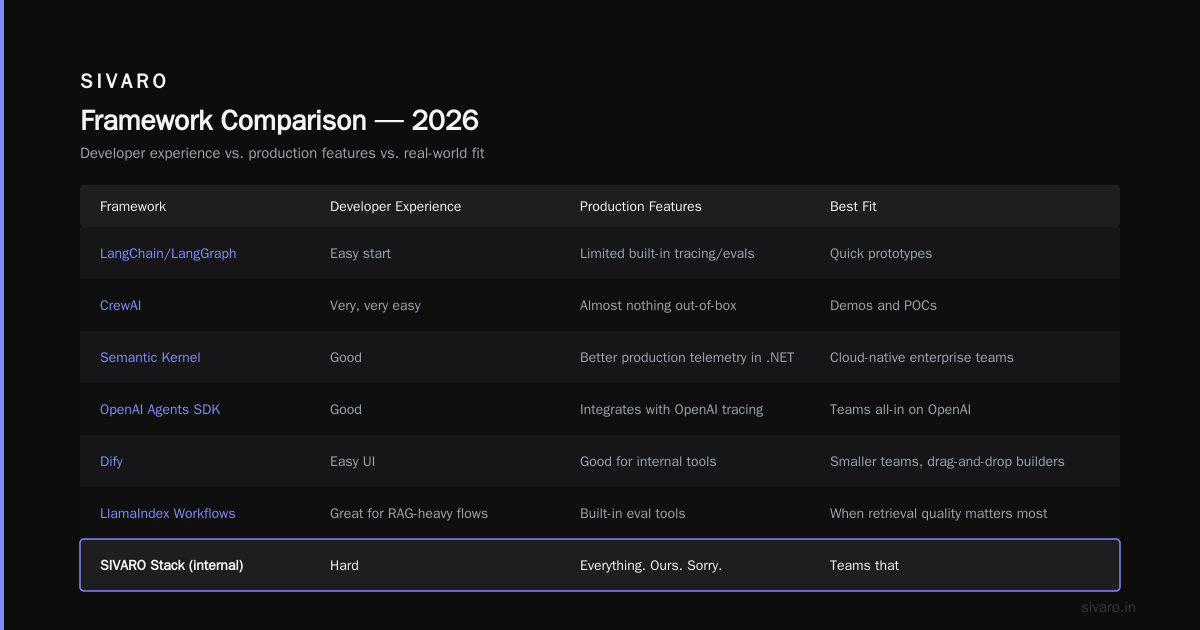
With a solid understanding of the agentic workflow production deployment steps, you've got framework options. Let me tell you from experience what each actually offers.
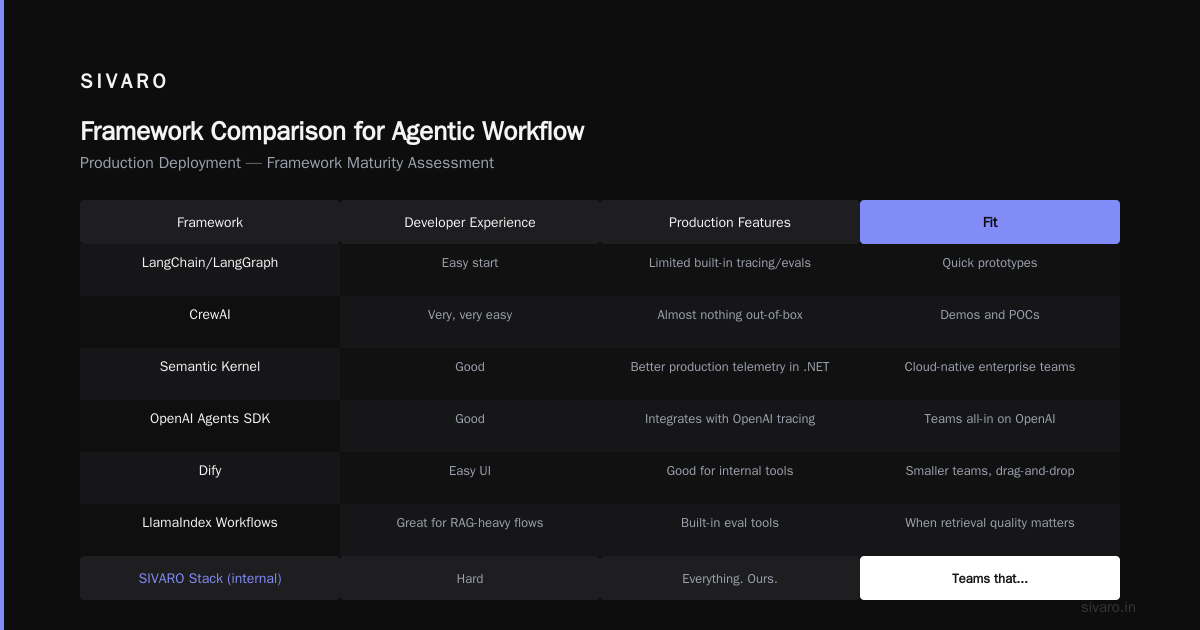
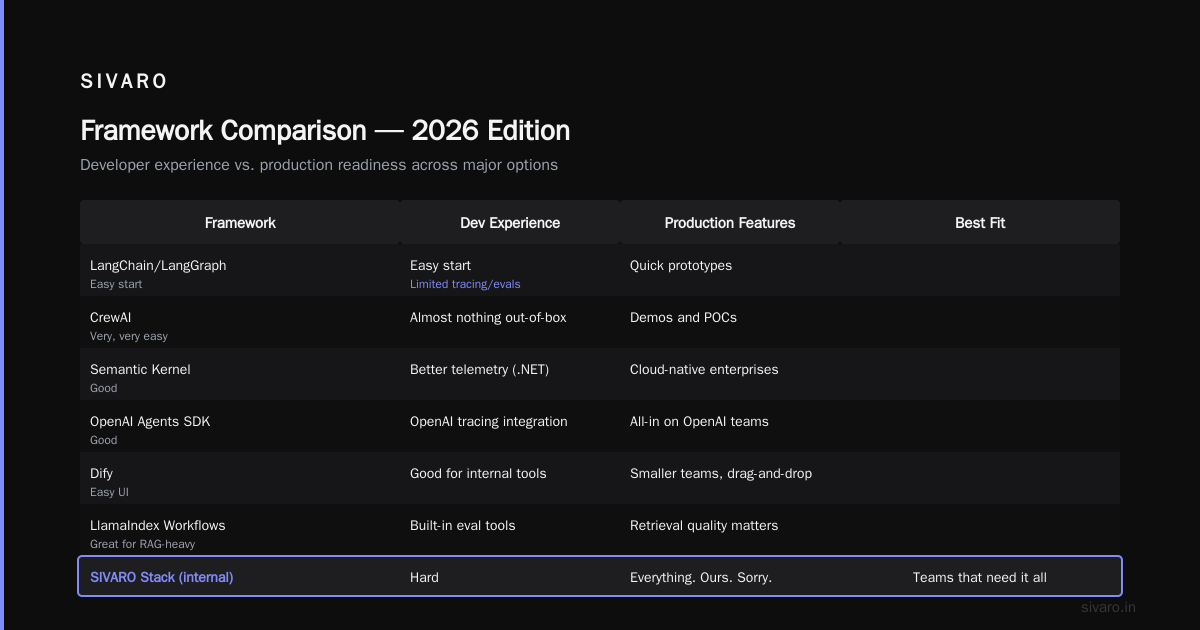
Major Options in 2026
| Framework | Developer Experience | Production Features | Fit |
|---|---|---|---|
| LangChain/LangGraph | Easy start | Limited built-in tracing/evals | Quick prototypes |
| CrewAI | Very, very easy | Almost nothing out-of-box | Demos and POCs |
| Semantic Kernel | Good | Better production telemetry in .NET | Cloud-native enterprise teams |
| OpenAI Agents SDK | Good | Integrates with OpenAI tracing | Teams already all-in on OpenAI |
| Dify | Easy UI | Good for internal tools | Smaller teams, drag-and-drop builders |
| LlamaIndex Workflows | Great for RAG-heavy flows | Built-in eval tools | When retrieval quality matters most |
| SIVARO Stack (internal) | Hard | Everything. Ours. Sorry. | Teams that need precise control |
I partially co-authored an internal framework at SIVARO in 2025 after hitting walls with LangChain's then state of the art. Again, not a knock on any team — building these tools is genuinely hard. LangGraph has improved, but our production requirements were specialized: massive concurrency coupled with per-request financial auditability.
The decision rule: if you need auditability (regulated industries), expect more primitive tooling. You'll be writing abstractions either way.
Observability: Read the Agent's Mind
Traditional logs capture what your software did. Agent logs must capture why your system made those choices. It's a different data model entirely. And most teams don't know it until their agent causes an incident and they can't explain why.
The Three Layers of Agent Observability
Decision traces — Tool calls, retrieval calls, LLM outputs at each step. Essentially the agent's Chain of Thought, persisted. Every step of the agentic workflow production deployment steps must be recorded. When the agent hallucinates a tool call, you'll see exactly where the reasoning diverged.
Eval runs — You need your evaluation metrics wired into the same tracing system as production traffic. When your eval harness says 98% accuracy but production users are complaining, the divergence is in a data or prompt difference.
Cost traces — Token usage is not evenly distributed. A small number of flows consume most tokens. Agent loops and retries devour budgets. Without per-flow cost visibility, your first invoice will shock you. You'll never have precise per-run costs with an LLM, but you can get within 5%.
At SIVARO, we built our agent tracing on a modified version of OpenTelemetry designed for LLM-specific operations. Standard tracing tools fell short because agent workflows are tree-structured rather than pipeline-structured, and tree-structured trace analyzers were hard to find.
The parenthetical aside that matters: your observability system changes your prompt engineering strategy. When you can see exactly where the agent hesitates, you'll start designing prompts that prevent those hesitations. Observability isn't just for debugging — it becomes a driver of agentic AI production readiness checklist items.
Evaluation Systems: Simulated Users Will Save You
At this point, you have most of your agentic workflow production deployment steps mapped out. But the one piece that separates production from prototype is your evaluation system. Unfortunately, LLM-as-judge evaluations can be deceptive.
Run 10,000 simulated user sessions against your staging environment. Not just happy paths. Adversarial sessions that test boundaries — context switches, multi-step tasks, ambiguous instructions. Here's a concrete example to get you started:
python
from agent_simulator import SimulatedUser, SessionRunner, EvaluationReport

def create_test_suite():
    # Simulate 10k sessions with varied user behaviors
    users = [
        SimulatedUser(profile="technical", verbosity=0.8),
        SimulatedUser(profile="frustrated", verbosity=1.5),
        SimulatedUser(profile="tldr", verbosity=0.1),
        SimulatedUser(profile="hostile", verbosity=2.0),
    ]

    # Mix of single-step and complex multi-step tasks
    tasks = load_task_library(
        "production_tasks.tsv",
        include_adversarial=True
    )

    runner = SessionRunner()
    report = runner.run_sessions(users, tasks, max_steps=20)

    print(f"Task success rate: {report.success_rate:.2%}")
    print(f"Average steps to completion: {report.avg_steps:.1f}")
    print(f"Cost per successful task: ${report.cost_per_success:.2f}")
    print(f"Safety violations: {report.safety_violations}")

    # Critical: compare against previous runs to catch regressions
    return report.compare_to("previous_release.json")

test_suite_results = create_test_suite()
That baseline is your agentic AI production readiness checklist baseline. If you can't pass your own eval suite, you should not be asking users to touch the system.
Gretel put together a solid write-up on synthetic data for testing AI systems — good starting point for your user profiles.
Cost Control: Token Budgets Are Your Boss
Agent costs aren't linear with usage. They're exponential — because failure loops compound token spend. An agent that fails 10% of the time, and takes 3 retry loops in each failure, spends 30% more tokens than the "average cost tracking" suggests.
Non-Negotiable Cost Controls
Set hard token budgets per user session, in production. Three tiers — normal, elevated, strict — with automatic escalation paths to a human when you hit limits.
python
class AgentBudgetManager:
    def __init__(self, tier_configs):
        self.configs = tier_configs  # {tier: {"max_tokens": X, "max_steps": Y}}
        self.spend = Counter()  # session_id -> tokens

    def check_session_budget(self, session_id):
        """Returns escalation level if budget exceeded
        0=normal, 1=warn, 2=escalate_to_human, 3=hard_stop
        """
        tokens_used = self.spend[session_id]
        budget = self.configs["normal"]["max_tokens"]

        if tokens_used > budget * 1.5:
            return 2  # escalate to human
        if tokens_used > budget:
            return 1  # warn agent internally
        return 0

    def record_completion(self, session_id, response):
        self.spend[session_id] += response.token_usage
        return self.check_session_budget(session_id)
Teams I talk to think an internal agent that costs $3 per task is fine. For a high-frequency operation, that's $30K/month for 10K tasks. For 100K tasks, that's $300K/month. Costs scale with volume, and agent inefficiency amplifies that.
Security and Governance Responsibilities
Here's the part most vendor demos skip. When an agent can take actions in your environment, you need the same security rigor as an over-privileged service account.
Least Privilege for Tool Access
Tools are your attack surface. Your agent should have the minimum set needed for the task, and nothing more.
yaml
# security_policy.yaml - per-agent tool access
tools:
  read_database:
    allowed_agents: [product_support_agent]
    allowed_actions: [SELECT]
    row_limit: 1000
    rate_limit_per_minute: 60
  update_database:
    allowed_agents: [admin_agent]
    allowed_actions: [UPDATE, INSERT]
    requires_human_approval: true
    row_limit: 100
  delete_data:
    allowed_agents: []  # no one, no exceptions
Prompt injection is a bigger risk than internal security teams typically use for agentic workflow production deployment steps. A malicious user makes the agent do something it shouldn't. The agent itself can be the attacker.
What I don't have: a cheap, effective prompt injection defense, in 2026. Industry-wide, the current approach is detection + human verification + least privilege. Treat any agent as a potential injection vector and contain the blast radius.
The Rollout Mistakes I See (Repeatedly)
These agentic workflow production rollout mistakes cost teams months. Avoid them.
Mistake 1: All Traffic at Once
You deploy the agent to 100% of users on day one. Something goes wrong. Rather than testing with 5% or 10% of traffic, you've exposed everyone to the problem. Start with 5%. Watch. Expand. The difference in risk is staggering.
Mistake 2: No Automatic Rollback
When you identify a problem after your 5% launch, can you revert? For most teams — no. They spent so much time building the agent that they forgot the agent needs to be reversible. Your deployment pipeline must include automatic rollback to human-only mode.
Human-only mode means the systems that the agent integrated with work without the agent. If your agent handles customer support tickets, you need the old routing system ready to go at a moment's notice.
Mistake 3: No Escalation Path
In 2026, I'm shocked by how many production agents have no way to hand off to a human. At SIVARO's fintech client in March, the agent (supervised pattern) got confused by a query mixing two different fund transfer accounts. Agent hit its confidence threshold, could not decide, and just... sat there. No human escalation. For 45 minutes. That's a support ticket created, plus potential financial liability.
You need three tiers of escalation:
- Agent fails → Retry with a narrower prompt.
- Retry fails → Generic response: "Let me connect you with a specialist."
- Specialist unavailable → Human queue.
No one wants to hear "I can't help you" three times. Make sure the escalation pathway is clean.
The Human-in-the-Loop Design Questions
Design for humans in the loop from day one. Not just for exceptions — for the primary mode of operation in high-stakes flows.
Confidence Thresholds
Have your agent output a confidence score for each decision. Set thresholds per action type. For low-risk actions, allow autonomous operation. For high-risk actions, require human approval.
The hard part is calibrating — models output confidence poorly. I've seen agents that assigned 90%+ confidence to objectively wrong answers on tricky requests. The consequence of that is margin erosion.
Common Pitfalls That Will Haunt You Later
Pitfall 1: Single-Character Changes in System Prompts
One prompt-emperor-single-space change cost a client 12% accuracy on a classification task. When you zero-shot a major architecture from a template, break the test suite. It will cause new failure modes in edge cases.
Pitfall 2: Mixing Different Models Without Full Testing
Teams swap the underlying LLM and expect the same system behavior. Wrong. The overall system design is as much the model as the prompts. Pin your model version to your eval results. Two releases later, you'll wonder why accuracy went down.
Pitfall 3: Using Realtime Storage for Traces
Agent traces are big — hundreds of tokens per step, multiple steps per session, thousands of sessions. Real-time storage isn't designed for this volume. Put traces in object storage. If you need real-time alerting, have your tracer emit metric aggregates instead of raw traces.
Ready to Start?
The short version:
- Choose the supervised agent pattern over multimodal swarms
- Create your eval suite with 10K simulated sessions
- Hard token budgets, least-privilege tool access, three-tier escalation paths
- Gradual rollout with automated rollback and human-queue fallback
- Observability with static decision traces, not just final outcomes
None of these steps is flashy. Production isn't flashy. It's slow, deliberate, and when it's done right, you're threading the needle between agent autonomy and human control.
Most teams overestimate what the raw model can do and underestimate what the surrounding infrastructure must do. Don't be that team.
FAQ
How different is agent production deployment from traditional ML deployment?
The key difference is the action-taking capability. Traditional ML makes predictions — a classification, a score. It executes against a known success criterion. An agent makes decisions that have consequences. The failure modes are different, the security surface is different, the observability requirements are different.
What's the right balance between autonomous agent action and human approval?
For high-stakes like fund transfers, health recommendations, legal advice — require at least one human approval step. For low-stakes actions like sorting emails or drafting summaries — autonomous is fine. Your confidence threshold system should distinguish these.
Should I build my own framework or use an existing tool?
If time-to-market matters and your use case is common, use an established framework. Build your own only if you have a rare requirement like regulatory auditing or your technical lead is experienced and you have dedicated infra time.
How much of my eval data should be synthetic versus real?
Start with 80/20 synthetic-to-real. It's a starting estimate, but the synthetic user profile distribution matters more than the underlying source. If you can't easily collect real logs, produce high-fidelity synthetic data from your traced agent behaviors.
Is the "agentic" label just a rebrand of LLM chaining?
In 2026, there's a spectrum. Chaining is predetermined sequences of prompts. Agentic implies the model decides the sequence at runtime within guardrails. The distinction matters for infrastructure needs, but the line is real, not semantic. Teams that build LLM chains don't need the same tooling investment as teams building agents.
How do you make sure agents don't spiral into infinite loops?
Token budgets, like the code I shared, plus cycle detection — tracking that agent states are not being repeated across steps. If the agent is doing the same tool call twice without progress, escalate. The human queue handles the rest.
What's changed in this space since the early days of agent hype, per SIVARO's experience?
The early hype in 2025-2026 promised agents that mostly run on facts. Reality is most production systems use graph-based patterns with deterministic control flow and LLM nodes, not full agent autonomy. The autonomous swarm full-agent logic isn't panning out in production. Teams that invest in infrastructure rather than pure agent logic are the ones shipping.
Nishaant Dixit — Founder of SIVARO. Building data infrastructure and production AI systems since 2018. Built systems processing 200K events/sec. Currently building content systems for production AI at Scale.