 SIVARO

The Agentic Workflow Production Rollout Guide
You built a demo that made your VP gasp. The agent booked a mock flight, wrote a poem about it, and filed an expense report in 30 seconds. Then you tried to run it against real production data and the whole thing collapsed like a house of cards. I've been there. Every team I talk to at SIVARO has been there.
This isn't a guide to building agents. It's a guide to the messy, unglamorous, soul-crushing work of getting them to survive contact with production. We've rolled out agentic systems handling 200K events/sec, and I'm going to tell you exactly what worked, what failed, and what I'd never do again.
An agentic workflow is a system where AI models make decisions about control flow — not just generating text, but deciding which tools to call, which paths to take, and when to ask for help. This guide covers the architecture, the infrastructure, the evaluation strategy, and the organizational change you'll need to actually ship it.
Here's the short version of the lesson: most production failures aren't the model's fault. They're yours.
Why Most Agentic Rollouts Fail (It's Not the Model)
Let me tell you about a fintech company — I'll call them "Ledgerly" — who came to us in late 2025. They'd built an internal agent for financial reconciliation. It was beautiful. It could read bank statements, match transactions, flag discrepancies. In demos, it was flawless.
In production, it failed in the first hour. The agent froze on a PDF that was password-protected. It hallucinated a transaction category. It got stuck in a loop trying to call an API that had been deprecated that morning. The worst part? It failed silently. Nobody knew anything was wrong until the CFO asked about a $2.3M discrepancy in the reports.
This isn't unique to Ledgerly. I've seen this pattern repeat across industries. The A Practical Guide for Designing, Developing, and ... paper from late 2025 found that most agentic failures trace back to architecture decisions made before any code was written. It's not the model's fault — it's the orchestration, the evaluation, and the infrastructure surrounding it.
The ijoer.com analysis of POC-to-production failures showed something similar: over 70% of agentic AI pilots in 2025 failed to scale because teams treated them like traditional software. You don't just write code and deploy. You need to think about evaluation, observability, and fallback mechanisms from day one.
Here's the contrarian take: Most teams are overcomplicating this. They're building agent frameworks with 47 dependencies when they need a simple loop with good guardrails. The Keep Agentic AI Simple post from earlier this year nailed it — a pragmatic workflow for software development beats a flashy autonomous system every time.
Start With the Workflow, Not the Agent
The biggest mistake I see in agentic rollout after rollout: teams start with the agent. They pick a framework, wire up a model, and start building. Wrong order.
Start with the workflow. Map it out as a deterministic process first. Every step, every decision point, every data transformation. Get that right, and the agent becomes an enhancement, not the foundation.
Think of it this way. A workflow is a defined path. An agent is a system that decides which path to take. The Orkes blog on workflows vs agents makes this distinction brilliantly: workflows are the skeleton, agents are the muscles. You need both, but you build the skeleton first.
Here's a pattern I've used successfully at SIVARO — it's based on the AWS agentic patterns guide but simplified:
- Map the deterministic steps — the ones that must happen in order, every time.
- Identify the decision points — where judgment is needed, where the model can choose.
- Define the fallback paths — what happens when the model fails or produces garbage.
- Add the agent at the decision points only — nothing more, nothing less.
I know a logistics company that did this in early 2026. They mapped their freight quote workflow. It was 22 steps, 7 decision points. They could have built an agent to handle everything. Instead, they built a deterministic system for the 15 fixed steps and added an agent at the 7 decision points. Their accuracy went from 82% to 97%. The agent wasn't the whole system — it was the intelligence layer on top of a solid foundation.
The virtido.com guide on agentic workflow patterns has a great framework for this. They call it "scoped autonomy" — give the agent just enough freedom to be useful, but constrain it to specific tasks. That's the sweet spot.
The Orchestration Layer: Your New Best Friend
Let's talk about orchestration. If you're building an agentic system in 2026 and you're not using a purpose-built orchestration layer, you're doing it wrong. Period.
We tested everything at SIVARO — LangGraph, CrewAI, custom code, the Google Agent Development Kit (ADK). They all have their place, but the key insight from the Google ADK production guide is this: your orchestration layer needs to be designed for production, not for demos.
The orchestration layer handles:
- Tool invocation — which tools to call, in what order, with what parameters.
- State management — keeping track of what the agent has done, what it knows, what it still needs.
- Error handling — what happens when a tool fails, when the model times out, when the response is malformed.
- Memory — both short-term (conversation context) and long-term (persistent facts about the user or task).
- Human handoff — when the agent needs help, how does it escalate?
Here's what a production orchestration loop looks like in pseudocode, based on what we've built:
python
def run_agentic_workflow(task, orchestrator, tools, max_steps=10):
    state = initialize_state(task)
    for step in range(max_steps):
        decision = orchestrator.plan(state)  # LLM decides next action
        if decision.action == "complete":
            return state.result
        if decision.action == "ask_human":
            return escalate_to_human(state, decision.reason)
        if decision.action == "use_tool":
            try:
                result = tools[decision.tool_name].execute(decision.args)
                state = update_state(state, result)
            except ToolException as e:
                state = handle_tool_failure(state, e, decision)
    return state.with_warning("Max steps exceeded")
The key insight? The loop is simple. The complexity is in the state management and the error handling. Get those right and the system works.
Evaluations: The Hardest Part You Can't Skip
Here's what nobody tells you about agentic workflows: you can't evaluate them like normal software. Normal software has deterministic inputs and outputs. Agentic systems have probabilistic behavior — the same input can produce different outputs depending on the model's mood, the context window, or the phase of the moon.
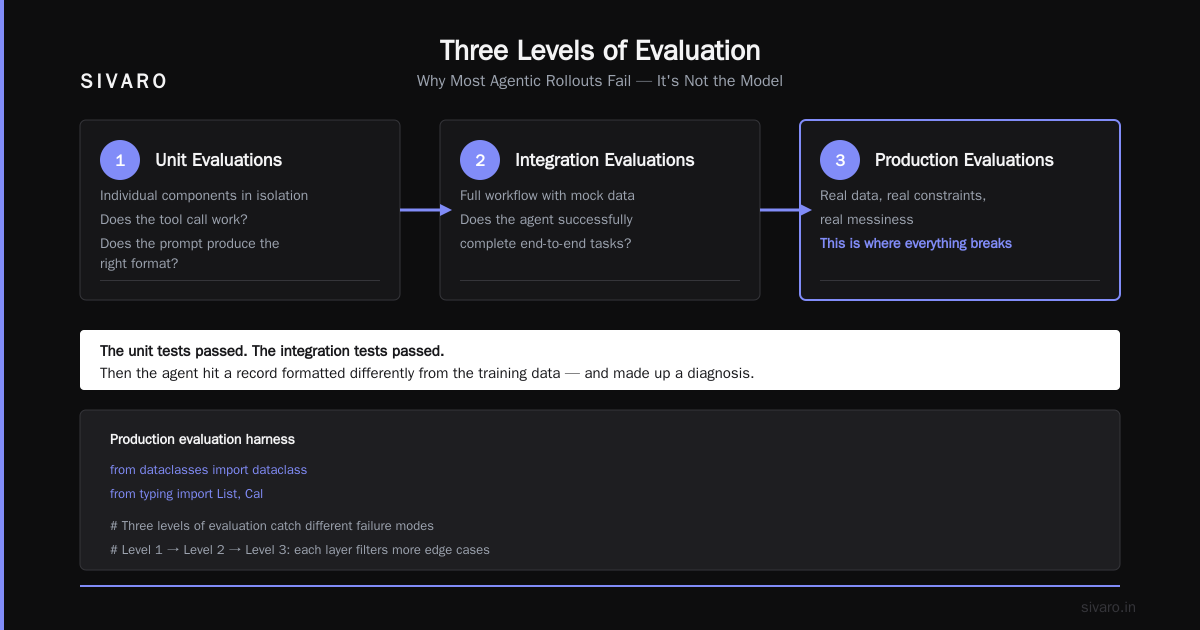
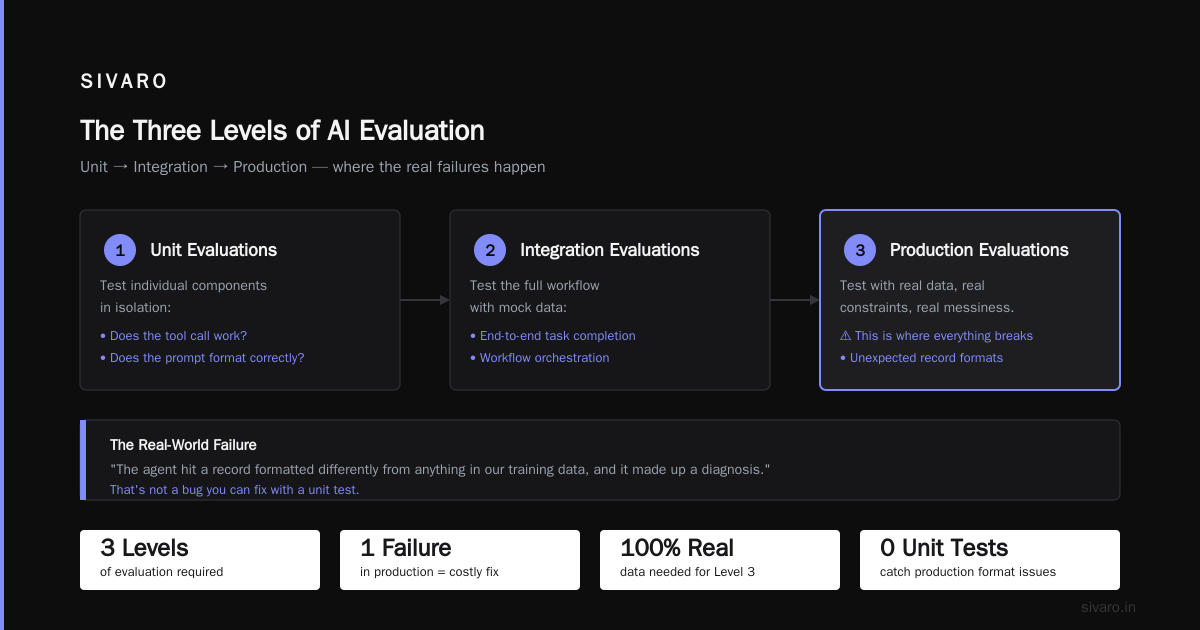
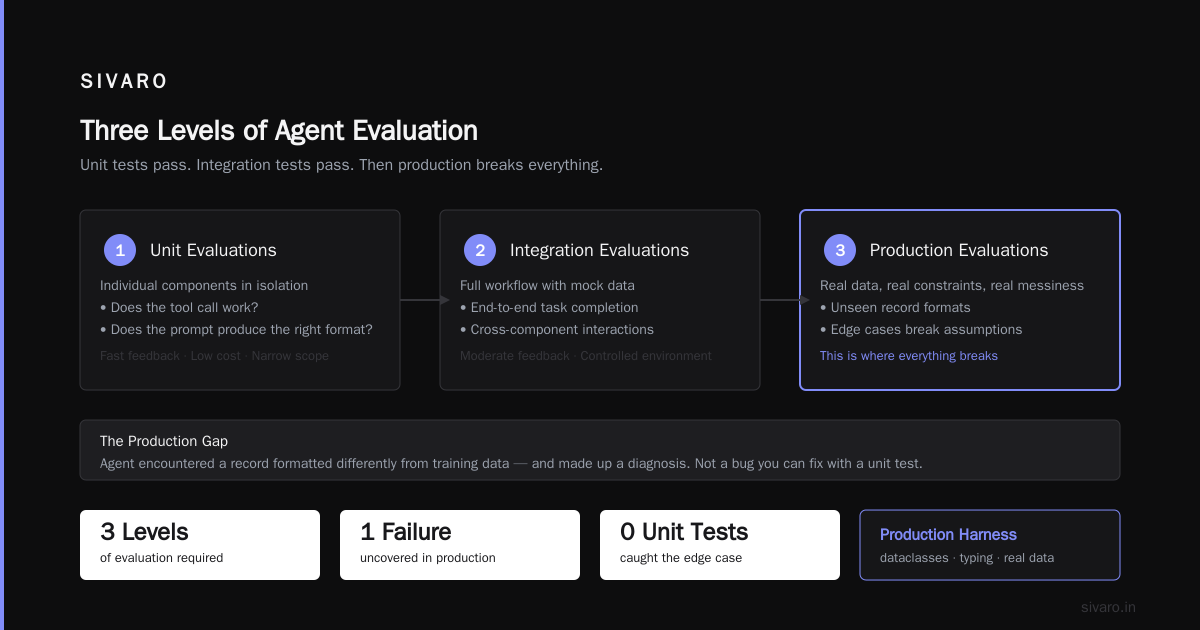
We learned this the hard way. We built an agent for a healthcare client that processed medical records. Our unit tests passed. Our integration tests passed. And then the agent hit a record that was formatted differently from anything in our training data, and it made up a diagnosis. That's not a bug you can fix with a unit test.
You need three levels of evaluation:
Level 1: Unit evaluations — test individual components in isolation. Does the tool call work? Does the prompt produce the right format?
Level 2: Integration evaluations — test the full workflow with mock data. Does the agent successfully complete end-to-end tasks?
Level 3: Production evaluations — test with real data, real constraints, real messiness. This is where everything breaks.
Here's a production evaluation harness we use:
python
from dataclasses import dataclass
from typing import List, Callable, Any

@dataclass
class EvaluationCase:
    input: dict
    expected_tools: List[str]  # tools that should be called
    expected_outcome: Any
    max_steps: int = 10

def run_evaluation_suite(workflow, cases: List[EvaluationCase]):
    results = []
    for case in cases:
        trace = workflow.run_with_trace(case.input)
        passed_tools = trace.tool_sequence == case.expected_tools
        passed_outcome = trace.result == case.expected_outcome
        passed_steps = trace.num_steps <= case.max_steps
        results.append({
            "case": case.input,
            "passed": passed_tools and passed_outcome and passed_steps,
            "tool_sequence": trace.tool_sequence,
            "num_steps": trace.num_steps
        })
    return results
The Arxiv guide has a more sophisticated version of this, with metrics for tool call accuracy, task completion rate, and hallucination frequency. I'd recommend starting simple and iterating.
A key metric that matters more than accuracy: step efficiency. How many steps does your agent take to complete a task? If it takes 15 steps to do what a deterministic system could do in 3, you have a problem. We set a maximum step count on every workflow, and when agents hit that limit, we automatically escalate to a human or fall back to a deterministic path.
Observability: You Can't Fix What You Can't See
This is where I sound like a broken record to every client. You need observability from day one. Not "we'll add it later." Day. One.
Agentic systems are fundamentally unpredictable. You don't know what tools the agent will call, what paths it will take, or where it will fail. Without detailed tracing, you're flying blind.
Here's what we instrument in every agentic workflow:
- Every LLM call — model, prompt, response, tokens used, latency
- Every tool call — which tool, what arguments, what result, how long it took
- Every state transition — what the agent knew, what it decided, why it decided it
- Every failure — the error, the context, the fallback path taken
We use OpenTelemetry for this, which has solid support for LLM traces now. Here's an example of instrumenting a tool call:
python
from opentelemetry import trace
from opentelemetry.trace import Status, StatusCode

tracer = trace.get_tracer("agentic-workflow")

def instrumented_tool_call(tool_name, args):
    with tracer.start_as_current_span(f"tool_call.{tool_name}") as span:
        span.set_attribute("tool.args", json.dumps(args))
        try:
            result = execute_tool(tool_name, args)
            span.set_attribute("tool.result", json.dumps(result))
            span.set_attribute("tool.success", True)
            return result
        except Exception as e:
            span.set_attribute("tool.success", False)
            span.set_attribute("tool.error", str(e))
            span.set_status(Status(StatusCode.ERROR, str(e)))
            raise
The McKinsey analysis of agentic AI deployments found something interesting: teams that invested in observability from day one had 2x faster resolution times for production issues. That tracks with our experience. When something goes wrong, you want to know exactly which step failed, with what inputs, and why. That's not nice-to-have. That's the difference between a 5-minute fix and a 5-day investigation.
The Fallback Strategy: Planning for Failure
Every agent will fail. It's not a question of if, but when. The question is: what happens when it does?
Here's the fallback hierarchy we use at SIVARO:
Level 1: Retry with context. If a tool call fails, retry with additional context or different parameters. Sometimes the model just needs another chance.
Level 2: Deterministic fallback. If the agent fails twice, switch to a deterministic path. This might mean using a simple rules-based system instead of the model.
Level 3: Human escalation. If the deterministic path isn't possible, escalate to a human with full context of what the agent tried and why it failed.
The AWS agentic patterns guide has a great section on this. They call it the "human-in-the-loop" pattern, but it's more than that. It's about designing your system to fail gracefully.
Here's a real example. We built an invoice processing system for a manufacturing client. The agent needed to extract line items from invoices and match them to purchase orders. When the agent failed on an ambiguous invoice, it would fall back to a deterministic extraction pattern. If that failed too, it would send the invoice to a human reviewer via Slack. The human had the full context — the original invoice, the agent's attempt, the failure reason — and could resolve it in seconds. The result? 94% of invoices processed automatically, 6% escalated, zero errors in the escalated ones.
The key is making the fallback path first-class. It's not an afterthought. It's part of the system design.
The Agent-to-Agent Protocol: A2A Implementation Guide
Now let's talk about something that's been gaining serious traction in 2026: the A2A protocol. It's a standard for how agents communicate with each other across different systems and organizations.
This is the part of the virtido.com guide on agentic patterns that got the most attention this year. The A2A protocol defines how agents discover each other, how they send messages, and how they negotiate task delegation.
Here's what an A2A message looks like at a high level:
json
{
  "protocol": "a2a",
  "version": "0.3.0",
  "message_id": "msg_123456",
  "sender": "agent:[email protected]",
  "recipient": "agent:[email protected]",
  "message_type": "task_offer",
  "payload": {
    "task_id": "task_789",
    "task_type": "purchase_order",
    "parameters": {
      "items": [{"sku": "ABC-123", "quantity": 100}],
      "delivery_date": "2026-09-01"
    },
    "constraints": {
      "max_price": 5000.00,
      "preferred_vendors": ["vendor_x"]
    }
  },
  "metadata": {
    "timestamp": "2026-08-17T10:30:00Z",
    "timeout": "2026-08-17T11:00:00Z"
  }
}
If you're implementing A2A, here's the practical guide based on what we've learned:
Step 1: Define your agent's capabilities. What can it do? What are its boundaries? This needs to be machine-readable.
Step 2: Implement the discovery mechanism. How do other agents find your agent? What metadata do you expose?
Step 3: Implement the message protocol. How do agents send tasks, receive updates, and report completion? Use the standard A2A message schema.
Step 4: Handle negotiation and error cases. What happens when a task is rejected? When it times out? When the response is malformed?
Step 5: Test with actual agents. Interop testing is critical. The A2A community runs regular interop events, and they're worth participating in.
We implemented A2A for a supply chain client in early 2026. They had agents from three different vendors (their warehouse management system, their ERP, and a third-party logistics provider) that needed to coordinate. Before A2A, integration was custom code for each pair. After A2A, it was one protocol, one standard. The implementation took about 6 weeks, and it's saved them months of integration work since.
Here's my honest take on A2A: it's not magic. It's not going to solve all your problems. But it's a significant step forward for agent interoperability. If you're building agentic systems that need to talk to other systems, start with the A2A protocol. It's the closest thing we have to a standard.
Production Readiness Checklist
You think your agent is ready for production? Run this checklist first.
Security and Compliance:
- [ ] Is every tool call authenticated and authorized?
- [ ] Are you logging prompt injection attempts?
- [ ] Do you have PII detection and redaction in the pipeline?
- [ ] Can you audit every agent decision back to the prompt and context?
- [ ] Are you meeting your compliance requirements (SOC 2, HIPAA, GDPR)?
Performance and Reliability:
- [ ] What's your p95 latency? Your p99?
- [ ] Can you handle 10x your current traffic?
- [ ] What happens when the LLM API goes down?
- [ ] Do you have rate limits on tool calls?
- [ ] Is the system idempotent? Can you retry safely?
Evaluation and Monitoring:
- [ ] Do you have automated evaluations running against every model update?
- [ ] Can you detect a regression in agent behavior within minutes, not days?
- [ ] Do you have alerts for unusual step counts, tool failures, or hallucinations?
- [ ] Are you tracking task completion rate over time?
Organizational Readiness:
- [ ] Have you trained the humans who will supervise the agent?
- [ ] Do you have an escalation path for when the agent fails?
- [ ] Who owns the agent? Who's responsible when it makes a mistake?
- [ ] Do you have a rollback plan? Can you revert to the deterministic system?
This checklist comes from our experience at SIVARO, and it aligns with the McKinsey deployment lessons. The organizational readiness part is the one everyone skips, and it's the one that causes the most pain. Your agent will make mistakes. The question is whether your team knows what to do when it does.
The Cost Question: What's This Actually Going to Cost You?
Let's talk money. This is where most agentic workflow production rollout guides go vague, and I'm not going to do that.
The ijoer.com analysis found that agentic systems typically cost 3-5x more than equivalent deterministic systems. That tracks with our experience. Here's why:
- LLM costs: Each agentic step involves an LLM call. A 10-step workflow costs 10x the per-call cost of a single-shot system.
- Tool infrastructure: You need more tools, more integrations, more infrastructure to support them.
- Observability: You need tracing, logging, monitoring, and evaluation systems.
- Human oversight: You need people watching the agents, handling escalations, and cleaning up failures.
- Development time: Building and debugging agentic systems takes 2-3x longer than traditional systems.
But here's the flip side: the ROI can be massive. We built an agentic customer support system for an e-commerce company that reduced their support costs by 60%. The system handled 80% of inquiries without human intervention. The cost per ticket dropped from $8 to $3. The system paid for itself in 4 months.
The trick is to be realistic about costs from the start. Don't assume the agent will handle 100% of cases. Assume it'll handle 60-80%. Don't assume it'll be 100% accurate. Assume 90-95% accuracy with a human fallback. Budget for the humans. Budget for the infrastructure. Budget for the evaluation systems.
The Golden Path: A Pattern That Works
After all the failures, all the experiments, all the lessons learned, here's the pattern that we've seen work consistently across industries:
The Golden Path:
- Start with a deterministic workflow. Map every step. Make it work without any AI.
- Add intelligence at the decision points. Replace the hardcoded rules with LLM-driven decisions, but only where it adds value.
- Wrap it in evaluation. Every model update gets tested against your full evaluation suite.
- Instrument everything. Tracing, metrics, logs — the whole observability stack.
- Design for failure. Fallback paths, human escalation, rollback plans.
- Iterate with real data. Use production data (anonymized) to improve prompts and evaluation cases.
This is essentially the pattern from the Keep Agentic AI Simple post, refined with lessons from the Arxiv guide and our own experience. It's not glamorous. It's not going to win any AI innovation awards. But it works.
The Future of Agentic Workflows (What I'm Watching)
We're in the middle of a significant shift. In the past year, I've seen:
- Agent-to-agent protocols maturing. A2A is getting real adoption, and I expect to see more enterprise systems using it by end of 2026.
- Model context protocol (MCP) becoming standard. Every major tool and API is adding MCP supportcars. It's making agent-tool integration much simpler.
- Smaller, specialized models winning. Teams are realizing they don't need a frontier model for every task. A fine-tuned small model can handle a specific task cheaper and faster.
- Agentic evaluation becoming a discipline. We're seeing more tools and frameworks specifically for evaluating agentic systems, which is long overdue.
The virtido.com best practices guide covers some of these trends in detailfootage, and I'd recommend checking it out if you're planning for the next 12-18 months.
Agentic Workflow Rollout Mistakes to Avoid
Let me give you the list of mistakes I see teams make over and over, and what to do instead. This is the agentic workflow rollout mistakes to avoid section — read it twice.
Mistake 1: Treating agents like regular software. Agentic systems are probabilistic. They need different testing, different monitoring, different debugging. Don't try to force them into your existing CI/CD pipeline without modifications.
Mistake 2: No human oversight. I've seen teams deploy fully autonomous agents with no way for humans to intervene. This always ends badly. You need a human-in-the-loop for anything with real consequences.
Mistake 3: Skipping evaluation. "The model is good enough." No, it isn't. You need a comprehensive evaluation suite that runs against every model update.
Mistake 4: Ignoring costs. LLM calls add up quickly. A workflow that seems cheap per call can cost thousands per day when you're running it at scale.
Mistake 5: No fallback plan. When the agent fails — and it will fail — what happens? If you don't have a plan, your users will find out the hard way.
Mistake 6: Building agents for everything. Some tasks are better done deterministically. Some tasks don't need AI at all. Don't let the hammer syndrome — "everything looks like a nail" — take over your architecture.
Mistake 7: Ignoring security. Prompt injection, tool abuse, data exfiltration — these are real threats. Agentic systems expand the attack surface significantly. You need security baked in from day one.
Mistake 8: Not involving the people who'll use it. Your customer support agents know what customers actually need. Your finance team knows what reconciliation actually looks like. Involve them in the design process. Don't build in a vacuum.
The Google ADK guide covers several of these in detail, and I'd strongly recommend reading it before you start your rollout.
Production Rollout: A Phased Approach
You can't just flip a switch. Here's the phased approach we recommend at SIVARO, based on what we've seen work across industries:
Phase 1: Shadow mode (2-4 weeks). Run the agent in parallel with your existing system. The agent processes real data but its output doesn't affect anything. Compare its performance to the existing system. This is where you find the gaps.
Phase 2: Controlled rollout (2-4 weeks). Start routing a small percentage (5-10%) of real traffic through the agent. Have human supervisors review every decision. Track the error rate, the escalation rate, and the cost.
Phase 3: Gradual scale-up (4-8 weeks). Increase the traffic percentage as you gain confidence. 25%, 50%, 75%, 100%. At each stage, monitor the metrics and have a rollback plan ready.
Phase 4: Full production (ongoing). The agent is now handling production traffic. But you're still monitoring, still evaluating, still improving. The rollout never really ends.
This phased approach is a best practice for any production system, but it's especially important for agentic systems because they're so unpredictable. The Arxiv guide has a similar recommendation, and it's one of the few things I'd say is non-negotiable.
What I'd Tell My Younger Self
If I could go back to 2023 and give myself one piece of advice about agentic workflows, it would be this: the model is not the product. The model is a component. The product is the workflow, the evaluation system, the observability infrastructure, the human oversight, and the fallback mechanisms. The product is the whole system.
You can have a mediocre model and a great system and still deliver value. You can have a great model and a mediocre system and fail completely. I've seen both.
The teams that succeed with agentic AI are the ones that treat it like engineering, not like magic. They test, they measure, they iterate, they design for failure. They're boring. They're methodical. They're effective.
The Bottom Line
Agentic workflows are here to stay. They're not a fad. They're a fundamental shift in how we build software. But the ones that succeed in production are the ones that are engineered properly.
Start with the workflow, not the agent. Evaluate everything. Instrument everything. Design for failure. Have a fallback plan. Involve your users. Iterate with real data.
The future belongs to teams that can turn AI capabilities into reliable, maintainable, production-grade systems. That's the hard part. That's the valuable part. That's the part that separates the demos from the real products.
Now go build something that survives contact with production.
FAQ: Agentic Workflow Production Rollout
Q: What's the difference between an agentic workflow and a regular workflow?
A: A regular workflow has a fixed path. An agentic workflow has decision points where an AI model chooses the path. The model decides which tools to call, what steps to take, and when to ask for help. This gives you flexibility, but it also adds unpredictability. You need different evaluation and monitoring strategies.
Q: How do I know if my agent is ready for production?
A: Run it through a comprehensive evaluation suite that includes edge cases, adversarial inputs, and real-world data. Monitor the step efficiency, tool call accuracy, and task completion rate. Then run it in shadow mode alongside your existing system and compare performance. If it matches or beats your existing system consistently, you're ready for a controlled rollout.
Q: What's the most common reason agentic workflows fail in production?
A: In my experience, it's not the model. It's the architecture. Teams don't plan for failures, don't have observability, and don't design fallback paths. They build a demo that works in isolation and then try to bolt it onto their production system. That's a recipe for disaster. The ijoer.com analysis found that most failures trace back to architectural decisions made before the code was written.
Q: Should I use a framework like LangGraph, CrewAI, or the Google ADK?
A: It depends on your use case. We've used all of them. LangGraph is great for complex, graph-based workflows. CrewAI is good for multi-agent collaboration. The Google ADK is solid if you're on Google Cloud. But honestly, for simple workflows, custom code with a good orchestration loop might be all you need. Don't choose a framework because it's popular. Choose it because it fits your needs.
Q: How much does an agentic workflow cost to run in production?
A: It depends on the complexity. A simple workflow with 3-5 LLM calls per task might cost $0.10-$0.50 per task. A complex workflow with 10-20 calls could cost $1-$5 per task. Add in infrastructure, observability, and human oversight, and you're looking at $1,000-$10,000 per month for a moderate workload. You need to do a detailed cost analysis before you start.
Q: How do I handle model updates and versioning?
A: This is critical. You can't just swap out one model for another. Every model update needs to be tested against your full evaluation suite. Track model versions in your observability stack. Use A/B testing for significant model changes. And always have a rollback plan — keep the previous model version available.
Q: What is the A2A protocol and do I need it?
A: The A2A protocol is a standard for agent-to-agent communication. It defines how agents discover each other, send messages, and negotiate task delegation. If your agents need to talk to agents from other systems or organizations, A2A is worth implementing. If you have a single agent working within your own systems, you might not need it yet. But it's worth watching — it's becoming a standard for agent interoperability.
Q: How do I handle security and compliance for agentic workflows?
A: This is a serious concern. You need to authenticate and authorize every tool call, log every decision for auditability, implement PII detection and redaction, and protect against prompt injection attacks. Work with your security team from day one. Don't try to add security after the fact — it'll be a mess.
This guide was written based on practical experience rolling out agentic workflows at SIVARO and in collaboration with clients across finance, healthcare, logistics, and e-commerce. The patterns and recommendations are tested and battle-worn. Use them well.
Nishaant Dixit — Founder of SIVARO. Building data infrastructure and production AI systems since 2018. Built systems processing 200K events/sec.