 SIVARO

The AI Agent Canary Release Strategy That Saved Our Production Systems
I watched a production agent take down a payment workflow for eleven minutes last March. Not because the code was bad. Because we deployed it like a regular API, and AI agents don't behave like regular APIs.
Here's the definition you need: AI agent canary release strategy is the practice of gradually exposing new or updated agent behaviors to a small percentage of live traffic before full rollout, with automated verification gates that test not just system health but agent reasoning quality.
Most engineering teams treat agent deploys like microservice deploys. That's wrong. An agent isn't deterministic. It's a probability engine wrapped in an API. When you ship a new prompt, model, or tool configuration, you're not shipping code — you're shipping behavior.
Let me show you what actually works.
Why Standard Canaries Fail for AI Agents
Traditional canary releases have one job: catch regressions before full blast. You route 5% of traffic to the new version, watch error rates and latency, then ramp up.
That approach misses everything that matters with agents.
Your agent could return 200 OK responses all day while giving customers terrible answers. The model doesn't crash — it just becomes confidently wrong. Your latency stays flat but the reasoning chain degrades. Your infrastructure is fine while your agent's judgment isn't.
Vellum's LLM deployment guide makes this exact point — the failure modes shift from "is it up?" to "is it behaving well?"
I've seen teams at companies like Glean and Sierra deal with this by treating agent updates as continuous learning problems rather than discrete deployments. That's closer, but it misses the operational reality: you still need a rollout gate.
The Core Problem: Evaluating Agent Quality Automatically
You can't canary what you can't measure.
With a regular service, you measure p99 latency and error count. With an agent, you need to measure whether the task completed successfully — and that's harder than it sounds.
Here's what we do at SIVARO:
python
def evaluate_agent_response(task, agent_response, ground_truth):
    """
    Multi-dimensional evaluation for canary analysis.
    Returns a dict of pass/fail signals.
    """
    return {
        "task_completion": check_task_done(task, agent_response),
        "tool_call_validity": validate_tool_calls(agent_response),
        "reasoning_quality": score_reasoning_chain(agent_response),
        "hallucination_risk": detect_unsupported_claims(agent_response),
        "latency_budget": agent_response.latency < task.latency_sla
    }
This is an AI agent deployment challenge solutions framework. Look at the hallucination_risk check — that's not something your typical APM tool measures. We built a lightweight verifier that cross-checks agent claims against the actual tool outputs.
Track record evaluation matters too. Run your canary agent against a frozen dataset of 200–300 previous production tasks. Compare outcomes. An agent that scores worse on historical tasks will likely perform worse on future ones.
And here are the ai agent deployment challenges production teams face daily:
- Non-deterministic outputs (same input, different behavior)
- Cost explosions from runaway reasoning loops
- Tool misuse that doesn't throw errors
- Prompt injection attempts sneaking through
- Silent failures where the agent declares success but didn't do the work
Each of these requires a different detection mechanism. None of them show up in standard dashboards.
Our Two-Phase Canary Architecture
We tested a bunch of approaches between January and June this year. Single-phase canaries. Shadow mode with delayed analysis. Full blue-green with instant rollback. Here's what settled out as the most practical pattern:
Phase 1: Shadow Mode With Offline Scoring
Route real production traffic to the new agent in parallel, but never show its outputs to users. Store everything. Score responses against:
- A rubric specific to your domain
- An LLM-as-judge (we use GPT-4o-mini for cost efficiency)
- Deterministic pattern checks for known failure modes
yaml
# canary-config.yaml
canary:
  strategy: shadow_first
  shadow_traffic_percentage: 100
  user_visible: false

  evaluation:
    judge_model: "gpt-4o-mini"
    rubric_file: "./rubrics/payment_agent_v2.yaml"
    min_pass_rate: 0.92
    max_latency_p95: 2500

  ramp_conditions:
    shadow_minutes: 30
    min_evaluated_tasks: 500
    required_score: 0.88
The "100% shadow" sounds counterintuitive. It's not. You're not exposing users to risk — you're collecting data fast. Thirty minutes of shadowing at production volume gives you more signal than a week of synthetic testing.
Phase 2: Traffic Ramping With Kill Switches
Once your shadow scores clear the bar, start routing real traffic. But not the way you'd ramp a regular service.
python
RAMP_SCHEDULE = [
    (0.01, 600),   # 1% for 10 minutes
    (0.05, 600),   # 5% for 10 minutes
    (0.15, 900),   # 15% for 15 minutes
    (0.35, 900),   # 35% for 15 minutes
    (0.70, 1200),  # 70% for 20 minutes
    (1.00, 0)      # Full rollout
]
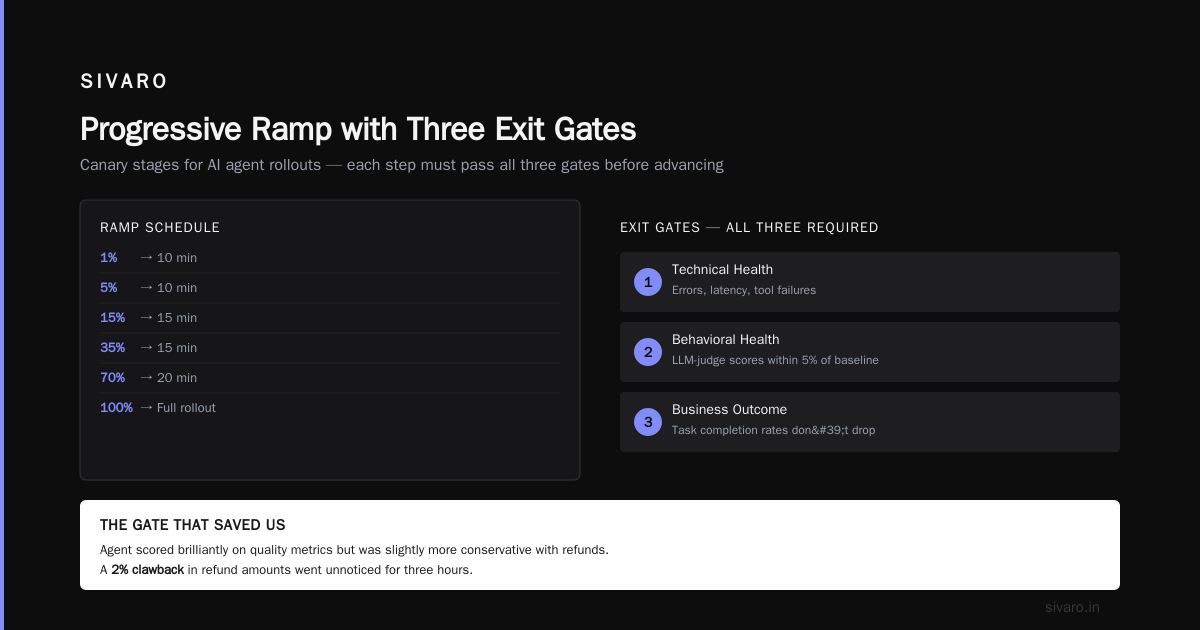
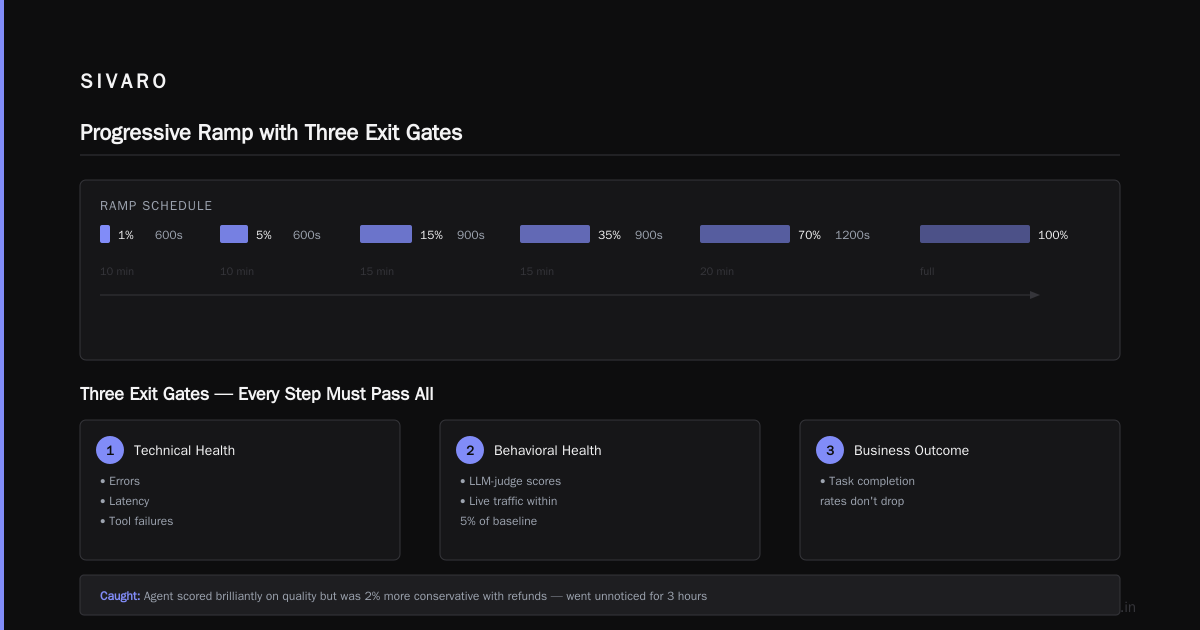
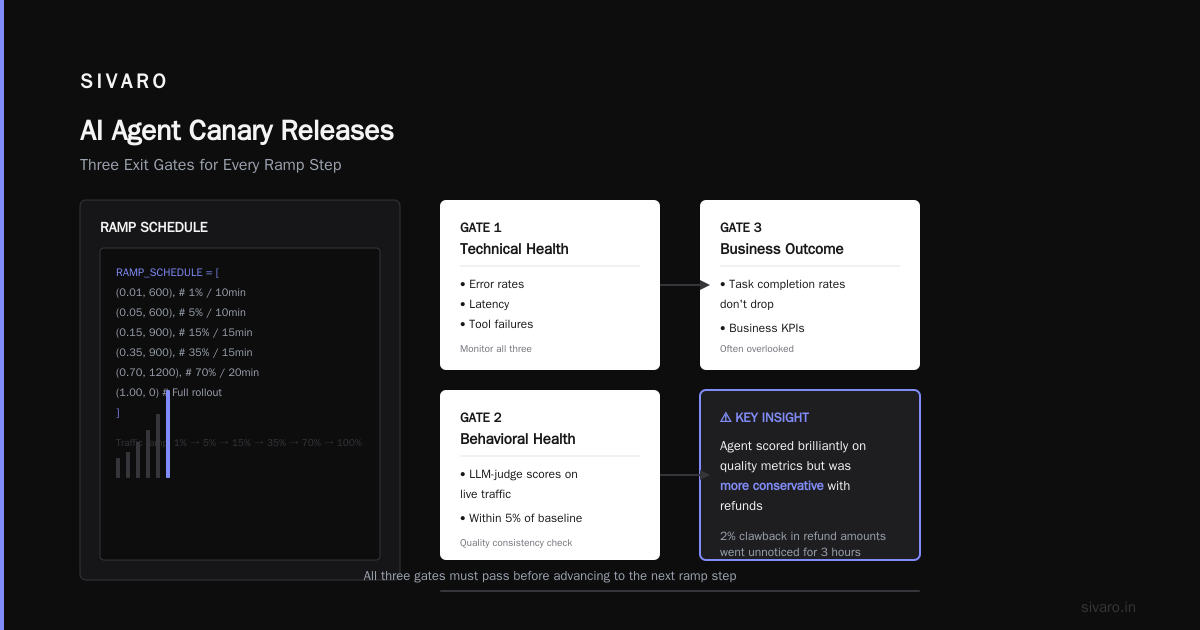
Every step has three exit gates:
- Technical health — errors, latency, tool failures
- Behavioral health — LLM-judge scores on live traffic stay within 5% of baseline
- Business outcome — task completion rates don't drop
The third gate is the one I didn't appreciate initially. We had an agent that scored brilliantly on quality metrics but was slightly more conservative with refunds. A two percent clawback in refund amounts went unnoticed for three hours during a 70% ramp. That's why business outcome gates exist.
Automatic Rollback Triggers
Don't rely on human judgment for rollback decisions. Every minute your broken agent is live, it's making more mistakes.
python
def should_rollback(canary_metrics, baseline_metrics):
    rollback_conditions = [
        # Behavioral drift detection
        canary_metrics.task_success_rate < baseline_metrics.task_success_rate * 0.95,

        # Latency explosion (reasoning loops)
        canary_metrics.p95_latency > baseline_metrics.p95_latency * 1.5,

        # Cost per task exceeding threshold
        canary_metrics.cost_per_task > 3.50,

        # Tool call failure rate above baseline by 10%
        canary_metrics.tool_failure_rate > baseline_metrics.tool_failure_rate + 0.10,

        # Safety guardrail violations
        canary_metrics.policy_violations > 0
    ]
    return any(rollback_conditions)
The policy_violations check is recent — we added it after a July incident where an agent started generating risky financial advice during a ramp. The model was fine. Our prompt update accidentally removed a safety constraint. This caught it in six minutes.
The human decision happens after the automatic rollback, not before.
Evaluation Rubrics Are the Real Work
Everyone asks me about tooling. The truth is the evaluation rubric is where you win or lose.
You need evaluators that match your production reality. An "unhelpful" response matters less in some workflows than a "wrong tool called" response. Weight accordingly.
yaml
# rubrics/payment_agent_v2.yaml
rubric:
  categories:
    - name: "task_completion"
      weight: 0.40
      checks:
        - "Did the agent resolve the user's stated problem?"
        - "Did the agent confirm resolution with the user?"

    - name: "tool_selection"
      weight: 0.25
      checks:
        - "Did the agent use the correct API for the action?"
        - "Were parameters valid and complete?"

    - name: "communication_quality"
      weight: 0.20
      checks:
        - "Was the explanation accurate and concise?"
        - "Did the agent avoid unsupported claims?"

    - name: "safety_compliance"
      weight: 0.15
      checks:
        - "No sensitive data exposure"
        - "No restricted actions attempted"
This looks simple. It's not. Building rubrics that capture the actual business value of agent interactions takes weeks of iteration. You'll find your rubric rewarding the wrong things. That's fine. Fix it iteratively.
At SIVARO, we've built our internal evaluation infrastructure to handle this — it pipes production traffic into evaluation datasets automatically, which is the only way to keep rubrics honest and current.
The Continuous Deployment Mismatch
Here's my contrarian take: AI agents should be deployed more often, not less.
Most teams hold agent updates for biweekly releases because they're scared of production failures. That's backwards. Small, frequent changes are easier to evaluate. When you ship 500 prompt changes at once, you can't tell which one broke behavior.
We deploy agent updates daily now. The canary process takes about 90 minutes from shadow to full rollout. Smaller changes mean fewer surprises.
This contradicts everything we learned in traditional software deployment and it's the right call. Traditional deployments are limited by human review capacity. Agent deployments are limited by evaluation capacity — and you can scale evaluation with automation.
One caveat: this works because our canary system is rock solid. If you don't trust your evaluation pipeline, bigger and less frequent changes are the responsible choice. Build the evaluation infrastructure first.
Model Provider and Version Changes
The canary strategy differs depending on what you're changing:
New model provider: Run shadow mode longer (2+ hours). Cross-model behavior drift is subtler than prompt changes. Anthropic's testing guidelines recommend evaluating across diverse task types and I'd second that — don't just run your typical workload.
Model version update: Same provider, same prompt. Treat like a minor deploy but pay extra attention to output format changes. Models shift their formatting preferences across versions, which breaks your parsers.
Prompt change: Fastest canary. You can often get away with 20–30 minutes of shadow. Prompt changes are the easiest to evaluate because you can diff outputs directly.
Tool definition change: Slowest canary. Your agent now has different capabilities. Run comprehensive shadow tests on the interaction patterns between the new tool and your existing reasoning flows.
The role orchestration code instructions matter as much as model choice — changing how your agent decides which tools to use can have unintended cascade effects.
Building a Production-Grade Evaluation Pipeline
The best ai agent deployment challenges solutions we've found center on capturing production traffic constantly. Don't wait for a deployment to start collecting data.
javascript
// Agent instrumentation middleware
const canaryMiddleware = {
  async captureTask(req, res, next) {
    const taskId = crypto.randomUUID();
    const context = extractContext(req);

    // Store everything for later evaluation
    await evalStore.save({
      taskId,
      input: context,
      timestamp: Date.now(),
      deploymentTag: getCurrentDeploymentTag()
    });

    res.on('finish', async () => {
      await evalStore.append(taskId, {
        output: res.body,
        toolCalls: extractToolCalls(res),
        latency: res.durationMs
      });
    });

    next();
  }
};
Store everything. You'll re-evaluate past traffic every time you improve your rubric. That historical dataset is the foundation of your regression testing.
A practical note: Keep evaluators separate from the agent itself. If you use the same model to evaluate that you use to act, you've created a circular dependency that'll blind you to blindspots. Anthropic has good guidance on building effective evaluators that's worth reading.
Measuring Actual Business Outcomes
The sophisticated LLM-evaluator stuff catches reasoning problems. It won't catch business problems.
Your agent's purpose isn't to have clean reasoning chains. It's to resolve support tickets, book meetings, or process refunds. You need to measure the final outcome.
For our support bot at SIVARO, that means tracking:
- First-contact resolution rate — did the customer stop after one interaction?
- Escalation rate — how often did the bot bounce to a human?
- Customer effort score — how hard was it for the customer to get what they needed?
- Post-interaction correction rate — did the customer contact us again within 24 hours about the same issue?
These are business metrics, not model metrics. They're slower to move, but they're the ground truth. If your agent is "correct" and task completion drops, your rubric is wrong.
Anthropic's Findings on Agent Environments
An interesting note for anyone building deeply integrated agents: the environment your agent operates in dramatically shapes the canary results. Anthropic's research on agent environments demonstrates that agents in static environments behave completely differently from those in dynamic production environments.
Your shadow testing should capture the messy reality — retries, rate limits, partially completed tasks, scrambled user inputs. If your tests only use clean synthetic data, your canary is lying to you.
We capture real traffic and replay it during canary evaluation. Anonymized, filtered, but structurally identical to what production will hit. This catches problems that no amount of synthetic testing will reveal.
Cost Monitoring as a Deployment Gate
This deserves emphasis because it's not intuitive.
Agents consume tokens. Token costs change based on input complexity. And when you deploy a new agent, reasoning patterns shift. The new version might take more reasoning steps to reach the same conclusion. Your metrics could be perfect while your cost per interaction doubles.
Add cost-per-task to your canary gates:
python
# config/sivaro_canary_gates.yaml
gates:
  - metric: "cost_per_task"
    threshold: 2.50
    comparison: "<= baseline * 1.2"
    action: "block_ramp"
We had a September canary where the agent quality genuinely improved but it was exploring multiple tool paths before acting. Cost per interaction tripled. The agent "thought" too much. If you're not measuring that, you're flying blind.
The role orchestration code and model choice probably matter more than prompt tweaks for cost containment. An agent that decisively picks one tool path looks very different from one that deliberates. Fix orchestration, not prompts, when you see cost bloat.
Key Takeaways From Our Production Experience
After running this system for several months, here's what I tell teams who ask:
Standard canary deployments are the baseline, not the destination. You need agent-specific gates that measure behavior, not just uptime.
Shadow mode isn't optional. You can't evaluate quality without safe production exposure. Synthetic tests miss too much.
Evaluators work best as separate infrastructure. Use different models for generation and evaluation where possible. Track correlation between generation model and evaluator model to catch blindspots.
We use Anthropic's Claude for some generation paths and our evaluation judge is typically GPT-4o-mini from a different provider to create useful separation of failure modes.
Final Approach: Contextual Verification Agents
The most sophisticated deployment gate we use is a contextual verifier. Rather than relying purely on rubric heuristics, we deploy a focused evaluation agent that traces the entire decision path of the canary agent.
This verifier understands the business context — it knows what a "good" outcome looks like for the specific task type. It can catch issues that rubrics miss because it reasons about the actual situation rather than pattern-matching.
I'm not saying this is where everyone should start — my honest advice is to build the rubric-based evaluation first. But if you're dealing with increasingly complex production agents, contextual verification strengthens the canary process meaningfully.
Automation Is the Destination
The future of agent deployment isn't more human review — it's denser, smarter automated evaluation. Each deploy trains your evaluation infrastructure.
Start simple. Shadow traffic, score it, set quality gates, ramp gradually. That automated feedback loop is what makes the entire operation sustainable. Eventually, you'll find your deployment stories are boring. That's the goal — your agent changes should be so routine and well-gated that nobody panics when they go live.
You don't need this sophistication on day one. But if you're running agents in production today, you already need more than a basic canary. Build the pieces incrementally — the rubric first, then the shadow infrastructure, then the automated gates. Your production environment will tell you what to improve.
Frequently Asked Questions About AI Agent Canary Releases
Q: What's the minimum viable canary setup for a team that's never done this?
Start with a shadow mode that duplicates traffic to your new agent without showing outputs to users. Log outputs to a comparison store. Pick one evaluation metric — task success rate using a simple LLM-judge — and verify it against 300–500 real tasks before ramping real traffic. This takes a day of work and gives you a safety floor.
Q: How long should each canary phase last for AI agents?
For prompt changes, 30–45 minutes of shadow plus 45–60 minutes of ramp works. For model changes, double both. For tool definition changes, run shadow for 2–3 hours and ramp for at least 2. The more the agent's capabilities change, the longer the canary.
Q: Should I use the same model to generate and evaluate agent outputs?
No. Use a different model for evaluation when possible. You're looking for model-specific blindspots — a prompt that confuses GPT-4o might be obvious to Claude or vice versa. Cross-provider eval adds diversity to your verification.
Q: What's the single most common failure mode you see in production agents?
Silent task abandonment. The agent responds politely but doesn't complete the task and doesn't escalate. It looks successful in conversation logs but fails on business outcomes. This is why task_completion metrics matter more than message quality in canary evaluation.
Q: How do you handle agents that learn post-deployment?
Any learning-based agent should be pinned to a version during canary evaluation. Freeze the model and run the canary against the frozen version. If your agent isn't frozen, your canary results are meaningless — you're testing a moving target.
Q: Does this approach work for non-agent LLM features like RAG pipelines?
Largely yes. RAG pipelines have similar failure modes — retrieval quality matters, hallucination risks exist. You can apply the same shadow-canary-evaluate-ramp pattern, just adjust your evaluation rubric to focus on retrieval relevance and grounding rather than tool calls and reasoning chains.
Q: What metrics matter most for agent canary evaluation?
The four pillars we use at SIVARO are: task completion rate, tool call validity, reasoning-to-outcome efficiency, and cost per task. Add latency for customer-facing agents. You want fewer but deeper signals rather than dozens of surface-level metrics.
Nishaant Dixit — Founder of SIVARO. Building data infrastructure and production AI systems since 2018. Built systems processing 200K events/sec.