 SIVARO

The AI Agent Deployment Pipeline: A 2026 Buyer's Guide
You’ve built a killer agent. It navigates your legacy ERP, summarizes contracts, and writes SQL queries that don't suck. Demo day goes great. Then the CFO asks the question that kills the buzz: "How do we get this into production without breaking our SOC 2 audit?"
Deployment. The unsexy graveyard of AI projects. We’ve spent the last eighteen months at SIVARO ripping out and rebuilding these pipelines for clients, and I’ve got some strong opinions about what’s worth buying versus what’s a trap.
Most people think the hard part is the model. They're wrong. The hard part is the boring plumbing between the agent's intent and your production database. This is a comparison guide for that plumbing.
What We’re Actually Buying Here
An AI agent deployment pipeline is the infrastructure and process that moves your agent code from a local Jupyter notebook (or Claude artifact) through staging, into a production environment that scales, observes, and bills you appropriately.
But it’s not just a CI/CD pipeline. You can't just run git push heroku main on a LangGraph state machine. Agent pipelines differ because they involve non-deterministic logic and external tool calls (APIs, databases) that have side effects.
The stack breaks down into four distinct layers:
- Orchestration & Runtime
- CI/CD Integration
- Evaluation & Guardrails
- Observability & Cost Tracking
We’ll compare the top tools in each layer, but first, let’s set the context with a real-world budget mindset.
The Cost Comparison Nobody Wants To Talk About
Let’s talk money since you asked for an "ai agent deployment cost comparison."
Everyone asks about token costs. That’s the tip of the iceberg. The real cost is split across infrastructure, engineering time, and the blast radius of a bad deployment.
If you scrape a vector DB just to save $50/month, you’ll spend $5,000 in engineering hours rebuilding it. Here is the reality of the pricing tiers we are seeing in Q3 2026:
| Approach | Setup Cost | Monthly Run Rate (1-10 agents) | Engineering Time |
|---|---|---|---|
| DIY (Airflow + Kubernetes) | High | $200 - $1,000 (Compute) | 2-3 weeks |
| Managed Vercel | Low | $100 - $500 | 2 days |
| Enterprise Agent Platforms | High | $3,000 - $10,000+ | 1-2 days |
I see enterprises burning cash on platforms like this because they think it gives them "control." It doesn't. It gives them a lightning-fast demo and a migration headache six months later when the agent needs a custom Retriever that the platform doesn’t support.
The "ai agent deployment cost comparison" isn't just about line items. It’s about how quickly your team can debug a hallucinated SQL query that your agent just wrote and executed against the production replica.
The DIY Trap vs. Low-Code Speed
Let’s look at the spectrum.
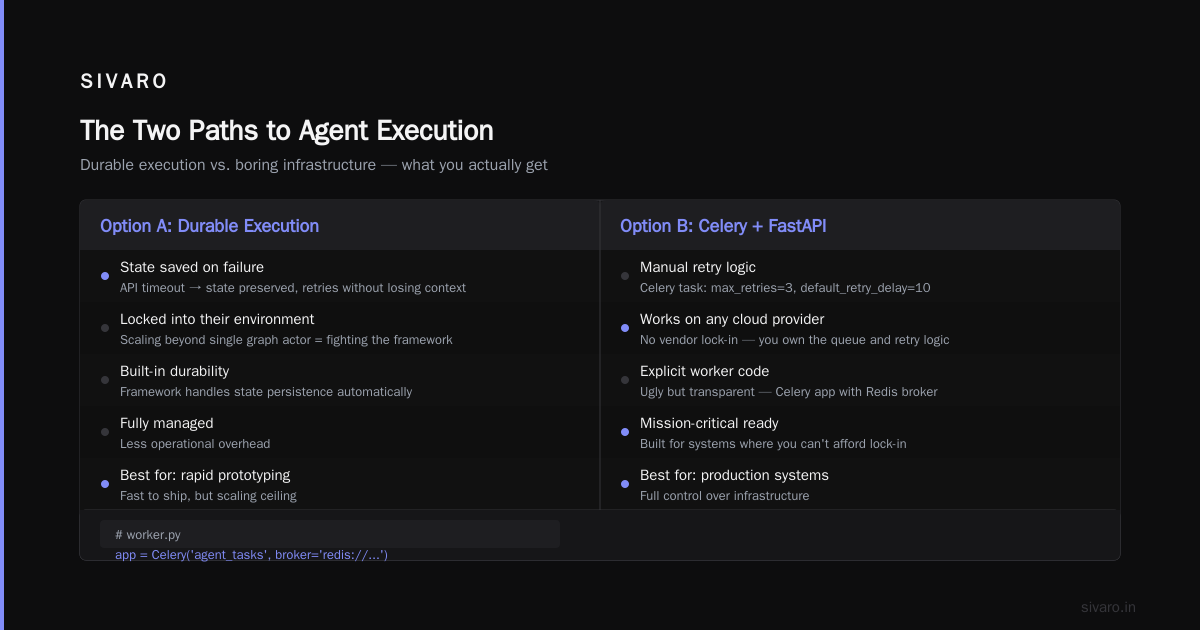
Option A: The "Mono-Code" Approach (LangGraph + Docker)
If you are building on LangChain/LangGraph, their LangGraph Platform is the fastest path to production. You define a langgraph.json and it handles the stateful checkpointing (crucial for resuming long-running agents) and auto-scaling.
python
# langgraph.json - Your deployment config
{
  "dependencies": ["."],
  "env": {
    "OPENAI_API_KEY": "your-key",
    "DATABASE_URL": "postgresql://..."
  },
  "graphs": {
    "agent": "./src/agent/graph.py:graph"
  }
}
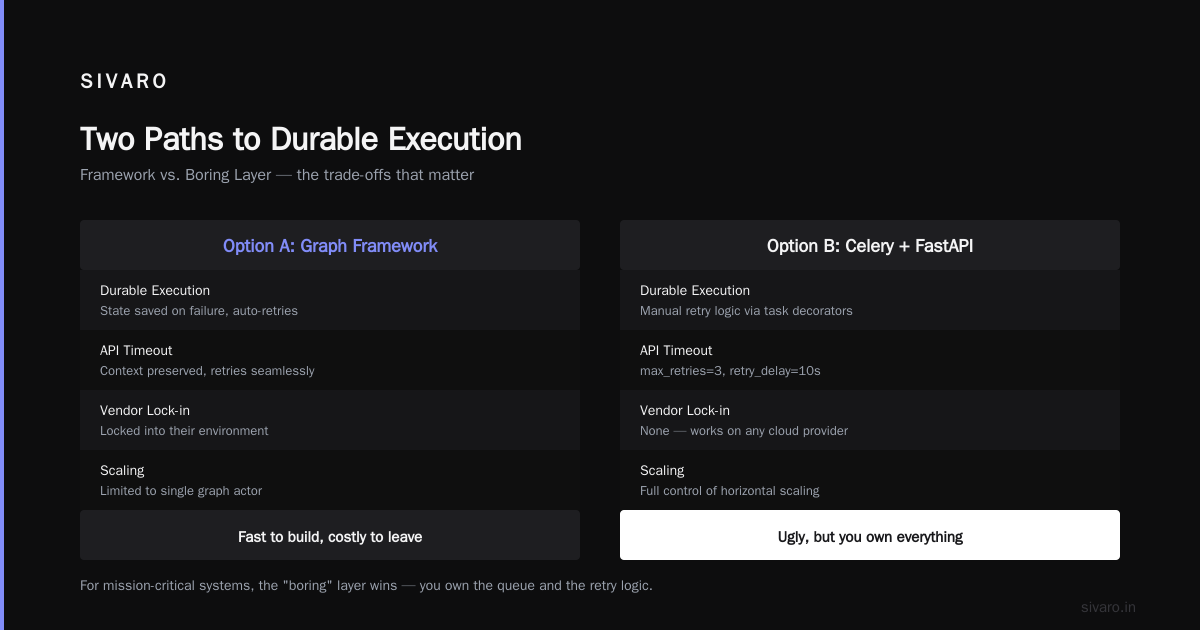
The Benefit: You don't have to write the orchestrator. It handles durable execution so if a step fails (say, an API timeout), the state is saved, and it retries without losing context.
The Cost: You get locked into their environment. If you want to scale beyond a single graph actor or need custom logic for horizontal scaling, you are fighting the framework.
Option B: The "Boring" Layer (Celery + FastAPI)
For mission-critical systems where you cannot afford vendor lock-in, we just use FastAPI to expose the agent and Celery for background task execution.
This is ugly. But it works on any cloud provider. You own the queue. You own the retry logic.
python
# worker.py
from celery import Celery

app = Celery('agent_tasks', broker='redis://...')

@app.task(bind=True, max_retries=3, default_retry_delay=10)
def run_agent_task(self, conversation_id: str):
    try:
        # Your heavy LLM loop here
        result = execute_agent(conversation_id)
        return result
    except Exception as exc:
        # Specific handling for API rate limits
        raise self.retry(exc=exc)
We use this for jobs that involve financial calculations—think invoice reconciliation. If there is a bug in the prompt engineering, Celery saves us because the input is just a payload. You can replay the queue. You don't need a fancy dashboard.
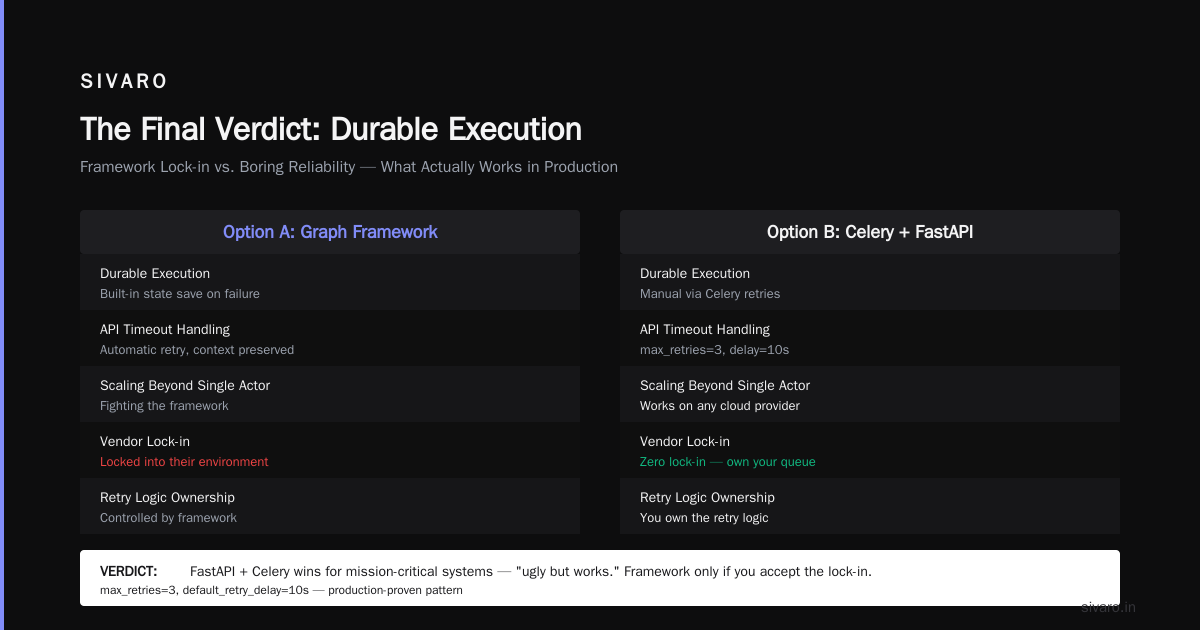
My position: If you have a dedicated infra team, go Code-First (Option B). If you are a startup of 5 people, buy the managed platform.
The Missing Middle: CI/CD Integration
Here is where the "ai agent deployment pipeline ci/cd" keyword actually matters. Traditional CI/CD looks at code changes. Agent CI/CD looks at prompt changes and evaluation scores.
You cannot just test for "does it crash?" You must test for "does it behave?"
Integrating with GitHub Actions
Most teams I talk to are doing this wrong. They treat the agent like a simple API. They deploy on a successful build. That’s catastrophic.
Here is a pipeline we built for a logistics client last quarter. We use promptfoo to evaluate response quality before we even trigger the deploy.
yaml
# .github/workflows/deploy-agent.yml
name: Agent Evaluation and Deploy

on:
  push:
    branches: [ main ]

jobs:
  evaluate:
    runs-on: ubuntu-latest
    steps:
      - uses: actions/checkout@v4

      - name: Run LLM Tests
        run: |
          pip install promptfoo
          promptfoo eval --config tests/promptfooconfig.yaml
        env:
          OPENAI_API_KEY: ${{ secrets.OPENAI_API_KEY }}

      - name: Deploy to Staging
        run: |
          curl -X POST "https://api.example.com/deploy/agent-staging" \
          -H "Authorization: Bearer ${{ secrets.AGENT_KEY }}"
The Key Shift: This is not syntax testing. It’s semantic testing. We are checking if the agent picked the right tool or if it decided to ask for a clarification when it should have just executed the command.
The "Human Gate" Requirement
I like the Approval Gate. Do you trust your agent to auto-deploy to prod with zero human review?
I don't.
No matter how good your eval set is, there is always a prompt injection vector or a tool-calling loop that will lock up your GPU cluster. Your CI/CD pipeline needs a "Pause" button that requires an SRE's thumbprint.
Deploy to Production? (Issues: #4321)
> Requires approval · #4321
This isn't about bureaucratic overhead. It's about blast radius. If your agent writes to a database, and it has a bad prompt, it can update 10,000 rows before your "anomaly detection" realizes it's wrong. A human gate adds 20 minutes of latency. That is worth the insurance.
Evaluation Is The New Testing
Let’s shift gears to the layer most overlooked: Eval. If you don't have an eval suite, getting an "ai agent deployment pipeline" is pointless.
We ditched unit tests for the agent logic. We now use golden datasets. We record the inputs and outputs of successful agent runs and use them as regression checks.
Here’s how we set up guardrails in code using a simple Python middleware layer. We call this the "Veto Power."
python
def agent_pipeline(input_data: str) -> str:
    # Step 1: Generate
    raw_output = llm_call(input_data)

    # Step 2: Validate (The Safety Check)
    is_safe = adherence_checker(raw_output)
    if not is_safe:
        # Step 3: Re-generate with stricter rules
        raw_output = llm_call(input_data, temperature=0.0)
        is_safe = adherence_checker(raw_output)

    if not is_safe:
        raise AgentGuardrailError("Agent violated policy, isolating...")

    return raw_output
The adherence_checker is often a cheaper model (like GPT-4o-mini) that validates whether the expensive model (GPT-5) deviated from its instructions. This dual-model setup catches issues that metrics like "logprobs" never will.
Feature Flags for Prompts
Managers hate this, but you need to version your prompts in production. We use a config in S3 (or Vercel/KV) that updates without a code deployment. If the prompt we ship on a Monday causes a customer complaint spike on Tuesday, we flick the flag back to the "v2" prompt immediately.
javascript
// config.js
const config = {
  prompts: {
    "invoice-summarizer": {
      v1: { key: "orig", ratio: 0.0 },
      v2: { key: "new-agentic", ratio: 1.0 }, // Gradual rollback
    },
  },
};
An ai agent deployment pipeline isn't just about moving forward. It's about moving backward efficiently.
Observability: The X-Ray Vision
You can't buy an observability tool that magically works for agents. The standard APMs (DataDog, New Relic) fail because they don't understand tracery—they look at microservice spans, but agents have loops.
Here is a concrete issue from our work with a fintech client: Their agent execution cost $12. It called 15 tools. It looped 3 times. DataDog showed it as a successful request. But the internal "thinking" time was bad because the model was confusing itself.
You need a tracing tool that captures state transitions of the agent graph, not just function calls.
Options:
- LangSmith: Best UI for visualizing LangGraph loops. Records token counts and latency per node.
- Braintrust: Better for automated evaluation suites.
- OpenTelemetry (OTel): The "Boring" Choice. We use OTel GenAI semantic conventions. Why? Because we aren't tied to a vendor.
bash
# Sending traces via OTel
from opentelemetry import trace

tracer = trace.get_tracer(__name__)
with tracer.start_as_current_span("agent/tool_call") as span:
    span.set_attribute("llm.prompts", str(prompt))
    span.set_attribute("llm.completion.usage.total_tokens", total_tokens)
Set up alerts on weirdness, not just errors. Alert when the temperature is overridden incorrectly, or when the tool_call_count exceeds a threshold of 5. That usually indicates the agent is confused and about to spin wildly.
The "Boring" Scaling Problem
Finally, let’s talk about scaling. The "ai agent deployment pipeline" sounds cool until you have 1,000 active users hitting a Claude API that throttles you at 400 RPM.
You need a Rate Limiter and a Queue Merger.
We render separate queues for different tasks:
- High Priority (User front-end): Processing time < 2 seconds.
- Low Priority (Data Extraction): Processing time < 5 minutes.
If you mix those in one queue, your front-end latency spikes during heavy batch jobs. We implement simple congestion control in our middleware.
python
RATE_LIMIT = {
    "high_priority": {"tokens_per_min": 3000},
    "low_priority": {"tokens_per_min": 1200},
}
Position: If you are spending more than $5,000/month on LLM inference, you are wasting capacity. You need a caching layer (prompt caching) and a routing layer to direct easy queries to cheap models and hard queries to frontier models. This deployment pipeline is actually a cost optimization engine.
FAQ: Deployment Pitfalls
Q: Is LangGraph Platform worth it over generic Celery?
A: It genuinely is for early-stage velocity. The add_node and state management handling of self-healing is superior. But once you hit the "custom control plane" requirement (like multi-tenancy isolation), it gets weird. Start with LangGraph, plan to move to Celery later.
Q: How do I handle dynamic prompts?
A: Treat prompts as source code versions. Commit them to a registry. Use a config server (like Vault or AWS AppConfig) to serve them. Never hard-code them in the agent script. This allows for A/B testing.
Q: What is the biggest mistake in deploying autonomous agents?
A: Allowing loops unconstrained. Set a max_iterations parameter on every agent. If they exceed it, force them to "summarize context" or restart. Agents don't have judgment about when to stop until you force them.
Q: Should I use a Vector DB for all history?
A: No. Storing all the raw chat trajectories in a vector DB is a waste of money. Save the summaries, not the raw logs. Pinecone and Weaviate are for retrieval, not for logging. Use S3 or ClickHouse for that.
Q: How safe is auto-deploying agents?
A: We auto-deploy to staging. For prod, we use "Progressive Delivery"—we push to 5% of traffic first. If the feedback_score drops 3 points, the pipeline auto-rolls back.
The Final Verdict
Stop over-engineering.
In 2026, the "ai agent deployment pipeline" is not about magic. It’s about applying 1980s software engineering discipline to non-deterministic code.
Buy a managed platform if your team is under 10 people and you need a demo in a week. Build if your agent touches production financial data or health records because you need the audit trail that the off-the-shelf platforms don't offer at a granular event level.
Remember:
- Prompt Eval beats Unit Testing.
- PostgreSQL (or whatever OLTP DB) for state is fine; Redis for caching, S3 for storage.
- You don't need Kubernete. You need a queue and a scheduler.
We deployed a system for a support ticketing client that handled 1.2M events/day. The whole thing runs on a single 8-core VM with Celery. No Kubernetes. The ai agent deployment pipeline ci/cd was just a simple Makefile and systemd service. It was boring. That’s why it worked. The agent never failed because the infrastructure was predictable.
Now, stop reading and go test your agent's failure modes. Can it handle a bad JSON response? Because if it can't, no pipeline will save you.
Nishaant Dixit — Founder of SIVARO. Building data infrastructure and production AI systems since 2018. Built systems processing 200K events/sec.