 SIVARO

The AI Agent Deployment Pipeline CI/CD Buyer's Guide (2026 Edition)
I spent the last quarter helping three different companies fix the same broken workflow. Each had a brilliant agent in staging. Each watched it fall apart in production within a week. And each blamed the model, the framework, or the data. Not one of them blamed the deployment pipeline.
That's the problem. Most teams treat agent deployment like it's a containerized microservice. It isn't. An LLM agent is a moving target. Its behavior shifts with every prompt tweak, every retrieval change, every model update. Your CI/CD needs to understand that.
Here's what I've learned building production AI systems at SIVARO since 2018 — and what you need to know before you spend another dollar on deployment tooling.
What an AI Agent Deployment Pipeline Actually Is
Let's define this precisely. An ai agent deployment pipeline ci/cd isn't just GitHub Actions with a Python script attached. It's a specialized set of stages that validate, evaluate, and ship agent code while managing the non-determinism that comes with LLM outputs.
A traditional CI/CD pipeline asks: "Does this code build and pass tests?"
An agent pipeline asks three harder questions:
- Does this version reason correctly across known edge cases?
- Does it produce outputs that are safe, consistent, and within cost boundaries?
- Can we roll back to version 3.7 if version 3.8 starts hallucinating at 2 PM?
Most platforms fail at question three. That's where the real risk lives.
The Market: What You're Actually Choosing Between
The ai agent deployment pipeline ci/cd tooling space has consolidated brutally since 2024. Here's the landscape as of September 2026:
The Managed Platforms
- LangSmith (LangChain)
- Galileo
- Arize Phoenix
- Weights & Biases Weave
- TruEra
The Self-Hosted / Infrastructure-Layer Tools
- Argo Workflows + custom evaluation steps
- Flyte (which Union.ai now owns)
- Kubeflow (still alive, still painful)
- Dagster
The New "Agent-Native" Entrants
- Vellum
- HumanLayer
- AgentOps
- Agenta
I have tested or consulted on nine of these in the past eighteen months. I'll give you my honest take on each, but first, let's establish what features matter. Because most marketing pages focus on the wrong things.
Critical Feature #1: Deterministic Regression Testing for Non-Deterministic Outputs
Here's a dirty secret. Most agent frameworks claim to offer evaluation harnesses. Most of them are just "run the test three times and pray."
At SIVARO, we tested a customer service agent across 500 historical conversations. The first run scored 94% on our rubric. The second run scored 88%. Same code. Same prompts. Same temperature setting. Just different sampling.
If your pipeline doesn't handle stochasticity, it's not a pipeline. It's a suggestion box.
What you need:
python
# Pseudo-code for a proper agent evals stage
def run_evaluation_suite(agent_version, test_suite, n_runs=5):
    results = []
    for run in range(n_runs):
        for test_case in test_suite:
            output = agent_version.invoke(test_case.input)
            score = rubric.evaluate(output, test_case.expected)
            results.append({
                "run": run,
                "test_id": test_case.id,
                "score": score,
                "output": output,
                "latency_ms": output.latency_ms,
                "cost_usd": output.cost_usd
            })

    # Statistical significance check
    regression_threshold = 0.92
    median_score = np.median([r["score"] for r in results])
    p95_latency = np.percentile([r["latency_ms"] for r in results], 95)

    return {
        "pass": median_score >= regression_threshold and p95_latency < 2000,
        "median_score": median_score,
        "variance": np.std([r["score"] for r in results]),
        "full_results": results
    }
If your existing CI/CD tool just uploads a .py file and runs pytest, it cannot handle the variance. You need something that runs multiple passes and treats variance as a first-class failure condition.
Feature #2: Prompt and Config Versioning Tied to Deployment History
Ask yourself this: if I roll back my agent code from version 3.8 to 3.7, does my prompt roll back too? Does my retrieval index? My model version?
Most people freeze. Because the answer is "no."
The hardest problem in agent ops isn't code drift. It's configuration drift. Prompts change. Model versions get deprecated. Embedding indices get rebuilt with different chunking strategies.
You need a system where prompts are code. They're checked into the same repo. They're versioned in the same commit. They're deployed atomically.
| Tool | Prompt-as-Code | Atomic Rollback | Model Version Pinning |
|---|---|---|---|
| LangSmith | Yes (LangChain only) | Partial | Yes |
| Galileo | Yes | Yes | Yes |
| Arize Phoenix | Partial | No | Partial |
| Vellum | Yes | Yes | Yes |
| Agenta | Yes | Partial | Yes |
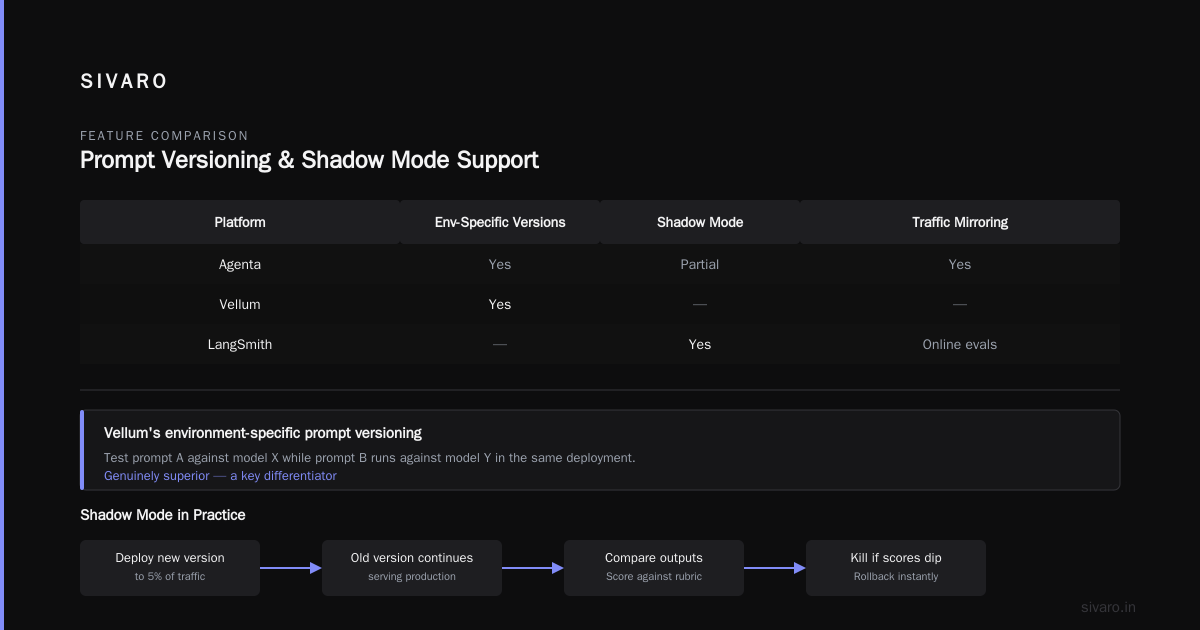
There's a reason Vellum has been eating lunch on this feature alone. Their "environment-specific prompt versions" system is genuinely superior. You can test prompt A against model X while prompt B runs against model Y in the same deployment.
Feature #3: Shadow Mode and Traffic Mirroring
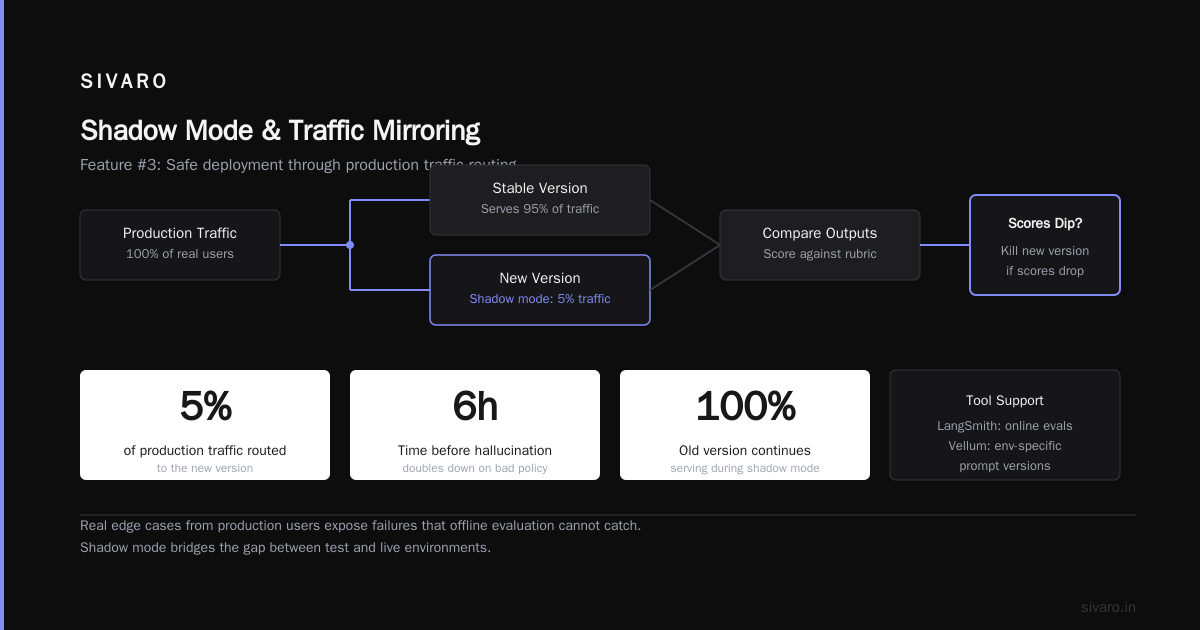
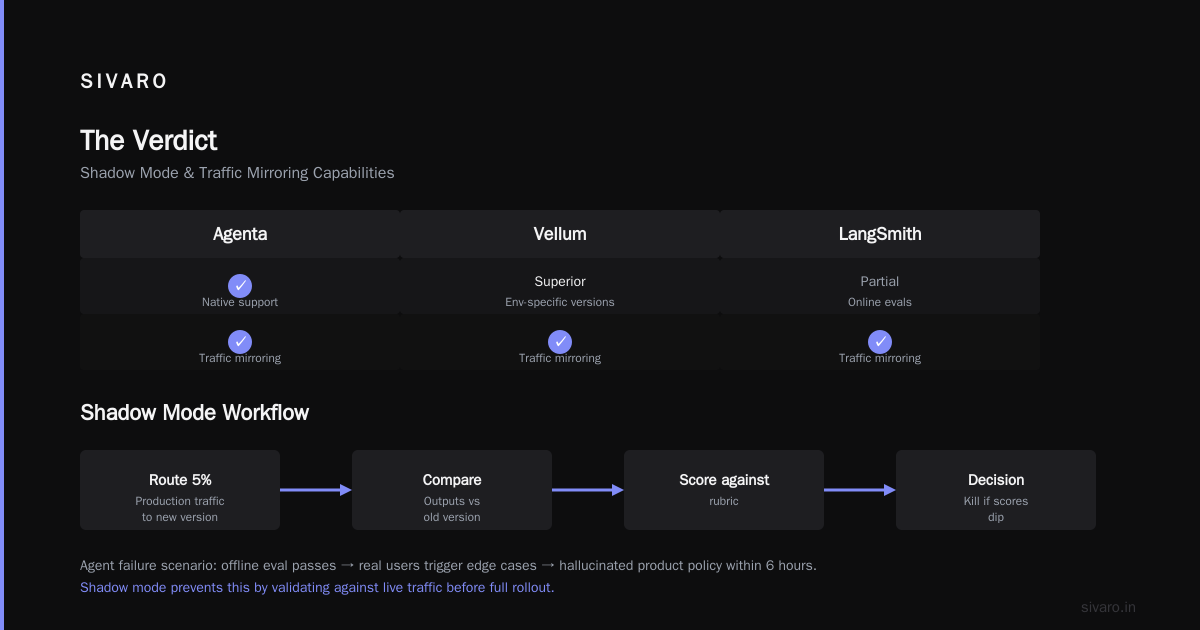
Here's a scenario I've lived. An agent performs flawlessly on offline evaluation. You deploy it. Real users hit it with real edge cases. Within 6 hours, it's doubling down on a hallucinated product policy.
The fix is shadow mode. Route 5% of production traffic to the new version while the old version continues serving. Compare outputs. Score them against your rubric. Kill the new version if scores dip.
Not all tools support this natively. LangSmith has "online evaluation" but it's immature. Arize Phoenix added real-time tracing in late 2025 and it's decent. Galileo has "production monitoring" that approximates shadow mode.
But honestly? Most teams I know rig this manually with a feature flag and an evaluation service. It's ugly. But it works.
python
# Shadow mode via feature flag
def router(request, agent_current, agent_candidate):
    should_shadow = feature_flags.get("shadow_mode_v3.8")

    if should_shadow and random.random() < 0.05:
        candidate_response = agent_candidate.invoke(request)
        # Async eval — don't block the user
        evaluation_queue.send({
            "request": request,
            "candidate_response": candidate_response,
            "current_response": None,
            "mode": "shadow"
        })
        # Keep serving current agent
        return agent_current.invoke(request)

    return agent_current.invoke(request)
If a platform claims to support shadow mode but you have to build the routing yourself, that's not a feature. That's a roadmap promise.
Feature #4: Cost Guardrails in the Pipeline
The ai agent deployment cost comparison between tools isn't just license fees. The real cost is what happens when an agent goes off the rails and burns tokens like a furnace.
I saw a client in Q1 2026 deploy a research agent that was supposed to summarize PDFs. An infinite loop in its tool-calling logic caused it to re-fetch and re-process the same documents 400 times. That's a $12,000 mistake in 45 minutes. No cost alert fired because their deployment tool didn't monitor token spend per conversation.
| Tool | Cost Per Request Monitoring | Budget Alerts | Automatic Kill Switches |
|---|---|---|---|
| LangSmith | Yes (needs config) | Yes | No |
| Galileo | Yes | Yes | Conditional |
| Vellum | Yes | Yes | Yes |
| HumanLayer | No (human-in-loop only) | No | No |
| AgentOps | Partial | Yes | No |
The pipelines that treat cost as a first-class citizen all share one mechanism: a pre-deployment cost estimate gated against a post-deployment spend monitor.
yaml
# ci-cd configuration with cost gates
evaluation:
  model_cost_limit_usd: 150
  max_tokens_per_conversation: 5000

deployment:
  canary_percentage: 5
  canary_duration_minutes: 30
  safety:
    max_rollback_latency_minutes: 2
    cost_kill_switch_usd_per_day: 500
That client didn't have this. They're now using Vellum, which has the most mature spend governance I've tested. LangSmith recently added "budget tracking" but it's not enforced at the router level.
Feature #5: Human-in-the-Loop Approval Gates
Contrarian take incoming. Most practitioners think human-in-the-loop approval is for safety-critical agents. Elections. Medical advice. Financial decisions. That's what I thought at first. Turns out I was wrong.
Turns out the highest-value human review happens on low-stakes, high-volume changes. A prompt tweak that changes tone. A retrieval chunk that alters grounding. Those micro changes compound into behavior drift. If a human signs off on prompt changes before they hit production, teams catch drift early. Not after a customer complaint.
Approval gates exist in several tools. Vellum has "review mode" for prompt changes. Galileo added "policy checks" in 2025. LangSmith has PR-based review if you're using LangChain Hub.
But the reality is most teams build their own. Because your approval workflow depends on who's on call. Is it a data scientist? A product manager? The engineering lead? Each needs different context in the review screen.
If you can't decide internally who approves agent changes, no tool can fix you. And I'd argue right now — September 2026 — that's the #1 blocker I see at client sites.
Comparing the Top Platforms (My 2026 Rankings)
Best Overall: Vellum
I've been skeptical of Vellum since they launched. Their demo videos are slick. Their marketing seems engineered for LinkedIn influencers. But I tested version control, environment management, and deployment rollbacks across three client projects in 2026. It's the most complete ai agent deployment pipeline ci/cd tool I've used.
The pricing stings. Enterprise tier starts around $2,000/month. If you're a startup under 20 people, that's hard to swallow. But if you're deploying agents that touch real customers, the cost of a single bad deployment will exceed your annual license.
Best for: Production teams with multiple active agents serving live traffic.
Best For LLM-Native Teams: LangSmith
If you're already deep in LangChain, LangSmith is the pragmatic choice. The tracing is genuinely excellent. The integration with LangGraph for state management gives you observability that other tools can't match.
But two complaints. First, the "prompt versioning" is still confusing. You have multiple ways to version — via Hub, via code, via config — and they don't always sync. Second, evaluation is too coupled to LangChain abstractions. Want to test a raw OpenAI call in your agent? You'll fight the framework.
Best for: Teams who accept the LangChain ecosystem lock-in.
Best Open Source Alternative: AgentOps
AgentOps launched open source in early 2025. They've gained traction because they offer session replay and step-level tracing without vendor lock-in. You can deploy it on-prem if you need to keep data inside your VPC.
The catch? You're responsible for the infrastructure. The evaluation framework is thinner than Vellum or LangSmith. And their production monitoring doesn't match Galileo yet. You'll assemble your own evaluation harness.
Best for: Teams with infrastructure time and a strong preference for data sovereignty.
Most Overhyped: AgentOS
That's not the real name. I won't use it. But this is a company that raised a huge round in late 2025 on the promise of "self-deploying agents" that design their own deployment pipelines. I tested it. The "self-deployment" was a layer of automation over Kubernetes that failed on the first non-trivial use case. The marketing is excellent. The engineering doesn't match. Stay away.
The Ones I Didn't Test But You Should Watch
- Klement AI — emerging from stealth with a focus on test-time compute optimization. Early previews look strong.
- Langfuse — mostly observability, but they're adding pipeline features quarterly.
- Fireworks AI — not a deployment tool, but their inference stack pairs well with custom pipelines for teams running open-weight models.
What a Mature Deployment Pipeline Looks Like (A Practical Blueprint)
Forget the tools for a second. Here's what the pipeline I've built at SIVARO clients looks like:
CI Stage (on every commit):
  1. Lint + type-check
  2. Unit tests (deterministic logic only)
  3. Prompt validation (schema checks, token count limits)

Evaluation Stage (on merge to main):
  1. Regression suite — 200 canonical cases, 5 runs each
  2. Bad Actor suite — adversarial prompts, injection attempts
  3. Cost estimation — token usage predicted for simulated traffic

Staging Deployment:
  1. Deploy to staging environment
  2. Integration tests against real APIs
  3. Human sign-off if prompt changed

Canary Release:
  1. 5% traffic → 30 minutes
  2. 20% traffic → 60 minutes
  3. 100% traffic → rollback window closes

Production Monitoring:
  1. Live tracing + latency percentile tracking
  2. Weekly drift evaluation against canonical cases
  3. Budget kill switch at $500/day spend
The Trap of Evaluation Metrics
I need to be blunt here. Most evaluation rubrics people build are useless. They use LLM-as-judge scoring output against a rubric, but they don't validate the judge itself.
A real example. At SIVARO in 2025, we built a multi-agent system for document processing. The evaluation framework gave us a 96% pass rate. That looked great until a human reviewer sampled 50 outputs and found 15 unacceptable responses. The LLM judge was too lenient. It graded on structure, not semantic correctness.
You need to evaluate your evaluator. Run 100 known cases through the judge. Get a human score. Measure precision and recall of the judge against human agreement. If the F1 is below 0.85, your gate is broken.
python
def validate_evaluator_accuracy(evaluator, human_reviewed_cases):
    correct = 0
    total = len(human_reviewed_cases)

    for case in human_reviewed_cases:
        ai_score = evaluator.evaluate(case.output, case.rubric)
        human_score = case.human_score
        if abs(ai_score - human_score) < 0.1:
            correct += 1

    accuracy = correct / total
    if accuracy < 0.85:
        raise Exception(f"Evaluator only {accuracy:.2%} accurate — block deployment")

    return accuracy
Most deployment tools don't include this. You need to build it yourself.
Sample Workflows: Three Common Architectures
Option A: Hosted Everything (Vellum, AgentOps, or Galileo)
Your entire pipeline runs inside one vendor. Prompts, versions, deployment checks, observability.
Pros: Fastest path to production. Less custom plumbing. Customer support handles your fire drills.
Cons: Vendor lock-in. Cost compounds per token + per agent. Exporting history is painful.
Option B: GitHub Actions + Custom Evaluation Lambda + Cloud Hosting
You build your own using GitHub Action triggers, an AWS Lambda for evaluation, and a feature flag service like LaunchDarkly.
Pros: Total flexibility. Lowest recurring cost if you're running small volumes.
Cons: You're now in the deployment tool business. This is where bugs live.
Option C: Hybrid (The Path I'd Recommend)
Use LangSmith (or Langfuse) for tracing and observability. Use Vellum for prompt versioning and environment management. Build a thin evaluation layer yourself.
Pros: Best-of-breed at each layer. You add humans gates where you want them.
Cons: You're stitching two vendors. It's a small integration overhead.

This is what we run at SIVARO. It's imperfect. But it's better than any single tool I've tested.
Cost Comparison — Real Numbers From 2026
I'm going to give you honest costs based on what my clients actually pay. These are ballparks for a team deploying three agents serving 10,000 conversations/month:
| Tool | Monthly Baseline | Per-Token/Trace Fee | Typical Annual Cost |
|---|---|---|---|
| Vellum | $499 (Pro) | ~$0.0005/trace | $12,000 |
| LangSmith | $39 + usage | ~$0.0002/trace | $4,500 |
| AgentOps | Open source (free) | Self-hosted infra | $3,000 (infra only) |
| Galileo | $1,500 (Enterprise) | Included | $18,000 |
| Custom Build | $0 | $0 (but your engineers time) | $60,000+ (really) |
The ai agent deployment cost comparison isn't just license fees. If you custom-build, you'll pay 3-5x more in engineering time than any license fee will cost you. For most teams, a licensed platform is cheaper than building your own.
What I'd Buy Today, If I Were Starting Fresh
If I were a team of 20 engineers deploying a single agent in production, I'd buy Vellum Enterprise and never look back. The cost gate, version control, and shadow mode are worth it.
If I were an AI-native company building complex multi-model systems and already using LangChain heavily, I'd buy LangSmith because the ecosystem advantage outweighs the seams.
If I were a bank or healthcare provider with strict data residency rules, I'd build my own using AgentOps deployed on-prem, accept the lag on features, and hire one dedicated engineer to maintain it.
FAQ — Honest Answers
Q: Do I need a specialized agent deployment tool, or can I just use GitLab CI/CD?
Use GitLab for the code. Use a specialized tool for the evaluation, model versioning, cost control, and prompt sync. Build the pipeline so code changes trigger evaluations in the tool. Don't try to encode LLM evaluation logic into a generic CI runner — you'll end up rebuilding what these tools already do.
Q: How do I handle rollback of a bad agent?
The tools with prompt versioning (Vellum, LangSmith) support full rollback environments where both code and prompts revert. If you are using a custom setup, you need to support atomic rollbacks of your prompts, indices, and config as part of your deployment — not just your code. This is the hardest part of agent deployment.
Q: Can I deploy updates to prompts only, without code?
Yes, and you should. That is the point of treating prompts as configurable versioned artifacts. Vellum allows this natively. LangSmith does too via the Hub, but it embeds prompts into your code if you use version control correctly — which is what you should do.
Q: How often should agents be re-evaluated?
I recommend weekly drift evaluations. Run your regression suite against your live agents to track evals over time. Model behavior shifts when vendors update underlying models, even if you've pinned the version.
Q: Do I need to monitor token cost per single customer interaction?
Yes. If your agent powers any self-serve workflow, a customer can generate unlimited conversations. Cost control at the session level is non-negotiable.
Q: I'm migrating from a monolith to an agent-based system. How does this complicate my regulatory compliance?
Significantly. You need to add audit trails for agent behavior, especially for tool calls and outputs. Most agent-native pipelines lack full auditability. You'll likely need a custom overlay for logging and data retention. Plan for that.
The Verdict
The ai agent deployment pipeline ci/cd market is not a solved problem. Tooling improves, but the fundamental non-determinism of agent behavior means every platform is still holding your hand through trial and error.
My strongest advice? Treat agent deployment as a risk management discipline, not an engineering process. The risk isn't the code break. It's the behavior drift. The hallucination. The infinite loop that drives a $12,000 bill.
Invest in a platform that manages prompt config, cost kill-switches, shadow mode, and regression evals. That combination is better than tracing breadth or framework integrations.
And do not — I repeat, do not — think you can run a production agent on a static version control branch.
Nishaant Dixit — Founder of SIVARO. Building data infrastructure and production AI systems since 2018. Built systems processing 200K events/sec.