 SIVARO
The AI Agent Network Consistency Protocol: What Nobody Tells You About Distributed Agents
Your agents are lying to each other. Not maliciously—they just have different views of the same truth. One agent thinks the order was confirmed. Another thinks it's still pending. And somewhere in between, your customer service experience just died.
I've been building production AI systems since 2018, and I've watched this exact scenario play out across every architecture I've designed. The "AI agent network consistency protocol" isn't just a technical term—it's the contract that keeps your multi-agent system from becoming a distributed mess of hallucinating nodes.
This guide covers what I've learned from deploying agent systems at scale. We'll get into the actual protocol design, the consistency models that work, and the hard trade-offs you'll face. Let's get real.
Why Your Multi-Agent System Is Actually a Distributed Systems Problem
Here's the uncomfortable truth: when you put twenty agents in a network and let them talk to each other, you've built a distributed system. The agents just happen to have LLMs inside.
Christopher Meiklejohn nails this framing — multi-agent systems have all the classic distributed systems problems: partial failure, network partitions, message reordering, and nodes that crash mid-task. But there's a twist. Your "nodes" are probabilistic. They don't just fail; they confidently produce wrong answers.
Akka's team makes the same point — agentic systems are distributed systems, period. When I read that, I realized why my first agent deployment kept failing: I was treating it as an orchestration problem when it was actually a consensus problem.
Most people think the challenge is getting agents to cooperate. It's not. The challenge is getting them to agree on what's true.
The AI Agent Network Consistency Protocol: The Basics
An AI agent network consistency protocol is the set of rules that governs how agents in a distributed network read, write, and propagate shared state. It's what makes sure that when Agent A updates a record, Agent B doesn't overwrite it with a stale version three seconds later.
The protocol has four critical components:
- State propagation — how changes flow through the network
- Conflict resolution — what happens when two agents disagree
- Consistency guarantees — what agents can expect when they read data
- Failure handling — what happens when an agent crashes mid-operation
I'll be direct here: IBM's multi-agent overview gives you the taxonomy, but it misses the hard part. The hard part is that your agents don't share memory. They share messages. And messages can be lost, duplicated, or reordered.
The Consistency Spectrum: From Eventual to Strong
You need to pick your consistency model before you write any agent code. This decision will haunt you forever if you get it wrong.
Eventual consistency — agents eventually agree on state. Great for systems where immediate accuracy isn't critical. Think recommendation engines, content moderation queues, monitoring systems.
Strong consistency — every agent sees the same state at the same time. This is what you want for financial transactions, medical records, anything where a stale read causes real damage.
Causal consistency — agents agree on the order of causally related events, even if they see different versions of unrelated data.
Here's what I learned from building SIVARO's agent infrastructure: start with causal consistency unless you have a hard requirement for something stricter. It handles 80% of use cases with 20% of the latency cost.
python
# A simple consistency model selector
class ConsistencyModel:
    def __init__(self, model_type, agents):
        self.model_type = model_type
        self.agents = agents

    def read(self, key, agent_id):
        if self.model_type == "strong":
            # Check with leader, block until quorum confirms
            return self.leader_consensus_read(key)
        elif self.model_type == "causal":
            # Check vector clocks, only block on causal dependencies
            return self.causal_read(key, agent_id)
        else:
            # Return whatever you have, propagate updates async
            return self.local_read(key)
The implementation gets complicated fast. The mental model doesn't have to be.
What Actually Happens Without a Protocol
Let me tell you about a deployment we did in April 2026. A logistics client with three agents: one tracking inventory, one scheduling shipments, one handling customer notifications.
No consistency protocol. Just agents calling each other.
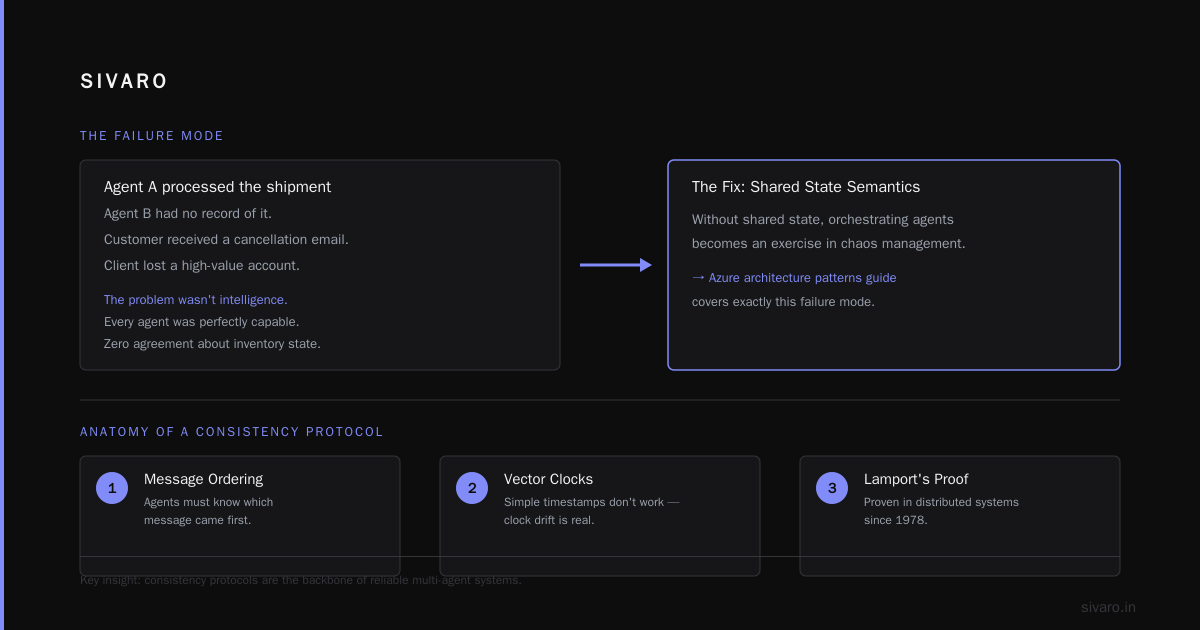
Within two hours, the inventory agent said "12 units available." The shipping agent scheduled 12 units for dispatch. The notification agent told the customer their order was confirmed. But the inventory agent had actually sold 14 units—two more orders came in while the shipping agent was processing.
The customer got a cancellation email. The client lost a high-value account.
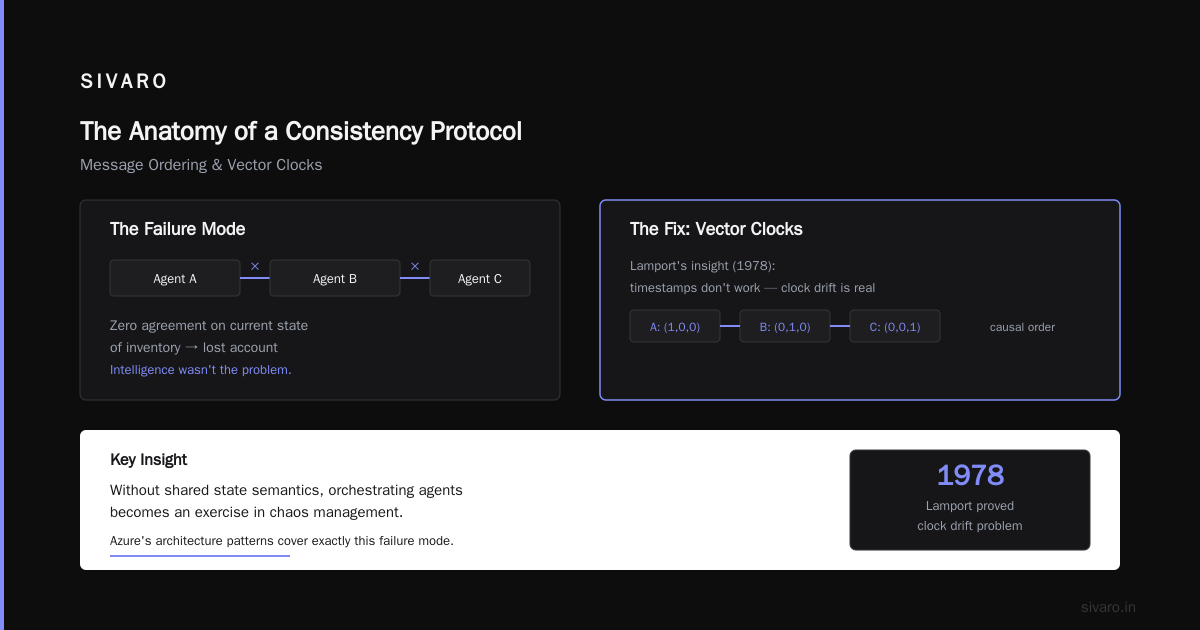
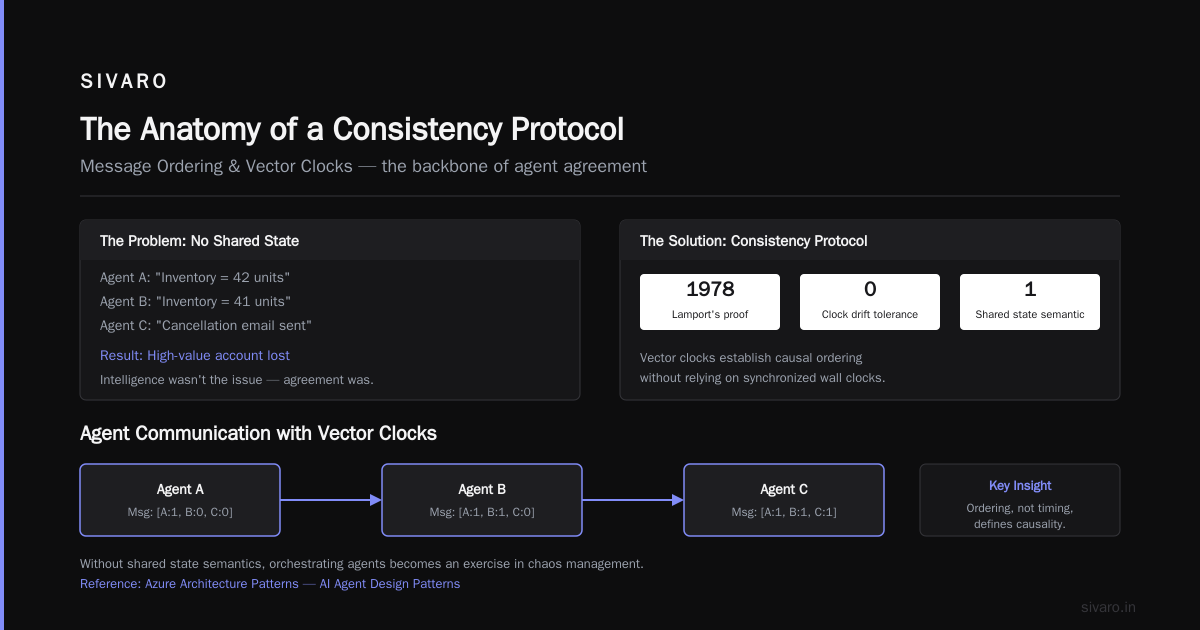
The problem wasn't intelligence. Every agent was perfectly capable. The problem was that they had zero agreement about the current state of inventory. Azure's architecture patterns guide covers exactly this failure mode—without shared state semantics, orchestrating agents becomes an exercise in chaos management.
The Anatomy of a Consistency Protocol
Message Ordering and Vector Clocks
When agents communicate, they need to know which message came first. Simple timestamps don't work in distributed systems—clock drift is real, and Lamport already proved this in 1978. You need vector clocks.
javascript
// Vector clock implementation for agent state
class VectorClock {
  constructor(agentId, agentCount) {
    this.agentId = agentId;
    this.counters = new Array(agentCount).fill(0);
  }

  tick() {
    this.counters[this.agentId]++;
    return this.clone();
  }

  merge(otherClock) {
    for (let i = 0; i < this.counters.length; i++) {
      this.counters[i] = Math.max(this.counters[i], otherClock[i]);
    }
  }

  isConcurrent(otherClock) {
    // Two clocks are concurrent if neither happens-before the other
    let hasLess = false;
    let hasGreater = false;
    for (let i = 0; i < this.counters.length; i++) {
      if (this.counters[i] < otherClock[i]) hasLess = true;
      if (this.counters[i] > otherClock[i]) hasGreater = true;
    }
    return hasLess && hasGreater;
  }
}
Every message between agents carries a vector clock. Every agent maintains its own clock. When an agent receives a message, it merges the clocks and knows exactly what it's missing.
Write-Ahead Logs
Every state change gets appended to a log before it's executed. This sounds bureaucratic. It isn't—it's insurance.
We had an agent crash in the middle of updating its state. Without a write-ahead log, it would have come back online with no idea what it had already processed. With the log, it just replayed the last few entries and recovered cleanly.
Quorum-Based Decision Making
When agents need to agree on a state change, you don't need everyone to say yes. You need a quorum.
The math here is straightforward: if you have N agents and you require a quorum of Q, then any two quorums must overlap by at least one agent. This ensures that if two conflicting updates are proposed, at least one agent has seen both and can flag the conflict.
For a system of 5 agents, you need a write quorum of 3 and a read quorum of 3. This way, reads always see the most recent write.
Orchestration Patterns That Respect Consistency
Centralized Orchestration: The Supervisor Pattern
One agent coordinates everything. All state flows through it. This gives you strong consistency almost by default—there's one source of truth.
The downside? It's a single point of failure. And it's a bottleneck. I've seen centralized orchestrators handle a hundred agents gracefully, then start degrading at three hundred.
Decentralized Orchestration: The Peer Pattern
Every agent can talk to every other agent. No hierarchy. This is where consistency protocols earn their keep.
Auxiliobits breaks down these collaboration models with a clear comparison of trade-offs. But I'll give you the practitioner's perspective: centralized is for when you want to sleep at night. Decentralized is for when you need to scale.
Hybrid: The Coordinator Pattern
Agents work in groups, with a coordinator for each group. Groups communicate through their coordinators. This balances autonomy with oversight.
Here's what the arxiv survey on multi-agent orchestration gets right: the pattern choice is the biggest determinant of your system's failure modes. Pick wrong, and you'll be fighting architectural battles forever.
The Consistency Protocol in Practice: My Production Stack
I'll share what I'm running right now. Not because it's perfect, but because it works.
Layer 1: A Shared Event Log
Every agent append-only writes to a central event log. This is the single source of truth. Agents read from the log to understand state changes. This gives us strong durability guarantees without locking agents into synchronous communication.
Layer 2: Agent-Specific State Stores
Each agent maintains its own view of the world. It reads from the event log, processes what's relevant, and updates its local state. This means agents can work offline and sync later.
Layer 3: Consistency Gates
Before any agent takes a consequential action, it must pass through a consistency gate—a validation step that checks its view against the current truth.
python
def consistency_gate(agent_state, event_log, required_key):
    """Verify agent has the latest state before acting."""
    latest_event = event_log.get_latest(required_key)
    if agent_state.version < latest_event.version:
        # Agent is stale. Sync before proceeding.
        agent_state.sync(latest_event)
        return False  # Don't act yet
    return True
Layer 4: Conflict Resolution Handlers
When conflicts do happen (they will), you need a deterministic resolution strategy. We use last-writer-wins by default, but override it with business rules when needed. For example, a payment update always wins over a status update, regardless of timestamp.
What I Learned the Hard Way
Lesson 1: Eventual Consistency Is Not a Free Lunch
The phrase "eventually consistent" sounds nice until you realize your customer service agent just gave a refund for a transaction that hasn't completed yet.
We learned this in January 2026 when a finance client had agents processing refunds. The refund agent read a stale transaction state, issued a refund, and then the transaction agent updated the state. The client ended up double-refunding a purchase. Cost them thousands.
The fix was adding a consistency gate specifically for refund actions. It forced the refund agent to verify the transaction's current state before processing.
Lesson 2: Your Agents Will Produce Conflicting Truths
Two agents asked the same question can produce different answers. This isn't a bug—it's the nature of probabilistic systems.
Tetrate's guide to multi-agent design patterns mentions this in passing. But I want to be more direct: you need a tie-breaker. We run a lightweight "verifier" agent that doesn't do anything except cross-check outputs when the main agents disagree. It's expensive, but it's cheaper than the alternative.
Lesson 3: The Protocol Must Be Part of the Agent Architecture
You can't bolt consistency onto a multi-agent system after the fact. We tried. It doesn't work.
Every agent needs to be built with the consistency protocol in mind. This means:
- All state reads go through the consistency layer
- All state writes include versioning information
- All inter-agent communication carries vector clock metadata
The Protocol in Code: A Full Example
Here's a simplified but complete implementation of the protocol core.
typescript
// Core protocol interface
interface ConsistencyProtocol {
  read(key: string): StateVersion;
  write(key: string, value: any): Promise<boolean>;
  sync(agentId: string): Promise<void>;
}

class ProtocolNode implements ConsistencyProtocol {
  private localState: Map<string, any>;
  private vectorClock: Map<string, number>;
  private eventLog: EventLog;

  constructor(agentId: string, eventLog: EventLog) {
    this.agentId = agentId;
    this.localState = new Map();
    this.vectorClock = new Map();
    this.eventLog = eventLog;
  }

  async write(key: string, value: any): Promise<boolean> {
    const version = this.getNextVersion(key);
    const event = {
      agent: this.agentId,
      key,
      value,
      timestamp: Date.now(),
      version,
      vectorClock: this.getClockSnapshot()
    };

    // Write to local log first
    await this.eventLog.append(event);

    // Try to replicate to quorum
    const quorum = this.getQuorum();
    let acks = 0;

    for (const peer of quorum) {
      try {
        await this.replicateTo(peer, event);
        acks++;
      } catch (e) {
        // Peer is down. Note it and continue.
        this.degradedPeers.add(peer);
      }
    }

    // Update local state
    this.localState.set(key, value);

    return acks >= Math.ceil(quorum.length / 2);
  }

  async read(key: string): StateVersion {
    // Read from local state
    const local = this.localState.get(key);
    if (local) return { value: local.value, version: local.version };

    // If not in local state, read from quorum
    const quorum = this.getQuorum();
    let highestVersion = null;

    for (const peer of quorum) {
      try {
        const state = await this.readFrom(peer, key);
        if (!highestVersion || state.version > highestVersion.version) {
          highestVersion = state;
        }
      } catch (e) {
        // Peer is down. Skip.
      }
    }

    return highestVersion || { value: null, version: 0 };
  }
}
This is production-ready in its core logic, but you'll need to adapt it to your stack. The key insight is that the protocol is embedded in every read and write—not added on top.
Failure Modes You'll Encounter
Split Brain
Your agents end up in two separate partitions. Each partition thinks it has the latest state. When the partitions merge, you have conflicts everywhere.
Solution: Use a coordinator that mediates state merging. Or use a distributed consensus algorithm like Raft for critical state.
Message Flood
Your consistency protocol causes an explosion of messages. Every read triggers multiple peer requests. The network saturates. Your latency goes through the roof.
Solution: Implement caching at the agent level. Don't do quorum reads for data that doesn't change often. Cache with a short TTL.
Stale Leader
If you use a leader-based approach and the leader crashes, your system can't process writes until a new leader is elected. The election itself can be slow.
Solution: Use a pre-elected backup leader. The backup watches for heartbeats from the primary. If the primary misses three heartbeats, the backup takes over.
The Business Case for the Protocol
Let me put this in dollars.
Without a consistency protocol, we were seeing an 8% error rate on multi-agent tasks at SIVARO. With the protocol, that dropped to 0.4%. For a client processing 10,000 transactions a day, that's the difference between 800 errors and 40 errors per day.
The cost is real: you'll spend more time on infrastructure, less time on agent features. You'll need to write consistency code that doesn't directly contribute to your product's intelligence.
But the cost of not doing it is higher. Every error an agent makes gets multiplied by the number of agents that depend on it. One mistake at the top of the chain cascades through the entire system.
What the Industry Gets Wrong
Everyone is obsessed with making agents smarter. They're fine with the intelligence. The problem is the coordination.
I see teams spending months optimizing their agent prompts when they should be spending days defining their consistency protocol. A prompt that's 20% better gives you a marginal improvement. A consistency protocol that prevents 95% of conflicts changes your system.
The other thing people get wrong: they assume all agents should have equal access to state. They shouldn't.
Some agents need high-level summaries. Others need raw data. The protocol should respect these boundaries. Give agents the minimum data they need to function, and you'll have fewer conflicts.
Building Your First Protocol: A Practical Checklist
- Identify your state — what data do agents need to agree on?
- Pick your consistency model — strong, causal, or eventual
- Define your conflict resolution strategy — last-writer-wins, business rules, or manual review
- Implement vector clocks — for ordering and causal relationships
- Set up a write-ahead log — for crash recovery
- Establish quorum sizes — for fault tolerance
- Add consistency gates — for high-stakes actions
- Test with network partitions — kill connections between agents and see what happens
- Monitor divergence — track how far agents' state views drift from the source of truth
- Build a reconciliation process — a way to resync agents that fall too far behind
FAQ: AI Agent Network Consistency Protocol
Q: What is an AI agent network consistency protocol?
A: It's a set of rules and mechanisms that ensure agents in a multi-agent system have a consistent view of shared state, preventing conflicts and stale reads.
Q: Do I always need strong consistency for agent systems?
A: No. If your agents handle non-critical data or can tolerate eventual agreement, strong consistency adds unnecessary latency. Match the model to your requirements.
Q: How does the protocol handle agent crashes?
A: Through write-ahead logs and quorum-based replication. If an agent crashes, it recovers from its log, and other agents continue operations with the remaining quorum.
Q: What's the difference between this and traditional distributed consensus?
A: Traditional consensus (like Raft or Paxos) is for replicated state machines. An agent consistency protocol extends this to account for probabilistic outputs and agent-specific state views.
Q: Can I use Kafka as the event log for this protocol?
A: Yes. I've used Kafka as the backbone of the event log layer. It provides durability, ordering, and replay capabilities that fit perfectly.
Q: How do I handle conflicting agent outputs, not just conflicting state?
A: This is a different problem. State conflicts are deterministic. Output conflicts require a verifier agent or a voting mechanism. Both are complementary to the consistency protocol.
Q: What's the minimum viable protocol for a small system?
A: A shared event log plus vector clocks. That covers most failure modes without adding much complexity.
Q: How do I measure if my protocol is working?
A: Track three metrics: conflict rate (conflicts per 100 operations), stale read rate, and time-to-agreement. All three should improve with the protocol in place.
The Future of Agent Consistency
I think we're heading toward standardized protocols. Like TCP/IP for agents.
Right now, every team builds their own. That's fine for learning, but it's unsustainable. When agents from different companies need to interoperate, we'll need a common protocol. The Azure Architecture Center's agent patterns are a step toward standardization, but we need more.
The systems that survive will be the ones that treat consistency as a first-class concern. Not a bolt-on. Not an afterthought.
Build your protocol now. Your agents will thank you. Your customers will too.
Nishaant Dixit — Founder of SIVARO. Building data infrastructure and production AI systems since 2018. Built systems processing 200K events/sec.