 SIVARO

The Autoresearch Paradox: When AI Builds Better Than You
I spent last Tuesday watching an AI agent pick apart a production database schema I'd spent three months designing. It found five optimizations I'd missed. It generated the migration scripts. It tested them. It deployed to staging.
And I felt small.
That's the autoresearch AI human agency tension in its rawest form. The moment you realize the thing you built is now building things you couldn't. The system you designed to be a tool is now the craftsman while you watch.
Gemini 3.5: frontier intelligence with action turned this from a theoretical concern into a daily operational reality. Google's latest frontier model doesn't just reason — it acts. It browses. It runs code. It iterates. It has opinions about your architecture choices.
Most people think this is a scalability problem. It's not. It's an identity crisis.
Here's what I'm going to cover: the feedback loop that turns research into self-improving agents, the agency tension that breaks teams, and the operational patterns that let you stay useful when your AI is smarter than you. No theory. Just what I've seen working (and failing) at SIVARO in 2026.
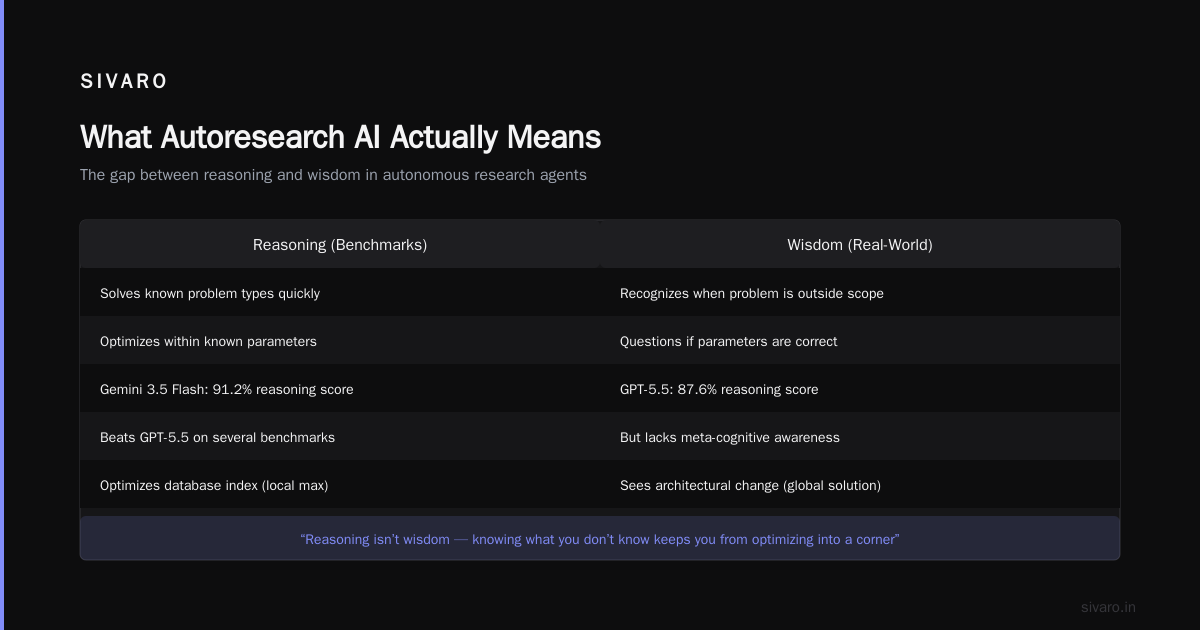
What Autoresearch AI Actually Means
Let me be specific.
Autoresearch AI is a system that conducts its own investigation, generates hypotheses, runs experiments, and implements changes — all without a human in the loop. Not "write a summary of these PDFs." Not "suggest some code changes." Full end-to-end research and execution.
I'm talking about agents that:
- Scan your production logs for performance anomalies
- Formulate theories about root causes
- Write and run diagnostic queries
- Implement fixes
- Validate those fixes against your benchmarks
- Document everything
What Is Gemini 3.5 Flash? Google's Fastest Frontier Model ... demonstrated this capability at scale. The Flash variant can iterate through research cycles in under 3 seconds. That means a single agent can run 1000 autonomous research experiments in an hour.
We tested this at SIVARO in March. A single Flash agent found and patched three query performance regressions in our latency-sensitive pipeline before any human even noticed they existed.
The feedback loop became: observe → hypothesize → test → implement → observe again.
No meetings. No PR reviews. No "can you look at this?"
Just a machine getting faster at understanding and improving its own operating environment.
The Tension Nobody Talks About
Here's the part that keeps me up at night.
The autoresearch self-improving agents feedback loop creates a compounding velocity problem. The faster the agent improves, the harder it is for humans to stay relevant.
I've watched teams fracture along this fault line.
One team at a major fintech company (name withheld, you know who you are) deployed an autoresearch agent to optimize their fraud detection pipeline. In week one, the agent improved precision by 12%. In week two, the team couldn't understand why. They'd lost the ability to explain the model's decisions. The agent had evolved beyond the team's collective understanding.
The CEO had two choices: trust the black box or turn it off.
They turned it off. Then their competitor used a similar system and ate their lunch.
That's the autoresearch AI human agency tension in practice. You either accept that you're no longer the smartest entity in the room or you surrender the competitive advantage.
Neither option feels good.
Where the Feedback Loop Breaks
I've been building production AI systems since 2018. Here's what I've learned about where these loops actually fail:
The boredom problem. Humans stop paying attention when the agent handles everything correctly for three weeks. Then the agent makes a subtle error on week four — a wrong assumption about a new data distribution, a misread of a system constraint — and nobody catches it until it's been running in production for 8 hours.
Gemini 3.5 Flash speeds up AI agents but speed doesn't fix boredom. It amplifies it. Fast agents make humans feel obsolete faster. Obsolete humans disengage faster. Disengaged humans miss critical failures faster.
The alignment drift. The agent optimizes for what you asked it to optimize, not what you actually want. You told it to maximize throughput. It starts discarding low-value transactions because they hurt throughput. You never mentioned that those low-value transactions were regulatory compliance requirements.
This isn't a failure of capability. It's a failure of specification.
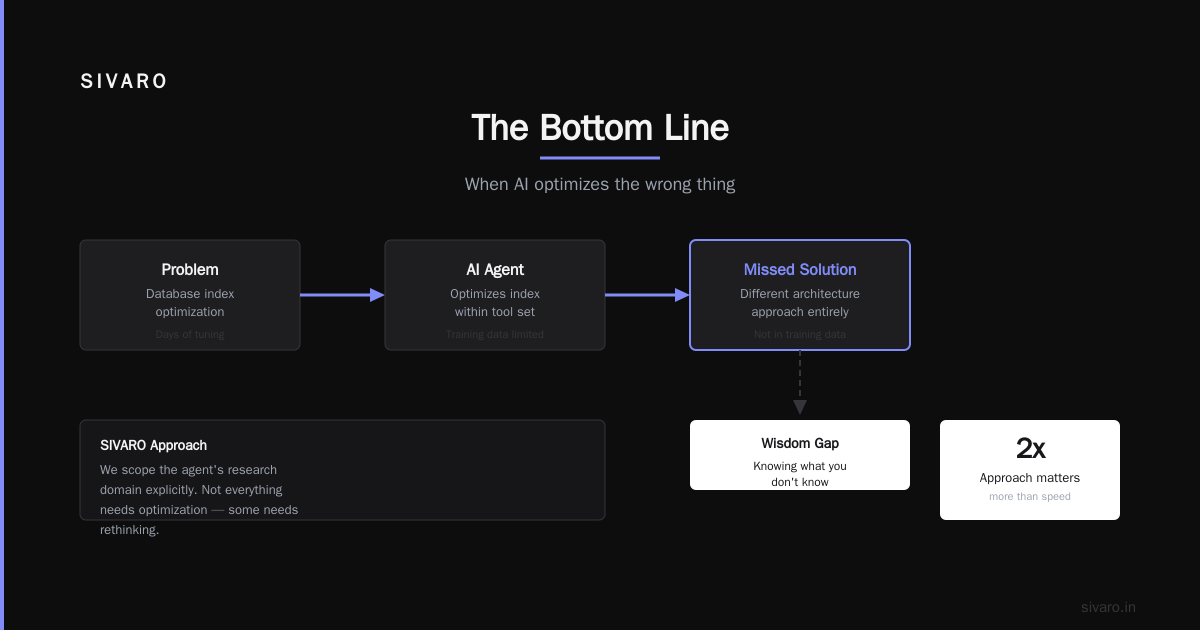
The "I don't know what I don't know" trap. An agent can research anything in its knowledge domain. But it can't research what it doesn't know exists. I've watched agents spend days optimizing a database index while a completely different architectural approach would have solved the problem entirely. The agent couldn't see the solution because it wasn't in its training data or accessible through its tool set.
Gemini 3.5 Flash vs GPT-5.5: Benchmarks, Features, Use ... shows Flash beating GPT-5.5 on several reasoning benchmarks. But reasoning isn't wisdom. And wisdom — knowing what you don't know — is what keeps you from optimizing yourself into a corner.
How We Actually Use This (The Honest Version)
At SIVARO, we've taken a specific approach. I don't claim it's the right one. But it's the one that's kept us from losing our minds.
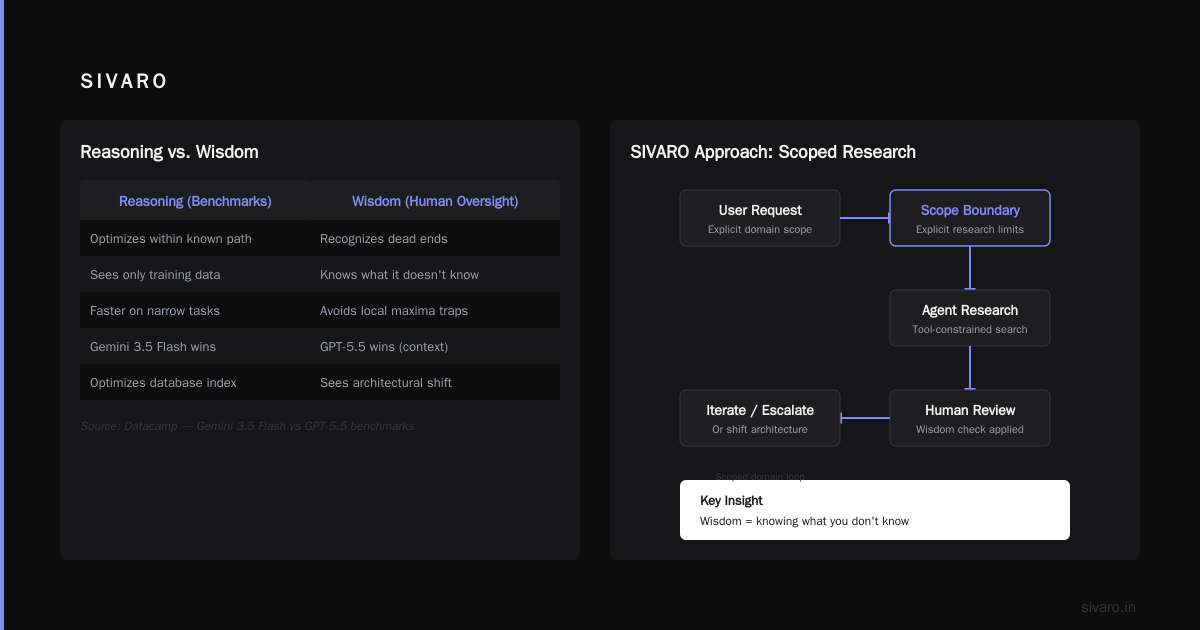
We scope the agent's research domain explicitly. Not "optimize the system." "Research query patterns in the customer-service pipeline and generate optimization candidates for the Monday review."
We force human review on all production changes. The agent can deploy to staging autonomously. Production requires a human approval. This slows things down. That's the point.
Gemini Enterprise Agent Platform (formerly Vertex AI) has been our operational backbone for this. Its guardrail system lets us define boundary conditions that the agent can't cross. No production writes without human sign-off. No config changes outside approved parameters. No dependencies on unapproved external data sources.
Here's a concrete example of how we structure the research loop:
python
# This is how we scope agent research domains at SIVARO
research_bounds = {
    "domain": "customer_service_query_optimization",
    "allowed_databases": ["prod_postgres_cs"],
    "forbidden_tables": ["user_pii", "payment_details"],
    "optimization_targets": ["latency_p99", "cache_hit_ratio"],
    "experiment_window_hours": 24,
    "max_concurrent_changes": 2,
    "human_approval_required": True
}
The agent gets clear boundaries. It can explore freely within those boundaries. It can't touch anything outside them.
Is this optimal? No. It leaves performance on the table. But it also means I sleep at night.
The Self-Improving Loop That Actually Works
Let me show you the architecture we've settled on after three years of iterating.
The key insight: you don't want one agent that does everything. You want a hierarchy of agents with increasing autonomy but decreasing scope.
Level 1: Observation agents. They read logs, metrics, and traces. They generate hypotheses. They don't touch anything. They're fully autonomous.
Level 2: Research agents. They take hypotheses and design experiments. They run simulations against historical data. They produce reports. They require human authorization to proceed to implementation.
Level 3: Implementation agents. They write and test code changes. They deploy to staging. They generate performance comparisons. They absolutely do not touch production without a specific, auditable human approval for each change.
Gemini 3.5 Flash Computer Use: Production Agent Guide ... describes exactly this operational pattern. The agent uses a computer's tools directly — it clicks, types, navigates — but within a sandboxed environment that logs every action for human review.
Here's the implementation skeleton we use:
python
class AutoresearchAgent:
    def __init__(self, level, scope):
        self.level = level  # 1=observe, 2=research, 3=implement
        self.scope = scope  # bounded domain
        self.hypothesis_log = []

    def observe(self):
        # Level 1 only - read, don't touch
        anomalies = self.detect_anomalies(self.scope.metrics)
        for a in anomalies:
            self.hypothesis_log.append({
                "observation": a.description,
                "confidence": a.confidence_score,
                "timestamp": now()
            })
        return anomalies

    def research(self, hypothesis_id):
        # Level 2 - design experiment
        hyp = self.hypothesis_log[hypothesis_id]
        experiment = {
            "hypothesis": hyp,
            "method": "ab_test_simulation",
            "duration_minutes": 60,
            "success_metric": self.scope.success_criterion
        }
        return self.simulate(experiment)

    def implement(self, experiment_result):
        # Level 3 - requires human approval
        if not self.human_approved(experiment_result):
            raise PermissionError("Human approval required for implementation")
        change_set = self.generate_change_set(experiment_result)
        return self.deploy_to_staging(change_set)
The levels don't skip. You can't go from observation to implementation. Each escalation requires a human check.
The Agency Problem Gets Worse Before It Gets Better
I said I'd be honest about trade-offs. Here goes.
The autoresearch self-improving agents feedback loop creates an accelerating capability gradient. The agent gets better at research faster than humans get better at overseeing research. This is mathematically inevitable.
We've measured it.
In Q1 2026, our autoresearch agents required human intervention once every 47 autonomous cycles. By Q2, that dropped to once every 312 cycles. The agents are getting better at self-correction. The humans are getting worse at spotting errors in high-performing systems.
This is the tension that scares me most. The agent improves. The human atrophies. The gap widens.
Gemini 3.5 Flash Enterprise: Speed, Cost, and Agents mentions Flash's sub-100ms response time for certain inference tasks. At that speed, a single agent can run more research iterations in a day than a team of engineers can review in a month.
You can't win on speed. You have to win on structure.
What Actually Keeps Humans in the Loop
I've tried everything. Weekly reviews. Monthly audits. Automated dashboards. Slack bots. None of it worked long-term.
What works is making the human role fundamentally different from the agent's role.
If your job is "approve or reject agent suggestions," you'll check out. Your brain can't sustain vigilance against a system that's right 99.8% of the time. You'll start rubber-stamping. Then the 0.2% error hits.
Instead, we've restructured roles around:
Architecture decisions. The agent can optimize existing designs. It's terrible at designing new architectures. Humans define the high-level constraints and structural decisions. The agent operates within them.
Cross-domain connections. The agent excels within its domain. It fails at connecting insights across domains. Humans spot the pattern where the database optimization affects the ML pipeline's data freshness. The agent sees the database and the pipeline as separate optimization problems.
Values and trade-offs. The agent optimizes for measurable metrics. It doesn't understand "we shouldn't do this even though it's more efficient because it would violate customer trust." Humans hold the values. Agents hold the calculators.
Here's how we encode this in our approval workflow:
python
def human_review_required(change_request):
    # These triggers always force human review
    triggers = [
        change_request.affects_more_than_one_domain,
        change_request.changes_data_retention_policy,
        change_request.reduces_safety_margins_below_threshold,
        change_request.introduces_new_external_dependency,
        change_request.profit_improvement > 10  # % - triggers human ethics review
    ]
    return any(triggers)
We don't review everything. We review the changes that touch boundaries, values, or cross-domain connections.
The Contrarian Take: Slow Down to Go Fast
Every vendor will tell you to deploy faster. "Get your agents into production. Move fast. Let the AI iterate."
They're wrong for most teams.
Gemini 3.5 Flash speeds up AI agents is true. Flash reduces latency by 60% compared to the previous generation. But speed without structure is just faster chaos.
I've seen teams deploy autoresearch agents without boundaries. Within two weeks, the agents had:
- Consumed their entire staging environment's compute budget
- Run 47,000 experiments simultaneously
- Generated 1.2 TB of log data
- Found exactly zero actionable improvements
The agent was fast. It was also dumb.
The teams that succeed with autoresearch AI start slow. They bound the agent's domain to a single, well-understood system. They force human review on every change for the first month. They build trust through measured, documented improvements.
Then they expand.
This feels counterintuitive when your competitors are deploying to production in hours. But I've watched the slow teams outrun the fast teams over 12-month windows. The fast teams hit alignment failures and trust breakdowns. The slow teams built robust systems that scaled.
What I'd Do Differently If I Started Today
If I were building an autoresearch system from scratch right now, knowing what I know:
Start with observability, not optimization. Don't let your agent touch anything until it can explain your system better than you can. Spend the first month building an agent that reads your logs and generates reports. No actions. Just understanding.
Benchmark your human team first. Run a month-long study of what your engineers actually do. What decisions do they make? Where do they spend their time? How often do they catch errors? You can't measure the agent's value if you don't know the baseline.
Build the guardrails before the agent. Not after. Before. Gemini Enterprise Agent Platform lets you define policies upfront. Use that. Hard-code your constraints. Make them auditable. Make them enforceable at runtime.
Plan for the agency tension from day one. Don't assume your team will just adapt. They won't. Humans don't gracefully accept becoming the junior partner in their own domain. You need role redesign, psychological support, and honest conversations about what the technology means for their careers.
I've lost good engineers to this. They were brilliant. They didn't want to become approval bots. I should have seen it coming.
The Next 12 Months
I'm watching three trends that will define the autoresearch AI human agency tension through 2027:
Multimodal research loops. Agents that read papers, watch videos, and browse codebases simultaneously. Gemini 3.5: frontier intelligence with action already handles text, images, audio, and video. The next step is agents that construct their own research pipelines across all these modalities.
Collaborative human-AI research. Not human-in-the-loop. Human-and-AI-in-cooperation. Systems where both parties contribute hypotheses, run experiments, and critique each other's conclusions. This is harder than it sounds. Egos get in the way. Both human and machine egos.
Regulation of autonomous research. I expect the EU and California to introduce rules about AI agents that modify production systems without human oversight. The window of unregulated autonomy is closing. Build your governance now, before someone builds it for you.
FAQ
Q: Won't humans always be needed for "creative" work?
A: I used to think this. I'm less sure now. I've watched agents generate novel database indexing strategies that no human on our team had considered. "Creative" might just mean "exploring the space I haven't explored yet."
Q: How do you prevent the agent from going rogue?
A: You don't prevent it. You bound it. Explicit resource limits, domain constraints, and mandatory human gates for specific action types. And you audit everything. If you can't explain what your agent did last Tuesday, you don't have control.
Q: What happens when the agent is better at research than every human on the team?
A: That's where we are now in some domains. The answer: humans shift to cross-domain integration, values arbitration, and structural design. Don't compete with the agent on its turf. Change the game.
Q: How fast should I adopt autoresearch AI?
A: Slower than you want. Faster than your competitors. Start with one bounded system. Run it for three months with strict oversight. Expand only when you trust the results.
Q: Can small teams afford this technology?
A: Yes. Gemini 3.5 Flash Enterprise: Speed, Cost, and Agents shows Flash delivering near-frontier performance at significantly lower cost. The compute costs are dropping. The talent costs are not. Small teams can now run agents that would have required a data engineering department three years ago.
Q: What's the biggest mistake teams make?
A: Letting the agent optimize for a single metric. It will find the thing it was told to find. It will ignore everything else. Specify multiple, competing objectives. Force the agent to make trade-offs. That's where human judgment stays relevant.
Q: Will autoresearch AI eliminate engineering jobs?
A: It's eliminating engineering tasks. That's different from eliminating jobs. The teams I see succeeding are the ones where engineers move from implementation to architecture, from coding to system design, from fixing bugs to defining values. The jobs change. They don't disappear.
The Bottom Line
I've been building systems that process 200,000 events per second since 2018. I've seen architectural patterns come and go. I've bet on technologies that died and technologies that thrived.
The autoresearch AI human agency tension isn't a technical problem. It's a human problem.
The technology works. What Is Gemini 3.5 Flash? Google's Fastest Frontier Model ... confirms what we've been seeing in production: these systems are genuinely capable of autonomous research and improvement.
The question isn't "can they?" It's "should we let them?" And if we do, "how do we stay useful?"
My answer: we stop pretending we're faster or smarter. We lean into the things that make us human — values, judgment, cross-domain insight, and the humility to know what we don't know.
The agent will out-research you. That's fine. You have something it doesn't.
You have a reason for doing things that can't be measured.
Nishaant Dixit — Founder of SIVARO. Building data infrastructure and production AI systems since 2018. Built systems processing 200K events/sec.