 SIVARO
The AWS Certificate for Distributed Systems Engineers That Actually Matters
In 2024, I watched a senior engineer with eight years of Kubernetes experience fail the AWS Solutions Architect Professional exam. He could debug etcd consensus issues in his sleep. But he couldn't tell you the difference between a VPC endpoint and a Transit Gateway. That's when I realized we've been thinking about AWS certifications all wrong. Distributed systems engineers don't need certs that prove we know how to click buttons. We need certs that prove we understand failure modes, consistency, and coordination at scale.
Here's what nobody tells you: the certification that matters for distributed systems work isn't the Solutions Architect track. It's the DevOps Engineer – Professional (DOP-C02), and increasingly, the Data Analytics – Specialty. I've been building data infrastructure at SIVARO since 2018, and I've put more engineers through AWS certs than I'd like to admit. Let me show you what's actually worth your time.
Why Most AWS Certifications Are a Waste for Distributed Systems Engineers
Most people think the AWS Certified Solutions Architect – Associate is the gold standard. They're wrong.
That cert tests you on EC2 pricing models, S3 storage classes, and RDS read replicas. Useful if you're a cloud admin. Not useful if you're designing systems that need to handle partition tolerance, leader election, and distributed consensus. I've interviewed dozens of candidates with AWS certs who couldn't explain why their distributed system fell over during a network partition. The cert taught them what AWS offers, not how to build resilient systems on top of it.
The cloud-native and distributed systems research from early 2026 highlights something I've been seeing in production for years: the hard problems aren't in the services themselves. They're in the interactions. The networking. The failure domains. The retry logic. None of that shows up on a multiple-choice exam.
The Certification That Actually Tests Distributed Systems Thinking
The AWS Certified DevOps Engineer – Professional (DOP-C02) is the one. It's not perfect, but it's the closest thing AWS offers to a distributed systems exam.
Why? Because it forces you to think about:
- Fault tolerance patterns – how do you design for failure when a single AZ goes down?
- Observability at scale – CloudWatch, X-Ray, and custom metrics across distributed services
- Automation of recovery – not just deployment, but self-healing infrastructure
- Data consistency – when to use DynamoDB global tables versus RDS Multi-AZ versus S3 event notifications
- Cost optimization under load – which matters a lot when you're running GPU clusters for training jobs
I had an engineer at SIVARO take this exam last year. She said the practice questions on "how to handle Lambda failures in a distributed workflow" were more useful than a month of reading distributed systems papers. That's the kind of practical validation you want.
The AI/ML Specialty Certification Is Sneaky Valuable
Here's the thing nobody expects: the AWS Certified AI Practitioner and the Machine Learning – Specialty certs have gotten more relevant for distributed systems engineers in the last eighteen months. Not because you need to know how to train models. But because production AI systems are distributed systems.
Agentic systems are literally distributed systems — multiple agents coordinating, communicating, and handling partial failures. If you're building multi-agent workflows, you're solving the same consensus and coordination problems you'd see in any distributed database. The difference is the agents might be running on Bedrock or SageMaker instead of EC2.
The ML – Specialty cert covers distributed training patterns in SageMaker. Amazon's documentation on distributed training walks through data parallel and model parallel approaches, which is genuinely useful if you're managing GPU clusters. And with GPU costs being what they are, understanding how to optimize aws cost for gpu cluster training is a superpower.
What the Certifications Don't Teach You
Let me be blunt: passing these exams won't make you a distributed systems engineer. They're a baseline, not a destination.
Here's what I've learned building and debugging production systems at scale:
Networking Fundamentals Beat Service Knowledge
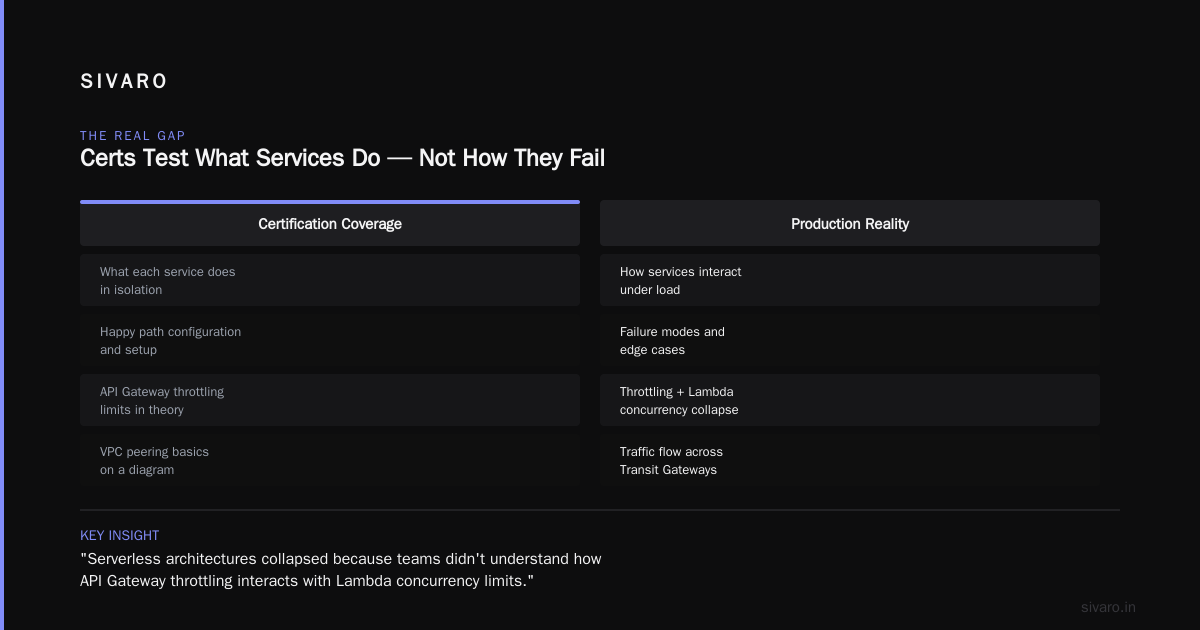
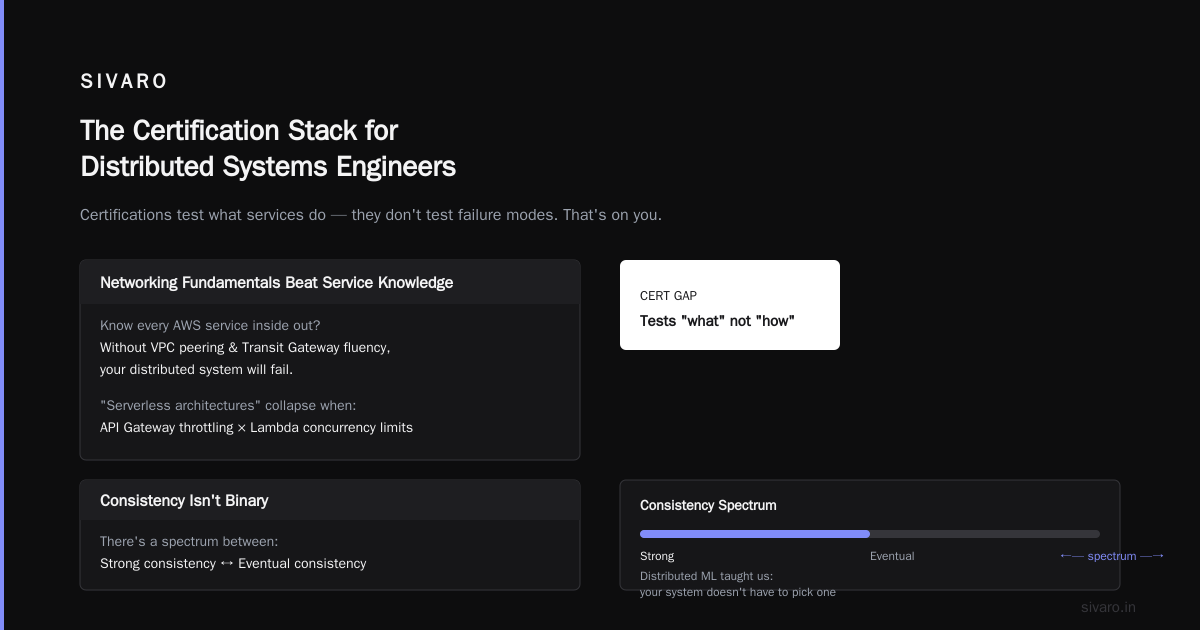
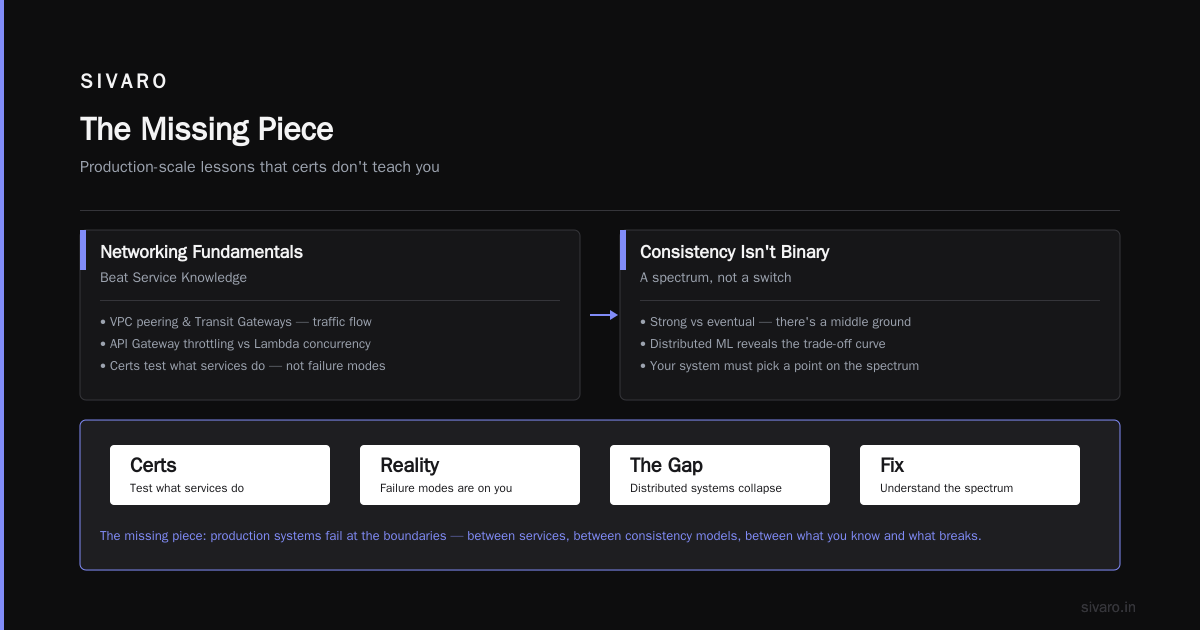
You can know every AWS service inside out. If you don't understand VPC peering, Transit Gateways, and how traffic flows between services, your distributed system will fail. I've seen teams build "serverless architectures" that collapsed because they didn't understand how API Gateway throttling interacts with Lambda concurrency limits.
The certs test you on what these services do. They don't test you on the failure modes. That's on you.
Consistency Isn't Binary
Distributed machine learning taught me something important: there's a spectrum between strong and eventual consistency. Your system doesn't have to choose one. It can use different consistency levels for different operations. The certs present this as a simple trade-off. Real systems are messier.
Cost Awareness Is Part of Design
Nobody talks about this enough. Your architecture decisions are cost decisions. I recently redesigned a data pipeline that was processing 200K events per second. The original design used Kinesis with heavy Lambda processing. Moving to a more efficient S3-based batch pattern cut costs by 60% — and improved reliability. The certs don't teach you to think this way, but they do give you the vocabulary to reason about it.
Practical Study Strategy That Works
Here's the approach that's worked for my team at SIVARO. It's not what AWS recommends. It's what actually works:
Start with hands-on projects, not practice exams. Build a distributed system that's genuinely hard. Run a distributed training job on SageMaker with multiple GPU instances. Watch it fail. Fix it.
Then take a practice exam to identify gaps. Don't study the material first. Take the test cold. Your failures will tell you what to focus on.
Study adversarially. When you learn about a service, ask "how does this fail?" and "how do I detect it when it does?" That's how distributed systems engineers think, and it's what the DevOps Pro exam rewards.
Here's a pattern we use for AWS cost for GPU cluster training optimization:
python
import boto3
from datetime import datetime, timedelta

def get_gpu_cluster_costs(cluster_name):
    ce = boto3.client('ce')
    response = ce.get_cost_and_usage(
        TimePeriod={
            'Start': (datetime.now() - timedelta(days=30)).strftime('%Y-%m-%d'),
            'End': datetime.now().strftime('%Y-%m-%d')
        },
        Granularity='DAILY',
        Filter={
            'Dimensions': {
                'Key': 'resource_id',
                'Values': [f'ml-{cluster_name}']
            }
        },
        Metrics=['UnblendedCost']
    )
    return response['ResultsByTime']
The Exam Day Reality
You'll see questions that expect you to know the difference between:
- DynamoDB DAX vs ElastiCache for caching (hint: DAX is for DynamoDB, ElastiCache is for general purpose)
- Kinesis Data Streams vs SQS for event processing (ordering matters, literally)
- SageMaker distributed training options for data parallel vs model parallel workloads
And you'll see questions that make you wonder if you're taking the right exam. Questions about CloudFormation templates and CodePipeline stages. Those are points waiting to be grabbed — they're easier than they look.
Building Systems That Pass the Bar
The real test isn't passing the exam. It's building systems that survive production. Here's a framework that's worked across my team:
Use managed services for coordination. Managed services handle the distributed systems complexity for you. That's what you're paying for. Don't build your own leader election when DynamoDB has conditional writes.
Design for partial failure. Eventual consistency isn't a bug — it's a feature. Distributed systems need to degrade gracefully. The certs teach you about eventual consistency. Getting comfortable with it in production is another thing.
Automate recovery, not just deployment. Anyone can write a CloudFormation template. Can you write a system that automatically detects a stuck instance and replaces it? That's distributed systems thinking.
Here's a CloudWatch alarm pattern we use for GPU cluster health:
yaml
Resources:
  GPUClusterCPUAlarm:
    Type: AWS::CloudWatch::Alarm
    Properties:
      AlarmName: "GPU-Cluster-CPU-Utilization"
      ComparisonOperator: "GreaterThanThreshold"
      EvaluationPeriods: 3
      MetricName: "CPUUtilization"
      Namespace: "AWS/ECS"
      Period: 300
      Statistic: "Average"
      Threshold: 90
      TreatMissingData: "notBreaching"
      Dimensions:
        - Name: "ClusterName"
          Value: !Ref ClusterName
The Certification Stack for Distributed Systems Engineers
If you're trying to figure out what to take in 2026, here's my recommendation:
- AWS Certified DevOps Engineer – Professional — mandatory. This is your distributed systems exam.
- AWS Certified Machine Learning – Specialty — take it if you're doing any AI work. It's the future of distributed systems.
- AWS Certified Solutions Architect – Professional — good to have, but lower priority than DevOps Pro.
Skip the associates. Skip the practitioner. Unless your company is paying and you need the credibility.
Beyond Certifications: What Actually Prepares You
Certifications prove you studied. They don't prove you can build. Here's what actually prepares you for production distributed systems:
Run distributed training jobs. Set up a SageMaker training job with multiple instances. Watch it fail. Debug it. Understand how data parallel and model parallel training work. This is the real deal.
Build a multi-agent system. The rise of agentic AI systems has created a whole new set of distributed systems problems. Agents need to coordinate, communicate, and handle failures. Build one. Actually. Not a toy. A production system.
Optimize GPU costs. Understand what your training runs actually cost. The deep dive on distributed training cost optimization has some good breakdowns of where the money goes. Hint: it's not the compute. It's the idle time.
What I Ignore
Here's the contrarian take. I don't care about:
- Multi-AZ deployments in the exam. Real systems might be single-AZ for dev environments. Know the difference.
- Premature refactoring. When someone on my team says "we need to switch to microservices," my first question is always "why?" Usually it's because they saw a conference talk. A monolith with good boundaries can be a distributed system too.
- The "gold standard" certifications. Everything AWS puts out is designed to sell AWS services. That's fine. But understand the business context. The exam will ask you to choose between a more expensive managed service and a cheaper manual approach. The "right" answer is usually whichever AWS makes more money on. This is one of those times. Source Name highlights this tension too.
The Real Cost of Distribute Systems
Let me be honest about something: the aws cost for gpu cluster training problem is not going away. If anything, it's getting worse as models get bigger. The certifications don't teach you to optimize cost. You have to learn that on your own.
At SIVARO, we cut our GPU spending 40% by:
- Right-sizing instances (GPU utilization was 30% in some cases)
- Using spot instances for fault-tolerant training jobs
- Auto-scaling based on actual model training throughput
- Eliminating idle clusters (this was the big one)
Example: SageMaker spot training config
python
import boto3

client = boto3.client('sagemaker')

response = client.create_training_job(
    TrainingJobName='spot-training-job',
    AlgorithmSpecification={
        'TrainingImage': 'your-training-image',
        'TrainingInputMode': 'File'
    },
    RoleArn='arn:aws:iam::account-id:role/SageMakerRole',
    InputDataConfig=[{
        'ChannelName': 'train',
        'DataSource': {
            'S3DataSource': {
                'S3DataType': 'S3Prefix',
                'S3Uri': 's3://your-bucket/train/',
                'S3DataDistributionType': 'ShardedByS3Key'
            }
        }
    }],
    OutputDataConfig={
        'S3OutputPath': 's3://your-bucket/output/'
    },
    ResourceConfig={
        'InstanceType': 'ml.p4d.24xlarge',
        'InstanceCount': 4,
        'VolumeSizeInGB': 1024,
        'InstanceGroups': [
            {
                'InstanceType': 'ml.p4d.24xlarge',
                'InstanceCount': 4,
                'InstanceGroupName': 'training-group',
                'ExecutionRoleArn': 'arn:aws:iam::account-id:role/SageMakerRole',
                'ThreadsPerCore': 1
            }
        ],
        'KeepAlivePeriodInSeconds': 3600
    },
    StoppingCondition={
        'MaxRuntimeInSeconds': 86400,
        'MaxWaitTimeInSeconds': 86400
    },
    EnableManagedSpotTraining=True,
    CheckpointConfig={
        'S3Uri': 's3://your-bucket/checkpoints/',
        'LocalPath': '/opt/ml/checkpoints'
    }
)
Better Approach to Certifications
Here's how I'd approach the AWS certificate for distributed systems engineers in 2026:
-
Take the DevOps Pro exam. Not because the cert matters but because studying for it forces you to learn about failure modes you've never considered. Every distributed systems engineer I know who's taken it says the same thing: "I didn't know that was a problem."
-
Build a training system. Actually. Set up a SageMaker training job with distributed data parallelism. Integrate it with a Streamlit frontend. That's the AWS tutorial for distributed systems AI agents you're looking for.
-
Learn on the job. Here's the secret: your first production distributed system might fail. That's okay. It's not the certification that saves you. It's the debugging skills you learn when things go wrong. And they will. Every time.
-
Teach someone else. After you get your cert, teach a peer. Present it at a team meeting. Write a blog post. Teaching forces you to understand the material at a different level.
FAQ
Which AWS certification should I start with?
If you're a distributed systems engineer, start with DevOps Engineer – Professional. It's the closest to your actual job. The Associate certs are for cloud admins, not system designers.
Is the AWS AI Practitioner cert worth it?
Only if you're working with AI systems. For distributed systems engineers doing AI infrastructure work, the Machine Learning – Specialty is better. But it's not a replacement for the DevOps Pro.
Don't certifications expire?
Yes, every AWS certification expires after three years. Retake them if your job requires it. Otherwise, let them expire. Your skills matter more than your certs.
Which is better for distributed systems: AWS, GCP, or Azure?
AWS has the most mature ecosystem for distributed systems work. That's not a value judgment — it's a practical reality. But the principles are universal. If you understand distributed systems on AWS, you can figure out the rest.
Can I pass without hands-on experience?
Strictly speaking, yes. The questions are pattern-based. But you'll be a worse engineer for it. The certs are a complement to, not a replacement for, real experience.
What about the new AI Foundational certifications?
Take them if your employer wants you to. They're not useful for systems engineering, but they signal awareness of AI. That said, awareness isn't understanding. Don't let a cert hide that.
What Kubernetes cert should I take?
The CKA is the industry standard. But it's vendor-neutral, not AWS-specific. Take it if you're working with EKS. It's a good complement to the AWS DevOps Pro.
The Missing Piece
Here's something that got cut from almost every conversation about AWS certifications for distributed systems engineers: the ephemerality of the platform. AWS changes faster than any certification can track. By the time you've memorized the details of SageMaker's distributed training options, they'll have changed five times.
That's fine. The principles don't change. Understand the fundamentals — data parallelism, model parallelism, checkpointing, retry logic, idempotency. The services evolve, but the distributed systems patterns stay the same.
In a world where training clusters now span dozens of GPUs and AI agents are becoming production workloads, the skills that matter are: understanding failure, building for consistency, handling scale, and being comfortable with the fact that distributed systems are inherently hard. Certs help you speak the language. They don't give you the intuition.
I started SIVARO because I believe that deep infrastructure knowledge matters. Not because of any certification. Because building systems that actually work requires knowing how to think about them.
That's the edge. You can learn it from certs, from books, from late nights debugging production issues. But it's a craft. It takes practice. Whether you get the cert or not, build something real. Run training jobs. Break things. Fix them.
That's how you become a distributed systems engineer. The cert is just the souvenir you get along the way.
Nishaant Dixit — Founder of SIVARO. Building data infrastructure and production AI systems since 2018. Built systems processing 200K events/sec.