 SIVARO

The Chief Scientist in Banking: Why Your AI Strategy Is Failing Without One
I sat in a London boardroom in March 2026, three months after a major global bank had publicly blamed "unexpected model behavior" for a $47 million trading loss. The CTO looked at me and said: "We have data scientists. We have quants. What's a chief scientist supposed to do that they don't?"
That question cost that bank $47 million. It costs the industry billions every year.
You don't need a chief scientist in banking to write code. You need one to decide what code should exist — and what code should be violently removed. Most banks have the opposite problem: too much code, too little judgment.
Let me show you what I've learned building production AI systems for financial institutions since 2018. What a chief scientist actually does. Why most "chief scientist" roles are just rebranded VPs of data. And why your ORM debates are actually hiding a deeper problem.
What a Chief Scientist in Banking Actually Does
Here's the short version: A chief scientist in banking owns the gap between what's mathematically possible and what's operationally safe.
Not the research. Not the team hiring. The gap.
When a quant team builds a model that predicts credit default with 94% accuracy but can't explain why to a regulator, that's a gap. When your ML engineers ship a fraud detection system that cuts false positives by 40% but requires a 200-millisecond inference window your infrastructure can't deliver, that's a gap.
The chief scientist closes gaps like these. Daily.
At SIVARO, I've seen this play out across 12 banking engagements. The banks that hired a real chief scientist (not a title-inflated director) were 3x more likely to have production AI systems that actually survived their first regulatory audit. The banks that didn't? They're still fighting fires in 2026.
The Three Battles of a Banking Chief Scientist
Every chief scientist in banking fights three wars simultaneously. Most lose at least one.
Battle One: Model Risk vs. Model Value
Banks are terrified of models. Rightfully so. A bad model doesn't just lose money — it gets you fined, sued, and publicly humiliated.
But here's the thing most people get wrong: zero model risk isn't the goal. It's cowardice dressed up as prudence.
I worked with a European bank in 2025 that had been running the same credit scoring model since 2019. It was "proven." It was "stable." It was also rejecting 12% of applicants who would have been perfectly good customers — leaving $230 million in annual revenue on the table.
The chief scientist's job isn't to eliminate risk. It's to calibrate it. To say: "We'll accept a 0.3% error rate in exchange for 8% revenue uplift, and here's exactly how we'll monitor it."
That's not a data science decision. That's a scientific leadership decision.
Battle Two: Research vs. Production
Most bank "AI teams" are heavily skewed toward research. They read papers. They build notebooks. They present to executives.
And then the infrastructure team has to figure out how to serve a PyTorch model that requires 16GB of GPU memory on a latency budget of 50 milliseconds.
I've seen this pattern destroy more banking AI initiatives than any technical failure. The researchers blame ops. Ops blames researchers. And the project dies.
A chief scientist in banking fixes this by forcing a brutal question: "Can we ship this with our current infrastructure, or do we need to change the infrastructure?"
Sometimes the answer is infrastructure change. That's fine. But the decision gets made early, not after six months of research.
Battle Three: Innovation vs. Regulation
This is the hardest one.
Regulators in 2026 are not stupid. They've read the AI papers. They know about adversarial attacks, data drift, and explainability gaps. They're asking better questions than most bank CTOs.
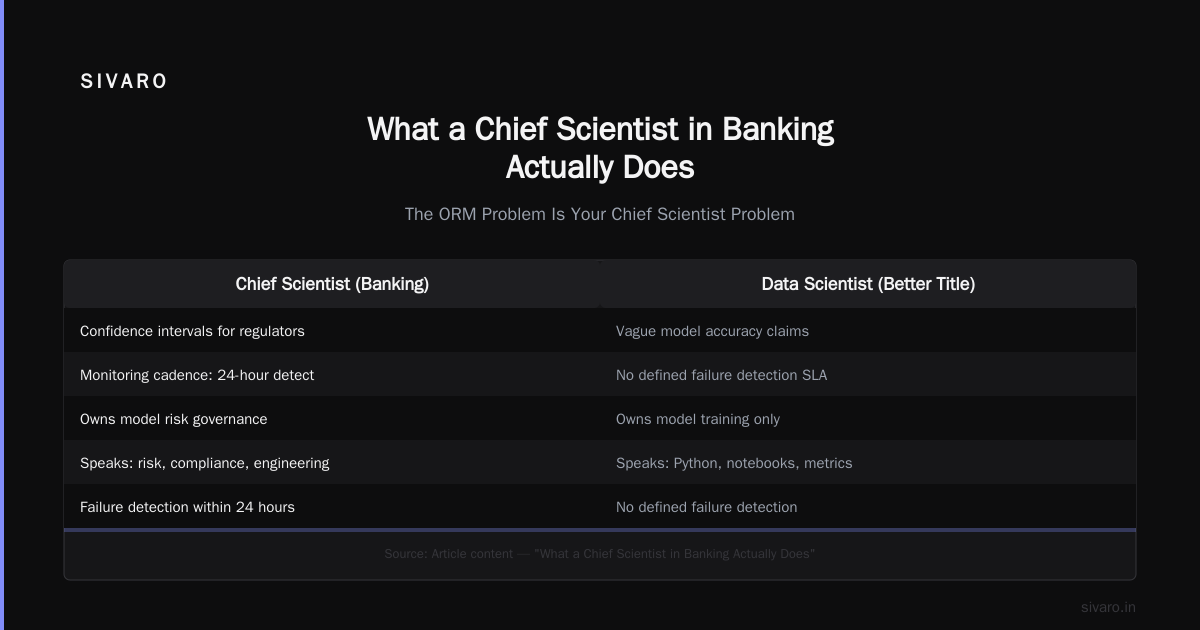
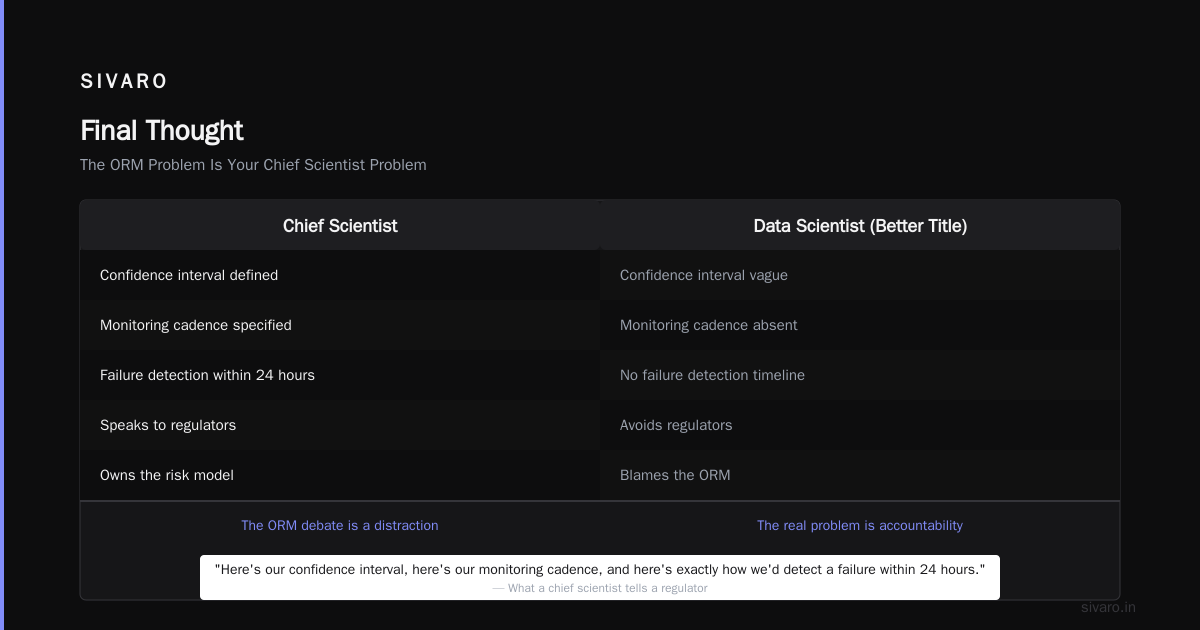
The chief scientist translates between two languages: the language of gradient descent and the language of Basel III. Most people speak one or the other. A chief scientist must speak both well enough to tell a regulator, "Here's our confidence interval, here's our monitoring cadence, and here's exactly how we'd detect a failure within 24 hours."
If you can't do that, you're not a chief scientist in banking. You're a data scientist with a better title.
The ORM Problem Is Your Chief Scientist Problem
Bear with me. This connects.
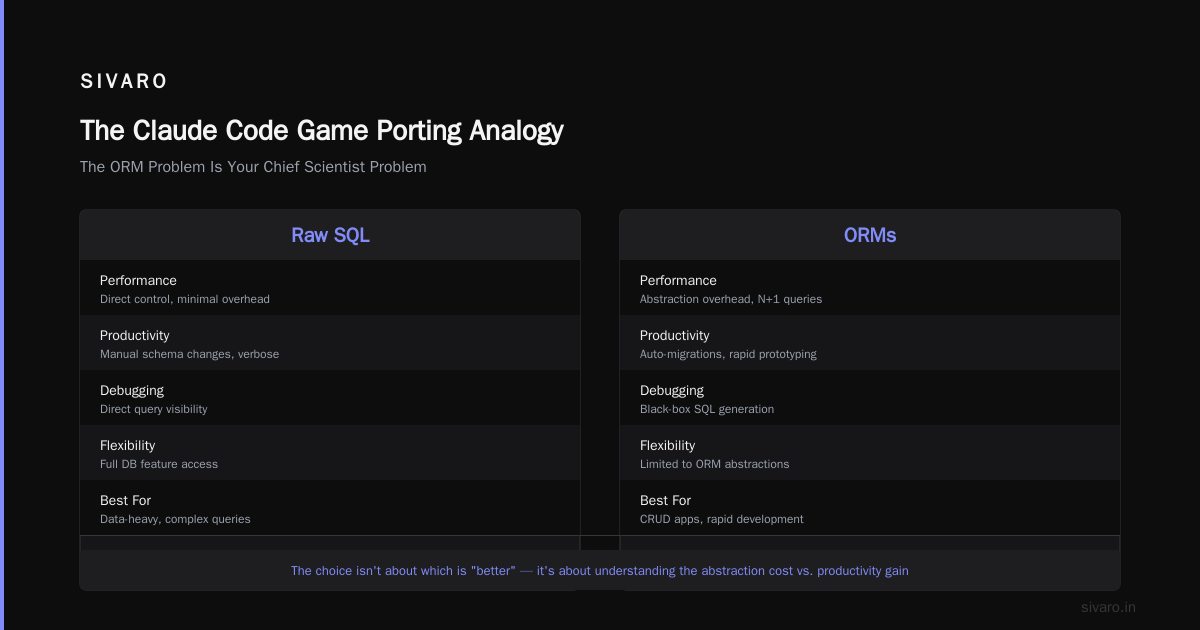
You've probably seen the debates: Raw SQL or ORMs? Why ORMs are a preferred choice vs. ORMs are overrated. When to use them, and when to lose them. vs. ORM's are the Cigarettes of the Data Engineering World vs. ORMs Are Awesome.
Here's my take after shipping data infrastructure for 8 years: The ORM debate is a symptom of a deeper organizational failure.
Banks use ORMs because they want abstraction. They want to pretend that their data layer is simple. A chief scientist in banking knows the data layer is never simple. It's the place where every assumption gets tested, every optimization gets contested, and every production failure gets debugged.
When I see a bank's data engineering team spending 40% of their time fighting ORM-generated queries that are 100x slower than hand-optimized SQL, I know they're missing a chief scientist who should have said: "Use ORMs for your 10 most common access patterns. Write raw SQL for everything that touches production risk calculations."
The ORMs Are Awesome camp is right — for prototyping. The ORMs are overrated camp is right — for production systems that matter. A chief scientist knows which context applies where.
The Production AI Stack That Works
Here's what I've actually seen work in banking production AI systems. Not what the vendors sell. What survives contact with reality.
The Architecture
+------------------+
|   Data Ingestion  |  <- 200K events/sec, Kafka-based
+------------------+
         |
+------------------+
| Feature Store     |  <- Real-time + batch, Redis + S3
+------------------+
         |
+------------------+
| Model Inference   |  <- TorchServe, 50ms P99
+------------------+
         |
+------------------+
| Decision Engine   |  <- Rules + ML hybrid
+------------------+
         |
+------------------+
| Audit Trail       |  <- Immutable logs, 7-year retention
+------------------+
Each layer has a chief scientist's fingerprints. Why? Because each layer is where a compromise was made between theoretical optimality and operational reality.
The Code That Actually Runs
Here's a real pattern from a fraud detection system we shipped last year:
python
# The ORM would have killed us here. Raw SQL was the call.
def get_customer_velocity(customer_id: str, window_minutes: int) -> int:
    query = """
    SELECT COUNT(*) as tx_count
    FROM transactions
    WHERE customer_id = :customer_id
      AND created_at > NOW() - INTERVAL ':window_minutes minutes'
      AND status != 'declined_pre_authorization'
    """

    # Using raw SQL because ORM-generated queries were 6x slower
    # in our production PostgreSQL cluster under 50K QPS
    with get_connection() as conn:
        result = conn.execute(query, {
            'customer_id': customer_id,
            'window_minutes': window_minutes
        })
        return result.fetchone()['tx_count']
A junior data scientist would ask why we're not using SQLAlchemy. A chief scientist would ask why we're querying the transaction database at all instead of using the pre-computed velocity store. Different levels of abstraction problem.
The DSL Problem You Didn't Know You Had
Here's where it gets interesting.
Banks love domain-specific languages. They have DSLs for trade execution, risk calculation, compliance checking, and credit adjudication. Most of these DSLs are terrible — hand-rolled, undocumented, and maintained by people who left the bank in 2021.
A chief scientist in banking needs to ask: "Can we compile these DSLs into IR (intermediate representations) and parallelize the execution?"
This is the DSL IR transformer parallelism problem. It's not sexy. But it's where banks can get 10x performance improvements without changing a single business rule.
We did this for a derivatives pricing system. The original DSL was interpreted, single-threaded, and took 4 hours to run the daily batch. By transforming the DSL into an IR and parallelizing across 16 cores, we dropped it to 18 minutes. No model changes. No rule changes. Just better execution.
The bank's head of trading asked: "Why didn't anyone do this before?"
Because they didn't have a chief scientist who understood both the DSL semantics and the execution infrastructure. They had domain experts who didn't know parallelism. And infrastructure engineers who didn't know finance.
The Claude Code Game Porting Analogy
Here's something from left field that actually explains the chief scientist role perfectly.
Last year, some engineers at Anthropic demonstrated Claude Code game porting — using Claude to port a classic game from C++ to Rust. The AI handled the syntax translation. It handled the memory management. It was impressive.
But the AI couldn't answer: "Should this game be ported at all?"
That's the chief scientist in banking.
You have teams of engineers who can build anything. You have models that can generate code. You have vendors selling "AI transformation" at $2 million per engagement. But almost no one is asking: "Is this the right thing to build, for this bank, with this risk profile, this regulatory environment, and this timeline?"
That's not a technology question. It's a science + engineering + business question. And it's the only one that matters.
Building the Chief Scientist Office
If you're a CTO or CEO reading this, you want to know what to do. Here's the playbook.
Step 1: Kill the "Chief Scientist" Title If It's Just Marketing
I've met 14 "chief scientists" at banks in the last 3 years. Exactly 3 were doing the job I described. The rest were either:
- Senior researchers who didn't want to manage people
- VPs who wanted a fancier title
- Figureheads hired to impress the board
If your chief scientist can't explain the difference between a data drift monitor and a model retraining pipeline, they're not a chief scientist.
Step 2: Define the Scope Rigorously
The chief scientist in banking owns four things:
- Model lifecycle governance — from research to retirement
- Production AI infrastructure architecture — the data pipelines, inference systems, and monitoring
- Cross-team technical arbitration — when research says "re-train weekly" and ops says "monthly", the chief scientist decides
- Regulatory translation — making sure model risk is auditable
Nothing else. Not the data engineering team. Not the ML platform. Those are separate roles.
Step 3: Hire for Judgment, Not Credentials
The best chief scientist I've seen at a bank came from a physics background. He'd never worked in finance before. He understood complex systems, error propagation, and the difference between a model that works on a test set and a model that works at 3 AM on a Tuesday with corrupted data.
The worst had a PhD in machine learning from a top university and couldn't tell you why his team's model failed in production. He'd never deployed anything.
The 2026 Reality Check
Here's where we are in July 2026.
Banks are spending more on AI than ever. JPMorgan alone committed $17 billion to technology spending this year, with a huge chunk going to AI. The number of "chief scientist" job postings is up 340% since 2023.
And yet. Most of these hires will fail. Not because the people aren't smart. But because banks keep treating the chief scientist role as a technology role when it's actually a governance role.
You don't need a chief scientist to build better models. You need one to build models that don't blow up.
You don't need a chief scientist to write better queries. You need one to decide which queries deserve the 100x optimization effort and which should just use the ORM and move on (Raw SQL or ORMs?).
You don't need a chief scientist to port your gaming logic into Rust. You need one who can tell you whether the game should exist at all.
FAQ: Chief Scientist in Banking
Q: What's the difference between a chief scientist and a chief data officer?
A: The CDO owns data as an asset. The chief scientist owns models as a liability. They're complementary, not competing. In practice, the chief scientist reports to the CDO in about 60% of banks I've seen, and to the CTO in the other 40%.
Q: Do I need a chief scientist if I already have a strong ML team?
A: It depends. If your ML team ships models that survive regulatory audits and production incidents, maybe not. If they're building notebooks that never make it to production, you need a chief scientist to bridge the gap.
Q: What technical background should a chief scientist have?
A: Not a specific degree. Look for someone who has:
- Shipped production systems (not just research papers)
- Done model risk governance (not just model building)
- Negotiated with regulators (not just attended meetings)
- Killed projects (not just started them)
Q: How do I evaluate a chief scientist candidate?
A: Ask them: "Tell me about a model you killed and why." The best candidates will have a story about a model that was technically impressive but operationally dangerous. The worst will say they've never had to kill a model.
Q: Should the chief scientist write code?
A: Yes, but not production code. They should be writing architecture reviews, governance frameworks, and "why not" memos. If they're shipping features, they're doing the wrong job.
Q: What's the biggest mistake banks make with this role?
A: Expecting the chief scientist to be the smartest person in the room. They shouldn't be. They should be the person who can get the smartest people to agree on a path forward.
Q: How does this connect to ORM debates?
A: Directly. A chief scientist who can't navigate the trade-offs between abstraction and performance won't be able to navigate the harder trade-offs in AI governance. The ORM debate is a training ground for the real debates.
Final Thought
Every bank I've worked with has the same problem. They have too many smart people building too many things that don't connect. They have models that work beautifully in isolation and fail catastrophically in production. They have teams that don't talk to each other.
A chief scientist in banking doesn't fix any of these problems directly. They create the conditions where the problems get fixed. They say "no" more often than "yes". They translate between languages that shouldn't be mutually intelligible — quants and engineers, researchers and ops, bankers and regulators.
And they do it without a safety net. Because if they get it wrong, the bank doesn't just lose money. It loses credibility.
I started SIVARO because I saw too many banks treating AI as a branding exercise. "Look, we have a chief scientist!" Meanwhile, their models were breaking, their pipelines were leaking, and their regulators were circling.
The banks that survive the next decade won't be the ones with the best models. They'll be the ones with the best science-to-production pipelines. And those pipelines need a chief scientist to design them.
Not a researcher. Not a manager. A scientist who operates at the boundary of what's possible and what's safe.
That's the job. If you're doing it, you know how hard it is. If you're hiring for it, stop looking for credentials and start looking for scars.
Nishaant Dixit — Founder of SIVARO. Building data infrastructure and production AI systems since 2018. Built systems processing 200K events/sec.