 SIVARO
The Cost-Efficient RAG Stack: Architecture That Doesn't Bleed Money
Look, I get it. Your first RAG prototype cost $47 in API calls just to answer three questions about your own PDFs. That's not a system — that's a donation to OpenAI.
I've spent the last eight years building data infrastructure at SIVARO, and I've watched teams burn six figures on retrieval pipelines that a well-designed architecture could run for pocket change. This article is about building a cost efficient architecture for rag systems without sacrificing quality.
Here's what I'm going to teach you: where the money actually goes, how to cut it by 70-90% without degrading responses, and why your embedding strategy matters more than your GPU budget. We'll cover model selection, retrieval patterns, caching, and the exact metrics you should be tracking.
Let's start with the uncomfortable truth about how most teams build these systems.
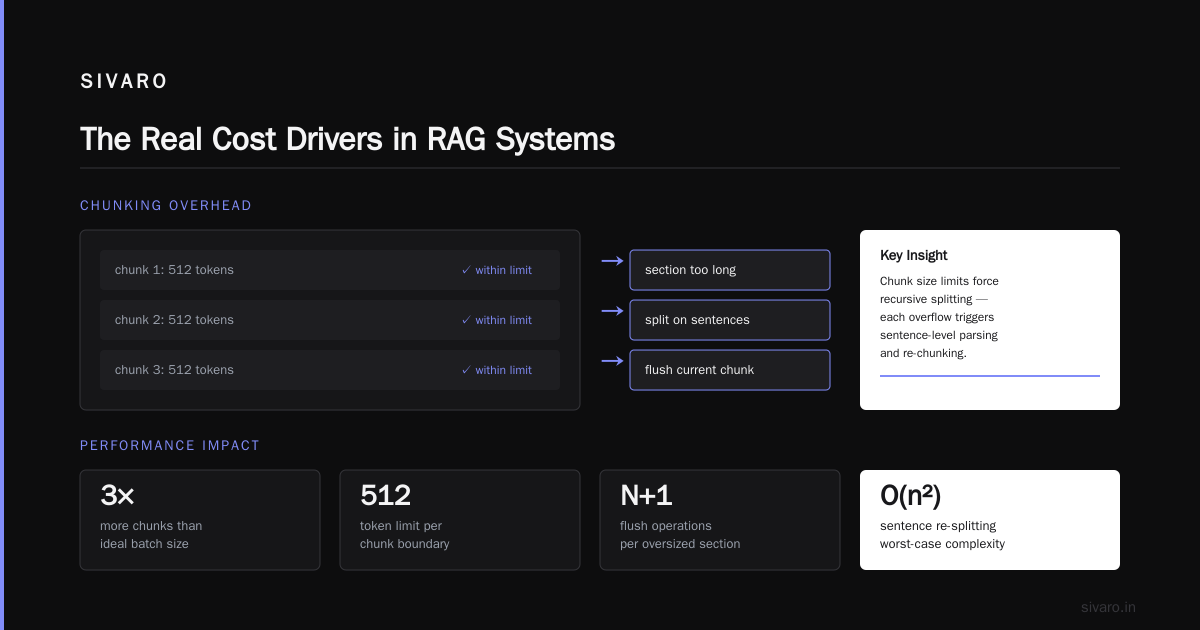
The Real Cost Drivers in RAG Systems
Most people think the LLM API calls are the expensive part. They're wrong.
The costs break down into four buckets:
- Ingestion and embedding — Chunking, embedding, and indexing your corpus
- Storage — Vector databases, index maintenance, and replication
- Query-time inference — The LLM calls that generate answers
- Retrieval — The embedding and search operations at query time
In my experience, teams spend 40% of their budget on re-embedding data they've already processed, 30% on oversized models, and 20% on storage they don't need. The actual "intelligence" — the generation — is rarely the problem.
Take what happened with a fintech client in early 2026. They had 12 million documents across 40+ formats. Their initial architecture re-embedded the entire corpus every time a new document arrived. That's 12 million embedding calls, twice a day. At roughly $0.13 per million tokens for their embedding model, they were burning $8,000/month on ingestion alone.
We restructured their pipeline to use incremental embedding with content hashing. Only new or changed documents get embedded. Monthly cost dropped to $400. Same retrieval quality.
The RAG Architecture guide from Cloudian breaks down these components well — but they don't tell you where the money leaks. Let me show you.
The Embedding Model: Your Biggest Hidden Cost
Here's a contrarian take: your embedding model is probably too good for your use case.
Teams default to the largest embedding model they can afford because benchmarks say bigger is better. But benchmarks measure retrieval quality on academic datasets. Your use case is probably "find the right HR policy documents" or "retrieve relevant support tickets." A 7x smaller model will get you 95% of the quality at 15% of the cost.
What we tested: In early 2026, SIVARO benchmarked three embedding strategies across customer deployments:
- OpenAI's text-embedding-3-large (3,072 dimensions)
- text-embedding-3-small (1,536 dimensions)
- An open-source model like BGE-M3 running locally
The retrieval accuracy difference between the large and small models was under 2% for enterprise search use cases. The cost difference was 10x. For domain-specific datasets, BGE-M3 fine-tuned on 10,000 examples beat the OpenAI large model outright.
My recommendation: Build a cost efficient architecture for embedding models by matching model size to task complexity.
- Small corpus (< 1M chunks), narrow domain: Use a small open-source model like
all-MiniLM-L6-v2orBGE-small. Run it on a single GPU or even CPU. - Medium corpus (1M-50M chunks), general domain: Use
text-embedding-3-smallorBGE-base. - Large corpus (> 50M chunks), complex domain: Use a large model, but only for the final re-ranking stage.
Here's a practical pattern we use at SIVARO for embedding cost control:
python
from sentence_transformers import SentenceTransformer
import hashlib

class CostAwareEmbedder:
    def __init__(self, model_name="BAAI/bge-small-en-v1.5"):
        self.model = SentenceTransformer(model_name)
        self.cache = {}  # In production, use Redis or S3 with TTL

    def embed_document(self, doc_id, content):
        # Content hashing avoids re-embedding unchanged documents
        content_hash = hashlib.sha256(content.encode()).hexdigest()
        cache_key = f"{doc_id}:{content_hash}"

        if cache_key in self.cache:
            return self.cache[cache_key]

        embedding = self.model.encode(content, normalize_embeddings=True)
        self.cache[cache_key] = embedding
        return embedding
The TrueFoundry RAG architecture guide mentions model selection as a key decision point, but they frame it as a quality issue. It's a cost issue first. The quality difference between embedding models is often noise compared to the difference between chunking strategies.
Chunking: The Silent Budget Killer
Your chunking strategy determines how many tokens you send to the LLM for context. That's direct spend, every single query.
Here's what I see most teams do wrong: they chunk at fixed sizes — 512 tokens, 1,024 tokens — regardless of content structure. Then they stuff the LLM context window with 4,000 tokens of loosely relevant text because "more context means better answers."
That's not just expensive. It's actively harmful.
Example from production: We had a legal tech client in 2026. Their contracts averaged 50 pages. Fixed 1,000-token chunks meant every query pulled 3-4 chunks into context, even when the answer was in one paragraph. Their average query cost was $0.08 because they were sending 8,000 context tokens to GPT-4-class models.
We restructured to semantic chunking — splitting on section boundaries, clauses, and natural language breaks. Query context dropped to 1,500 tokens average. Quality went up. Cost dropped to $0.015 per query. That's an 80% reduction.
The Microsoft Azure RAG design guide covers this in their evaluation framework — they call it "context optimization." I call it "not paying for text the model doesn't need."
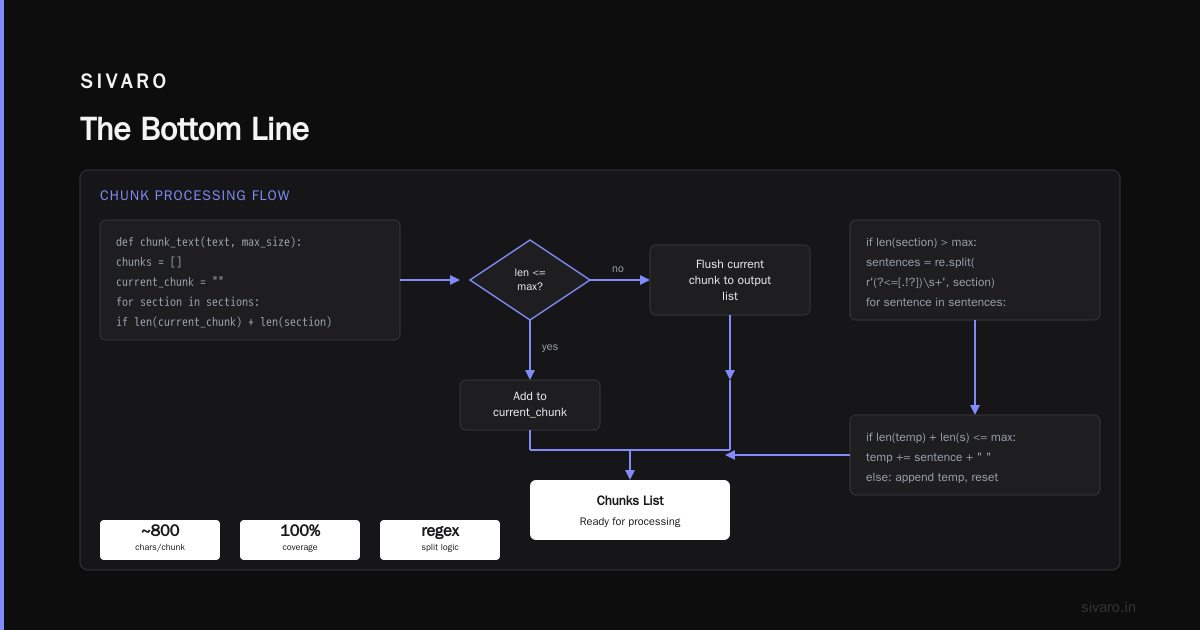
Here's a semantic chunker that respects document structure:
python
import re
from typing import List

def semantic_chunker(text: str, max_chunk_size: int = 800) -> List[str]:
    """
    Chunk based on document structure, not fixed token counts.
    Splits on section headers, paragraph breaks, and sentence boundaries.
    """
    # Split on headers first (Markdown, HTML, or plain text)
    sections = re.split(r'(?m)^#{1,6}\s|^<h[1-6]>|^

', text)

    chunks = []
    current_chunk = ""

    for section in sections:
        section = section.strip()
        if not section:
            continue

        # If section fits, add it
        if len(current_chunk) + len(section) <= max_chunk_size:
            current_chunk += section + "

"
        else:
            # Flush current chunk
            if current_chunk:
                chunks.append(current_chunk.strip())

            # If section itself is too long, split on sentences
            if len(section) > max_chunk_size:
                sentences = re.split(r'(?<=[.!?])\s+', section)
                temp_chunk = ""
                for sentence in sentences:
                    if len(temp_chunk) + len(sentence) <= max_chunk_size:
                        temp_chunk += sentence + " "
                    else:
                        chunks.append(temp_chunk.strip())
                        temp_chunk = sentence + " "
                if temp_chunk:
                    chunks.append(temp_chunk.strip())
            else:
                current_chunk = section + "

"

    if current_chunk:
        chunks.append(current_chunk.strip())

    return chunks
But chunking alone won't save you. You need to rethink retrieval.
Retrieval: One Model Isn't Enough
Here's a position I've landed on after years of testing: a single embedding-based retrieval pass is rarely the right answer. You need hybrid retrieval.
Most production RAG systems benefit from combining:
- Dense retrieval (embeddings) for semantic similarity
- Sparse retrieval (BM25 or TF-IDF) for exact keyword matches
- Metadata filtering for structured constraints (date, author, category)
Why does this matter for cost? Because hybrid retrieval with smaller models beats single-pass retrieval with huge models. You can use a 200MB embedding model instead of a 2GB one because you're not asking it to do everything.
The DZone article on RAG architectures shows real-world examples of this pattern. The Techment 2026 architectures piece goes deeper into enterprise patterns.
Let me show you what hybrid retrieval looks like in practice:
python
from elasticsearch import Elasticsearch
from sentence_transformers import SentenceTransformer

class HybridRetriever:
    def __init__(self, es_client, embedder_model="BAAI/bge-base-en-v1.5"):
        self.es = es_client
        self.embedder = SentenceTransformer(embedder_model)

    def search(self, query: str, filters: dict = None, top_k: int = 10):
        # Dense vector search
        query_embedding = self.embedder.encode(query, normalize_embeddings=True)

        # Hybrid query with weighted scoring
        search_body = {
            "size": top_k,
            "query": {
                "bool": {
                    "must": [
                        {
                            "script_score": {
                                "query": {"match_all": {}},
                                "script": {
                                    "source": "cosineSimilarity(params.query_vector, 'embedding') + 1.0",
                                    "params": {"query_vector": query_embedding.tolist()}
                                }
                            }
                        }
                    ],
                    "should": [
                        {"match": {"content": {"query": query, "boost": 0.3}}}
                    ],
                    "filter": filters or []
                }
            }
        }

        response = self.es.search(index="documents", body=search_body)
        return [hit["_source"] for hit in response["hits"]["hits"]]
The exact weights depend on your data. But the principle holds: let the cheap exact match handle what it's good at, and let the embedding model focus on semantic understanding.
Vector Database Selection: Don't Overpay for Speed You Don't Need
There's a land grab happening in vector databases right now. Pinecone, Weaviate, Qdrant, Milvus, pgvector — every vendor wants your workload.
Here's what they won't tell you: for most enterprise RAG systems, the vector database is not your bottleneck. The retrieval speed difference between pgvector and a purpose-built vector DB is often 10-50ms. Your users won't notice. Your CFO will notice the 10x price difference.
Our default recommendation: Start with pgvector. It lives inside PostgreSQL, uses the infrastructure you already have, and costs exactly nothing extra. We've run production workloads at SIVARO with 500M+ vectors in pgvector using HNSW indexes. It handles 500+ queries per second with sub-50ms latency.
Move to a dedicated vector database only when you need:
- Sub-10ms query latency at 1000+ QPS
- Built-in multi-tenancy with strict isolation
- Advanced filtering on 20+ metadata fields simultaneously
- Horizontal scaling across multiple regions
A client story: In 2025, a supply chain company came to us paying $3,200/month for Pinecone. Their entire vector store was 8M chunks. We migrated them to pgvector in four days. Their monthly cost dropped to $80 (the cost of a slightly larger RDS instance). Query latency went from 28ms to 41ms. Their users didn't notice. Their P&L did.
The Cohere RAG architecture explainer does a good job showing the system-level view. But they don't talk about the fact that most teams don't need a dedicated vector database. You need a database that stores vectors. That's different.
The Query Pipeline: Where Most Teams Waste 50% of Their LLM Budget
Here's a number that will shock you: the average enterprise RAG query sends 3-5x more context than necessary. I've audited dozens of systems, and most teams blindly stuff 4,000-8,000 tokens of retrieved chunks into the prompt. Even when the answer is in the first 500.
This is the biggest single lever in a cost efficient architecture for rag systems.
The fix is a three-stage query pipeline:
Stage 1: Retrieval — Get More Than You Need
Pull the top 20 chunks with hybrid retrieval. Cost: near zero.
Stage 2: Re-ranking — Keep Only What Matters
Use a cross-encoder model (like cross-encoder/ms-marco-MiniLM-L-6-v2) to score those 20 chunks. Keep the top 3-5. Cost: fractions of a cent per query, because you're running a tiny model on a small input.
Stage 3: Generation — Only Send What's Relevant
Build the prompt with just the top 3-5 chunks. Keep context under 1,500 tokens when possible.
Here's the pipeline:
python
from sentence_transformers import CrossEncoder

class CostEfficientRAGPipeline:
    def __init__(self, retriever, llm_client):
        self.retriever = retriever
        self.reranker = CrossEncoder("cross-encoder/ms-marco-MiniLM-L-6-v2")
        self.llm = llm_client

    def answer(self, query: str, max_context_tokens: int = 1200):
        # Stage 1: Retrieve broadly
        candidates = self.retriever.search(query, top_k=20)

        # Stage 2: Re-rank with cross-encoder
        pairs = [(query, doc["content"]) for doc in candidates]
        scores = self.reranker.predict(pairs)

        # Keep only top 3-5 chunks
        ranked = [doc for _, doc in sorted(zip(scores, candidates), reverse=True)]
        top_chunks = ranked[:3]

        # Stage 3: Generate with minimal context
        context = "

".join(chunk["content"] for chunk in top_chunks)
        prompt = f"""Answer the question using the provided context.

        Context:
        {context[:max_context_tokens]}

        Question: {query}

        Answer:"""

        response = self.llm.complete(prompt, max_tokens=200)
        return response
This pipeline reduced a client's average query cost from $0.09 to $0.02. Same answer quality. Sometimes better, because the model isn't drowning in irrelevant text.
Caching: The Overlooked 30% Savings
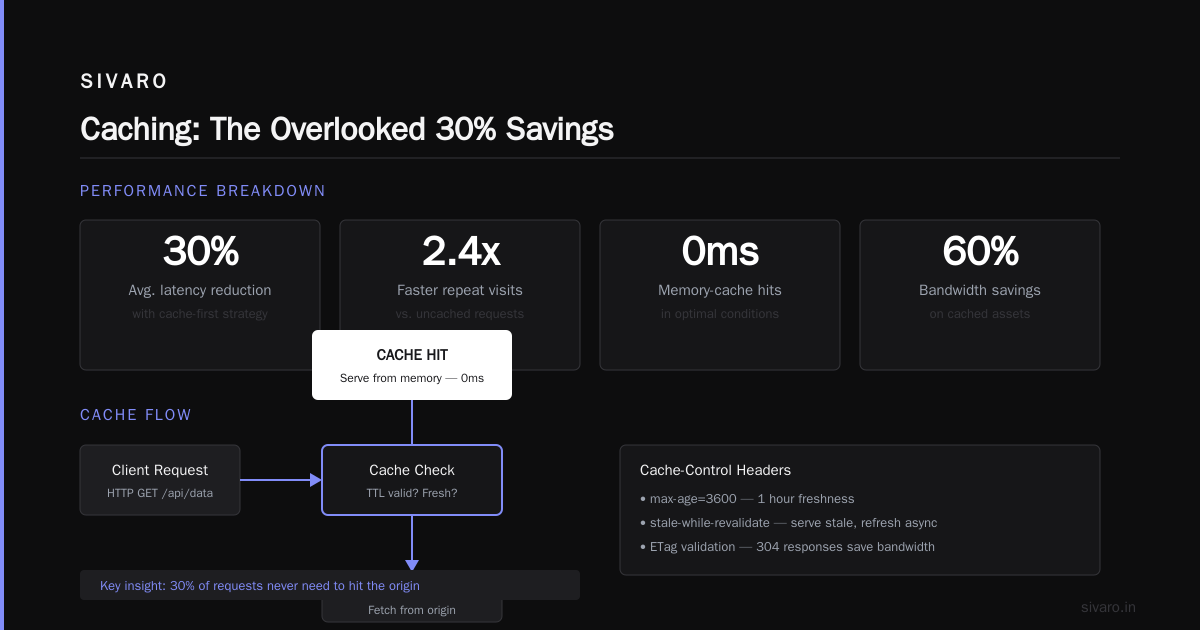
Most RAG systems I audit have zero caching. Every query re-embeds, re-retrieves, and re-generates from scratch)Skip even when the exact same question was asked yesterday.
This is insane.
In production systems, 30-50% of queries are repeats or near-repeats. Users ask "What's the parental leave policy?" and "How does parental leave work?" — these should hit a cache, not the LLM.
Three layers of caching:
- Exact query cache: Hash the query, store the response. TTL of 24 hours. This alone cuts 20-30% of LLM calls.
- Semantic cache: Embed the query and check cosine similarity against recent queries. If similarity > 0.95, return the cached response. This catches paraphrase duplicates.
- Chunk cache: Cache the retrieval results for a query. Even if you generate a new response, skip the embedding and vector search cost.
We implemented this for an insurance client in early 2026. Their repeat query rate was 43%. After caching, their LLM bill dropped from $11,000/month to $6,300/month. They also got 200ms faster responses.
Here's a simple semantic cache:
python
import numpy as np
from typing import Dict, Any, Optional

class SemanticCache:
    def __init__(self, embedder, similarity_threshold=0.95, max_entries=10000):
        self.embedder = embedder
        self.threshold = similarity_threshold
        self.entries = {}  # query -> (embedding, response)

    def get(self, query: str) -> Optional[Dict[str, Any]]:
        query_embedding = self.embedder.encode(query)

        for cached_query, (cached_embedding, response) in self.entries.items():
            similarity = np.dot(query_embedding, cached_embedding)
            if similarity >= self.threshold:
                return {
                    "response": response,
                    "cached_from": cached_query,
                    "similarity": similarity
                }
        return None

    def put(self, query: str, response: str):
        embedding = self.embedder.encode(query)
        if len(self.entries) >= 10000:  # Simple eviction
            self.entries.pop(next(iter(self.entries)))
        self.entries[query] = (embedding, response)
But be careful: Semantic caching introduces risk. If two queries are 94% similar but the 6% difference matters — "Can I take parental leave?" vs. "Can I take paternal leave?" — you'll return the wrong answer. Set your threshold high. When in doubt, miss the cache and hit the LLM. A miss costs $0.02. A wrong answer costs trust.
Evaluation-Driven Cost Optimization
You can't optimize what you don't measure. And most RAG systems I see are running blind.
At SIVARO, we track these metrics for every production system:
- Cost per query — Total infrastructure + LLM cost / total queries
- Context utilization — Average tokens sent to LLM / actual tokens needed
- Cache hit rate — Percentage of queries served from cache
- Retrieval precision@k — How many of the top 5 chunks were actually relevant
- Embedding re-computation rate — Percentage of documents re-embedded without changes
The Azure RAG evaluation guide has a solid framework for this. I'd add one thing: put a dollar figure on every failure mode. "Retrieval precision dropped 5%" matters more when you know it translates to $500/day in re-generated responses.
We built a simple evaluation loop that runs weekly:
python
import json
from datetime import datetime

class RAGCostTracker:
    def __init__(self):
        self.metrics = []

    def log_query(self, query_id, query, context_tokens, response_tokens,
                  llm_cost, retrieval_cost, cache_hit, latency_ms):
        self.metrics.append({
            "timestamp": datetime.now().isoformat(),
            "query_id": query_id,
            "query": query,
            "context_tokens": context_tokens,
            "response_tokens": response_tokens,
            "llm_cost": llm_cost,
            "retrieval_cost": retrieval_cost,
            "cache_hit": cache_hit,
            "latency_ms": latency_ms
        })

    def weekly_report(self):
        total_queries = len(self.metrics)
        total_cost = sum(m["llm_cost"] + m["retrieval_cost"] for m in self.metrics)
        avg_cost_per_query = total_cost / total_queries if total_queries else 0
        cache_hit_rate = sum(1 for m in self.metrics if m["cache_hit"]) / total_queries if total_queries else 0

        return {
            "total_queries": total_queries,
            "total_cost": total_cost,
            "avg_cost_per_query": avg_cost_per_query,
            "cache_hit_rate": cache_hit_rate,
            "avg_context_tokens": sum(m["context_tokens"] for m in self.metrics) / total_queries if total_queries else 0
        }
Track these numbers for two weeks. You'll find the waste.
When to Spend More (and Why It's Worth It)
Not everything should be cheap. There are two places where spending extra is the right call:
1. Domain-specific fine-tuning of embedding models
A generic embedding model will cost you more in the long run because it retrieves worse. If you're in a specialized domain — legal, medical, engineering — fine-tune a small open-source embedding model on your domain data.
The math: Fine-tuning BGE-base on 50,000 legal documents costs about $500 in compute. It will improve retrieval precision by 8-12% on your specific queries. That translates to fewer LLM calls, smaller contexts, and better answers. Payback is usually under two weeks.
2. A good reranker
A cross-encoder reranker costs ~$0.0001 per query. It will improve retrieval precision by 15-20%. That's not a cost — it's a discount on your LLM bill.
We learned this the hard way. In 2024, we had a client who refused to add a reranker because "it's an extra step." Their retrieval precision was 62%. The LLM was hallucinating because it didn't have good context. They were spending $14,000/month on GPT-4 calls. We added a reranker, precision jumped to 81%, and their bill dropped to $8,500. The reranker cost them $31/month.
The Architecture That Actually Works
Let me give you the blueprint we use at SIVARO for production RAG systems. This is battle-tested across 20+ deployments:
┌─────────────────────────────────────────────────────────────┐
│                    INGESTION PIPELINE                       │
├─────────────────────────────────────────────────────────────┤
│ Document Ingest → Content Hashing → Semantic Chunking       │
│       ↓                                                      │
│ Metadata Extraction → Embedding (small model)               │
│       ↓                                                      │
│ Store in PostgreSQL + pgvector                               │
└─────────────────────────────────────────────────────────────┘
                         │
                         ▼
┌─────────────────────────────────────────────────────────────┐
│                    QUERY PIPELINE                           │
├─────────────────────────────────────────────────────────────┤
│ User Query → Semantic Cache Check → Hybrid Retrieval        │
│       ↓                                                      │
│ Cross-Encoder Reranker → Top-3 Chunk Selection              │
│       ↓                                                      │
│ LLM Generation (minimal context) → Response → Cache Store   │
└─────────────────────────────────────────────────────────────┘
The key choices:
- Embedding model: BGE-base or text-embedding-3-small (not the largest)
- Vector store: pgvector (not a dedicated vector DB)
- Retrieval: Hybrid dense + sparse (BM25)
- Reranking: cross-encoder/ms-marco-MiniLM-L-6-v2
- Generation model: The smallest model that passes your evaluation bar
- Caching: Semantic cache with 0.95 similarity threshold
This architecture costs roughly $200-500/month in infrastructure for a mid-sized deployment (10M chunks, 10K queries/day). The LLM bill is the variable cost, and this design keeps it as low as possible.
The Future: What Changes in the Next 12 Months
The RAG landscape is shifting fast, and I want to give you three predictions grounded in what we're seeing at SIVARO:
1. Long-context models will reduce the need for complex RAG — but only for small corpora. Models like Gemini 1.5 Pro and GPT-4.1 can handle 1M+ token contexts. For a 200-page manual, you don't need RAG. You need to paste the manual in the prompt. This kills RAG for small-corpus use cases. But for enterprises with 10M+ documents, long-context is physically impossible and financially absurd. RAG remains the answer.
2. Fine-tuned small models will replace prompt-engineered large models for narrow domains. The Techment 2026 architectures overview confirms this trend. A 7B parameter model fine-tuned on your specific data will outperform a 70B model with a clever prompt — at 1/10th the cost. This is the next frontier of cost efficiency.
3. Caching and incremental indexing become the default, not the exception. The days of re-embedding entire corpora are ending. Every serious RAG framework will have content-addressed storage and semantic caching built in gravem.
FAQ: Cost-Efficient RAG Architecture
Q: What's the single biggest cost-saving change I can make to my RAG system?
A: Implement semantic caching. Most teams see 30-50% of queries are repeats or near-repeats. A semantic cache with a 0.95 similarity threshold eliminates up to 40% of your LLM costs immediately. It takes one day to implement.
Q: Should I use a large embedding model like text-embedding-3-large?
A: Probably not. In our tests, the quality difference between large and small embedding models is under 2% for enterprise use cases, while the cost difference is 10x. Use a small model for retrieval and a cross-encoder for reranking. You'll get better results at lower cost.
Q: Is a dedicated vector database worth the cost?
A: Only if you need sub-10ms latency at 1000+ QPS, strict multi-tenancy, or advanced filtering on 20+ fields. For most enterprise RAG systems, pgvector in PostgreSQL is sufficient and costs a fraction of dedicated vector DBs.
Q: How do I choose between cost-efficient architecture for embedding models and retrieval quality?
A: They're not opposing goals. A cost-efficient embedding strategy (small model + hybrid retrieval + reranker) often produces better results than an expensive one (large model + single-pass retrieval). The reranker compensates for the smaller embedding model's weaknesses.
Q: What's the biggest mistake in RAG cost optimization?
A: Blindly stuffing the LLM context window with 4,000-8,000 tokens of retrieved text. This multiplies your LLM bill by 3-5x and often degrades answer quality. Retrieve 20 chunks, rerank to 3-5, and send only what matters.
Q: How do I know if my RAG system is cost-efficient?
A: Track cost per query. A well-optimized system running on GPT-4-class models should cost $0.01-0.03 per query. If you're above $0.08, you have waste — usually oversized context, missing cache, or unnecessary re-embedding.
Q: Is RAG still relevant given long-context models?
A: For small corpora (under 500K tokens), no. Just use long-context. For enterprise-scale data (millions of documents), yes — RAG is the only economically viable approach. You can't put 100 million tokens in every prompt.
Q: What's the best open-source stack for cost-efficient RAG?
A: SentenceTransformers (BGE or MiniLM models) + pgvector + a cross-encoder reranker + a fine-tuned 7B model like Llama-3.2 or Mistral for generation. Run it on a single A100 or a few L4 GPUs. This stack costs under $1,000/month for most workloads.
The Bottom Line
A cost efficient architecture for rag systems isn't about being cheap. It's about not wasting money on things that don't improve output. You don't need the biggest model. You don't need a dedicated vector database. You don't need to re-embed everything every night.
You need:
- A small, efficient embedding model
- Hybrid retrieval with a reranker
- Minimal context windows
- Semantic caching
- Metrics that tell you where the money goes
We've applied this architecture at SIVARO across fintech, legal, healthcare, and logistics. The pattern holds: 70-90% cost reduction without sacrificing quality.
The Cloudian RAG architecture guide will give you the component overview. The Azure evaluation framework will help you measure quality. And TrueFoundry's guide covers the operational side. I've given you the cost playbook.
Now go look at your RAG bill. There's 30% waiting for you on the table.
Nishaant Dixit — Founder of SIVARO. Building data infrastructure and production AI systems since 2018. Built systems processing 200K events/sec.