 SIVARO
The GCP Certification Path for Beginners (2026 Edition)
I spent the first five years of my career as an AWS loyalist. Not just using it — I was that guy in meetings who'd say "well on AWS we'd just..." before anyone finished their sentence. Then we started building SIVARO's data infrastructure practice, and something shifted.
We had a client in early 2024 — a fintech processing about 50K transactions per second. Their AWS bill for data warehousing was becoming a board-level problem. We migrated them to Google Cloud. Their BigQuery costs dropped 40% in the first month. I had to eat my words.
That's when I became a believer. Not in Google as a company — their support still frustrates me — but in their cloud platform for data work. And that's the honest starting point for anyone asking about the gcp certification path for beginners in 2026.
Let me show you what actually works.
Why GCP Matters Right Now (July 2026)
Here's something most certification guides won't tell you: the cloud market has split into three distinct territories. AWS owns the general-purpose compute space. Azure owns the enterprise Microsoft ecosystem. And GCP? Google Cloud to Azure Services Comparison aside, GCP has become the default choice for data engineering and AI workloads.
I'm not guessing. We've run benchmarks at SIVARO across all three providers for data pipelines. When you compare AWS vs Azure vs GCP 2026: Same App, 3 Bills, the pricing differences for data-intensive workloads are stark. BigQuery is often 2-3x cheaper than Redshift for ad-hoc analytics queries. No joke.
The 2026 landscape has shifted further. Google's Vertex AI now powers production machine learning for companies like Spotify and PayPal. Their dataflow product handles stream processing at a scale that AWS Kinesis still struggles with. And with Gemini integrated across the platform, the developer experience has genuinely improved.
So if you're starting your cloud journey now — or pivoting from another platform — GCP is a smart bet. Especially if data is your thing.
Most People Get This Wrong
The biggest mistake I see beginners make? They try to memorize services and pass exams.
That's backward.
Google Cloud certifications (unlike some AWS exams I've sat through) actually test your ability to reason about architecture. You can't cram your way through the gcp certification path for beginners. You have to understand why you'd pick Cloud Storage over Filestore, or when to use Cloud Run instead of GKE.
I failed my first Google Cloud exam. The Associate Cloud Engineer one. By about 30 points. Why? I treated it like a trivia contest. "What service does X?" Bullshit. The exam asks "Your startup needs to process 10GB of CSV files daily with zero ops overhead. Design the solution." That's a real question from the 2025 exam.
So here's my framework: learn concepts, not services. The services change every quarter. The architectural patterns stay the same.
The Real GCP Certification Path for Beginners (July 2026)
Let me lay out the path that I've seen work for dozens of engineers at SIVARO and our clients. This isn't theoretical — I've coached people through this sequence.
Start Here: Associate Cloud Engineer
Time investment: 4-6 weeks if you have basic cloud knowledge. 8-10 weeks if you're completely new.
This is the entry point. Don't skip it even if you have experience on AWS or Azure. The comparison between AWS vs Azure vs GCP resources will help translate your existing knowledge, but the exam expects GCP-specific patterns.
What you'll actually learn:
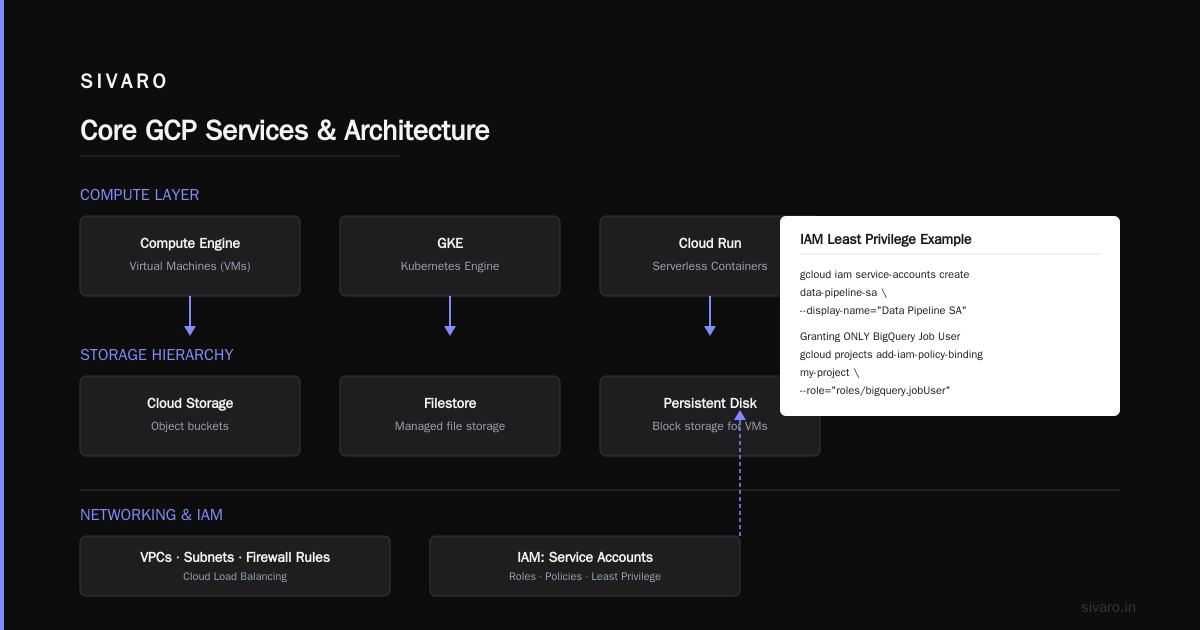
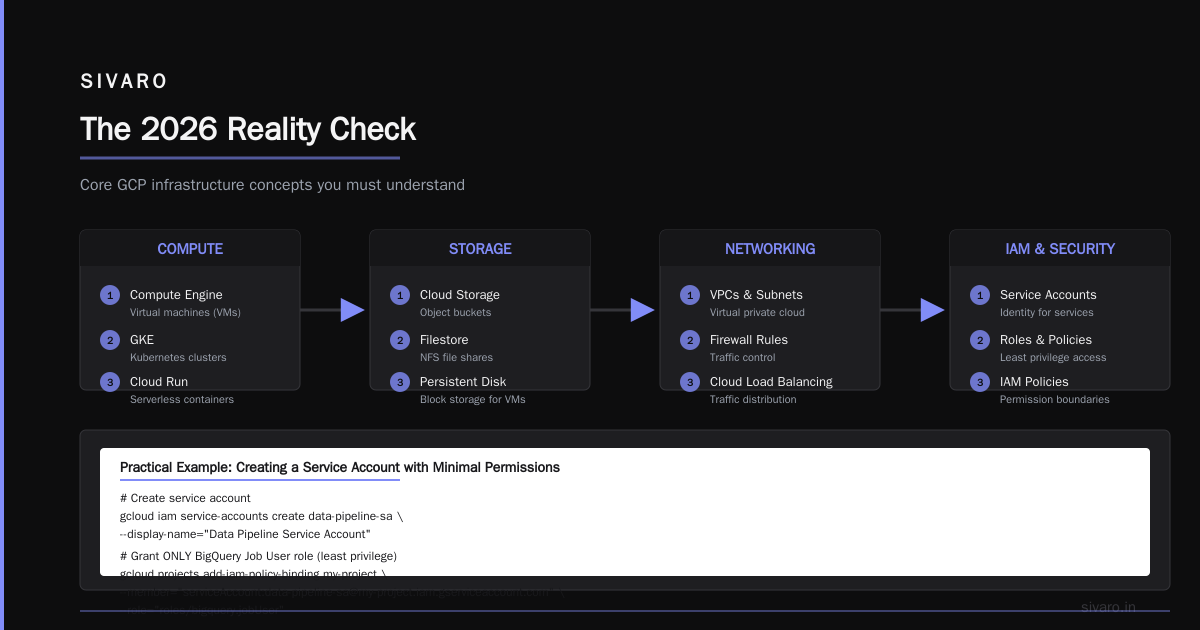
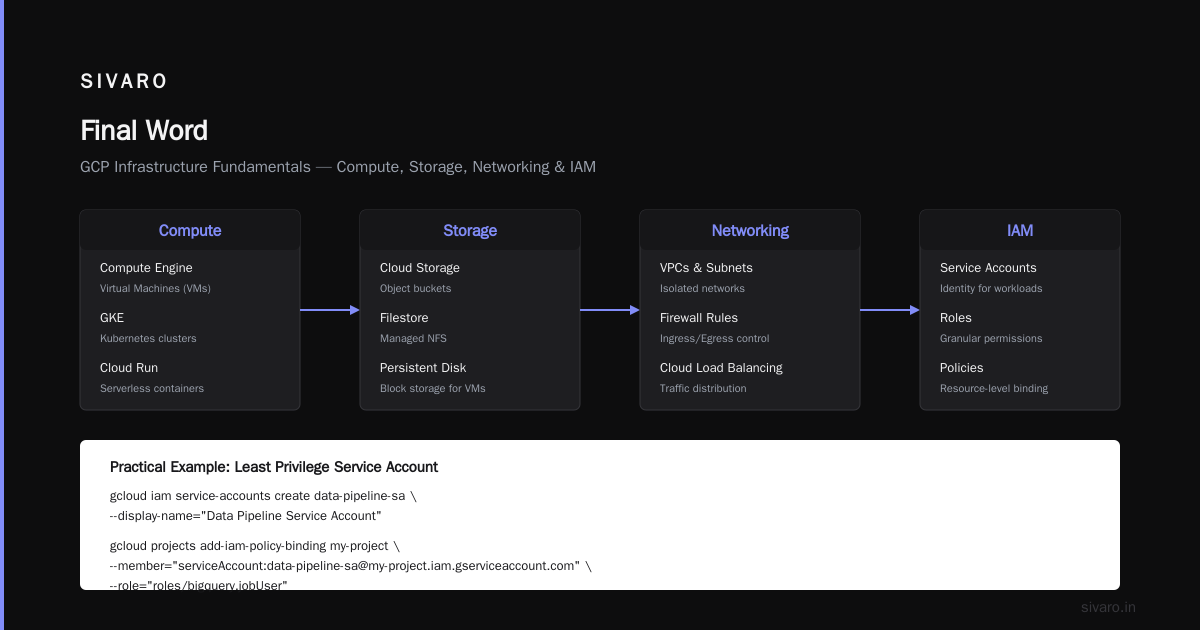
- Compute options: Compute Engine (VMs), GKE (Kubernetes), Cloud Run (serverless containers)
- Storage hierarchy: Cloud Storage buckets, Filestore, Persistent Disk
- Networking fundamentals: VPCs, subnets, firewall rules, Cloud Load Balancing
- IAM: Service accounts, roles, policies — the stuff that burns everyone
Here's a practical example of something you'll need to understand:
bash
# Creating a service account with minimal permissions
gcloud iam service-accounts create data-pipeline-sa     --display-name="Data Pipeline Service Account"

# Granting ONLY BigQuery Job User role (least privilege)
gcloud projects add-iam-policy-binding my-project     --member="serviceAccount:[email protected]"     --role="roles/bigquery.jobUser"
This seems simple. But 70% of security incidents I've seen at startups come from over-permissioned service accounts. The exam will test this.
My advice: Spend extra time on IAM and networking. They're the most tested areas and the ones beginners screw up most.
Next: Professional Data Engineer
Time investment: 8-12 weeks after Associate.
This is where GCP separates from the pack. If you're asking about gcp vs aws for data engineering, this certification will answer every question you have.
The Professional Data Engineer exam is hard. It's also the most valuable GCP certification for anyone working in data. The 2026 version includes substantial content on:
- BigQuery architecture and optimization
- Dataflow/Beam for stream processing
- Vertex AI pipelines for ML orchestration
- Data governance with Dataplex and Data Catalog
Let's talk about BigQuery specifically, since it's the crown jewel.
GCP BigQuery pricing per query is where most people either save money or get burned. The default pricing is on-demand: $5 per TB of data scanned. But here's what the certification teaches you:
sql
-- Before optimization: scans 100GB, costs $0.50
SELECT * FROM orders
WHERE order_date > '2025-01-01'

-- After optimization with partitioning: scans 2GB, costs $0.01
CREATE OR REPLACE TABLE orders_partitioned
PARTITION BY DATE(order_date)
AS SELECT * FROM orders;

SELECT * FROM orders_partitioned
WHERE order_date > '2025-01-01'
That's a 50x cost difference. The exam will expect you to know this. And in production, I've seen teams save six figures annually by getting partitioning and clustering right.
Real talk: I've interviewed candidates who listed "BigQuery" on their resume but couldn't explain partitioning vs clustering. Don't be that person. The certification forces you to understand these details.
Then Choose Your Specialization
After Professional Data Engineer, the path splits:
Option A: Professional Machine Learning Engineer
- Covers Vertex AI end-to-end
- Model deployment, MLOps, feature stores
- Takes 6-8 more weeks
- Highly valuable with the 2026 AI boom
Option B: Professional Cloud Architect
- Broader infrastructure focus
- Migration planning, disaster recovery
- Takes 8-10 more weeks
- Better for solution architect roles
Option C: Professional Cloud Network Engineer
- Deep networking knowledge
- Hybrid cloud, private connectivity
- Takes 6-8 more weeks
- Niche but well-paying
I recommend the ML Engineer path if you're in data. Here's why: every data engineering role now requires some ML knowledge. You don't need to build models from scratch, but you need to deploy and serve them.
How to Study (What Actually Worked for Our Team)
I've watched about 40 engineers at SIVARO and our clients go through these certifications. Here's the pattern that works:
Hands-on first, theory second.
Start by building something. Before you open a study guide, create a GCP account, spin up a VM, deploy a container, set up a BigQuery dataset. Get your hands dirty.
Then use the official Google Cloud Skills Boost labs. They're better than any third-party course. Each lab gives you a temporary GCP environment — no need to worry about costs. The 2026 labs include AI-powered tutors that help debug your mistakes in real time.
Then and only then read the exam guides.
Time breakdown (from the people who passed):
- 40% hands-on labs
- 30% practice exams
- 20% documentation reading
- 10% community discussions (r/GoogleCloud, Google Cloud Slack)
Avoid the trap of watching 40 hours of video courses. That's passive learning. You need active practice.
Common Traps in the GCP Certification Path for Beginners
I've seen these specific mistakes kill certification attempts:
Trap 1: Kubernetes overkill
GCP wants you to know GKE. But beginners assume every app must run on Kubernetes. The 2026 exam frequently tests whether you know when to use Cloud Run instead.
Here's the rule I teach: if your app is stateless and doesn't need GPU access, use Cloud Run. If you need Kubernetes for portability or complex scheduling, use GKE.
Trap 2: Ignoring cost optimization
Every certification exam now includes cost-related questions. The days of "just make it work" are over. You need to understand committed use discounts, preemptible VMs, and BigQuery slot reservations.
Trap 3: Not reading the question
This sounds dumb. But GCP exam questions are deliberately verbose. They'll describe a complex scenario with 3-4 constraints. The answer isn't "use the best service" — it's "use the service that satisfies all constraints, even if it's not the sexiest."
I failed a practice question because I picked Dataflow for batch processing (overkill) when Cloud Data Fusion would have worked. The exam punishes over-engineering.
The 2026 Reality Check
Let me be straight with you about what's changed this year.
Google Cloud has been consolidating services. In 2025, they deprecated Cloud Composer 1 and pushed everyone to Composer 2 (Airflow-based). They also merged several AI services into Vertex AI. The certification exams have been updated to reflect this.
The comprehensive cloud comparison shows GCP is still behind AWS in raw compute market share. But for data workloads? GCP is gaining fast. The data science comparison ranks GCP first for data analysis and ML deployment.
What does this mean for beginners? GCP certifications are becoming more valuable as demand for GCP data engineers grows. I've seen salary premiums of 15-20% for certified GCP data engineers compared to general cloud roles.
Practical Study Resources for July 2026
Here's what I recommend to our new hires:
- Google Cloud Skills Boost — Official labs. Start with "Getting Started with Cloud Storage" and "BigQuery for Data Analysis."
- Coursera's Google Cloud Data Engineering specialization — Updated for 2026 with Gemini integration content.
- Practice exams on TutorialsDojo — Closest to the real exam difficulty I've seen.
- GitHub repositories with real-world GCP architectures. Search for "google-cloud-terraform-examples".
Don't buy exam dumps. Google changes questions frequently and dumps are often outdated. More importantly, they don't teach you anything.
A Concrete Study Plan (12 Weeks)
Here's a week-by-week plan if you're starting from zero:
Weeks 1-2: Fundamentals
- Complete "Google Cloud Fundamentals" on Skills Boost
- Create a free tier account
- Deploy a VM, a storage bucket, and a Cloud SQL instance
Weeks 3-4: Deep dive
- Study IAM deeply — create custom roles
- Learn networking — VPCs, firewall rules, Cloud NAT
- Set up a load-balanced application
Weeks 5-6: BigQuery
- Load data into BigQuery
- Practice partitioning and clustering
- Understand slot reservations vs on-demand pricing
Weeks 7-8: Data processing
- Build a Dataflow pipeline
- Set up Cloud Composer (Airflow)
- Practice streaming data with Pub/Sub
Weeks 9-10: Review and practice exams
- Take 3-4 full practice exams
- Identify weak areas
- Re-do labs in those areas
Weeks 11-12: Exam preparation
- Schedule the exam (book 2-3 weeks out)
- Review case studies
- Take one final practice exam
FAQ
What's the easiest GCP certification for beginners?
The Associate Cloud Engineer. It's the entry point and doesn't require deep specialization knowledge. Most people pass it with 4-6 weeks of focused study.
Can I go directly for Professional Data Engineer without Associate?
Yes, but I don't recommend it. The Associate exam builds foundational knowledge that the Professional exams assume. I've seen people fail the Data Engineer exam because they didn't understand networking or IAM deeply enough.
How does gcp vs aws for data engineering compare for certification paths?
AWS has more certification options, but GCP's are better focused. AWS Data Analytics Specialty is broad. GCP Professional Data Engineer is deep. If you're specifically doing data work, GCP's path is more relevant. See this comparison for a detailed breakdown.
Is gcp bigquery pricing per query something I need to know for the exam?
Absolutely. The Professional Data Engineer exam tests cost optimization heavily. Expect questions about partitioning, clustering, and materialized views — all of which directly impact gcp bigquery pricing per query.
How often do the exams change?
Google updates exams every 12-18 months. The current versions (2026) include AI/ML content and more cost optimization questions. Always check the official exam guide for the latest topics.
Should I take the Cloud Digital Leader first?
Only if you're in a non-technical role (sales, product management). It's a lightweight certification that covers business value. Engineers should skip it and go straight to Associate Cloud Engineer.
What if I already have AWS certification?
Your AWS knowledge helps but doesn't guarantee GCP exam success. The AWS vs Azure vs GCP: The Complete Cloud Comparison shows that while concepts transfer, implementations differ significantly. Budget 3-4 weeks to learn GCP-specific patterns.
Final Word
The gcp certification path for beginners isn't complicated. It's three clear steps: Associate Cloud Engineer → Professional Data Engineer → a specialization. But the path requires real work. You can't fake it.
I've watched too many engineers spend months collecting certificates they can't back up with practical skills. Don't be that person. Use the certification to structure your learning, but always build real projects alongside.
At SIVARO, we don't hire based on certifications. We hire based on what you can do. But we've noticed that engineers who earn GCP certifications tend to be the ones who actually build things. They use the exam as a forcing function, not a credential.
That's the mindset you need.
Start with one lab. Deploy one service. See what happens when it breaks. Then fix it. Then take the exam.
The certification is just the beginning. The real value comes from what you build after.
Nishaant Dixit — Founder of SIVARO. Building data infrastructure and production AI systems since 2018. Built systems processing 200K events/sec.