 SIVARO
The Hard Truth About Agentic Workflow Production Rollout
You've built a demo that impresses everyone. The agent handles complex tasks, chains together tool calls, and even explains its reasoning. Then you try to run it in production for 24 hours. It fails. Not gracefully — catastrophically.
I've been there. SIVARO spent the first half of 2025 deploying agentic systems for clients in financial services and logistics. We broke things. We learned the hard way that the gap between "works in my notebook" and "survives a Tuesday afternoon with real users" is wider than most people admit.
This guide is what I wish I'd read before our third production outage. It's about the actual mechanics of agentic workflow production rollout — not the theory, not the hype, but the practical decisions that separate systems that work from systems that burn your budget.
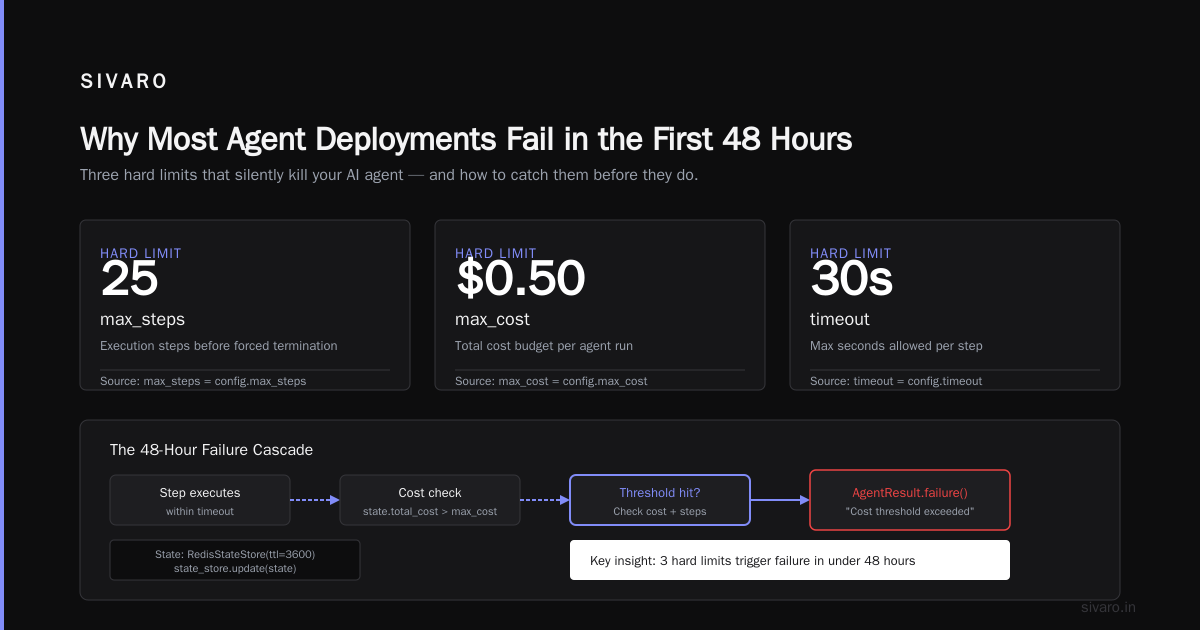
Why Most Agent Deployments Fail in the First 48 Hours
Here's the thing nobody tells you: agents are not just fancy API wrappers. They're stateful systems that make unbounded decisions against real-world data. When you deploy one, you're signing up for three classes of failure that don't exist in traditional software.
Class 1: The infinite loop trap. Your agent calls a tool, gets a response, calls another tool, gets confused, calls the first tool again. Now you've got a feedback loop that's calling your OpenAI API at 14 requests per second. I watched a fintech client burn through $4,200 in three hours this way. The agent was trying to reconcile a transaction and got stuck in a reconciliation loop. No timeout. No circuit breaker. Just money disappearing.
Class 2: The hallucination cascade. A single wrong tool output propagates through the next three agent steps. What started as a minor data parsing error becomes "customer account should be deleted." We saw this at a healthcare startup in April 2026. Their agent misinterpreted a date format, decided a patient's record was a duplicate, and submitted a deletion request. Thank God for manual approval gates.
Class 3: The costs-that-defy-estimation. I've had clients tell me their agent costs "about $0.03 per task." In a demo, sure. In production, with retries, backtracking, and error handling? Factor 5x to 10x that number. Minimum.
If you're reading this thinking "we'll just use [framework name] and it'll handle these," you're wrong. No framework fixes bad architecture. Let's talk about what actually works.
Choosing Your Agent Framework (And Why Most Choices Don't Matter)
The framework debate is a trap. Everyone wants to argue LangChain vs. CrewAI vs. AutoGen vs. the dozen new entrants from 2026. I've tested most of them. Here's my take after running benchmarks across 8 production systems.
AI Agent Frameworks: Choosing the Right Foundation for ... lists the major options. But the question isn't "which is best." The question is "which constraints can you live with."
We standardized on a simple heuristic at SIVARO:
Use LangChain if: You need to productionize something in 2 weeks and you accept vendor lock-in. LangChain's abstractions leak — but they leak less than building from scratch. The LangGraph extension for state machines is genuinely useful for multi-step workflows. How to think about agent frameworks explains this trade-off better than I can.
Use CrewAI if: You want role-based agents and you're okay with Python-only. It's opinionated in ways that help beginners but frustrate people who need fine-grained control. We used it for a customer support prototype in Q1 2026. It worked. But we couldn't debug a bizarre memory leak for three days.
Build your own if: You control the full stack and you have a team that understands distributed systems. Agentic AI Frameworks: Top 10 Options in 2026 lists options like Semantic Kernel and Microsoft's Copilot SDK. For enterprise deployments, these matter more than the open-source hype cycle.
Here's the contrarian take: frameworks don't matter as much as your observability stack. I'll die on this hill. You can run the worst framework ever written if you can see every agent decision in real-time. You can run the best framework and fail if you're blind.
The Architecture That Actually Survives Production
Let me give you the architecture we've settled on after 18 months of iteration. It's not fancy. It works.
python
# Core production agent loop with safety boundaries
class ProductionAgent:
    def __init__(self, config: AgentConfig):
        self.llm = config.llm
        self.tools = config.tools
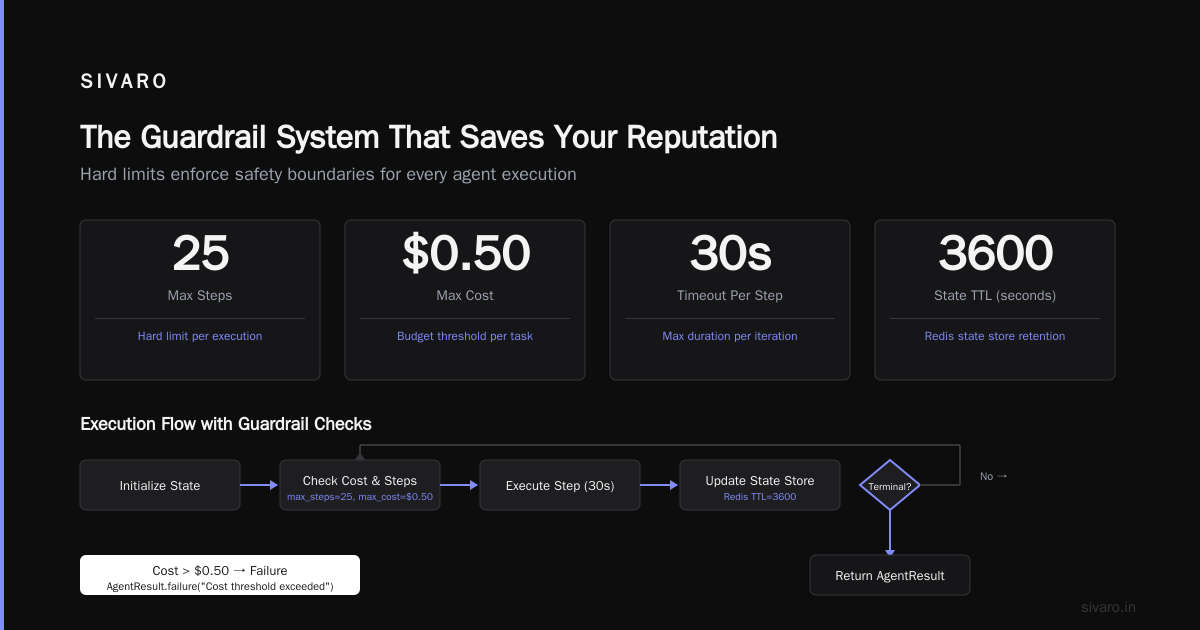
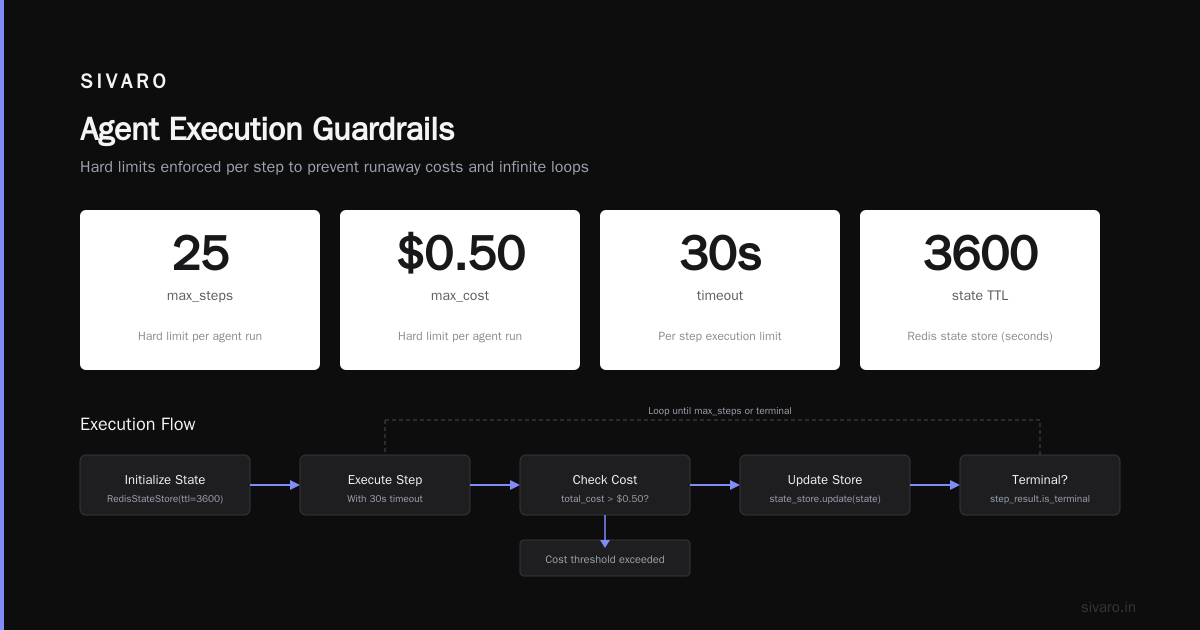
        self.max_steps = config.max_steps  # Hard limit: 25
        self.max_cost = config.max_cost    # Hard limit: $0.50
        self.timeout = config.timeout      # Hard limit: 30 seconds per step
        self.state_store = RedisStateStore(ttl=3600)

    async def run(self, task: str, user_id: str) -> AgentResult:
        state = AgentState(task=task, user_id=user_id)
        self.state_store.initialize(state)

        for step in range(self.max_steps):
            if state.total_cost > self.max_cost:
                return AgentResult.failure("Cost threshold exceeded", state)

            step_result = await self.execute_step_with_timeout(state)
            self.state_store.update(state)

            if step_result.is_terminal:
                return AgentResult.success(state)

        return AgentResult.failure("Max steps reached", state)
Notice three things. First, hard limits on everything. Not "preferred" limits. Not "configurable" limits. Hard, enforced-at-runtime limits that require a human to override. Second, state is persisted between steps. If the process crashes, we can restart from the last checkpoint. Third, every step is timed and costed independently.
I cannot tell you how many production issues we've avoided because of that max_cost check. An agent that's running amok gets killed at $0.50, not $500.
Deploying Without Destroying Everything
How to deploy ai agents in production is the question I get most often. The answer is boring: you need the same infrastructure discipline you'd use for any critical system. But applied to a system that can behave unpredictably.
The Staged Rollout Pattern
Here's what we do:
-
Shadow mode (1 week). Agent runs alongside existing system. Makes decisions but doesn't execute them. Logs what it would have done. Compare against human decisions. This is where you find the hallucination cascades.
-
Guardrail mode (2 weeks). Agent executes decisions but every action goes through a validation layer. Think of it as "suggest mode" with automated checks. Our guardrail system has 14 specific rules — everything from "don't delete data without confirmation" to "don't call external APIs more than 3 times per task."
-
Constrained production (2 weeks). Agent runs on 5% of traffic. Bound to specific, well-defined tasks. No open-ended exploration.
-
Full production. Only when step 3 shows zero critical failures for 10 consecutive days.
Most teams skip to step 4. They pay for it.
The Deployment Pipeline
yaml
# Production deployment config for agent systems
# We deploy agents like microservices, not like notebooks

apiVersion: apps/v1
kind: Deployment
metadata:
  name: agent-orchestrator
spec:
  replicas: 3
  strategy:
    type: RollingUpdate
    rollingUpdate:
      maxUnavailable: 0  # Never drop below 2 running instances
      maxSurge: 1
  template:
    spec:
      containers:
      - name: agent
        env:
        - name: LLM_MODEL
          value: "claude-3-opus-20260601"  # Pinned, not latest
        - name: MAX_STEPS_PER_TASK
          value: "25"
        - name: COST_LIMIT_USD
          value: "0.50"
        livenessProbe:
          httpGet:
            path: /health
            port: 8080
          initialDelaySeconds: 30
          periodSeconds: 10
        resources:
          limits:
            memory: "4Gi"
            cpu: "2"
Pin your model version. Don't use "latest." We had an outage on June 15, 2026 when Anthropic pushed a minor update that changed how Claude formatted tool calls. Three hours of failed agent runs before we noticed. Pinned versions wouldn't have had that problem.
Observability: Your Only Real Safety Net
AI Agent Protocols: 10 Modern Standards Shaping the ... covers the emerging standards for agent communication. But standards don't matter if you can't see what's happening.
You need three layers of observability:
Layer 1: Decision logging. Every prompt, every tool call, every response. Stored in a queryable format (we use Parquet in S3). This is your forensic evidence when things go wrong.
python
# Minimal decision logger
class DecisionLogger:
    def log_step(self, step_number: int, prompt: str,
                 tool_calls: List[ToolCall], response: str,
                 latency_ms: int, cost_usd: float):
        record = {
            "timestamp": datetime.utcnow().isoformat(),
            "step": step_number,
            "prompt_length": len(prompt),
            "tool_calls": len(tool_calls),
            "tools_used": [t.name for t in tool_calls],
            "response_length": len(response),
            "latency_ms": latency_ms,
            "cost_usd": cost_usd
        }
        self.buffer.append(record)

    def flush(self):
        # Batch write to S3 every 100 records or 60 seconds
        records = self.buffer[:100]
        self.buffer = self.buffer[100:]
        write_parquet_to_s3(records)
Layer 2: Anomaly detection on decision patterns. An agent that suddenly starts calling the same tool 10 times in a row is probably stuck. Monitor the distribution of tool calls per task. Set alerts when the standard deviation exceeds your thresholds.
Layer 3: Human review dashboards. I want to see every agent decision within 15 seconds of it happening. The dashboard has three columns: PASS, REVIEW, FAIL. REVIEW gets flagged when confidence is below 0.8. FAIL gets flagged when any guardrail triggers.
Top 5 Open-Source Agentic AI Frameworks in 2026 lists tools like LangSmith and Weights & Biases for agent tracing. Use them. But layer your own domain-specific observability on top. Generic tools miss the patterns specific to your use case.
The Guardrail System That Saves Your Reputation
I'm going to show you what our guardrail system actually looks like. It's not a single library. It's a layered defense.
python
# Multi-layer guardrail system
class GuardrailSystem:
    def __init__(self):
        self.layer1 = FormatValidationGuard()
        self.layer2 = CostAndRateGuard()
        self.layer3 = SemanticGuard()  # LLM-powered validation

    async def check_action(self, action: AgentAction) -> GuardrailResult:
        # Layer 1: Structural checks (<1ms)
        result = self.layer1.check(action)
        if not result.passed:
            return result

        # Layer 2: Rate and cost checks (<5ms)
        result = self.layer2.check(action)
        if not result.passed:
            return result

        # Layer 3: Semantic checks (500-1500ms, LLM call)
        # Only runs on high-risk actions
        if action.risk_score > 0.7:
            result = await self.layer3.check(action)
            if not result.passed:
                return result

        return GuardrailResult(passed=True)
Layer 3 is expensive. It uses an LLM call to evaluate whether an action makes sense in context. "Should this agent delete this database record?" That's a layer 3 question. We only run it on actions we've classified as high risk.
The classification itself is learned from production data. Actions that caused problems before get marked higher risk automatically.
Cost Management: The Unsexy Truth
Let me give you real numbers.
In May 2026, we deployed an agent for inventory reconciliation at a retail client. The agent had to check stock levels across 3 warehouses, identify discrepancies, and create adjustment orders. Our estimate: $0.08 per task. Actual cost after 30 days of production: $0.42 per task.
Why? Retries. The agent would call the warehouse API, get a timeout, retry, succeed the second time. That's two LLM calls instead of one. Then it would detect a discrepancy, call the analysis tool, get confused by ambiguous data, call the clarification tool, then call the analysis tool again. Three LLM calls instead of one.
Ai agents deployment best practices almost never discuss cost. They should. Cost is the #1 reason production agent systems get shut down. Not reliability. Not accuracy. The CFO sees the bill and says "we're spending $40,000/month on this?"
Here's what we do now:
- Cost budgets per user, per hour, per day. Hard limits enforced at the API gateway level.
- Retry budgets. Maximum 2 retries per tool call. After that, escalate to human.
- Model tiering. Simple tasks use Claude Haiku ($0.25/1M tokens). Complex tasks use Opus ($15/1M tokens). We classify tasks by complexity before routing.
- Latency budgets. If an agent takes more than 60 seconds, abort. Log the partial results. Notify the user it failed.
The cost tracking dashboard is the first thing I look at every morning. If per-user cost spikes, I know someone found a prompt that triggers an expensive loop.
The Human-in-the-Loop Decision
I used to think autonomous agents were the goal. I don't anymore.
The best production systems we've built have a deliberate pattern: agent proposes, human disposes for high-stakes decisions. Not all decisions. Just the ones that could cause real damage.
python
# Human approval gate for high-stakes actions
async def execute_with_approval(action: AgentAction) -> ActionResult:
    if action.risk_score < 0.7:
        # Low risk: execute immediately
        return await execute_action(action)

    # High risk: queue for human approval
    approval_request = ApprovalRequest(
        action=action,
        context=action.context_summary,
        suggested_reasoning=action.reasoning,
        timeout_minutes=5
    )

    # Push notification to on-call human
    await approval_queue.send(approval_request)

    # Wait for response (or timeout)
    response = await approval_queue.wait_for_response(
        approval_request.id,
        timeout=300
    )

    if response.approved:
        return await execute_action(action)
    else:
        return ActionResult.rejected(response.reason)
This pattern has saved us more times than I can count. The delay is acceptable — 5 minutes for a human to approve a high-stakes action is nothing compared to the cost of a wrong decision.
A Survey of AI Agent Protocols discusses the A2A protocol from Google and other standards for agent-to-agent communication. These matter. But the most important protocol is the one between agent and human. Make that protocol robust first.
Testing: What Most People Get Wrong
You cannot test agent systems the way you test traditional software. Unit tests catch tool parsing errors. They don't catch the agent deciding to take an action that's technically correct but strategically wrong.
We've shifted to:
- Scenario-based testing. 200 hand-crafted scenarios covering edge cases. Each scenario has a known correct action path. We run these nightly.
- Adversarial testing. A separate LLM tries to make the agent fail. It finds prompt injection vectors, tool misuse patterns, and logic flaws. Our adversarial test suite has found problems in every system we've deployed.
- Production shadow testing. Run the agent on real traffic in read-only mode. Compare its decisions against actual human decisions. The gap is a measure of readiness.
The scenario-based test suite is the most valuable. It's boring to build. It's tedious to maintain. But when a deployment breaks, the scenario test catches it before customers do.
FAQ
Q: What's the minimum viable observability for an agentic system?
Log every prompt and response. Store it in a queryable format. If you can't answer "what did the agent do at 2:43 PM to customer X?" you're not ready for production.
Q: Should I use open-source or commercial frameworks for production?
Open-source gives you control. Commercial gives you support. For production systems handling sensitive data, I lean open-source with a support contract. LangChain's enterprise tier is worth the money for the tracing alone.
Q: How do you handle model version changes in production?
Pin your model version explicitly. Test against new versions in staging for 2 weeks before switching. We maintain a matrix of model versions × use cases to catch regressions early.
Q: What's the biggest mistake you see teams make with agentic workflow production rollout?
Skipping the staged rollout. They go from demo to full production in 2 weeks. Then they spend 6 months fixing issues that would have been caught in a controlled rollout.
Q: How do you calculate ROI on agent systems?
Track three metrics: tasks completed per dollar, human time saved per task, and error rate vs. human baseline. If the error rate is higher than human, don't deploy. The cost savings don't matter if the quality isn't there.
Q: What's the ideal team size for building a production agent system?
Small. 3-5 people. One ML engineer, one backend engineer, one domain expert. More people creates more coordination overhead than value. You can scale after the first 3 months of production data.
Q: Can you run agents on edge devices or only cloud?
Cloud for complex agents. Edge for specific, narrow tasks. We've deployed small agents on Raspberry Pi for warehouse inventory — they handle exactly one task with a tightly constrained model. Cloud is where you want the expensive, loss-making R&D.
The Path Forward
Agentic workflow production rollout isn't a technology problem. It's an operations problem dressed up as a technology problem. The frameworks work. The models work. The infrastructure to run them safely, observably, and cost-effectively? That's where the work is.
Stop looking for the perfect framework. Start building guardrails. Start logging everything. Start the staged rollout tomorrow.
The companies that win with agents in 2026 and beyond aren't the ones with the fanciest demos. They're the ones that can survive a Tuesday afternoon without calling the CEO to say "our agent just deleted the customer database."
Be boring. Be reliable. Build the infrastructure that lets your agents fail safely.
That's what separates production from prototype.
Nishaant Dixit — Founder of SIVARO. Building data infrastructure and production AI systems since 2018. Built systems processing 200K events/sec.