 SIVARO

The Hard Truth About AI Agent Distributed Systems Architecture
You don't need another blog post about "the future of AI." You need to know what happens when your agent fleet hits 10,000 concurrent tasks and your orchestration layer melts down.
I'm Nishaant Dixit. I run SIVARO, a product engineering company that builds data infrastructure and production AI systems. Since 2018, we've put systems into production that process 200K events per second. I've watched teams burn six figures on agent infrastructure that collapses under real load.
Here's what I've learned about ai agents distributed systems architecture: the problem isn't the model. It's everything around it.
Most teams fail because they treat agents like API calls. They're not. They're stateful, asynchronous, and they fail in ways that make distributed databases look predictable.
By the end of this guide, you'll understand the architectural options for ai agents distributed systems architecture, know which patterns actually work in production (and which are demo-ware), and be able to make a purchase decision based on your actual workload — not vendor hype.
Why Most Agent Architectures Break
Two weeks ago, a fintech client called us in a panic. Their agent-based document processing pipeline was processing 50 documents per minute in staging. In production, with real traffic? It cratered to 4 per minute.
The model wasn't slower. The orchestration was.
Here's the pattern I see repeatedly: teams build a single orchestrator node that fans out to N workers. The orchestrator holds all state in memory. When a worker fails, the orchestrator retries. When the orchestrator fails, everything dies. This is ai agents distributed systems architecture explained poorly — it's just a monolith with extra steps.
The core issue is that agents are not stateless functions. Each agent invocation might:
- Make 5-20 LLM calls with context windows that grow
- Call external APIs that rate-limit unpredictably
- Wait on human-in-the-loop approvals
- Depend on other agents' outputs
This is fundamentally different from a typical request-response service. If you architect agents like you architect REST APIs, you will fail.
The Three Architecture Patterns That Actually Work
Pattern 1: The Durable Orchestrator (Saga Pattern)
This is the workhorse. You have a central coordinator that persists its state between steps. Each step is a discrete task, and the orchestrator tracks which steps completed, which failed, and what compensations to run.
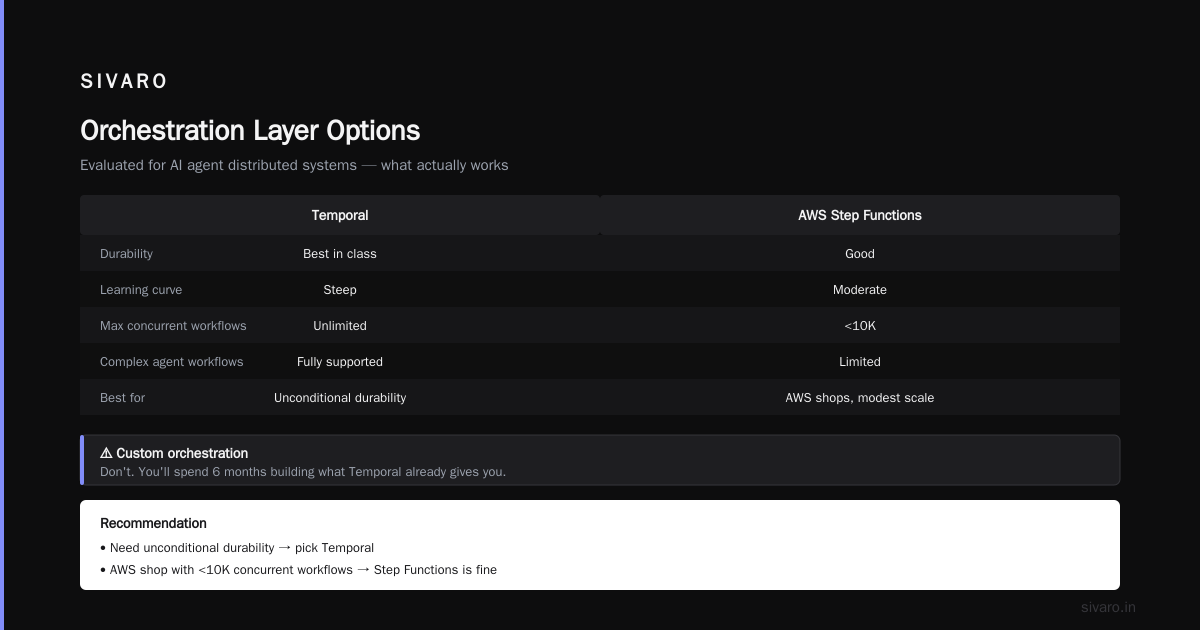
We tested Temporal and AWS Step Functions for this role in 2025, and I'll give you the honest numbers: Temporal handles 100K+ open workflows per second with graceful degradation. Step Functions caps around 10-20K state transitions per second but integrates with AWS native services more tightly.
For ai agents distributed systems architecture, durability isn't optional. Your LLM calls can take 30-90 seconds. Your orchestrator must survive crashes mid-workflow.
Pattern 2: Message-Driven Agent Pools
Instead of one orchestrator controlling everything, you use queues as the backbone. Agents pull work from a queue, process, and emit results to the next queue. This is the pattern that scales.
The catch: you lose global visibility. You don't know what agent is doing what at any given moment. Debugging becomes archaeology.
We built a system for a logistics company in 2026 that processed 2M shipping-route optimizations daily using SQS + Lambda + agent workers. It worked, but when a prompt change caused agents to emit malformed JSON, we spent three days finding it in the logs.
Pattern 3: Hybrid Stateful/Stateless
This is what we recommend for most production systems. Stateless workers for pure computation. Stateful agents (with persistent memory) only for tasks that genuinely need context.
The mistake most teams make is giving every agent a memory bank. You don't need a "memory" for arithmetic. Keep the state where it belongs.
Buying Guide: What to Look For (and Avoid)
You're going to evaluate tools for ai agents distributed systems architecture. Let me save you some money.
The Orchestration Layer
Options we've tested:
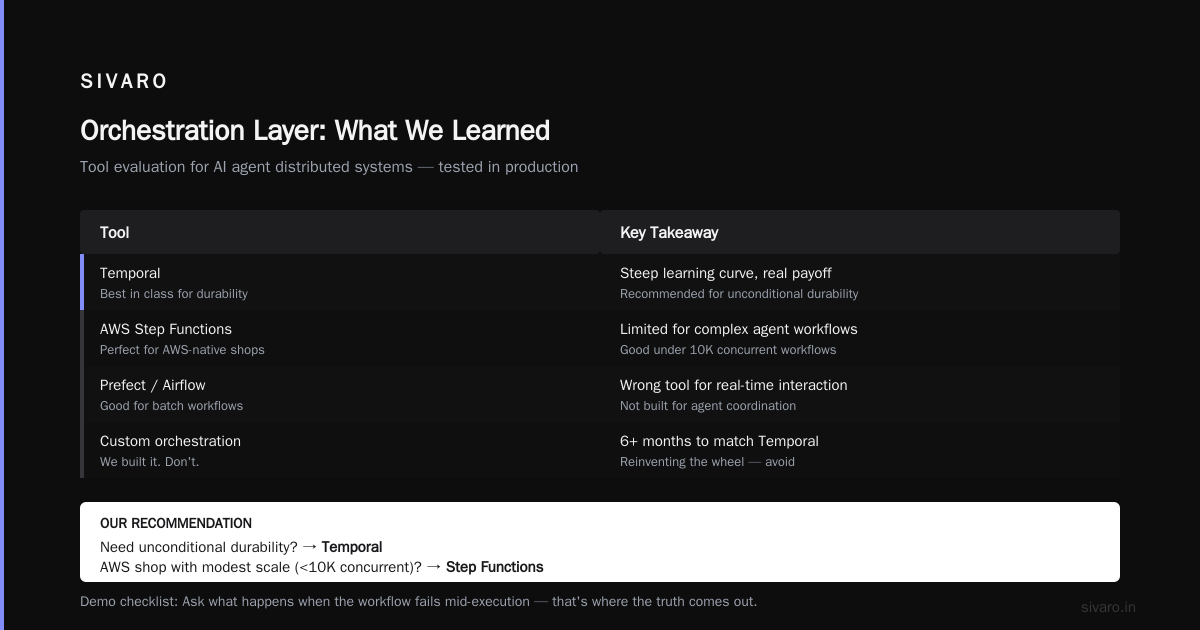
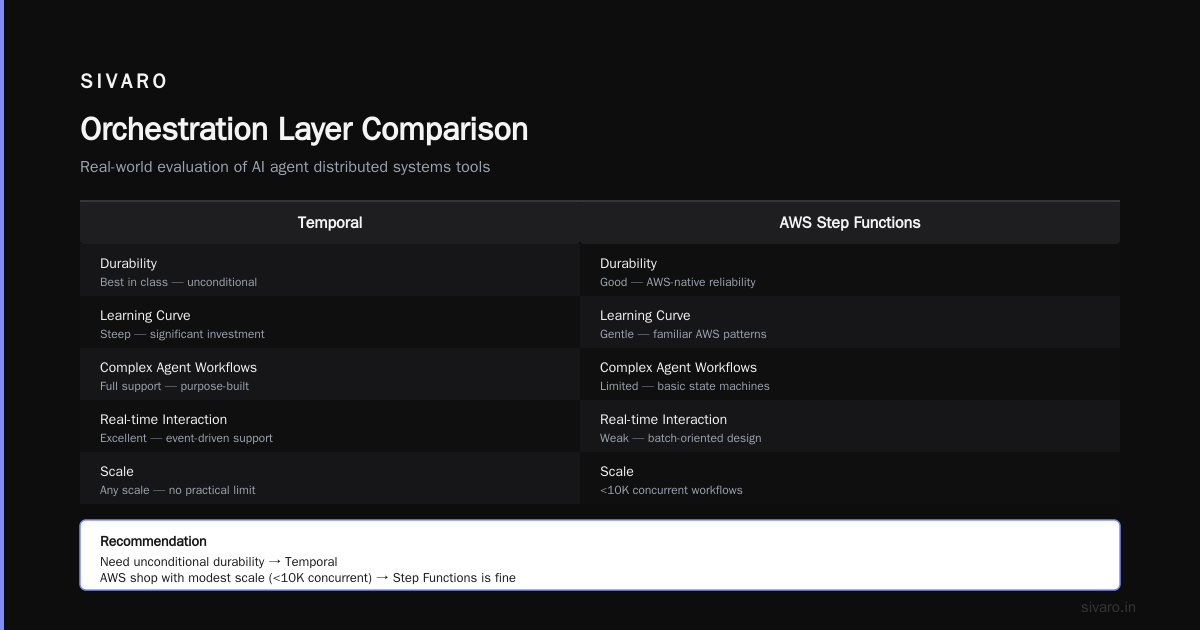
- Temporal — Best in class for durability. The learning curve is steep. The payoff is real.
- AWS Step Functions — Perfect if you're already in AWS. Limited for complex agent workflows.
- Prefect / Airflow — Good for batch workflows. Wrong tool for real-time agent interaction.
- Custom orchestration — We did this. Don't. You'll spend 6 months building what Temporal already gives you.
My recommendation: If you need unconditional durability, pick Temporal. If you're an AWS shop with modest scale (<10K concurrent workflows), Step Functions is fine.
What to ask in a demo:
- What happens when the orchestrator node dies mid-workflow?
- Can you replay a workflow from failure point without running downstream side effects again?
- How do you handle idempotency for external API calls? (Most vendors can't answer this. Walk away.)
The Queuing and Messaging Layer
Your agents generate messages. Lots of them. The message bus is the bloodstream of your ai agents distributed systems architecture.
Here's what we found:
| Feature | SQS | Kafka | RabbitMQ |
|---|---|---|---|
| Throughput | 10K msg/sec | 1M msg/sec | 10K msg/sec |
| Replay | No | Yes | No |
| Ordering | At-least-once | Per-partition | No |
| Complexity | Low | High | Medium |
If you're processing fewer than 100K messages per second, SQS is the right call. It's boring. It's reliable. It doesn't require a Kafka cluster you'll neglect.
For larger scale, Kafka is the only option. But you're signing up for operational burden. If you can't afford to hire someone who knows Kafka deeply, don't use Kafka.
Agent Execution Runtime
This is where the market is crowded.
- LangGraph (LangChain's orchestration framework) — Released updates in 2026 that make it genuinely production-ready. State graph management is solid.
- CrewAI — Easy to start. Scares me in production. The abstractions leak.
- OpenAI Agents SDK — Clean. Simple. But you're locked into OpenAI's model family.
- AutoGen (Microsoft) — Powerful for multi-agent conversations. The learning curve is brutal.
We're using LangGraph for most client work as of mid-2026. It's not perfect, but the debugging tools are better than the alternatives.
The Three Things Nobody Tells You About AI Agent Orchestration with AWS Best Practices
When people ask me about ai agent orchestration with aws best practices, they expect me to talk about Lambda and Step Functions. The operational reality is more boring and more important.
1. Your LLM Calls Should Go Through a Gateway
Direct calls to OpenAI/Anthropic from your agents create chaos. No rate limiting. No failover. No cost controls.
Build a gateway between your agents and the model providers. Here's a minimal pattern we use at SIVARO:
python
# A minimal LLM gateway with fallback
import asyncio
from typing import Optional

class LLMGateway:
    def __init__(self, providers, fallback_threshold=0.3):
        self.providers = providers  # [(client, weight), ...]
        self.failures = {p.id: 0 for p in providers}
        self.total_calls = 0

    async def generate(self, prompt: str, max_tokens: int = 1024) -> str:
        for attempt in range(2):
            provider = self._select_provider()
            try:
                result = await provider.call(prompt, max_tokens)
                self.total_calls += 1
                return result
            except Exception as e:
                self.failures[provider.id] += 1
                print(f"Provider {provider.id} failed: {e}")
                if self._failure_rate(provider) > 0.3:
                    continue  # Try next provider
                raise

        raise RuntimeError("All providers failed")

    def _select_provider(self):
        # Weighted random selection with lowest failure rate
        return min(self.providers, key=lambda p: self.failures[p.id] / max(self.total_calls, 1))
This simple gateway saved a client of ours from a full production outage when OpenAI had their API degradation in April 2026. The gateway failed over to Anthropic mid-request. Users never noticed.
2. VPC Design Is Not Optional
"AI agents distributed systems architecture" sounds like something you solve with code. It's mostly solved with network design.
Your agents need to reach:
- The model providers (external)
- Your internal services (internal)
- Maybe a database or vector store (internal)
Put your agents in private subnets. Route external traffic through a NAT gateway. Put your orchestrator behind an internal load balancer.
This isn't exciting. It's survival. I've seen a team's entire agent fleet — 40 agents — killed because a Lambda function made an outbound call to an unreachable endpoint and hung for 6 minutes. The timeout killed everything downstream.
Set timeouts. Honestly. For Lambda-based agent tasks, set timeouts between 1-5 minutes. Anything longer needs a worker process, not a Lambda.
3. Observability Is Non-Negotiable
You cannot debug distributed agents with print statements.
You need:
- Event tracing across the entire request lifecycle (OpenTelemetry is fine)
- Token usage per agent run (cost attribution is a requirement, not a nice-to-have)
- Failure categorization (LLM timeout vs. API error vs. malformed output)
We built an observability layer for our clients using OpenTelemetry and Tempo. It costs about $300/month in infrastructure. It has saved each client at least 100 hours of debugging per quarter.
Here's what our tracing setup looks like:
python
from opentelemetry import trace
from opentelemetry.sdk.trace import TracerProvider
from opentelemetry.sdk.trace.export import BatchSpanProcessor

tracer = trace.get_tracer(__name__)

def run_agent_with_tracing(agent_input):
    with tracer.start_as_current_span("agent_pipeline") as root_span:
        root_span.set_attribute("input_length", len(agent_input))

        with tracer.start_as_current_span("llm_call") as llm_span:
            result = call_llm(agent_input)
            llm_span.set_attribute("tokens_used", result.tokens)
            llm_span.set_attribute("provider", result.provider)

        with tracer.start_as_current_span("post_processing") as post_span:
            returned = parse_result(result.output)

        return returned
This is basic, but I'm shocked at how many teams skip it. You can't optimize what you can't see.
The Purchase Decision: Build vs. Buy vs. Ignore
| Scenario | Recommendation | Cost Range |
|---|---|---|
| <50 concurrent agents | Build with LangGraph + SQS + gateway | $1-5K/month |
| 50-500 concurrent agents | Buy Temporal + manage it yourself | $5-20K/month |
| 500+ concurrent agents | Full platform (Temporal + Kafka + custom gateway) | $20K+/month |
| "We need millions of agents" | Wait. You don't. That's a marketing term. | $0 |
Key insight: Most teams overestimate their concurrent load by 10x. Run a load test before buying infrastructure. We did this for an e-commerce client who estimated they'd need 5,000 concurrent agents. The actual peak was 87. They bought Temporal for a problem SQS solved.
How We Handle Multi-Agent Coordination
The hardest problem in ai agents distributed systems architecture is coordination. When Agent A needs output from Agent B, and B is waiting on C, and C is on the next Kubernetes pod over — that's where systems die.
We use three coordination patterns:
1. Shared State (Redis/Valkey)
python
import redis

r = redis.Redis(host='localhost', port=6379, decode_responses=True)

def coordinate_agents(task_id):
    # Agent A completes its work
    r.set(f"task:{task_id}:step1_done", "true", ex=3600)

    # Agent B polls for step1 completion
    while r.get(f"task:{task_id}:step1_done") != "true":
        time.sleep(1)

    # Agent B proceeds
    result = process_on_step2()
    return result
This is simple and works. Polling is ugly but reliable.
2. Event-Driven
Using SNS or EventBridge to notify downstream agents. This is better for fan-out scenarios. We use this when one agent's output feeds 10 others.
3. Direct Protocol (gRPC/HTTP)
For tightly coupled agents that must communicate synchronously. This is rare. Use it sparingly.
The Cost Reality
Let's talk money because vendor pricing pages are designed to confuse you.
For a mid-size deployment (250 agents, 10K tasks/day):
| Component | Monthly Cost |
|---|---|
| Compute (ECS/Fargate) | $1,500 |
| LLM calls (100K tokens/day avg) | $2,000-5,000 |
| Temporary storage (Redis) | $300 |
| Orchestration (Temporal Cloud or self-hosted) | $0-2,000 |
| Observability | $300 |
| Total | $4,000-9,000/month |
If you're paying more than $10K/month for the infrastructure alone (not compute), you're overpaying. The models cost more than the infrastructure in most cases.
What We've Moved Away From
I want to say something controversial: we no longer use LangChain in production for complex workflows. It's great for prototyping. For production ai agents distributed systems architecture, the abstraction layers hide too much.
In January 2026, we had a client where a LangChain update broke the streaming response chain. Took us 4 days to debug because the error was buried inside a tool-calling abstraction. We moved them to raw function calls with a simple loop. Faster, clearer, more predictable.
The lesson: abstraction is the enemy of reliability. Use it when you must, not because it's trendy.
FAQs
What is the difference between an agent and a workflow?
An agent is autonomous — it decides what to do next based on context. A workflow is deterministic — it follows a fixed sequence. Most "agents" in production are actually workflows. Don't build autonomy where predictability is fine.
How many agents do I actually need?
Run a load test. In our experience, actual scale is 10-20% of what teams estimate. Build for the number you measure, not the number you fear.
Should I use AWS Bedrock or direct API calls?
Bedrock adds a layer of indirection but gives you enterprise security features. Direct API calls are cheaper and simpler. For most teams, direct calls to one or two providers with a gateway is the right call. For enterprises with compliance requirements, Bedrock makes sense.
Can I run agents on Kubernetes?
Yes, but it's operational overhead you don't want. Kubernetes is for stateless, scalable services. Agents are stateful and sequential. You'll spend more time debugging pod restarts than building features.
What about agent memory and vector databases?
Vector databases are useful for retrieval-augmented generation, not for agent memory. Use a proper key-value store or database for agent state. We've seen teams use Pinecone for memory and then wonder why it's slow and expensive.
Is temporal worth the cost for small teams?
If you have fewer than 20 agents, probably not. Use SQS + Lambda with careful timeout handling. If you have more than 20 agents, Temporal saves you debugging time that pays for itself.
What's the biggest mistake in agent architecture?
Not handling failure. LLM calls fail. APIs fail. Timeouts happen. Design for failure from day one, or you'll rebuild the entire system when something breaks.
The Bottom Line
Ai agents distributed systems architecture is not solved by buying the fanciest orchestration platform. It's solved by:
- Persisting state (durability over speed)
- Decoupling the pieces (queues over direct calls)
- Instrumenting everything (observability over hope)
We built SIVARO on these principles, and they've survived 200K events per second. They'll survive your agent workload too.
Start boring. Use tried patterns. Add complexity only when you've proven the simple version doesn't work. Your production system will thank you.
Nishaant Dixit — Founder of SIVARO. Building data infrastructure and production AI systems since 2018. Built systems processing 200K events/sec.