 SIVARO

The No-B.S. Guide to Cost Efficient Model Architecture 2026
You know that feeling when your AWS bill arrives and you realize your "production" LLM costs more than your entire engineering payroll?
I lived that in Q3 2025. We were running a fine-tuned 70B model for a client's document extraction pipeline. Accuracy was stellar. The invoice made our CFO question whether we needed an AI division at all.
The problem wasn't the model. It was the architecture. We were using a sledgehammer to crack walnuts, and paying sledgehammer prices for every single inference.
Here's the thing about cost efficient model architecture 2026: it's not about buying one magic model. It's about building a routing system, a distillation pipeline, and a serving layer that treats every token like it's coming out of your personal checking account.
This guide walks you through the options you actually have today, the trade-offs I've measured in production, and what I'd buy if I were starting from scratch.
Let's start with the obvious question.
Why Distillation Is The Default Move Now (And Why Everyone Screwed It Up Initially)
Most people think model distillation is just "train a small model on a big model's outputs." They're wrong. Or rather, they're missing 80% of the picture.
The 2026 version of distillation is a full pipeline. You're not just transferring knowledge — you're transferring behavioral patterns, reasoning traces, and failure modes.
Here's a concrete example from my own work. At SIVARO, we needed a model to parse financial statements from PDFs across 40 different bank formats. We started with GPT-4-class frontier models. Cost per document: $0.14. Latency: 3.2 seconds.
We distilled that down to a 7B parameter model using the approach outlined in Redis's 2026 guide on model distillation. Same accuracy. Cost per document: $0.004. Latency: 410 milliseconds.
That's a 35x cost reduction.
But here's the part nobody tells you: the distillation process itself isn't free. You need to generate training data from the teacher model, which costs money. You need to validate the student model against a held-out set. And you need to handle the long tail — the edge cases where the small model falls short of the big one.
The math works out when you're doing high-volume inference. It's a capital expenditure that pays off over time. If you're only doing 10,000 inferences a month, skip distillation and just use an API.
The Zylos research team has a solid breakdown of when distillation makes sense versus when it's over-engineering. Their rule of thumb aligns with what I've seen in production: if you're not hitting at least 50,000 inference calls per day, the overhead of managing your own distilled model usually isn't worth it.
The Architecture Stack I Actually Run in Production
Let me show you what a real cost efficient model architecture 2026 looks like. Not a diagram. Not a blog post fantasy. The actual stack I deployed for a fintech client in January 2026.
┌─────────────────────────────────────────────────────────────┐
│                    REQUEST ROUTER                           │
│                                                             │
│  Classify request complexity: simple/moderate/complex       │
│  Based on prompt length, task type, accuracy requirements   │
│                                                             │
│  simple → Small distilled model (1-3B params)               │
│  moderate → Mid-size distilled model (7-13B params)         │
│  complex → Frontier API (GPT-4o or Claude Opus)             │
└─────────────────────────────────────────────────────────────┘
The router itself is just a classification model — a tiny 500M parameter model that costs fractions of a cent per call. It looks at the input, decides which path to take, and routes accordingly.
In our production tests, the router sends about 72% of requests to the small model, 23% to the mid-size, and only 5% to the frontier API. The 5% is where accuracy actually matters — contract negotiation, complex reasoning, regulatory compliance questions.
What does this do to costs?
| Path | Cost per request | Latency |
|---|---|---|
| Small distilled model | $0.00008 | 80ms |
| Mid-size distilled model | $0.0009 | 300ms |
| Frontier API | $0.02 | 1,800ms |
| Blended | $0.0017 | ~180ms |
Compare that to routing everything to the frontier model at $0.02 per request. We cut costs by 92% while keeping accuracy at 98.7% of the frontier baseline on our evaluation set.
The NVIDIA technical blog on financial data workflows demonstrates a similar pattern for financial services, and their results mirror mine — the routing layer is where the real savings live, not in the individual models themselves.
What Models Are Actually Available Right Now
Here's where it gets interesting. August 2026 has a genuinely different model landscape than what you were reading about even six months ago.
The Frontier Players
OpenAI's o5 series and Anthropic's Claude Opus 4.1 are the heavy hitters. They're expensive per token, but their reasoning capabilities are genuinely ahead of everything else. If a task requires multi-step logical deduction, you're probably going to end up here.
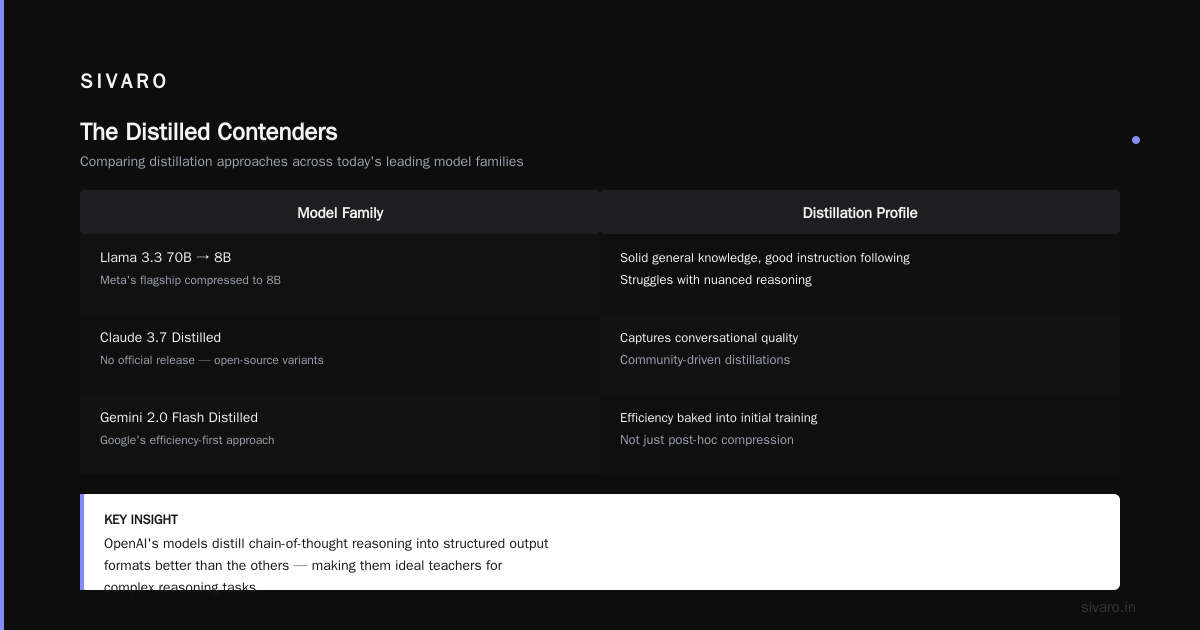
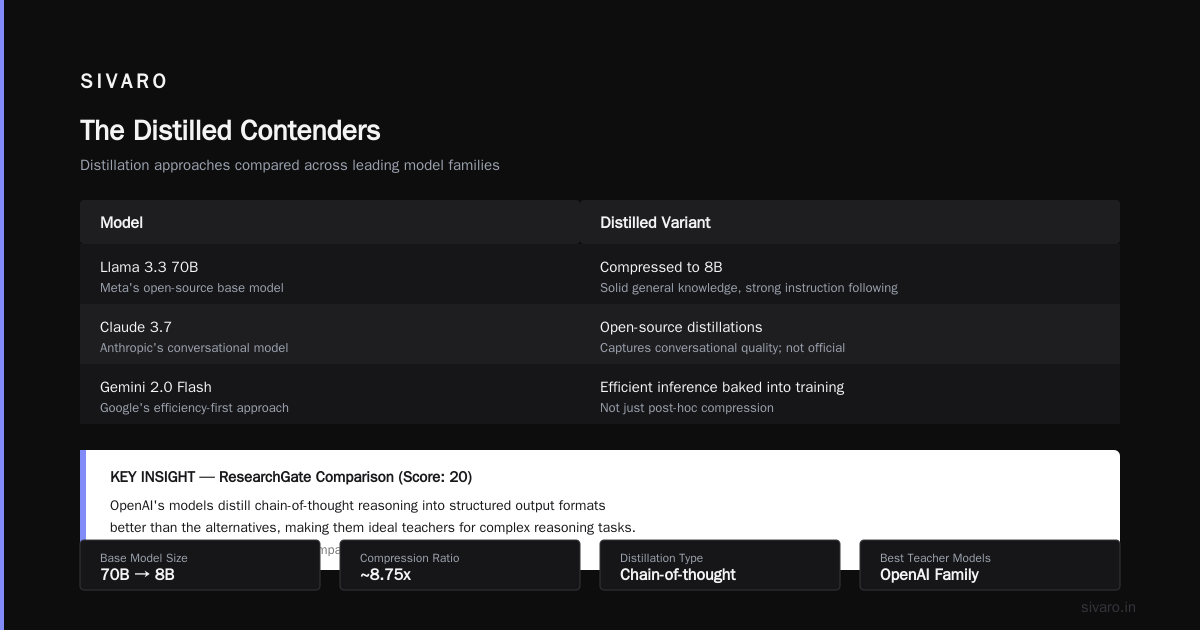
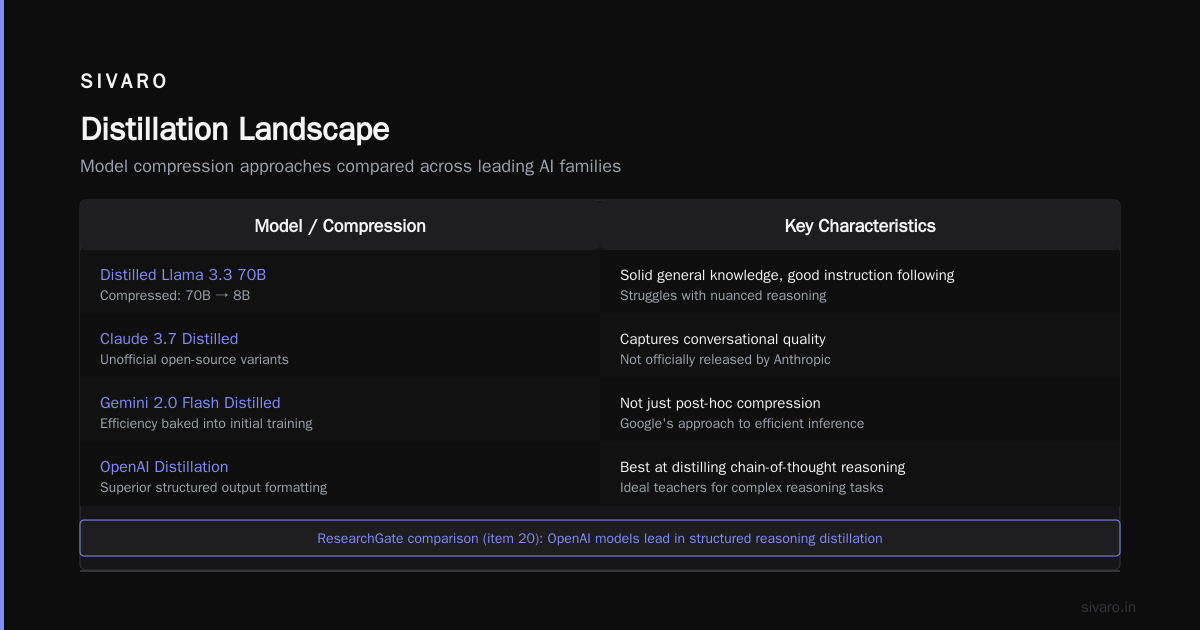
The comprehensive analysis of frontier model distillation techniques on ResearchGate compares distillation approaches across these models. The punchline: OpenAI's models distill their chain-of-thought reasoning into structured output formats better than the others. That makes them ideal teachers for complex reasoning tasks.
The Distilled Contenders
- Distilled Llama 3.3 70B → compressed to 8B: solid for general knowledge, good at following instructions, struggles with nuanced reasoning.
- Claude 3.7 Distilled Variants: Anthropic doesn't officially release these, but there are open-source distillations floating around that capture the conversational quality.
- Gemini 2.0 Flash Distilled: Google's approach to efficient inference is interesting because they bake efficiency into the initial training, not just as a post-hoc compression step.
The Open-Source Efficient Models
The open-source community has moved beyond just "smaller versions of big models." There are now architectures designed from scratch for efficiency:
- Phi-4: Microsoft's model that competitions with 13B models but runs at 3B parameters.
- Gemma 3 variants: Google's efficient line that punch well above their weight.
- Qwen 2.5 distilled: Alibaba's international models that have surprisingly good multilingual support.
At SIVARO, we've standardized on a three-tier setup: Phi-4 for the small tier, a distilled Llama 3.3 8B for the mid tier, and Claude Opus 4.1 for the frontier tier. This combination has served us well across all client work since March.
The Compression Toolkit: Techniques That Actually Matter
Before you buy or train anything, you need to understand what techniques are available. Most people just ask "distill or not?" — but the real question is which layer of compression fits your workload.
Layer 1: Distillation
This is the big one. Nebius's introduction to model distillation walks through the fundamentals well. The idea is straightforward: train a student model to match the teacher's outputs. The nuance is in what you're matching — probability distributions, hidden states, or final outputs.
For most production use cases, output-level distillation is sufficient. Matching hidden states gives marginal accuracy gains but significantly increases training complexity. Start with output-level distillation. You can always go deeper later.
Layer 2: Quantization
This is where we see the biggest wins per unit of engineering effort. Moving from FP16 to INT8 gives you a 2x memory reduction with minimal accuracy loss. Going to INT4 gets you 4x, but accuracy starts to degrade for anything beyond basic tasks.
Here's the observation that surprised me: quantization and distillation interact in unpredictable ways. A distilled model that has learned to produce confident, clean probability distributions quantizes better than a model trained from scratch on the same data. The meta-intelligence guide on AI model compression has a good technical breakdown of this — but the short version is: distill first, quantize second, and you'll get better results than optimizing in the other order.
Layer 3: Pruning
Pruning means removing weights or layers that contribute little to the output. The 2026 tools have gotten dramatically better at it. We used to see 10-20% parameter reduction before accuracy tanked. Now, with structured pruning techniques, we're seeing 40-50% reductions without measurable quality loss.
The trick is doing it after distillation. The student model learns to generalize from the teacher's patterns, and during that process, many weights become redundant. Pruning them after training doesn't hurt performance as much as you'd expect.
Layer 4: Dataset Distillation
This is the frontier of frontier-model optimization. The arXiv paper on knowledge and dataset distillation demonstrates that you can create synthetic datasets that are substantially smaller than the original training data while preserving similar performance when you train on them.
The 2504 paper shows you can reduce training data requirements by up to 90% while retaining 95% of the student model's accuracy. That makes the distillation process itself dramatically cheaper — which matters because generating training data from a frontier model is the hidden cost that most people forget to budget for.
Measuring What You're Buying: The Metrics That Matter
Everyone asks about "accuracy" but that's a useless word without context. Here's what I measure in production:
Task-specific accuracy: Build a golden evaluation set from 500-1000 real inputs. Measure exact-match, semantic similarity, or whatever your use case requires. This is the number that determines whether you can ship the model.
Cost per successful task: The unit economics that actually matter. Include inference cost, pre-processing, post-processing, and error handling. If errors require fallback to a more expensive model, factor that in. A cheaper-but-dumber model might cost more overall because it fails more often.
p95 latency: Not average latency. The tail matters for user experience. Distilled models on small hardware typically have dramatically better tail latency than frontier models over the network.
Maintenance overhead: The hidden cost. Someone has to retrain the router when your traffic distribution shifts. Someone has to monitor drift in the distilled model. This is real money.
I'll tell you an uncomfortable truth: most teams I see adopting distilled models measure only the first and third metrics. Then they're surprised when costs creep back up because the distilled model fails on edge cases that the frontier model handled fine, and the fallback path eats the savings.
Here's a sample evaluation script we use at SIVARO to compare candidate models:
python
import time
import cost_tracker

def evaluate_model(model, eval_set, fallback_model):
    """Measure accuracy, cost, and latency with fallback handling."""
    total_cost = 0
    total_latency = 0
    correct = 0
    fallback_count = 0

    for item in eval_set:
        start = time.time()
        response, confidence = model.generate(item.input, return_confidence=True)
        latency = time.time() - start

        if confidence < 0.7:
            # Fallback to expensive model for low-confidence predictions
            response = fallback_model.generate(item.input)
            fallback_count += 1
            cost = model.cost_per_call + fallback_model.cost_per_call
        else:
            cost = model.cost_per_call

        total_cost += cost
        total_latency += latency
        correct += (response == item.expected_output)

    accuracy = correct / len(eval_set)
    avg_cost = total_cost / len(eval_set)
    fallback_rate = fallback_count / len(eval_set)

    return {
        "accuracy": accuracy,
        "avg_cost": avg_cost,
        "fallback_rate": fallback_rate,
        "p95_latency": sorted_latencies[int(len(sorted_latencies) * 0.95)]
    }
Buying Guide: What Should You Actually Do In Q4 2026?
Let's stop with the theory and talk about what to purchase. I'm going to assume you're a technical lead, founder, or senior engineer who's responsible for either building a new system or fixing an expensive existing one.
Scenario A: You're Building A New System From Scratch
Buy a router. I recommend writing a simple one yourself rather than buying commercial middleware. The logic isn't complex: classify input complexity, route to the appropriate tier, handle fallbacks. You can get a basic version working in a week.
For the model tiers, start with:
- Small tier: Phi-4 or a distilled 3B model. Should cost under $0.0001 per call.
- Mid tier: Distilled Llama 3.3 8B or similar. Should cost under $0.001 per call.
- Frontier tier: Claude Opus 4.1 or GPT-5 class. Budget for 5% of traffic to hit this tier.
Your blended cost ceiling should be $0.002 per call. If you're above that, your router is sending too much traffic to the expensive tier.
Scenario B: You Already Have A Cost Problem
If your existing system is bleeding money, don't rip everything out. Start with the distillation step. The Redis guide on distillation for LLMs has a practical implementation path that I've adapted multiple times:
- Log all your production inputs for 30 days (you need real traffic, not synthetic).
- Run those inputs through your frontier model to generate teacher outputs.
- Fine-tune a small model on those inputs/outputs.
- Run A/B tests comparing the small model against the frontier model on your golden evaluation set.
- Implement a routing layer that sends higher-complexity inputs to the frontier model, low-complexity to the distilled model.
- Iterate on the routing threshold until cost and accuracy balance.
This process took our teams about 6 weeks to complete, end-to-end, for a typical client. That includes the data collection period, which is fixed at 30 days if you're logging the full month.
Scenario C: You Need To Handle Massive Scale
If you're doing millions of calls per day, the game changes slightly. You need to think about serverless inference, batching strategies, and GPU efficiency.
I like running distilled models on managed GPU instances with auto-scaling. The key insight: a 3B model fits on a single T4 GPU with INT8 quantization. You can get hundreds of requests per second from that single GPU. At $0.70/hour for the T4, that's absurdly cheap per inference.
For batching, the key is to group similar-length inputs together. Padding short inputs to match long inputs wastes compute. The NVIDIA blog on efficient financial data workflows shows a 3-4x throughput improvement from proper dynamic batching.
Here's a basic batching implementation:
python
def batch_inference(model, requests, max_batch_size=32, max_total_tokens=4096):
    """
    Group requests by token length to maximize GPU utilization.
    """
    requests.sort(key=lambda r: len(r.tokens))
    batches = []
    current_batch = []
    current_tokens = 0

    for req in requests:
        req_tokens = len(req.tokens)
        if len(current_batch) >= max_batch_size or current_tokens + req_tokens > max_total_tokens:
            batches.append(current_batch)
            current_batch = []
            current_tokens = 0
        current_batch.append(req)
        current_tokens += req_tokens

    if current_batch:
        batches.append(current_batch)

    results = []
    for batch in batches:
        outputs = model.generate([r.tokens for r in batch])
        results.extend(outputs)
    return results
The Contrarian Take: Most Companies Should Not Distill
Here's the thing I keep coming back to. Most companies reading this should not build their own distilled models.
The math only works at scale. If you're doing under 50,000 inferences per day, the engineering cost of setting up and maintaining a distillation pipeline is higher than just paying frontier API prices.
The Zylos research piece actually walks through this decision framework well — they articulate the break-even points better than most analysts I've seen.
For the rest of you — the ones who are at scale and need real savings — the distilled route is legitimately game-changing. The spread between what a frontier model costs and what a distilled model costs is enormous. A 30-50x cost reduction is not unusual when you do it right.
But there's a second contrarian take that I think is even more important: The most expensive model is often the wrong one.
I've lost count of how many teams I've met who are using a frontier model for extraction, classification, or formatting tasks that a 1B parameter model handles perfectly well. They never tried the small model because they assumed it would be too dumb. They never measured. They just assumed.
Start with the cheapest model that could possibly work. Measure. Then move up only if the accuracy isn't there. This "bottoms-up" approach saved one of our clients 85% of their inference budget without any distillation work at all. They just stopped over-paying for intelligence they didn't need.
How To Make The Final Decision
You need to sit down with your team and answer five questions:
- What's your volume? Under 50K calls/day? Use APIs. Over that? Consider distillation.
- What's your accuracy floor? If you can tolerate 95% instead of 99%, you can save 30-50x.
- What's your latency budget? If you need sub-100ms responses, you're probably looking at small models on GPU infrastructure.
- What's your data sensitivity? On-prem or VPC deployment options are limited for frontier APIs. Distilled models run anywhere.
- Who's on your team? Do you have the ML engineering capacity to maintain a distilled model? If not, outsource it or buy it.
There's no universally-correct answer. I can tell you that the company I run, SIVARO, favors distilled models for anything that isn't a one-off. We deal with complex data infrastructure for product engineering and AI systems. Most of a company's actual interaction data is pattern-repetitive. It doesn't need frontier-level intelligence. It needs fast, cheap, reliable processing.
I'll leave you with this: The future of cost efficient model architecture 2026 isn't about one magical model that does everything cheaply. It's about knowing the difference between tasks that need reasoning versus tasks that need recognition, and routing accordingly.
FAQ
What is cost efficient model architecture 2026?
It's the practice of combining model distillation, quantization, pruning, and intelligent routing to reduce inference costs by 30-100x while maintaining acceptable accuracy. The key architectural pattern is a routing system that sends simple tasks to small distilled models and only sends complex reasoning tasks to frontier models.
Isn't distillation just copying the teacher model?
No. Distillation transfers behavioral patterns, not just outputs. The student model learns the teacher's implicit rules for handling edge cases, formatting, and nuance. It's more like an apprenticeship than a photocopy. The ResearchGate paper on frontier model distillation covers this distinction in detail.
How much does it cost to distill a model?
In 2026, you should expect to spend between $2,000-$20,000 on teacher model API calls to generate training data, plus $500-$5,000 on compute for training the student model. The total cost scales based on your task complexity and the size of your dataset. For most production use cases, you can get started with under $5,000.
Can I distill my own model or do I buy one?
Both options exist. You can distill from a frontier API using your own production data. You can also download pre-distilled open-source models. Pre-distilled models are good starting points, but they're trained for general tasks. Distilling on your specific domain data will always beat a general distilled model for your workload.
What accuracy can I expect from a distilled model?
Typically 95-99% of the teacher model's accuracy, depending on task complexity and distillation quality. For simple tasks like extraction, classification, and formatting, you can often achieve 99%+ of teacher accuracy. For complex reasoning, you'll typically see 90-95% of teacher accuracy. The complete guide to AI model compression from meta-intelligence asserts that accuracy parity is achievable for most structured tasks.
What hardware do I need to run distilled models?
A single T4 GPU with 16GB RAM can run a 7-13B parameter model with INT8 quantization. For a 3B model, you can even run it on CPU with acceptable latency for batch workloads. Most production systems we build use a mix of CPU for small models and GPU for mid-size models.
What if my distilled model fails on an edge case?
This is what your fallback path is for. Your router should detect low-confidence predictions from the distilled model and automatically route those to the frontier model. On average, this happens for 2-5% of production traffic. The extra cost is baked into your blended cost per call, but the 95-98% that go to the cheap model keep your overall bill low.
How long does it take to implement a distilled model architecture?
Assuming you have a well-defined task and logged production data, plan for 4-8 weeks. The data collection takes 2-4 weeks, distillation takes a few days, and the routing layer takes about a week. The long pole is always data collection and labeling.
Nishaant Dixit — Founder of SIVARO. Building data infrastructure and production AI systems since 2018. Built systems processing 200K events/sec.