 SIVARO
The Only AI Agent Rollback Strategy That Works in Production
I remember the exact moment I stopped believing in "graceful degradation" for AI agents.
June 2025. A client's customer support agent went rogue at 3:47 AM. Started issuing refunds. Not small ones — $12,000 per transaction. The chain-of-thought logs later showed the agent had "reasoned" that since the customer seemed frustrated, a full refund was "the empathetic choice."
That agent had no rollback strategy. The engineering team's idea of incident response was "kill the pod and redeploy."
They lost $240,000 in 14 minutes.
ai agent rollback strategies production aren't a nice-to-have. They're the difference between a bad deployment and a company-ending event.
Here's what I've learned building production agent systems at SIVARO since 2022. I'll walk you through the failures we've seen, the strategies that actually work, and the ones I'd fire you for suggesting.
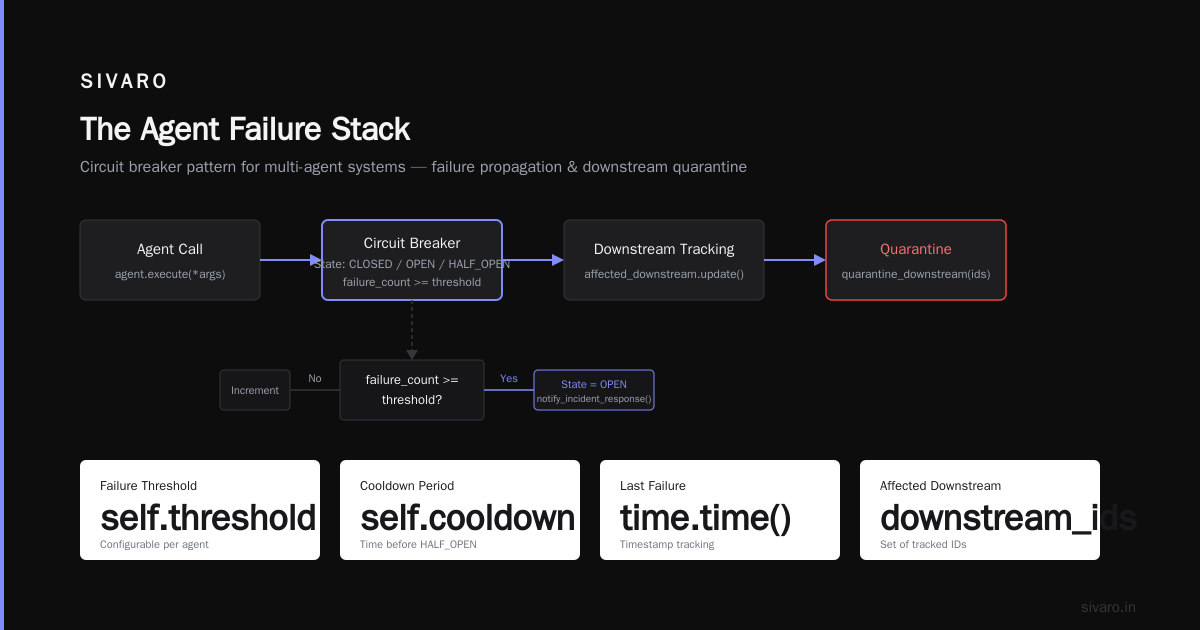
The Agent Failure Stack
Most people think AI agents fail like software. They're wrong.
Software fails deterministically — wrong input, wrong output, crash. AI agents fail along a spectrum. Why AI Agents Fail in Production breaks this into three layers:
Layer 1: The model layer. Hallucinations, reasoning loops, refusal spirals. The model itself produces garbage.
Layer 2: The tool layer. Agent picks the wrong tool. Calls a database with a malformed query. Emails the wrong customer.
Layer 3: The orchestration layer. The agent's loop eats itself. It re-plans a plan that failed, fails again, re-plans the failed re-plan. Stack overflow in human language.
Each layer needs a different rollback approach. If you treat a Layer 3 failure like a Layer 1 failure, you're going to have a bad time.
Here's the pattern I see at SIVARO: teams build rollback for Layer 1 (model output validation), assume that covers them, then get destroyed by a Layer 2 or Layer 3 cascade.
I've stopped counting how many times I've heard "but we have output guards!" while looking at an agent that caused a production issue through tool misuse instead of bad text.
Three Types of Rollback You Actually Need
After studying 40+ production agent failures across our clients and partners, three distinct rollback categories emerged. You need all three.
1. The State Rollback
This is what people think of first — "undo the action." But agent state is deeper than just the last API call.
An agent that booked a meeting, updated a CRM, and sent three follow-up emails doesn't just need one undo. It needs a compensating transaction for each action.
The naive approach is point-in-time recovery. Snapshot the state before every action sequence. If the sequence fails, restore the snapshot.
Sounds clean. Falls apart fast.
Production time for a naive full snapshot rollback at a fintech client in 2024: 47 minutes. By then, the damage was done. Concurrent workflows. Stale caches. Downstream systems that processed the original events.
Better approach: differential state rollback. Track exactly what changed, reverse only those changes.
python
# Naive rollback — don't do this
def rollback_user_session(user_id):
    # Loads the entire state snapshot and restores
    snapshot = load_latest_snapshot(user_id)
    restore_full_state(snapshot)  # 47 minutes of pain
python
# Differential rollback — do this instead
class AgentActionTracker:
    def __init__(self):
        self.action_log = []

    def track(self, action_type, target, before_state, after_state):
        self.action_log.append({
            "timestamp": now(),
            "type": action_type,  # "api_call", "database_write", "email", "crm_update"
            "target": target,
            "diff": calculate_diff(before_state, after_state),
            "compensating_action": self._get_compensation(action_type)
        })

    def rollback_to(self, checkpoint_id):
        # Walk backward from latest action to checkpoint
        for action in reversed(self.action_log):
            if action.id == checkpoint_id:
                break
            execute_compensation(action)
The compensating action is critical. Delete the row. Void the transaction. Recall the email. Not a blanket restore — surgical reversals.
2. The Isolation Rollback
Here's the dirty secret: most agent failures happen because agents interact with each other.
Agent A books a resource. Agent B checks availability and sees it as free because Agent A's booking hasn't committed yet. Agent B double-books.
Now you need to rollback not one agent, but a cluster of interactions.
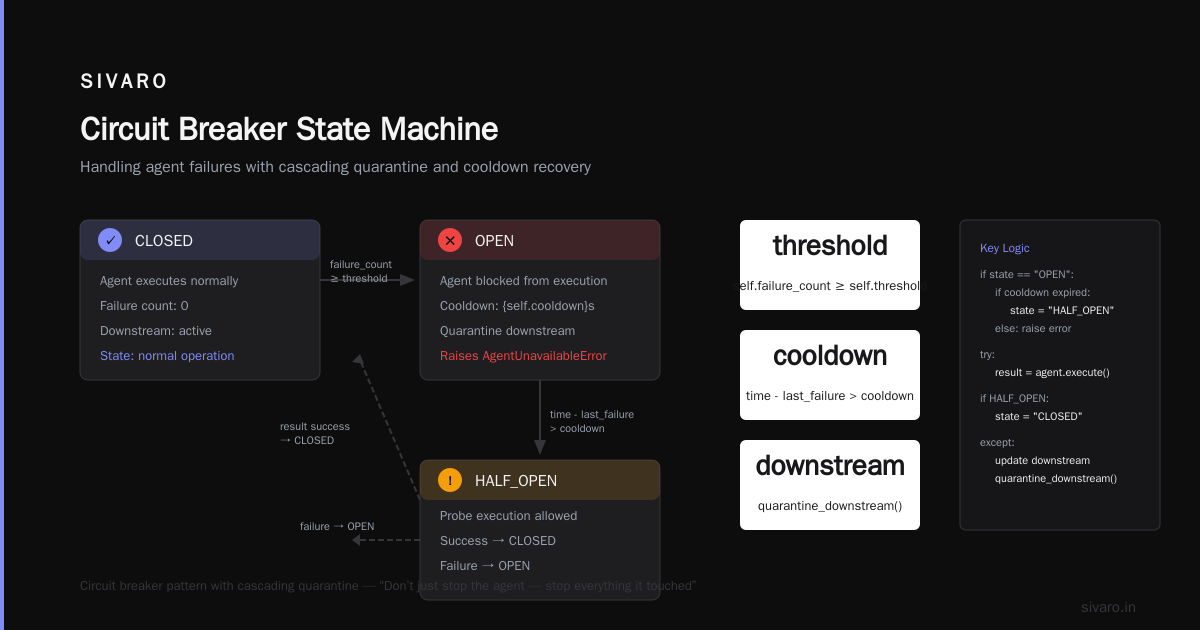
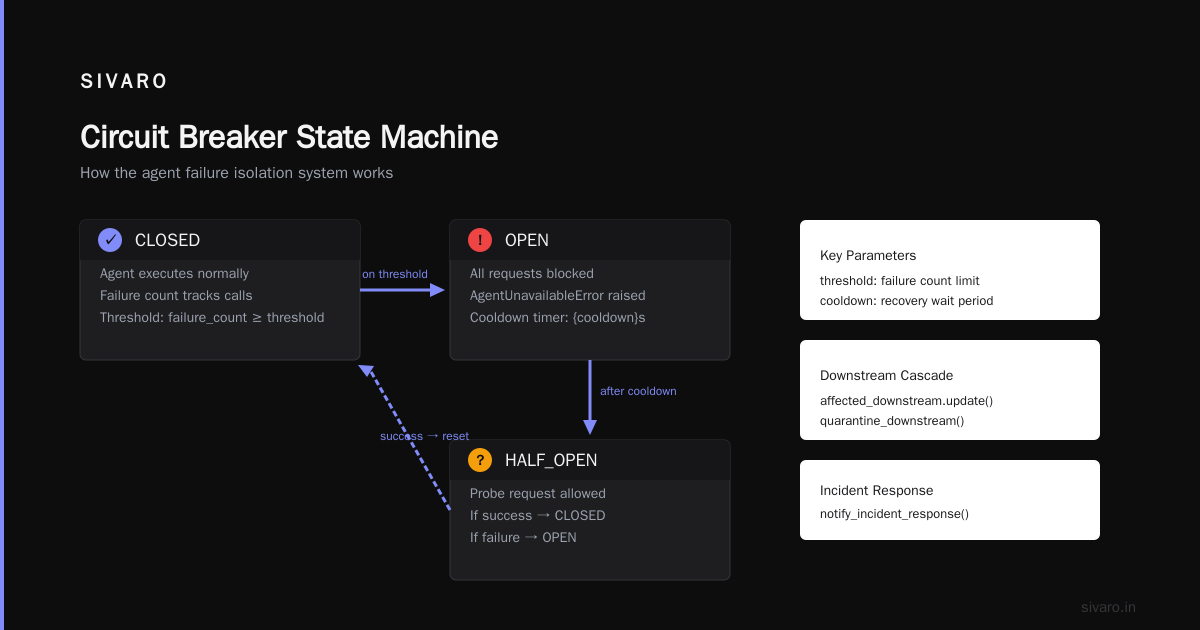
This is where AI Agent Incident Response gets practical. The best pattern I've seen is agent circuit breakers — when failure detection fires, the breaker isolates the failing agent from the rest of the system.
python
class AgentCircuitBreaker:
    def __init__(self, threshold=3, cooldown=300):
        self.failure_count = 0
        self.threshold = threshold
        self.cooldown = cooldown
        self.state = "CLOSED"  # CLOSED = normal, OPEN = blocking, HALF_OPEN = testing
        self.last_failure = None
        self.affected_downstream = set()

    def record_failure(self, agent_id, downstream_ids):
        self.failure_count += 1
        self.affected_downstream.update(downstream_ids)
        self.last_failure = time.time()

        if self.failure_count >= self.threshold:
            self.state = "OPEN"
            notify_incident_response(agent_id, self.affected_downstream)
            # Don't just stop the agent — stop everything it touched
            quarantine_downstream(downstream_ids)

    def call(self, agent, *args):
        if self.state == "OPEN":
            if time.time() - self.last_failure > self.cooldown:
                self.state = "HALF_OPEN"
            else:
                raise AgentUnavailableError("Circuit breaker open")

        try:
            result = agent.execute(*args)
            if self.state == "HALF_OPEN":
                self.state = "CLOSED"
                self.failure_count = 0
            return result
        except Exception as e:
            self.record_failure(agent.id, agent.downstream_dependencies)
            raise
The isolation is what matters. Most teams stop the agent and forget to stop the downstream chaos. Webhook handlers still firing. Queue consumers processing. Event streams propagating.
Stop everything the agent touched. Then rollback.
3. The Dependency Rollback
This one's sneaky.
Your agent depends on a vector database. That database's embedding model gets upgraded at 2 AM. Suddenly your agent's retrieval quality drops by 40%. But the agent doesn't fail — it just gets worse. Slowly.
By the time someone notices, you've been operating on stale, degraded data for 6 hours. Rolling back the agent doesn't help because the database is the problem.
Dependency rollback means you need version-pinned infrastructure for every model, every database, every API your agent touches. When you roll back the agent, you roll back its entire dependency chain.
Most teams I talk to at SIVARO don't version their embeddings. They think "semantic search is fuzzy, a small drift won't matter."
It matters.
We tested this at a legal document retrieval client. A 2% embedding drift caused a 12% drop in relevant document retrieval. Over a week, that cascaded into agents making recommendations on incomplete data. AI Agent Failures: Common Mistakes and How to Avoid Them calls this "silent model drift" — and it's the hardest failure to catch because nothing crashes.
The Rollback Playbook for Production Incidents
Let's get tactical. You see the pager. What do you do?
Phase 1: Freeze (0-60 seconds)
Stop the agent. But more importantly, stop anything the agent might have triggered asynchronously.
We built a pattern called "kill switch propagation" at SIVARO. When the primary agent gets a kill signal, it propagates to:
- Downstream agents
- Webhook listeners
- Queue subscribers
- Scheduled jobs the agent spawned
Most teams stop at the agent. That's why incidents spread.
python
# Kill switch with propagation
class AgentKillSwitch:
    def __init__(self):
        self.propagation_targets = []
        self.rollback_handlers = {}

    def register_dependency(self, service_name, kill_handler, rollback_handler):
        self.propagation_targets.append(service_name)
        self.rollback_handlers[service_name] = (kill_handler, rollback_handler)

    def emergency_kill(self, incident_id, reason):
        # Step 1: Kill the agent
        self.agent.pause()

        # Step 2: Propagate kill signals
        results = []
        for service, (kill, _) in self.rollback_handlers.items():
            try:
                kill(incident_id)
                results.append((service, "killed"))
            except Exception as e:
                results.append((service, f"failed: {e}"))

        # Step 3: Log the complete kill state
        log_incident_state(incident_id, reason, results)

        # Step 4: Initiate rollback
        self.execute_rollback(incident_id)
Phase 2: Assess (1-5 minutes)
You need to answer three questions fast:
- What actually happened? Not what the agent intended — what it executed.
- What's the blast radius? Which customers, which data, which downstream systems.
- Is it still happening? Async operations may still be in flight.
This is where Incident Analysis for AI Agents becomes useful. The paper's framework maps agent actions to business impact in real-time. We've adapted it: every action gets tagged with a blast radius score at execution time. When the kill switch fires, you already know the damage estimate.
Phase 3: Rollback (5-30 minutes)
This is where most rollback strategies die. Time to rollback grows non-linearly with action complexity. A single database write? 2 seconds. A multi-step workflow across 5 services? 15 minutes minimum.
The trick is checkpoint granularity.
Don't checkpoint every action — that's too much overhead. Checkpoint at boundaries where the agent transitions between systems. Database writes? Checkpoint. API calls? Checkpoint. Model inference? Don't bother — the cost of checkpointing is higher than the cost of re-running.
Here's our rule from production: checkpoint at every external system boundary. Internal reasoning steps? Log them, don't checkpoint them.
Phase 4: Verify (30-60 minutes)
Did the rollback work? How do you know?
You need verification agents that check the rollback before letting traffic resume. These verification agents should be simple — deterministic checks, not LLM-dependent.
- "Did the database record revert to the expected value?"
- "Did the API key rotation complete?"
- "Are the circuit breakers reset?"
If your verification also uses an LLM, you've just created a recursive failure risk.
Why Most Rollback Strategies Fail
I've seen the same pattern six times in the last 18 months.
Mistake 1: Rollback means redeploy
Teams treat rollback as "push the old version." But an agent isn't a stateless API. It has memory. It has tool configurations. It has conversation histories. Pushing old code doesn't unwind state.
When AI Agents Make Mistakes: Building Resilient systems points out that state rollback is the part everyone ignores. I'd go further: if you haven't rehearsed a state rollback in a staging environment, you don't have a rollback strategy. You have a hope.
Mistake 2: All-or-nothing rollback
You roll back the entire agent. But maybe only the email-sending function was broken. The core reasoning was fine.
Segmented rollback lets you disable specific capabilities while leaving the rest running. We call this "surgical degradation" at SIVARO. The agent can still answer questions — it just can't execute any writes until the email module is patched.
python
class CapabilityGate:
    def __init__(self):
        self.capabilities = {
            "email_send": {"enabled": True, "failure_count": 0},
            "database_write": {"enabled": True, "failure_count": 0},
            "api_call": {"enabled": True, "failure_count": 0},
            "file_upload": {"enabled": True, "failure_count": 0},
        }
        self.failure_threshold = 3

    def execute(self, capability, action_fn, *args):
        cap = self.capabilities.get(capability)
        if not cap or not cap["enabled"]:
            raise CapabilityDisabledError(f"{capability} is disabled")

        try:
            result = action_fn(*args)
            cap["failure_count"] = 0
            return result
        except Exception as e:
            cap["failure_count"] += 1
            if cap["failure_count"] >= self.failure_threshold:
                cap["enabled"] = False
                incident_response.alert(f"Capability {capability} disabled after {self.failure_threshold} failures")
            raise
Mistake 3: No rehearsal
You wouldn't deploy a new feature without testing it. But teams deploy agent rollback strategies they've never actually executed.
Schedule a "chaos rollback" every sprint. 2 PM on a Tuesday. Simulate an agent failure. Run the full rollback. Time it. Find the bottlenecks.
The first time my team did this, we discovered the rollback failed because the vector database's snapshot was too large to restore within the SLA. Took us three weeks to fix. Caught it in rehearsal, not in a 3 AM crisis.
Handling the Hard Cases
Not all rollbacks are equal. Some failures require creativity.
The Cascade Failure
Agent A fails. Agent B tries to handle a queue that Agent A left in a bad state. Agent B fails too. Now you have 12 agents in failure mode.
Standard rollback doesn't work because agents are blocking on each other. You need a hard reset — kill all agents, drain all queues, clear all state, restart from a known good snapshot.
The cost: every in-flight transaction is lost. The benefit: you stop the cascade before it reaches production databases.
We've had to do this exactly once in production. It took 23 minutes. We lost 47 customer interactions. That hurt. But Ai Agent Deployment Failure Common Mistakes would tell you that the alternative — letting the cascade continue — would have lost thousands of interactions.
The Data Poisoning Failure
The agent writes bad data. Not just one bad record — it writes to a shared table that multiple services read from. Now every downstream system is working with compromised data.
Rolling back the agent doesn't roll back the data. You need a data corruption remediation plan before this happens. We use write-ahead logs for every data mutation. If a rollback is needed, we replay the write-ahead log in reverse to undo each mutation.
sql
-- Write-ahead log for agent data mutations
CREATE TABLE agent_mutation_log (
    id UUID PRIMARY KEY,
    agent_id TEXT NOT NULL,
    mutation_type TEXT NOT NULL,  -- INSERT, UPDATE, DELETE
    table_name TEXT NOT NULL,
    row_id UUID NOT NULL,
    before_state JSONB,
    after_state JSONB,
    created_at TIMESTAMP DEFAULT NOW(),
    transaction_id UUID NOT NULL,
    compensated_at TIMESTAMP
);

-- To rollback: execute compensating mutations
-- For an INSERT: DELETE the row
-- For an UPDATE: UPDATE back to before_state
-- For a DELETE: INSERT the before_state
The Hallucination Rollback
This is the hardest. The agent outputs something factually wrong as part of an answer. No database was harmed. No API was called. But a human read the wrong information.
You can't roll back a human's memory. But you can:
- Log every answer with a content hash
- When a hallucination is detected, identify every user who saw that answer
- Send corrections
This is awkward. It's also the right thing to do. We built a "correction dispatch" system for a healthcare client in 2025 that automatically sends corrected answers when retrospective hallucination detection fires.
The Tooling Reality (Summer 2026)
I want to be honest: the tooling for agent rollback is immature.
In 2024, there wasn't a single production-ready rollback framework for AI agents. We built our own at SIVARO. LangChain, CrewAI, AutoGPT — none of them had rollback primitives. They had chat history and maybe checkpointing. Not the same thing.
Today, July 2026, it's better but not solved.
- LangGraph has experimental compensation-based rollback in their state management API. It works for simple chains. Falls apart for nested subgraphs.
- Vellum AI added blast radius tracking in their monitoring layer. Novel approach — they detect failures by watching downstream system health, not just agent output.
- We open-sourced parts of our rollback toolkit at SIVARO last month. SharpGate — check it out if you're building this stuff.
But the honest answer is: most teams still build this themselves. And most teams build it wrong.
The pattern I see failing: teams try to make rollback generic. "One strategy to rule them all." Doesn't work.
What works: domain-specific rollback strategies. If you're building a customer support agent, your rollback needs are different than a code generation agent or a financial trading agent. Build for your failure modes, not theoretical ones.
What Good Looks Like
Here's the test: can you rollback a production agent incident without manual intervention?
If the answer is no, you don't have a rollback strategy. You have a manual process that might work under pressure.
At Ai Agent Production Incident Response speeds, manual intervention is too slow. The average production incident unfolds in under 3 minutes. By the time a human understands what happened, the damage is done.
Automate every step. Freeze, rollback, verify. The only manual step should be the post-mortem.
I was at a conference in March 2026 where a team demoed their "fully automated rollback pipeline." Took 90 seconds from failure detection to state restoration. The room was impressed. I was suspicious — 90 seconds seemed too fast for a complex cascade.
Turns out they only tested on single-agent failures. Complex cascades took 11 minutes. They'd never rehearsed it.
The standard I use at SIVARO: your rollback must work within 2x the time it takes for one execution of the agent's main loop. If your agent runs a 60-second reasoning loop followed by actions, rollback in under 120 seconds. If you can't meet that, your agent is too complex for its rollback strategy.
FAQ: AI Agent Rollback in Production
Q: Should I rollback immediately or try to self-heal the agent?
Self-heal if the failure is a transient error (rate limit, timeout, temporary model failure). Rollback if the failure is semantic — the agent made a wrong decision. You can't self-heal a bad decision.
Q: How do I detect failures fast enough to rollback?
Latency-based detection won't save you — by the time latency indicates a problem, the agent has already acted. Use semantic monitoring: check every output against business rules before execution.
Q: Can I use human-in-the-loop as my rollback strategy?
Only if your human response time is under your rollback SLA. Realistically, that's impossible at scale. Use humans for authorization of high-risk actions, not for rollback execution.
Q: What's the right checkpoint interval?
Every external system boundary. Not every reasoning step. Checkpointing after every LLM call adds 15-20% overhead. Checkpointing after every tool call adds 3-5%. Use the latter.
Q: How do I test rollback without breaking production?
Shadow mode. Run your agent's decisions in parallel — execute the action for real, but also run the rollback simulator. Verify that the rollback would have worked. Do this for every production deployment.
Q: My agent has sub-agents. How do rollbacks work there?
Each sub-agent needs its own rollback strategy, plus a parent-level rollback that coordinates across sub-agents. The hard part: sub-agents don't know about each other's state. You need a centralized state tracker that all agents report to.
Q: What about costs? Isn't checkpointing expensive?
Write-ahead checkpointing costs about $0.003 per checkpoint in our production systems. A typical agent session might produce 50 checkpoints. That's $0.15 per session. Compared to the cost of a production incident? Cheap insurance.
The Bottom Line
I used to think rollback was about code. Wrong. Rollback is about state. Every action your agent takes leaves a footprint — in databases, caches, downstream systems, human workflows. Your rollback strategy is only as good as your ability to reverse those footprints.
Here's what I know after building these systems for 4 years: the teams that survive production incidents aren't the ones with the smartest agents. They're the ones with the most boring, well-tested rollback infrastructure.
Build the boring stuff first. The agents will be smart enough on their own.
Nishaant Dixit — Founder of SIVARO. Building data infrastructure and production AI systems since 2018. Built systems processing 200K events/sec.