 SIVARO
The Platform Engineer Career Path: What Nobody Tells You
I founded SIVARO in 2018. Back then, “platform engineer” wasn’t even a job title. We were just the team that kept the data flowing and the APIs from falling over. Today, platform engineering is the fastest-growing role in infrastructure. And the platform engineer career path is still being written – mostly by people who made every mistake first.
This guide is what I wish someone had handed me. I’ll cover the actual skills that matter, how to break in without a degree, what certifications matter in 2026, and the interview questions that will separate you from the crowd. No fluff. No “it’s worth noting.” Just hard-won lessons from building production systems that process 200K events per second.
What Platform Engineering Actually Is
Most people think platform engineering is just DevOps rebranded. They’re wrong because it’s one level above. A DevOps engineer configures CI/CD and manages Kubernetes. A platform engineer builds the abstraction layer that lets dozens of product teams self-serve that infrastructure without touching YAML.
At SIVARO, we started as a data infrastructure shop. We had three teams writing the same Terraform modules. Every deployment was a snowflake. So we built an internal platform – a set of APIs, CLIs, and pre-approved golden paths. Product engineers could deploy a streaming pipeline in ten minutes. They didn’t need to know about VPC peering or Helm charts.
That’s the job. You’re not the plumber. You’re the person who designs the plumbing system so that ten other plumbers can work simultaneously without flooding the basement.
Google Cloud’s guide on how to become a platform engineer puts it well: “Platform engineering is about reducing cognitive load for developers.” Couldn’t agree more.
The Skills That Actually Move the Needle
I’ve interviewed over 200 platform engineer candidates. Here’s what separates the good from the great.
Deep Systems Thinking
You can’t just know Kubernetes. You have to understand how the parts interact. When a pod crashes, is it OOM, a node failure, or a bad liveness probe? When a database write timeout happens, is the storage layer saturated or is the application locking rows? The best platform engineers reason through the entire stack in their head.
At first I thought this was a problem of tooling – give them better dashboards. Turns out it was habits. You need to practice the mental model. Run strace on a failing process. Read kernel logs. Understand how cgroups enforce memory limits.
I require every hire to do a live debugging session. No docs. Just a terminal and a broken system.
Infrastructure as Code (the Right Way)
Terraform, Pulumi, Crossplane – pick one, but learn it until you can explain module composition patterns. But here’s the contrarian take: most IaC code I see is over-engineered. Teams wrap every resource in a reusable module, then end up with 30 parameters and no documentation. Keep it simple. Use workspaces or stacks for environment separation. Write tests for your Terraform using Terratest or official testing frameworks.
hcl
# Minimal Terraform module example for an internal platform
module "compute_cluster" {
  source = "./modules/kubernetes-cluster"

  cluster_name  = "platform-${var.env}"
  node_pools    = var.node_pools
  vpc_cidr      = var.vpc_cidr
  enable_autoscaling = true
}

resource "helm_release" "platform_core" {
  name       = "platform-core"
  chart      = "./charts/platform-core"
  depends_on = [module.compute_cluster]

  set {
    name  = "global.env"
    value = var.env
  }
}
Observability That Actually Gets Used
Every platform team has dashboards. Most are wallpaper. The real skill is building actionable observability: alert fatigue kills incidents. At SIVARO we use SLO-based alerting. If 99% of requests are below 200ms, don’t page me. But if error budget burns faster than 5% per day, wake me up.
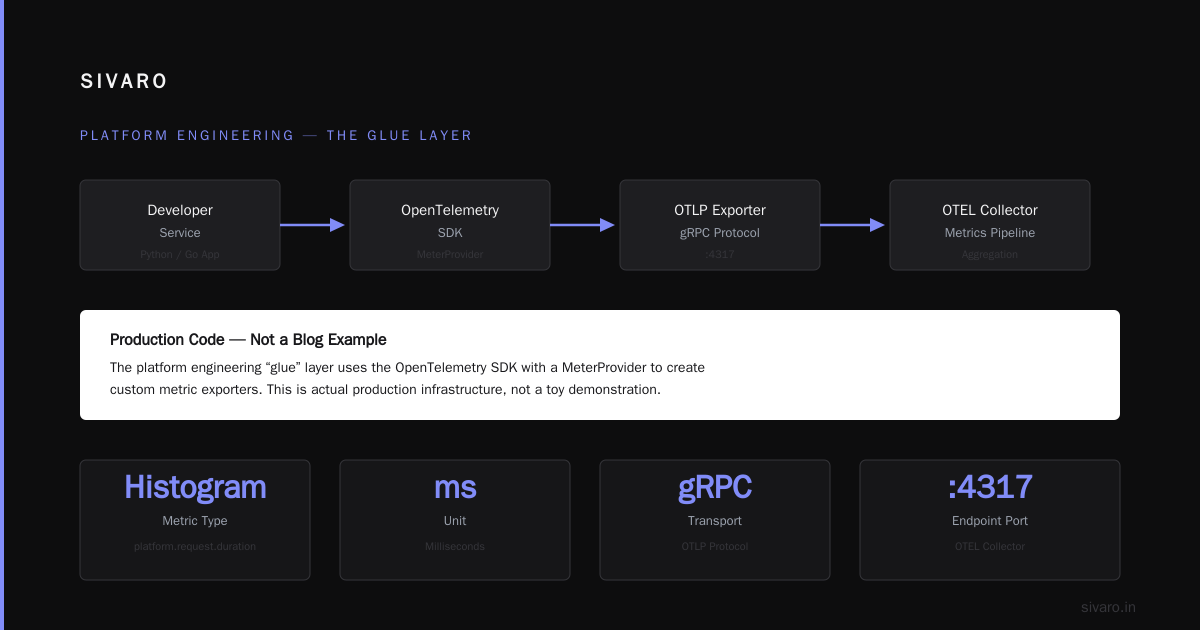
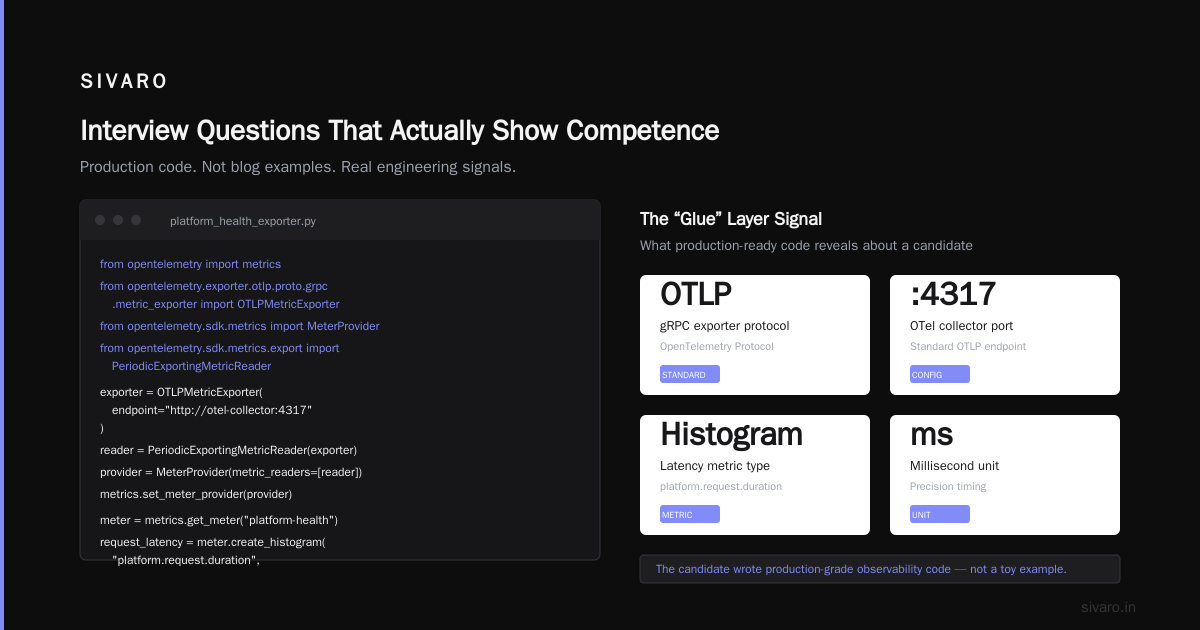
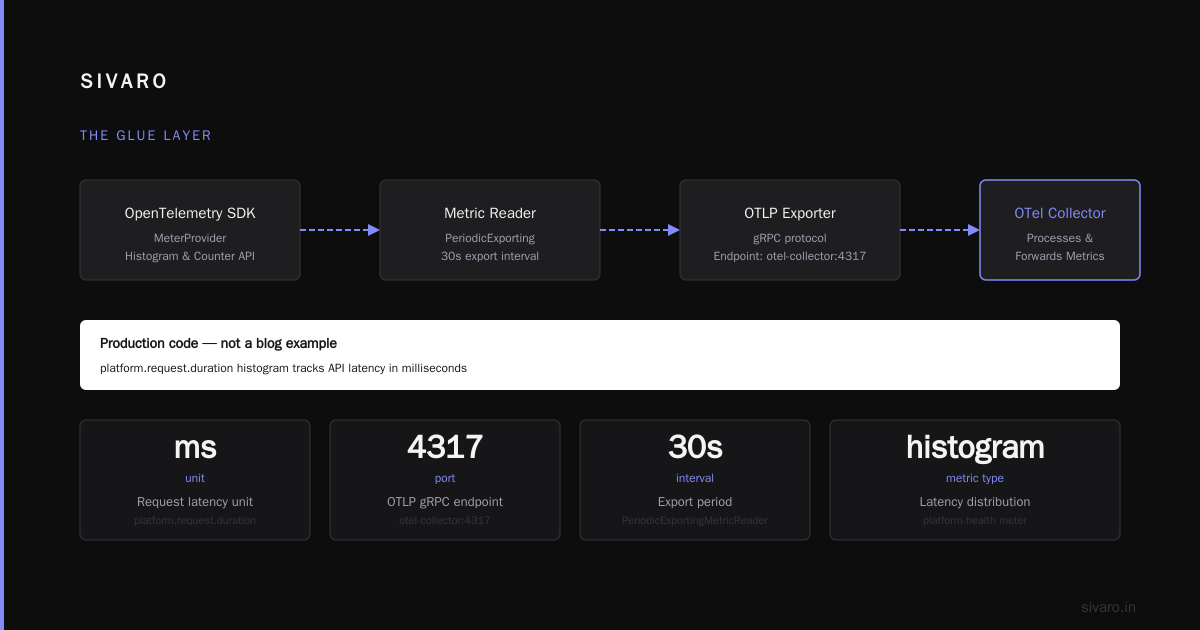
Learn OpenTelemetry. Understand time-series databases. Write a custom exporter in Go or Python:
python
# Simple custom metric exporter for platform health
from opentelemetry import metrics
from opentelemetry.exporter.otlp.proto.grpc.metric_exporter import OTLPMetricExporter
from opentelemetry.sdk.metrics import MeterProvider
from opentelemetry.sdk.metrics.export import PeriodicExportingMetricReader

exporter = OTLPMetricExporter(endpoint="http://otel-collector:4317")
reader = PeriodicExportingMetricReader(exporter)
provider = MeterProvider(metric_readers=[reader])
metrics.set_meter_provider(provider)

meter = metrics.get_meter("platform-health")
request_latency = meter.create_histogram(
    "platform.request.duration",
    unit="ms",
    description="Request latency for platform API"
)
That’s production code. Not a blog example.
The “Glue” Layer
Platform engineers write a lot of glue. Python, Go, Bash, maybe TypeScript for CLIs. You don’t need to be a language expert, but you must be comfortable writing automation that calls APIs, parses JSON, and errors gracefully.
I’ve seen candidates who freeze when they need to write a script that polls an internal API and updates a DNS record. That’s a dealbreaker.
The Career Ladder (Real Titles, Real Levels)
There’s no standard taxonomy, but in practice the platform engineer career path looks like this:
- Associate Platform Engineer (0–2 years): Maintain existing platform modules, write documentation, handle Tier-2 support tickets.
- Platform Engineer (2–5 years): Design new internal services, implement golden paths, mentor product teams. Own a domain like CI/CD or service mesh.
- Senior Platform Engineer (5–8 years): Set technical direction for the platform. Build abstractions that scale across 50+ microservices. Drive incident response improvements.
- Staff / Principal Platform Engineer (8+ years): Influence org-wide architecture. Build the strategy. Write RFCs that get litigated. Hire and grow the team.
- Director of Platform Engineering (12+ years): Manage managers. Align platform roadmap with business goals. Fight for budget. This is more management than coding, but you still need credibility.
I’ve seen people skip from Senior to Staff by shipping a platform that cut deployment time from 30 minutes to 90 seconds. That’s the kind of impact that changes careers.
Do You Need a Degree? No. Do You Need a Certification?
The short answer: no degree required. The longer answer: it’s harder but doable. I’ve hired two platform engineers without degrees. One learned by contributing to open-source infrastructure projects. The other built a homelab with Kubernetes and wrote blog posts about it.
The Coursera guide on how to become a software engineer without a degree makes a valid point: “Employers value demonstrable skills over formal credentials.” That’s true for platform engineering more than most roles. Build a portfolio. Contribute to Crossplane, Flux, or Backstage.
As for certifications? In 2026, the market is flooded with platform engineer certification programs. Most are cash grabs. The only ones I respect are the vendor-neutral ones that require a practical exam – for example, the CKA (Certified Kubernetes Administrator) or the HashiCorp Terraform Associate. But even those are just proof you can pass a test. Real street cred comes from shipping.
I’d recommend the AWS Solutions Architect (Professional) or Google Cloud Professional Cloud Architect if you work on cloud platforms. Those force you to reason about trade-offs. But for pure platform engineering? There isn’t a single “gold standard” certification yet. That will change by 2026 Q4 – I know of at least two organizations building a production-grade platform engineer exam. Stay tuned.
How to Break In (Without a Degree)
I get this question constantly. Here’s the path:
- Master one cloud deeply. Pick AWS, GCP, or Azure. Build a multi-tier app with networking, databases, and load balancers. Delete it. Rebuild it with Terraform.
- Learn Kubernetes beyond the basics. Run kind or k3s locally. Deploy a web service. Expose it with an Ingress. Add a service mesh (Istio or Linkerd – I prefer Linkerd for simplicity).
- Write a platform tool. Don’t just use Backstage – build a simple internal developer portal. A Flask or Go app that generates a Kubernetes manifest based on a form. Show it on GitHub.
- Open-source contributions. Fix a
good first issuein Crossplane or ArgoCD. Even documentation counts if it’s well-written. - Interview prep. Practice the platform engineer interview questions and answers that actually come up: “How would you design a multi-tenant CI/CD pipeline?” “Walk me through a time you debugged a production incident.” “What’s the trade-off between a monorepo and polyrepo for platform configs?”
The EdX guide on learning to become a software engineer without a degree echoes this: “Build a portfolio that demonstrates your ability to solve real problems.” That’s the currency.
Interview Questions That Actually Show Competence
I’ll list the top five questions I ask in platform engineer interviews, and what I’m looking for.
1. “Design an internal developer platform for a 50-person engineering org.”
Candidates who start with “I’d use Backstage” fail. Candidates who ask “What are the developers’ pain points?” pass. I want to see them define a persona, identify friction (slow deployments, lack of visibility, inconsistent configs), and build a simple self-service API that abstracts the complexity without hiding it.
2. “Your platform’s CI/CD pipeline broke on Friday evening. Describe your debugging process.”
Third-order thinking. Step one: verify the SCM webhook arrived. Step two: check the runner availability. Step three: inspect the build logs. If their first instinct is “restart the pipeline,” that’s a red flag. I want to hear about monitoring, staging, and postmortem culture.
3. “How do you handle secrets management on a Kubernetes cluster?”
Bad answer: “We use environment variables.” Good answer: “We use External Secrets Operator backed by AWS Secrets Manager, with rotation policies and audit logging. Secrets never hit etcd in plaintext. And we validate that no secret is mounted in a namespace that shouldn’t have access.”
4. “A production incident: your internal API returns 503 for 2% of requests. What do you do?”
I want to see a systematic approach: check error rates per pod, check dependency health (database, upstream service), check resource exhaustion (CPU throttled, memory pressure), then root cause. If they say “add retries” without understanding the cause, hard no.
5. “Tell me about a platform you built that you’re proud of.”
I’m looking for ownership, metrics, and lessons learned. “We reduced setup time from two weeks to one hour.” “We cut P0 incidents by 60%.” “I made a bad decision on networking that I later refactored.” Humility and impact are not mutually exclusive.
The Salary Reality
Salaries vary widely by location, but as of mid-2026, here’s the rough ballpark for US-based roles:
- Associate: $80k–$110k
- Mid-level: $120k–$160k
- Senior: $160k–$200k
- Staff: $200k–$260k
- Director: $260k+
These numbers come from real offers I’ve seen at companies like Stripe, Datadog, and mid-stage startups. Remote roles pay less but offer flexibility. At SIVARO, we pay at the 75th percentile because we can’t afford to lose platform engineers – they’re the force multiplier.
Common Mistakes That Kill Platform Engineering Careers
Building for “Platform” Instead of for People
I’ve seen teams spend six months building a golden path that nobody uses because they didn’t ask what product engineers needed. Talk to your users. Run developer experience surveys. Don’t build a cathedral in the desert.
Over-Automation
A startup I advised automated everything – right down to ticket creation for missing logging. The engineering team felt like they worked inside a machine. They revolted. Automation should remove toil, not control. Keep a human-in-the-loop for decisions.
Ignoring Observability for the Platform Itself
Your platform goes down? Then every product goes down. Your observability needs to be better than anyone else’s. If your CI/CD system is a black box, you’re gonna get paged at 3 AM and not know why.
Not Understanding the Business
Platform engineering isn’t just tech. It’s about speed to market, cost optimization, and developer productivity. If you can’t tie your work to a business metric (reduced deploy time, lower cloud bill), you’ll never get budget for that new service mesh.
Future Trends (2026–2027)
Two big shifts:
-
AI infrastructure as a platform service. Every platform team will need to provide GPU scheduling, model serving (vLLM, Triton), and data pipelines for LLMs. I’m already seeing requests for “give me a way to deploy a RAG pipeline in one command.” That’s the next frontier.
-
Platforms become shared across companies. Open-source platforms like Backstage, Port, and Humanitec are converging. The platform engineer career path will increasingly involve integrating external platforms rather than building from scratch. That’s both a threat (less custom work) and an opportunity (more cross-company impact).
The WeAreDevelopers article on becoming a software engineer without a degree talks about the importance of adaptability. That’s doubly true for platform engineering. The tools will keep changing. Your ability to learn and systematize is the only constant.
FAQ
Do I need to know Kubernetes to be a platform engineer?
Yes. Kubernetes is the de facto compute orchestrator. Even if your platform abstracts it, you must understand its internals. If you don’t know how a pod gets scheduled or what a control plane does, you’ll fail.
What’s the difference between a DevOps engineer and a platform engineer?
DevOps focuses on the practices and tools of continuous delivery and operations. Platform engineering builds the internal product that embodies those practices at scale. DevOps is a culture; platform engineering is a product.
How do I switch from software engineering to platform engineering?
Start by volunteering for infrastructure work in your current team. Automate a manual process. Write a deployment pipeline. Propose an internal tool. Then build a portfolio and apply for internal mobility or a new role.
Is platform engineering certification worth it in 2026?
The CNCF certifications (CKA, CKAD) are valuable. The new platform-specific certifications are emerging – evaluate them by looking at the curriculum. If it’s just theory, skip it. If it includes a hands-on lab, consider it.
What programming languages should I learn?
Go is dominant in the platform engineering ecosystem (Kubernetes, Terraform, many CLIs). Python is great for glue and automation. Bash is non-negotiable. TypeScript is growing (for Backstage plugins, for example).
How do I get experience without a job in platform engineering?
Build a platform for yourself. Create a GitHub repo called “my-platform.” Implement a simple API that provisions a VM. Use Terraform, GitHub Actions, and a small Kubernetes cluster. That counts as experience.
What’s the most common interview mistake I see?
Candidates who can’t explain trade-offs. “Why did you choose this tool?” “What are its limitations?” If they can’t name three cons of their favorite tool, they haven’t used it in production.
Don’t Just Collect Titles – Collect Systems
The platform engineer career path isn’t a ladder you climb by staying put. It’s a series of systems you build, each one more abstract and more impactful than the last. You start by configuring YAML. Then you write modules. Then you design internal APIs. Then you shape engineering culture.
I’ve been doing this since 2018. I still get surprised every month. That’s what makes it worth it. If you’re patient, curious, and willing to be wrong in public, you’ll go far.
Nishaant Dixit — Founder of SIVARO. Building data infrastructure and production AI systems since 2018. Built systems processing 200K events/sec.