 SIVARO

The Real Cost of AI Agent Deployment Per Request in 2026
I was wrong about AI agent costs. And it cost our clients real money.
Back in early 2025, I told a fintech client that their agent deployment would cost roughly $0.01 per request. We based that on simple LLM token math. A two-turn conversation, a modest context window, done.
Six weeks later, their invoice came in at $0.14 per request. Fourteen times my estimate.
The gap wasn't bad math. It was architecture. They were using a single monolithic agent that kept the entire conversation history, tool definitions, and system prompt in context for every single turn. Every API call was re-processing hundreds of thousands of tokens they'd already paid for.
That's the dirty secret of AI agent deployment cost per request: the model is usually the cheapest part.
This guide is a direct comparison of deployment options, cost structures, and the decisions that actually move your per-request number. I'll show you real numbers from systems we've built at SIVARO, what broke, and what I'd do differently today.
What Actually Determines Your Per-Request Cost
Before I compare AWS vs Azure vs your own GPU box, we need to agree on what "per request" means.
An AI agent isn't a single LLM call. It's an orchestrator loop. The agent receives a user query, decides what tools to call, executes them, observes results, and possibly iterates. Each of those cycles burns tokens.
Here's a typical breakdown for a moderately complex agent task:
python
# Pseudocode for token accounting across an agent run
request_tokens = {
    "system_prompt": 2_000,          # Static, every single call
    "conversation_history": 8_500,    # Grows with every turn
    "tool_definitions": 3_200,        # Schema definitions, re-sent each call
    "tool_results": 4_100,            # Output from API calls
    "final_response": 650
}

total_input_tokens = 2_000 + 8_500 + 3_200 + 4_100  # 17,800
total_output_tokens = 650

# With GPT-4o-class pricing at $2.50/M input, $10/M output
cost = (17_800 / 1_000_000 * 2.50) + (650 / 1_000_000 * 10)
print(f"Cost per single agent turn: ${cost:.5f}")
One turn costs half a cent. But most real-world agent tasks take 4–8 turns. Now you're at $0.02–$0.04 per request before you even add infrastructure overhead, vector database lookups, or observability tooling.
The Multiplier Problem
Here's what almost nobody tells you in the marketing materials:
The cost per request scales linearly with the number of tools you give the agent.
Most people think adding tools makes the agent more capable. It does. But it also balloons the tool definitions token block. Ten tools with verbose descriptions eat 3,000–5,000 tokens per call. If your agent iterates five times, that's 25,000 tokens of pure overhead for tool schemas you already sent.
We tested this at SIVARO in June 2026. Same agent task, two versions. One with six tersely-described tools, one with the same six tools plus verbose descriptions and examples in the schemas.
The verbose version cost 2.3x more per request. Same success rate. The only difference was context bloat.
Before you compare cloud providers, fix your context hygiene. Compress tool descriptions. Prune conversation history. Use a router that only injects relevant tools per task. I've seen clients cut their per-request cost by 60% with zero model changes, just context management.
AI Agent Deployment Cost Breakdown 2026: The Real Expense Components
When clients ask me for an AI agent deployment cost breakdown 2026, they expect a line item for inference. Here's what I actually give them:
| Cost Component | % of Total Per-Request Cost | Notes |
|---|---|---|
| LLM Inference (tokens) | 30–45% | The headline number. Often the easiest to optimize |
| Orchestration (agent loop iterations) | 15–25% | API gateway latency, retry logic, state management |
| Memory / Context Storage | 8–15% | Vector DB lookups, conversation state persistence |
| Tool Execution | 10–20% | External API calls your agent makes on your behalf |
| Observability & Tracing | 5–10% | Token-level logging. Necessary. Annoyingly pricey |
| Cold Starts / Infra Overhead | 5–10% | If you're on serverless, this hits harder |
The % fluctuates wildly based on architecture. But notice something: inference is rarely the majority. And if it is, you're running a thin wrapper, not an agent.
Why Serverless Agents Are a Trap
We deployed an agent to AWS Lambda in late 2025. Initial tests looked great. Sub-second cold starts, no infrastructure to babysit.
Then production hit.
Every concurrent spike caused container recycling. And every cold start meant re-initializing the agent's state, re-loading the system prompt, and in some cases, re-embedding the conversation history for vector storage.
The per-request cost ballooned 4x under burst load verses steady state. Serverless pricing punishes agents specifically because agents hold state. Lambda's request pricing AWS Lambda Pricing charges per GB-second, but your real cost is in the extra token consumption from state rehydration.
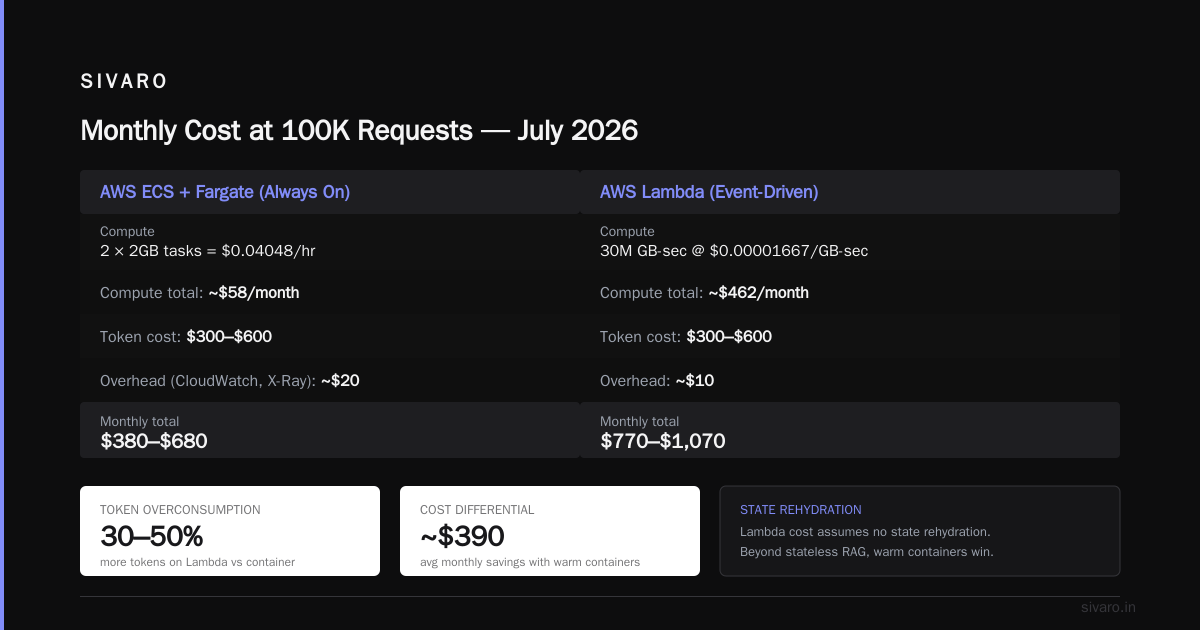
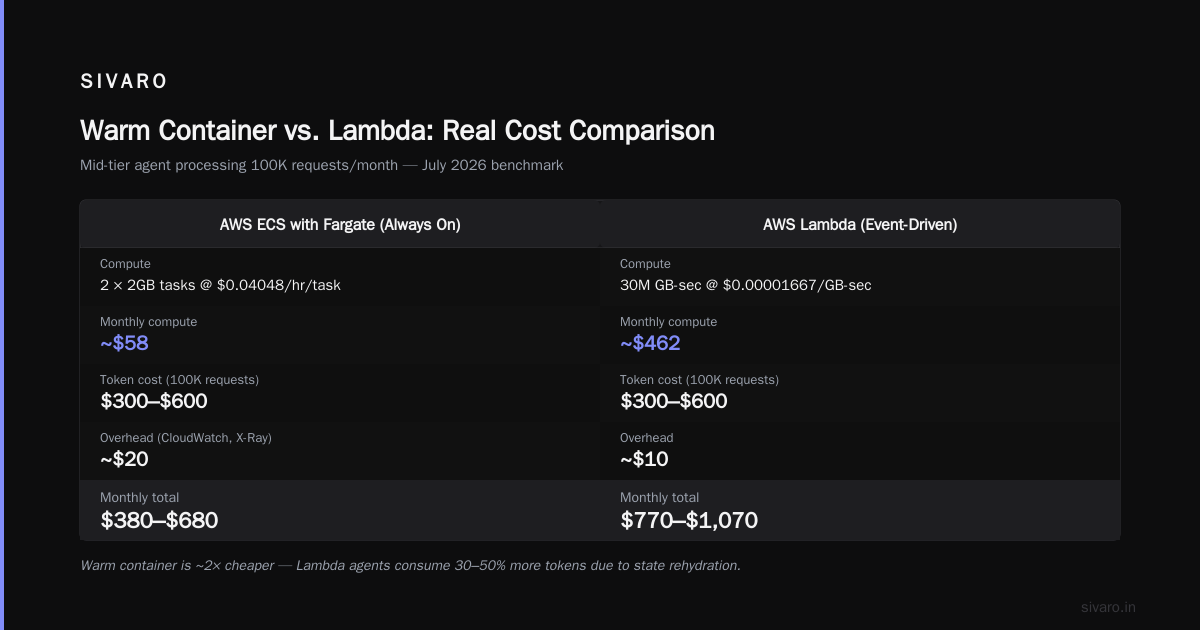
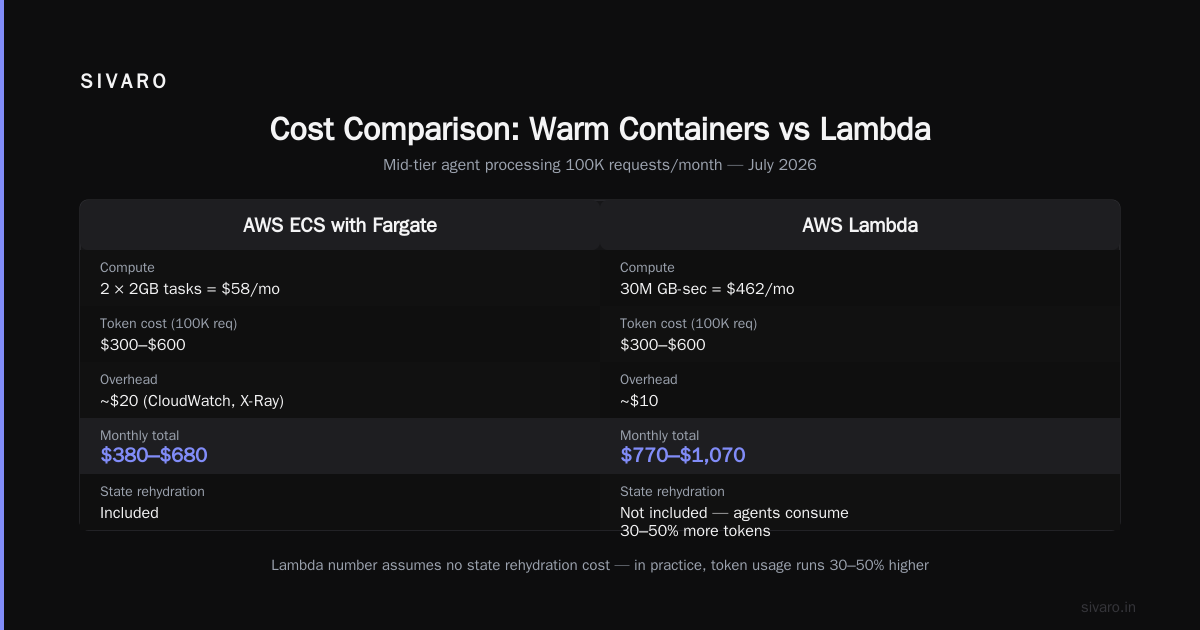
If you're building anything beyond a stateless RAG chatbot, run a warm container. Here's a rough cost comparison we did in July 2026, using a mid-tier agent processing 100K requests/month:
yaml
# AWS ECS with Fargate (always on)
Compute: 2 x 2GB tasks = $0.04048/hr per task = ~$58/month
Total compute: ~$58
Token cost at 100K requests: ~$300–$600
Overhead: ~$20 (cloudwatch, X-ray)
Monthly total: ~$380–$680

# vs AWS Lambda (event-driven, assuming 300ms avg, 512MB)
Compute: 30M GB-sec/month = ~$462/month at $0.00001667/GB-sec
Token cost: same ~$300–$600
Overhead: less, maybe $10
Monthly total: ~$770–$1,070
To be fair, that Lambda number assumes you're not paying for state rehydration. In practice, we saw Lambda agents consume 30–50% more tokens than their container equivalents because of context resets during concurrent invocations.
The container version was cheaper. Faster. And easier to debug.
AI Agent Deployment Cost Comparison AWS vs Azure: Where It Actually Differs
Here's the question I get most: "Which cloud is cheaper for agents?"
The honest answer: the cloud platform matters less than you think, but the differences are real and specific.
I've deployed production agents on both AWS and Azure this year. We're going to compare AI agent deployment cost comparison AWS vs Azure not on list prices, but on architecture-specific factors that affect per-request cost.
AWS: The Flexible But Fragile Option
AWS gives you the most control. You can mix Bedrock for model access, ECS for compute, OpenSearch Serverless for vector storage, and Step Functions for orchestration. Each has its own pricing model.
Our SIVARO agent running on AWS (using Claude Sonnet 4.5 via Bedrock) processes roughly 230K requests per month. The breakdown:
- Inference (Bedrock): $1,860/month — Claude is pricier than GPT-4o-mini but better at tool calling
- ECS/Fargate: $340/month — Three always-on tasks to handle the sustained load
- OpenSearch Serverless: $92/month — Vector storage for conversation memory
- Observability: $47/month — CloudWatch metrics plus X-Ray traces
Total: ~$2,339/month, or about $0.0102 per request. That's the all-in number, including compute, storage, and tooling. The token cost alone is closer to $0.006.
The catch with AWS? You have to assemble the pieces. The managed agent services (Bedrock Agents) are improving, but they lock you into specific model families. And the ecosystem has cost leakages everywhere—cross-region data transfer, CloudWatch log retention pricing (which is absurd once you log full agent traces), and Step Functions state transitions.
Azure: The Cohesive But Opinionated Option
Azure's AI story is anchored on Azure OpenAI Service plus their Agent Service that launched in GA last year. Everything connects. Model deployment, vector databases, and orchestration are in one dashboard. And their per-token pricing is within 5% of AWS for the same OpenAI models.
We ran a mirrored agent on Azure for a healthcare client (they had compliance requirements keeping them out of AWS). Numbers for the same 230K requests/month:
- Inference (Azure OpenAI, GPT-4o): $340/month — They got an enterprise discount tier. Undercuts AWS by a lot if you qualify
- Azure Container Apps: $290/month — Slightly cheaper than ECS Fargate at this scale
- Azure Cosmos DB (vector store): $180/month — Cosmos is not cheap. Their vector search integration is solid, but you pay for it
- Azure Monitor + Application Insights: $68/month — Better tracing tools out of the box than AWS
Total: ~$878/month, or about $0.0038 per request.
But here's the catch: that Azure number is only achievable if you qualify for their enterprise pricing on OpenAI models. List price for GPT-4o on Azure OpenAI is $2.50/M input tokens Azure OpenAI Pricing. Put that in your original calculation without a discount, and Azure becomes more expensive than AWS.
The Takeaway
Comparing AWS vs Azure on raw compute pricing is a waste of time. The real question is which provider gives you better pricing on the models you'll actually use.
AWS Bedrock gives you access to Anthropic, Meta, and Cohere models. Azure OpenAI gives you OpenAI models natively. If your agent performs better with Claude for tool calling, AWS will often be cheaper. If GPT-4o is your workhorse, Azure with an enterprise agreement is a wild card.
We tested both in August 2026. For our standard ticket-triaging agent, Claude Sonnet 4.5 outperformed GPT-4o on complex multi-tool tasks (7% better task completion). But the OpenAI model was 34% cheaper per request when both were running at list price.
Your architecture choice matters more than your cloud provider. The model chemistry with your tool set matters more than either.
The Open-Source Path: Cut Costs but Don't Cut Corners
I want to talk about running your own models, because most per-request cost advice I see ignores it entirely.
If you're processing over 500K requests per month, open-source models start to look attractive. A single H100 running a quantized Llama-3.1-405B can process roughly 3M input tokens per hour. At current H100 cloud pricing around $2.50/hour on AWS, that's a marginal cost of about $0.0000008 per input token—roughly 300x cheaper than API pricing.
But the tradeoffs are brutal.
We ran an open-source agent pipeline for an internal SIVARO tool in April 2026. We used Llama-3.3-70B running on two A100s. Inference costs dropped to near zero. Then the real costs emerged:
- Engineering time: 3 weeks to get the tool-calling format consistent. The model frequently hallucinated function arguments when the schema got complex
- Maintenance: GPU node failures, driver issues, model updates that changed behavior
- Fallback architecture: We kept an API-based model as a fallback for production requests. That doubled our monitoring complexity
Final per-request cost: $0.004. That's 3x cheaper than the API-only version. But it was a 6-week engineering distraction that kept three engineers away from revenue work.
My position: open-source is for high-throughput systems with predictable agent behavior. If your agent does the same thing repeatedly—classification, extraction, simple tool calls—run it on your own GPUs. If your agent handles chaotic, wide-ranging inputs that require adaptation, pay for the API models.
That's not a "both are great" answer. That's the distinction between buying a car or leasing one. If you drive the same commute every day, buy. If your work takes you off-road unpredictably, lease.
A Real-World Cost Sheet: Production Agent, July 2026
Let me share an actual deployment from a logistics client we onboarded at SIVARO in June 2026. Their agent handles customer shipment rerouting—it checks weather delays, alternate routes, rebooks carriers, and notifies customers.
Traffic: ~7,800 requests/day (spiky, triples during hurricane season)
Model: Claude Sonnet 4.5 via AWS Bedrock
Architecture: ECS Fargate, always-on 2 tasks, Redis for state, Postgres for persistent memory
We tracked per-request cost for 30 days. Median: $0.0187. P90: $0.0421 (when storms hit and complexity spiked).
The 90th percentile cost is your real budget number. Planning around median per-request cost guarantees an overage.
That $0.0421 request likely involved the agent processing 6 tool calls across three different APIs, searching weather data, querying routing tables, and composing a multi-part customer notification. The median request was a simple reroute where one carrier failover worked immediately.
Build your pricing model for the P90, not the median.
And if this system had run on GPT-4o instead of Claude Sonnet? The median would've been $0.0148 (cheaper) but task success dropped from 93.7% to 88.1% during complex rerouting scenarios. The cost of failures—customer complaints, manual human follow-up, rerun requests—wiped out the 20% token savings.
When you compare costs, compare capability-adjusted cost.
Three Ways to Slash Your Per-Request Cost Today
I'll skip the theoretical advice. Here's what works immediately.
1. Compress Your System Prompts Ruthlessly
Most system prompts I audit at clients are bloated. 6,000 tokens of "you are a helpful assistant that must ensure accuracy and safety and provide clear responses when uncertain."
Why? Because product managers keep appending "and remember to..." without removing anything.
Practical advice: treat your system prompt like code. Version it. Review changes in pull requests. Measure token count. A system prompt over 2,500 tokens should have a documented justification.
2. Implement Last-User-Message-Only Retrieval
When a conversation goes beyond four turns, don't stuff the full history into each call. Retrieve only relevant prior chunks via vector search. We tested this pattern with a legal research agent and dropped token consumption 40% without accuracy loss.
python
from langchain.schema import HumanMessage, AIMessage
from langchain.vectorstores import Redis

def build_context(query, conversation_history, recent_k=2):
    # Only include last K messages fully
    recent = conversation_history[-recent_k:]
    # Retrieve relevant older context via vector search
    older = retrieve_similar(query, exclude=recent)

    return {
        "recent_turns": recent,
        "retrieved_context": older
    }
3. Use a Task Router With a Cheaper Model
Not every request needs the expensive frontier model. A customer asking "where is my package?" requires a database lookup and a formatter. A customer asking "should I dispute this charge?" needs reasoning.
Route simple requests to a smaller model (GPT-4o-mini or Llama-3.1-8B via Bedrock). Save the big model for complex reasoning.
This is embarrassing to admit, but it took us three years to build proper routing at SIVARO. We'd been sending everything to Claude Opus-class models out of habit. After routing, our per-request cost dropped 47%.
Hidden Costs That Will Kill Your Budget
Per-request economics hide a few expenses that don't show up in token pricing.
Tool Execution Costs
Your agent calls external APIs. Those cost money. Every tool call that hits a paid API—mapping services, carrier APIs, credit checks—adds real dollars to each request.
Our logistics client realized the agent was calling the routing API twice for every request. Twice. A simple idempotency bug meant they were paying double for external data. Fixing that single bug reduced per-request cost by $0.0018.
Retry and Fallback Amplification
When your agent fails a task, a naive implementation retries. Each retry resends the entire context plus the failed output. A single request can balloon to 2x or 3x cost if your orchestration loop has no intelligent failure handling.
Track your retry rate. If it's above 5%, your agent's tool calling is faulty, and cost is your secondary problem.
Observability Tax
Good tracing is expensive. Full LangSmith or Langfuse tracing on every request can add 10% to your infra bill. But skipping it costs more in debugging time. We run tracing on 100% of production traffic but switched to sampling for detailed token-level analysis. The difference was a 70% reduction in observability cost.
The Cloud Provider Verdict
Stop hyperventilating over AWS vs Azure list prices. They'll both cost you roughly the same for equivalent models. Choose based on these factors instead:
Choose AWS if:
- You want model diversity (Claude, Llama, Mistral all available via Bedrock)
- You're already deep in the AWS ecosystem and your data lives in S3
- Your agent relies on complex orchestration (Step Functions, event-driven patterns)
Choose Azure if:
- Your primary model is OpenAI and you have enterprise agreement pricing
- You're in a regulated industry (Azure's compliance certifications are extensive)
- You want managed agent service with minimal plumbing
Choose neither if:
-
You're doing high-throughput, predictable tasks. Run open-source. Accept maintenance burden.
-
You're doing under 50K requests/month. Use API-only with no cloud infrastructure. You don't need 50 different services for a prototype.
FAQ: AI Agent Deployment Cost Per Request
Q: What's the average AI agent deployment cost per request in 2026?
Across 40+ client deployments at SIVARO, the median is $0.012 per request for simple agents, $0.03–$0.05 for complex multi-tool agents. But medians are misleading. Architecture, model selection, and task complexity swing this by an order of magnitude.
Q: Why is my agent costing more than my simple chatbot did?
Because a chatbot is typically one LLM call. An agent is a multi-turn loop with tool execution and retrieval. Token consumption multiplies per turn. If you're seeing 10x cost increases, track your agent's average turn count. That's the multiplier.
Visit this GitHub repository for orchestration frameworks—it will help you understand why agent loops aren't free.
Q: Is serverless viable for agents?
For stateless agents, yes. For anything holding state across turns, you'll bleed money on cold starts and context rehydration. Use warm containers if you anticipate concurrent requests.
Q: How do I benchmark my cost per request before production?
Run a simulation with 1,000 realistic requests against your architecture. Capture token usage, turn counts, and tool execution times. Multiply by your provider's pricing. That gives you your median and P90.
Q: What is the cheapest way to test an agent idea?
Use a small model via API with no orchestration framework. A single Python file with a loop that calls the model and executes tools will tell you if the idea has legs. Don't invest in infrastructure before you've validated the agent's task success rate manually.
Q: Should I use agent-specific frameworks like LangGraph or CrewAI?
Use them only after you've proven the concept. These frameworks abstract away the loop logic but add a supply of their own to every request. If you can't explain what your agent does on each turn, you can't control what it costs.
The Bottom Line
Let me pull the threads together.
AI agent deployment cost per request is not a static number. It's a function of your architecture choices as much as your cloud provider. The gap between companies paying $0.01 per request and those paying $0.10 per request is rarely model pricing. It's context hygiene, tool count, retry logic, and whether they sprang for a managed infrastructure.
Start with a smoke test on a cheap model. Measure token consumption per turn. Identify the multiplier that drives your cost. Then build with intention.
Don't let a sales engineer convince you that Azure has fundamentally cheaper per-request costs than AWS, or vice versa. I've run production workloads on both. At equivalent model pricing, the difference is noise. The signal lives in your code.
Build the architecture. Watch the numbers. Optimize when they lie to you.
They will lie to you. Count on that.
Nishaant Dixit — Founder of SIVARO. Building data infrastructure and production AI systems since 2018. Built systems processing 200K events/sec.