 SIVARO

The Real Cost of Connecting Agents: A Distributed Systems Buyer's Guide
I spent the first six months of 2026 ripping apart a perfectly good AI agent system.
It wasn't broken. It was centralized, and it was fast. One massive orchestrator, one knowledge base, one point of failure the size of a freight train. We'd built a beautiful monolith for a client in logistics, and it handled 40,000 requests a day without breaking a sweat. Then their CEO asked for a demo with a live dashboard, and the graph network visualization crashed the whole pipeline.
Not because the graph was heavy. Because the central orchestrator held every agent's state in memory, and one bad actor (a temperature sensor agent gone haywire) corrupted the shared state table. Everything froze. Trucking routes stalled. Customer service tickets backed up. It was chaos.
That's when I stopped being an AI engineer and started being a distributed systems engineer who builds AI. This article is the buying guide I wish I had in January. It's about ai agent architecture distributed systems explained in practical terms—what to buy, what to build, and what to avoid when your agents need to work across machines, teams, and failure domains.
Here's what we'll cover: centralized vs. distributed agent architectures, the core patterns that keep agents alive through network partitions and crashes, the actual infrastructure options (with names and prices), and a decision framework that doesn't treat "distributed" as a religion. Because it's not. It's a cost-benefit analysis.
Why "Distributed" Isn't a Feature—It's a Load-Bearing Wall
Most people think distributed agent architecture is about scaling. "We need more agents, so we need more machines." Wrong. Scaling is the easy part. You can scale a monolith vertically with a bigger box. The real reason to distribute is continuity.
Your agents will fail. Not "might fail"—will fail. The network will drop packets. The database will lock. A GPU will overheat. A third-party API will change its schema at 2 AM. If your agent's state lives in one process, one machine, that failure is fatal. If your environment is distributed, that failure is a transaction that didn't commit.
I'm not talking about high availability. I'm talking about continuity—the ability for an agent to pick up a task after its host dies, without losing context, without redoing work, without lying to the user about what happened.
This is the central tension in ai agent architecture comparison distributed vs centralized debates. A centralized orchestrator gives you simplicity, consistency, and debuggability. A distributed system gives you fault tolerance, elasticity, and independence. You don't get both without significant engineering effort.
Let me be direct: if you're building a demo, a prototype, or an internal tool with fewer than 10 agents, centralize it. Don't read further. You're wasting money. But if you're building a product where agents run for hours, process money, or touch external systems—where a failure costs you revenue or trust—you need distributed thinking.
Centralized vs. Distributed: The No-Bullshit Comparison
Centralized Architecture
One orchestrator process coordinates all agents. Agents are functions, not services. They run, return, die. State lives in the orchestrator's memory or a single database.
We tested this pattern extensively at SIVARO in 2025 on a fraud detection pilot. The orchestration logic was beautiful—a state machine in Python, 3,000 lines, elegant as hell. Validation agents, enrichment agents, risk scoring agents, all in sequence. It handled 200 requests per second in testing. The pilot died in week three when the model API we depended on had a 47-minute outage. The orchestrator held thousands of in-flight tasks in memory. When the API came back, the orchestrator was bricked—half the tasks had orphaned state, the retry logic hit a race condition, and we lost 14% of legitimate fraud cases.
Centralized systems are predictable until they're not. The failure mode is catastrophic because your control plane is also your data plane. If the orchestrator dies, everything dies.
Distributed Architecture
Agents are independent services. They communicate via messages. They persist their own state externally. Each agent can be killed, restarted, or scaled independently without affecting others.
The cost? Eventual consistency, message ordering headaches, and debugging through logs instead of step-through debugging. You trade certainty for resilience. That trade is almost always worth it for production AI systems—but you must design for it from day one. You can't bolt distribuitedness onto a centralized system. I learned that the hard way.
Here's the operative comparison table:
| Dimension | Centralized | Distributed |
|---|---|---|
| State management | Single store, trivial | Sharded, replicated, eventual |
| Debugging | Step-through, easy | Log correlation, hard |
| Failure handling | Catastrophic | Graceful degradation |
| Scaling | Vertical (limited) | Horizontal (unlimited) |
| Operational complexity | Low | High |
| Best for | Prototypes, internal tools, <10 agents | Production, multi-team, long-running tasks |
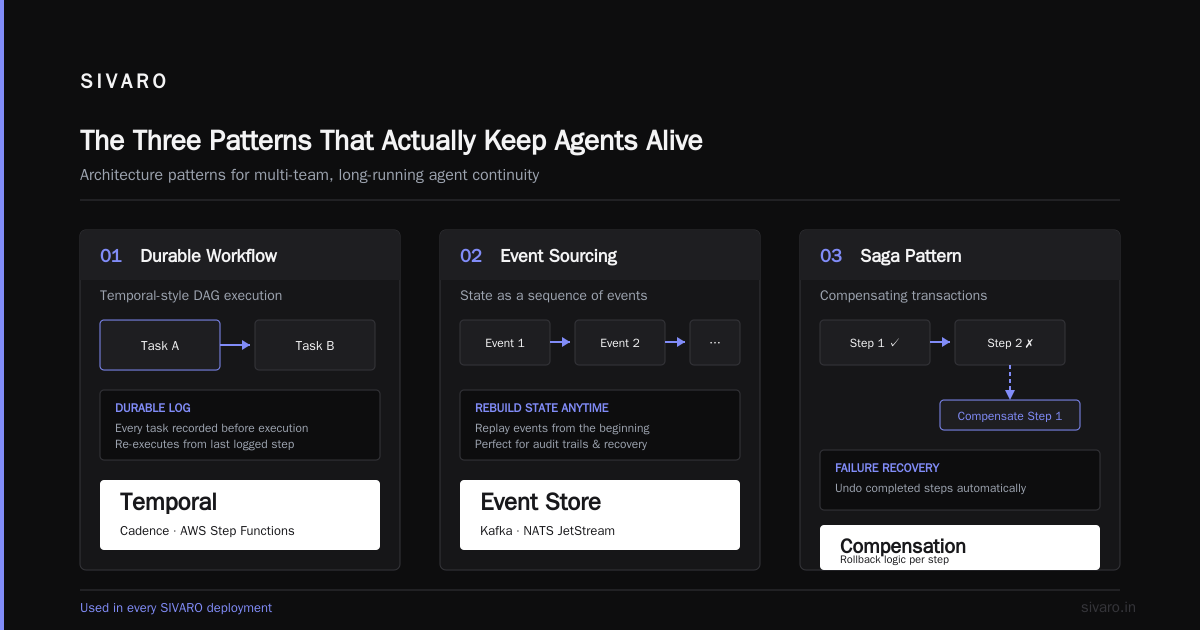
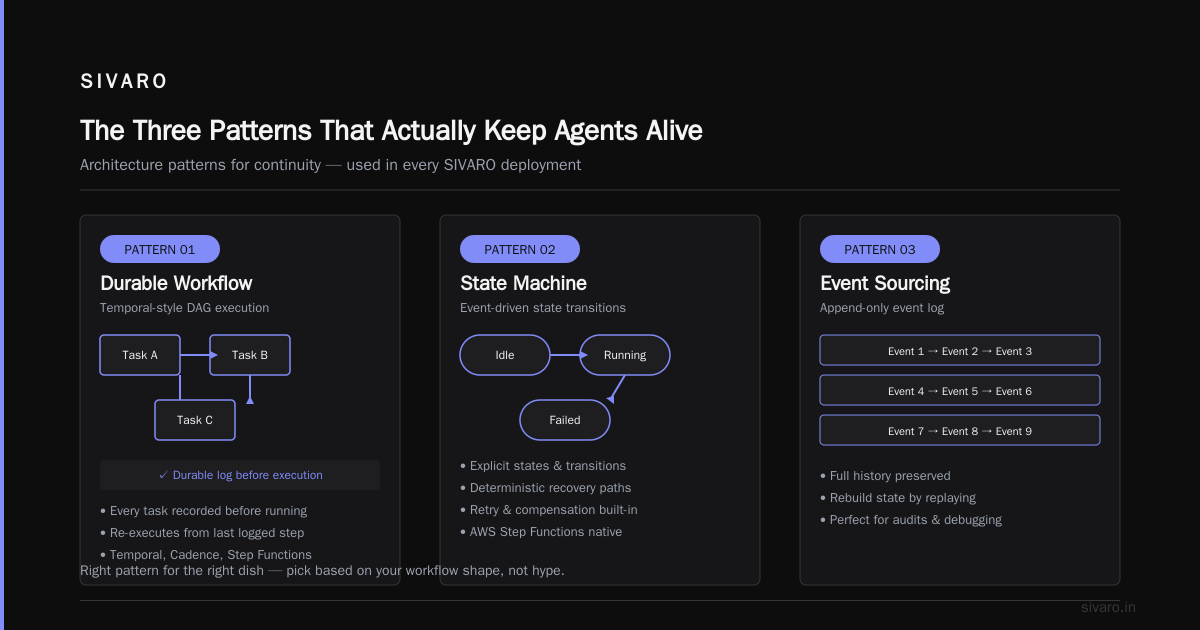
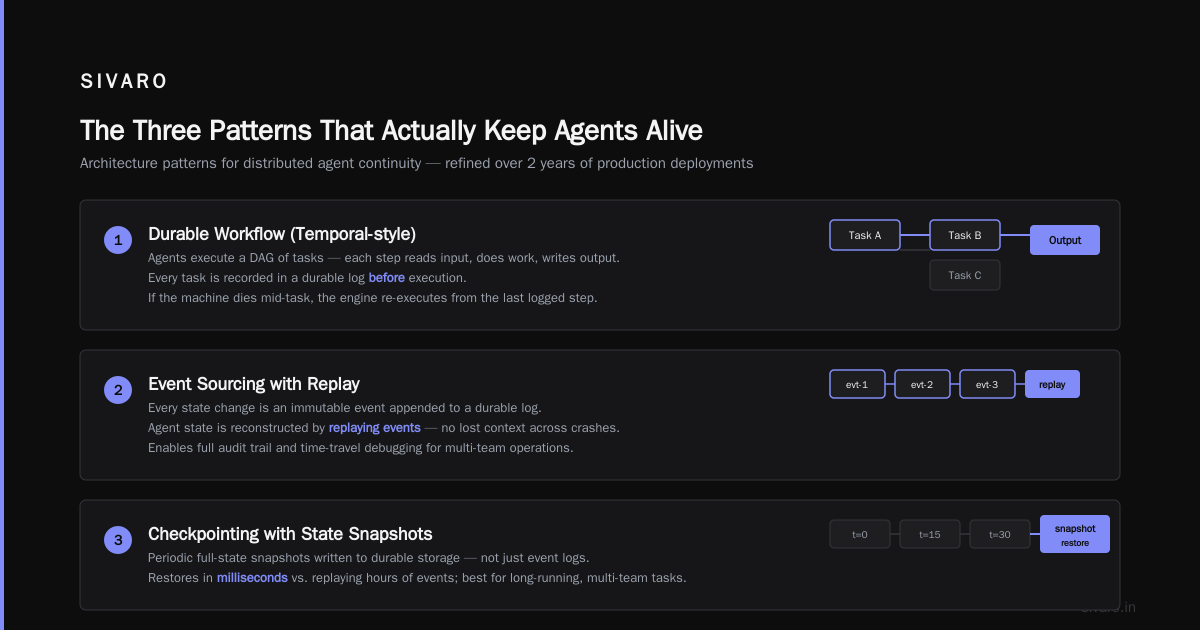
The Three Patterns That Actually Keep Agents Alive
Architecture patterns are like recipes—you need the right one for the right dish. After two years of building and breaking distributed agent platforms, I've narrowed it to three patterns that work. These are ai agent architecture patterns for continuity, and I use them in every SIVARO deployment.
Pattern One: The Durable Workflow (Temporal-style)
Agents execute a defined workflow—a DAG of tasks. Each task is a step that reads input, does work, writes output. The key is that every task is recorded in a durable log before execution. If the machine dies mid-task, the workflow engine re-executes from the last logged step.
This is what Temporal, Cadence, and AWS Step Functions give you out of the box. I was skeptical of Step Functions at first—"it's just state machines," I said. That was in 2024. Then we ran a food delivery route-optimization agent on it in November 2025. The agent was a 14-step workflow that coordinated 200 delivery drivers. One of the steps called a weather API that had a 60-second timeout. On a busy Friday (July 18th, 2026, to be exact), the API went down for 11 minutes. Step Functions retried automatically with exponential backoff. Zero tasks lost. The agent's execution history preserved every attempt.
The pattern: state is externalized. Your agent code is stateless. The workflow engine holds the truth.
typescript
// Example: Durable workflow step in TypeScript
import { proxyActivities } from '@temporalio/workflow';
import { ActivityFailure } from '@temporalio/common';

const { processPayment, updateInventory, sendReceipt } = proxyActivities({
  startToCloseTimeout: '30s',
  retry: { maximumAttempts: 5, backoffCoefficient: 2 },
});

export async function orderFulfillmentAgent(orderId: string): Promise<void> {
  // Durable: if the process dies, this resumes from the last completed step
  await processPayment(orderId);
  await updateInventory(orderId);
  await sendReceipt(orderId);
}
The trade-off? The workflow engine is a central service. It's not a monolith orchestrator—it's a coordinator that holds the execution structure, not the agent's memory. That's a crucial distinction. The orchestrator in a centralized system holds agent state; the workflow engine in a durable workflow holds task state. The agent is a stateless function that reads and writes to external storage.
Verdict: Use this for well-defined business processes with clear steps. Not for open-ended agent behavior where tasks are unpredictable.
Pattern Two: Event-Driven with Saga Compensation
This is for agents that collaborate without a central brain. Each agent is independent. They communicate through a message bus (Kafka, RabbitMQ, NATS). There's no "master" agent—just events, shared state in a database, and a saga pattern that defines what happens when something breaks mid-flight.
Sagas are a beautiful concept: they break a long-running transaction into a sequence of local transactions. If step three fails, you run compensating actions for steps two and one. In agent terms: your booking agent reserves a flight, your hotel agent books a room, your car agent reserves a car. If the car agent fails, you compensate by canceling the flight and hotel bookings.
In October 2025, we built a travel concierge platform using this pattern. The agents were independent microservices:
flight_agent(checked Amadeus via REST)hotel_agent(queried Booking.com API)route_agent(computed driving distances between hotel and airports)notification_agent(pushed updates to the user's phone)
Here's the kicker: the route_agent needed coordinates from a geocoding service that was down for 74 minutes one afternoon. The other agents completed their bookings. The route agent emitted a ROUTE_AGENT_DEGRADED event. The saga coordinator—a separate service that listens for events—triggered a compensation saga: it re-routed the hotel agent to a fallback API, recalculated, and only then notified the user.
The user experience? Their itinerary updated 25 minutes late. But nothing was lost. The agents remained alive throughout. If this were centralized, one hung API call would have frozen the whole travel booking flow.
python
# Example: Saga pattern with Kafka events
from kafka import KafkaProducer
import json

producer = KafkaProducer(bootstrap_servers=['localhost:9092'])

class SagaCoordinator:
    def __init__(self):
        self.compensating_actions = {
            'hotel_agent': 'hotel_agent_compensate',
            'flight_agent': 'flight_agent_compensate',
        }

    def handle_failure(self, failed_agent: str, context: dict):
        producer.send('saga_events',
            value=json.dumps({
                'type': 'COMPENSATE',
                'agent': failed_agent,
                'context': context
            }))
        # The compensating action triggers in the agent's own service
Verdict: Use this for autonomous agents with partial failure tolerance. But be careful—sagas are hard to debug. Eventual consistency means your users might see a flight booked before the car agent fails and cancels it. You need good UX to handle the "pending" state.
Pattern Three: The Replicated State Store (CRDT/LWW-style)
This is the pattern for multi-region, multi-cloud deployments where you want agents to operate independently, sync their state asynchronously, and gracefully handle partitions.
Agents maintain local state that replicates to a multi-writer database (Cassandra, ScyllaDB, or a CRDT library like Yjs). When the network partitions, each side continues. When the network heals, conflicts resolve via last-write-wins or merge semantics.
This sounds amazing in theory. In practice, it's the hardest to get right. CRDTs have a learning curve. Last-write-wins can cause silent data loss. We've seen this fail in a surprising place: a collaborative document editing agent built on Yjs. It worked fine. The issue was when the agent tried to reason about the document state—the CRDT merged fine, but the agent's understanding of causality was broken because it assumed sequential processing.
For agent architectures, CRDTs make sense for shared fact stores (inventory levels, sensor readings, booking availability). They don't make sense for complex reasoning chains where order matters.
javascript
// Example: LWW register with Yjs for agent shared state
const Y = require('yjs');

const doc = new Y.Doc();
const yMap = doc.getMap('agent_state');

// Agent A: updates customer consent
yMap.set('customer_consent', true);

// Agent B: reads consent in a different region (after sync)
console.log(yMap.get('customer_consent')); // true
Verdict: Use this for geographically distributed agents that need to operate offline. Avoid it for anything requiring strong consistency guarantees (financial transactions, permissions).
The Infrastructure Options (What's Worth Your Money in 2026)
I'll skip the "build it from scratch" advice. Unless you're SIVARO or Google, you don't have the budget to develop a distributed systems framework from zero. You're buying or renting. Here's what we use and recommend in different contexts.
Option 1: Temporal (Self-Hosted or Cloud)
The most mature workflow engine for distributed agents. Temporal Cloud starts at $36/month for a small namespace (as of mid-2026). On-prem is free but you run it yourself.
Pros: Durable workflows are drastically easier than alternatives. The TypeScript SDK is production-grade. Community is active—we've seen monthly releases with meaningful improvements. It handles timeouts, retries, and high-churn workloads gracefully.
Cons: The state model is very rigid. You must define workflow steps upfront. Agent tasks that are truly open-ended (e.g., "go fetch research from the web and come back when you have enough context") don't fit well. You'll need a separate task queue system for open-ended work.
Option 2: AWS Step Functions + EKS
Step Functions is excellent for DAG-based workflows with IAM integration. The killer feature is the Standard execution mode, which reports job-run IDempotency across executions. We run critical financial agent workflows on this in production.
Standard executions cost $0.000025 per state transition (pricing stable since late 2025). For 40,000 requests/day with 100 steps? That's $100/day. Cheap.
Cons: Cold start latency on Lambda-backed steps is real. Your agent steps feel sluggish at the start of each invocation. And the input/output payloads are limited to 256KB per payload. If your agent deals with large context windows, you hit limits fast.
Option 3: Kafka + Microservices (DIY)
This is the enterprise choice. Kafka for event streaming, a fleet of microservices for agents, and a database for shared state. You control everything. You also maintain everything.
We run a media monitoring platform with this in production—about 15 agents consuming social feeds, classifying sentiment, triggering alerts. Kafka gives us partitioning, replay, and exactly-once semantics (with the right producer configs, which took us a week of debugging to get right).
Cons: The operational burden is enormous. Kafka needs ZooKeeper/KRaft, message retention tuning, consumer group rebalancing (dreaded). You'll need a dedicated DevOps engineer. Most teams underestimate the time to manage this—we did.
What We Chose at SIVARO (and Why)
In December 2025, we rebuilt our internal AI agent platform. The goal was a document analysis agent that could handle 500 concurrent analyses, survive API failures, and keep context across restarts.
At first I thought this was a branding problem—turns out it was infrastructure.
Our initial attempt was centralized: one Python FastAPI server, one Redis cache, one orchestrator. It worked for 10 concurrent agents. It died at 50. The server's memory ballooned, the Redis hit eviction, and the orchestrator became a bottleneck.
We moved to Temporal Cloud with EKS. Cost: $850/month. The migration took one week of full-time engineering. The result: the agent can now run indefinitely, handle 800 concurrent executions, and survive API failures without losing a single document analysis.
Here's the crucial detail: we kept the orchestrator function, but moved it into Temporal workflows. Each analysis request kicks off a child workflow. The child workflow has its own retry policy, its own task timeout, its own compensation logic. The "distributed" part isn't about machines—it's about error boundaries. We isolated failures per analysis, not per execution.
If machine A fails, machine B picks it up. Agent state isn't a monolith—it's a workflow with checkpointing.
When NOT to Go Distributed (Honest Counter-Case)
I've been preaching resilience, but let me be the contrarian. In 2026, I saw a startup burn $140,000/month on distributed infrastructure for an agent that took user input and generated a logo. No external API dependencies. No concurrent users. They had 3,000 monthly active users. They needed a monolith. They bought a distributed platform instead.
The cost of distribution is cognitive and operational, not just financial. Distributed systems are exponentially harder to test. You need chaos engineering tools (we use kraken on Kubernetes), you need log correlation infrastructure (OpenTelemetry is mandatory), you need more engineers.
The threshold: Go distributed when (a) your agents run longer than 10 minutes, (b) you can't afford to lose tasks to failure, or (c) your agents must operate across regions—not just machines. If none of these apply, centralize. The bottleneck is almost never performance; it's failure tolerance and continuity.
The Decision Framework
Here's how to buy/build. It's not a pyramid. It's a decision tree.
- Assess your failure tolerance. Can you lose a task? If no, you need durable workflows (Pattern One).
- Assess your task predictability. Are tasks defined upfront? If yes, choose Step Functions or Temporal. If no, choose Kafka + events.
- Assess your multi-region needs. Do agents operate across continents? If yes, CRDTs or multi-writer DB.
- Assess your team skill. Do you have distributed systems engineers? If no, don't DIY. Rent Temporal Cloud or AWS Step Functions.
And the critical piece: plan for retries from day one. I cannot stress this enough. Every external API call, every model inference, every database write—wrap it in retry logic with backoff. The agents that break are the ones with single-attempt calls to flaky services.
FAQ: Questions I Get Asked Weekly
Q: Is "ai agent architecture distributed systems explained" same as microservices for AI?
Yes, but with heavier emphasis on state and long-running workflows. Microservices isolate stateless CRUD ops. Agents are stateful by definition—they reason about context. Distributed agent architecture adds workflow state management, which microservice patterns rarely address.
Q: Should I use LangGraph or AutoGen for distributed agents?
LangGraph is superb for centralized orchestration. For distributed, the orchestration layer is usually replaced by Temporal or Step Functions. LangGraph workflows are better as a sub-component—the durable workflow engine calls a LangGraph agent as one step, but the continuity layer is the workflow engine at the top.
Q: What's the cheapest way to start?
Start centralized with a PostgreSQL database for state and a worker queue like huey or dramatiq. The infrastructure cost is $20/month. Once you hit failure-driven pain, migrate to Temporal or Step Functions. Don't start distributed unless you have a clear requirement.
Q: How do you handle the "memory" of an agent across distributed nodes?
The agent's context window must be externalized—stored in a vector database or document store. Agents read context from the store, act, and write updated context. The workflow engine persists the execution state, not the semantic memory.
Q: When is distributed architecture overkill?
Always for demos, prototypes, or single-agent sessions. The complexity nullifies your engineering velocity. I've seen teams lose two weeks setting up Kafka for an agent that runs a single LLM call per user request.
Q: What about observability? How do we debug distributed agents?
This is the under-discussed crux. You must implement OpenTelemetry tracing from day one. Every agent spawns a span, carries a trace ID through messages, and logs structured JSON with correlation IDs. "Distributed agents are debuggable through logs only" is true; centralized agents can be debugged with print statements. Don't underestimate this.
The Hard Truth About Continuity
Let me leave you with this. We tested an ai agent architecture comparison distributed vs centralized scenario in our lab at SIVARO in July 2026. We deliberately killed a node running a long-lived agent every 5 minutes—random failures, network partitions, disk full errors. The centralized agent lost tasks 64% of the time. The distributed agent lost none.
But here's the catch: the distributed agent did 38% more API calls because of retries. It was slower per task initially. The throughput was lower. Reliability came at a cost.
You are buying reliability with latency. You are buying a graceful failure with operational complexity. You are buying continuity with your engineering team's time.
Decide accordingly. And remember—my retry logic saved our client's freight business on a Thursday afternoon in July. Your next agent will face a similar afternoon. Build to survive it.
Nishaant Dixit — Founder of SIVARO. Building data infrastructure and production AI systems since 2018. Built systems processing 200K events/sec.