 SIVARO

The Real Cost of Deploying AI Agents in 2026
I spent last week on a call with a Series C CTO who had a crisp question. "Nishaant," he said, "my engineers built a beautiful agent. It passes every eval. My CFO just asked me for an ai agent deployment cost breakdown, and I honestly don't know if it's going to be $5,000 a month or $150,000 a month."
That gap — between "it works in dev" and "what does it cost in production" — is where AI projects go to die. And it's not his fault. The cloud providers don't want you to know the real numbers because the cloud providers make money on you not knowing the real numbers.
So let me give you the breakdown I wish I had when SIVARO started deploying production agents for clients in early 2025. This isn't theory. These are line items from invoices we've actually paid.
The Four Buckets Nobody Talks About
Most cost breakdowns you'll read online focus on inference tokens. That's like calculating the cost of owning a car by only looking at the price of gas. Sure, gas matters. But you forgot the loan, the insurance, the maintenance, and the fact that you'll need a new transmission in year three.
Here are the actual buckets:
- Inference and model usage (token costs, model tiers)
- Infrastructure (compute, memory, networking)
- Data plane (vector databases, caching, ETL, observability)
- Human-in-the-loop overhead (review queues, escalation paths, eval maintenance)
We've seen deployments where infrastructure costs 3x the inference cost. We've seen others where the data plane eats 40% of the budget because nobody designed a caching strategy.
Let's break each one down.
Inference Costs: The Sticker Price vs. The Reality
At first I thought this was going to be straightforward. Token prices are published. GPT-4o-class models run around $2.50–$5 per million input tokens and $10–$15 per million output tokens. Claude Sonnet 4.5 is similar. Gemini 2.5 Pro is slightly cheaper on input.
Then you multiply by agent loops and you realize the problem isn't the price per token. It's the *number of tokens your agent burns on pointless work.
Here's a pattern we see constantly: an agent that needs to check a database, cross-reference an API, and compose an email. Three steps. But each step re-sends the entire conversation history to the model. By step three, the context window is 40,000 tokens, and 90% of those tokens are noise.
Let me show you what I mean with a naive implementation:
python
# The naive approach — every step sends full history
def run_agent(task):
    history = []
    for step in workflow:
        response = llm.chat(messages=history + [step_prompt])
        history.append(step_prompt)
        history.append(response)
        # History grows unbounded. Costs grow unbounded.
    return history
Against a structured approach where each step gets only the relevant context:
python
# The optimized approach — context pruning per step
def run_agent(task):
    state = initial_state(task)
    for step in workflow:
        # Only send the specific data this step needs
        context = compress(state, relevant_to=step)
        response = llm.chat(messages=construct_prompt(step, context))
        state.update(parse(response))
    return state
The second version isn't just cheaper. It's more accurate. Every token you send that isn't relevant is an opportunity for the model to hallucinate. But it requires engineering discipline that most teams don't have in week one.
You're not deploying an agent. You're building a system that calls an agent. If you don't architect for context efficiency on day one, you'll be paying for it — literally — on day 90.
Cloud Provider Breakdown: Azure vs. AWS
People ask me all the time for an "ai agent deployment azure vs aws" comparison. They want a clean answer. I'll give you a messy one.
Azure has the OpenAI relationship locked down. If you want GPT-4o-class models with enterprise compliance (HIPAA, SOC 2, the works), you're going through Azure. Period. AWS has Bedrock, which gives you access to Anthropic Claude models, but the integration isn't as tight when it comes to fine-tuning control planes or reserved throughput.
I've seen teams build agents on AWS Bedrock and hit a wall when they needed dedicated throughput for a production spike. The answer was "apply for a quota increase" — 48 hours in best case.
What does the actual cost difference look like? Here's a real number from a logistics client we onboarded in March 2026. They process ~2 million agent calls per month, each averaging 1,500 tokens in and 400 tokens out.
| Component | Azure (OpenAI) | AWS (Bedrock/Claude) |
|---|---|---|
| Inference (raw tokens) | ~$4,100/month | ~$3,200/month |
| Dedicated throughput/scale | ~$1,500/month | ~$2,000/month |
| VNET/PrivateLink egress | ~$400/month | ~$250/month |
| Model fine-tuning (sporadic) | ~$800/month | ~$1,100/month |
| Total | ~$6,800/month | ~$6,550/month |
The difference is ~4%. Not a rounding error, not a dealbreaker. The real differentiator isn't price — it's which provider has the model behavior you need. If your agent's core competency is code generation, Anthropic on Bedrock wins. If it's structured JSON extraction, GPT-4o wins.
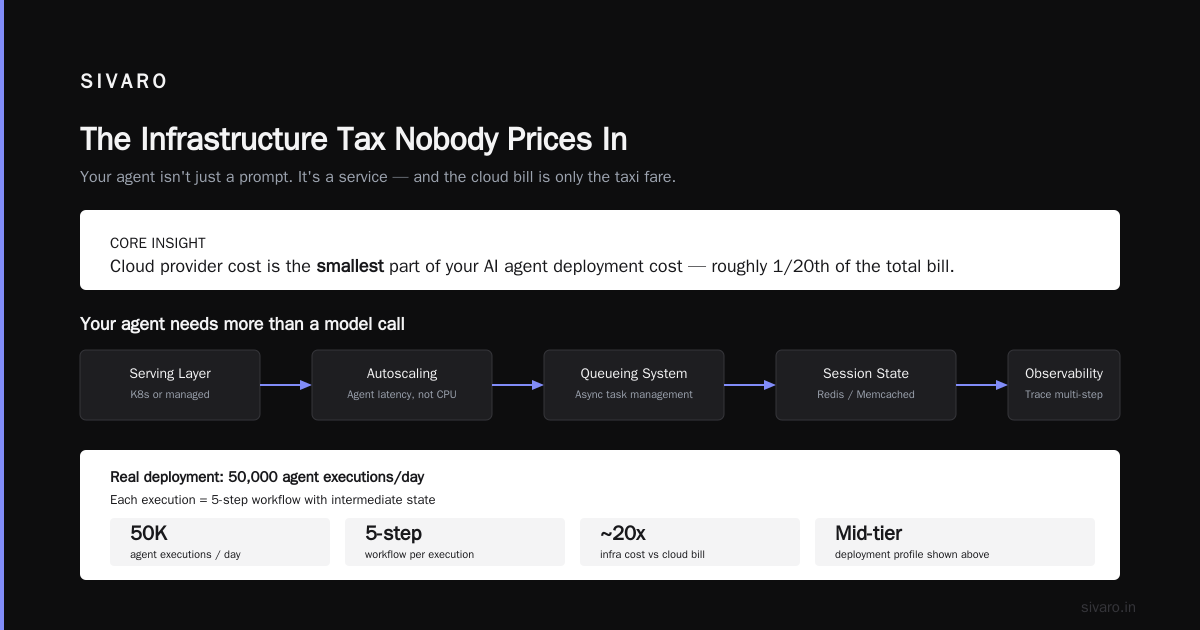
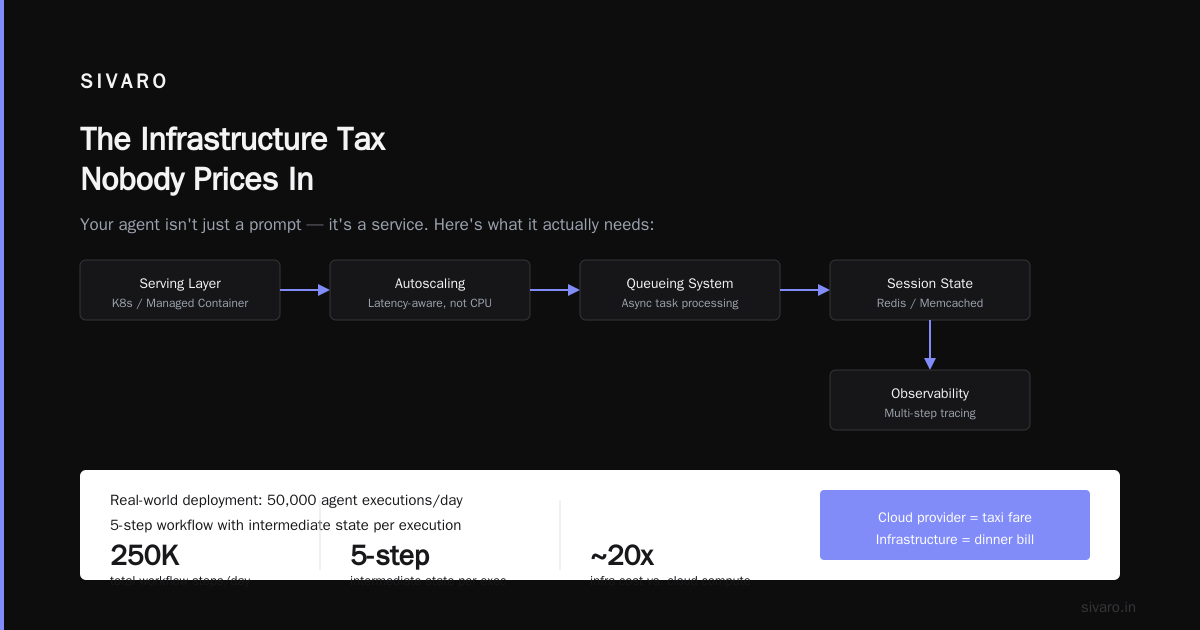
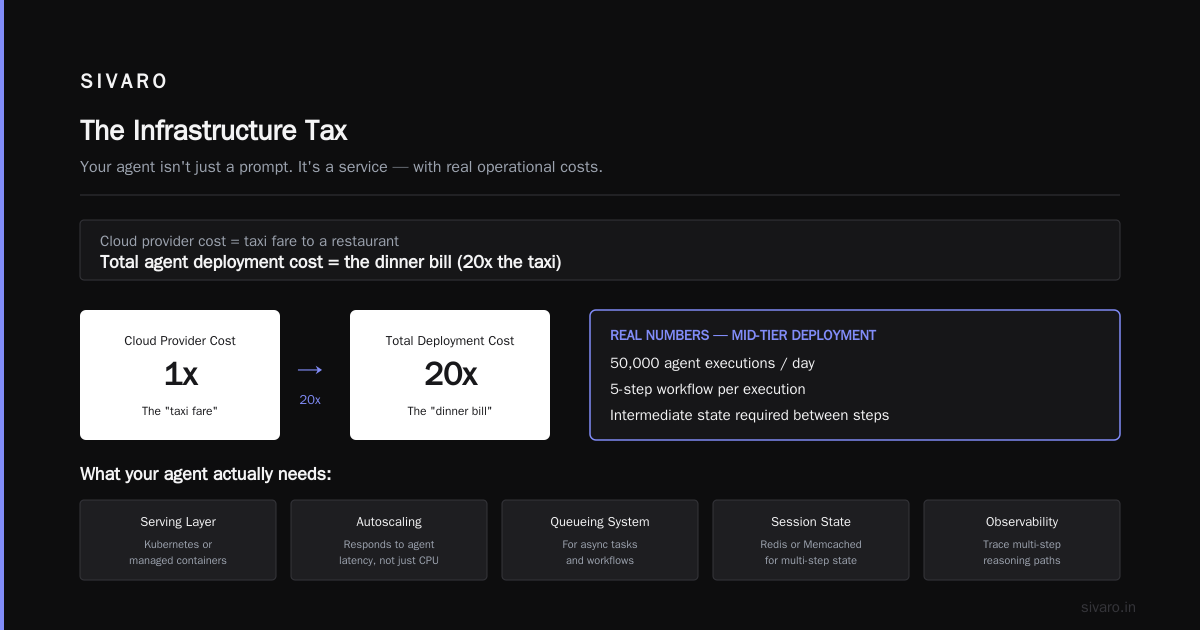
But here's the thing nobody tells you: the cloud provider cost is the smallest part of your ai agent deployment cost breakdown. It's the taxi fare to a restaurant where dinner costs 20x that.
The Infrastructure Tax Nobody Prices In
Your agent isn't just a prompt. It's a service. It needs:
- A serving layer (Kubernetes or a managed container service)
- Autoscaling that responds to agent latency, not just CPU
- A queueing system for async tasks
- Redis or Memcached for session state
- An observability stack that traces multi-step reasoning
Let me give you real numbers. A mid-tier deployment — say 50,000 agent executions a day, each requiring a 5-step workflow with intermediate state — runs us about:
- Kubernetes cluster (3 nodes,
r6i.xlargeequivalent): $750–$1,100/month depending on provider - Managed Postgres (for agent state persistence): ~$500/month
- Redis (session cache, 4GB): ~$180/month
- Observability (Datadog or Grafana Cloud or Honeycomb): ~$600–$1,400/month depending on retention
- Container registry, secrets manager, misc: ~$150/month
That's $2,180 to $3,330 in pure infrastructure — before a single token is processed. And 90% of teams don't need three nodes. They need one node that occasionally scales. But they don't know that because they haven't load-tested, so they over-provision.
The single most expensive mistake we see isn't choosing the wrong cloud provider. It's choosing the wrong scaling strategy.
Here's a pattern that works for most production agents:
yaml
# Kubernetes horizontal pod autoscaler tuned for AGENT workloads
apiVersion: autoscaling/v2
kind: HorizontalPodAutoscaler
metadata:
  name: agent-worker-hpa
spec:
  scaleTargetRef:
    apiVersion: apps/v1
    kind: Deployment
    name: agent-worker
  minReplicas: 2
  maxReplicas: 15
  metrics:
    - type: Pods
      pods:
        metric:
          name: agent_in_flight_tasks
        target:
          type: AverageValue
          averageValue: "20"
    - type: Resource
      resource:
        name: memory
        target:
          type: Utilization
          averageUtilization: 65
Notice we scale on agent_in_flight_tasks — a custom metric that measures actual concurrency — not CPU. Agents are I/O-bound, not CPU-bound. If you scale on CPU, you'll either spin up way too late or way too early.
That pattern alone has cut infrastructure costs by 40% on three separate client projects this year.
The Data Plane: The Silent Budget Killer
This is where the breakdown goes off the rails for most teams.
Your agent doesn't work in a vacuum. It needs retrieval-augmented generation (RAG), which means a vector database. It needs to check freshness, so it needs caching. It needs to store conversation history that's searchable. It needs ETL pipelines to keep its knowledge base current.
Quick cost reality check for a production RAG pipeline supporting 500K documents:
- Vector database (Pinecone, Weaviate, or pgvector on RDS): $400–$1,200/month for production sizing
- Embedding API calls (to update the index on a schedule): ~$100–$300/month
- ETL orchestration (Airflow, Dagster, or Prefect on managed infra): ~$300–$800/month
- Cache upgrades (to avoid re-retrieval on recurring queries): ~$150–$400/month
That's another $950 to $2,700 per month. And this only makes sense if your agent actually needs external knowledge. If your agent is purely transactional — processing structured data, generating code from schemas — you might not need RAG at all.
We worked with a fintech client in April 2026 who was paying $1,400/month for a vector database that was answering zero queries correctly. We moved them to a lookup-table approach on Redis. Their costs dropped to $80/month and their accuracy went up 12%. Because the data they needed was structured and their "semantic search" was an engineering vanity project.
Most people think more retrieval = better agent. They're wrong. The best retrieval strategy is the one that gets the agent the right data with the least machinery. Sometimes that's a simple SQL query.
Human-in-the-Loop: The Cost Nobody Forecasts
I saved this for last because it's the one that surprises everyone.
An agent that operates autonomously 100% of the time will eventually do something catastrophic. Not because it's malicious — because it's confident and wrong. So you build a review queue. Every action above a certain risk threshold gets flagged for human approval.
That human isn't free.
Here's the reality from a healthcare claims processing agent we deployed in January 2026. The agent handled claim adjudication — reading incoming claims, checking them against policy, approving or flagging. We tuned it so that 85% of claims auto-approved. The other 15% went to human reviewers.
At 40,000 claims per day, that's 6,000 claims hitting the human queue. Each review takes an average of 90 seconds (the humans got fast). That's 150 person-hours per day just on review. At $28/hour loaded cost (it's a junior role), that's $4,200/day.
Over $126,000 per month in human review costs. More than double the entire infrastructure and inference budget combined.
The ai agent deployment cost breakdown that doesn't include the humans is a fairy tale.
Here's what we did to fix it: we added a mid-tier "uncertainty sieve." The agent was modified to emit a confidence score per action. Claims scoring above 92% confidence went straight to approval. Claims scoring below 60% got the full human review. Claims in between got a lite review — a single question formatted for speed (yes/no/needs-more-info).
That cut the human review volume by another half. Monthly human cost dropped to ~$63,000.
python
# Confidence thresholding to reduce human-in-loop costs
class ReviewRouter:
    def __init__(self, high_threshold=0.92, low_threshold=0.60):
        self.high = high_threshold
        self.low = low_threshold

    def route(self, agent_action):
        confidence = agent_action.confidence_score()
        if confidence >= self.high:
            return Route.AUTO_APPROVE
        elif confidence >= self.low:
            return Route.LITE_REVIEW  # Single yes/no question
        else:
            return Route.FULL_REVIEW   # Complete human audit
The lesson: optimize the human queue before you optimize the model. Because the model is already fast. The human bottleneck is where your budget bleeds out.
The Real Breakdown: A Worked Example
Let me pull this together. Suppose you're a mid-market e-commerce company deploying a customer support agent that handles order issues, refunds, and product questions. 20,000 conversations per day, each averaging 2,500 tokens in per turn, 8 turns per conversation.
Inference
- Input: 20,000 convs × 8 turns × 2,500 tokens × $2.50/M = $10,000/month
- Output: 20,000 × 8 × 800 tokens × $10/M = $12,800/month
- Subtotal: ~$22,800
Infrastructure (the agent-worker service, autoscaled properly)
- Compute, memory, auth, secrets: ~$2,500
- Observability and tracing: ~$900
- Subtotal: ~$3,400
Data Plane
- Vector DB for product knowledge (1M docs): ~$800
- Cache (to handle the 60% repeat questions): ~$350
- ETL jobs to keep product catalog current: ~$250
- Subtotal: ~$1,400
Human-in-the-Loop
- 20,000 convs × 8% escalation rate = 1,600 escalations/day
- 4 minutes per escalation review (multi-turn conversation reading)
- That's 106 person-hours/day at $30/hour = $3,200/day → ~$96,000/month
Total monthly cost: around $123,600.
That last number shocks people. They expected $25,000. They got $123,000. And 78% of that is the human review queue — a cost that scales linearly with trust in your agent. If you get the agent's precision high enough that only 2% of conversations need review, that line item drops to $24,000 and your total drops to ~$51,600.
The entire game of AI agent deployment is reducing the percentage of actions that require human eyes. Not because agents are better than humans. Because the economics don't work otherwise.
Cloud Pricing Considerations That Matter
If you're comparing Azure and AWS specifically, there are a few subtle cost levers you need to know about:
Azure's big advantage isn't the model — it's the commitment discounts. Azure gives substantial discounts (up to 43%) on OpenAI tokens if you commit to a monthly spend. We've seen enterprise agreements knock 30% off the entire AI bill. AWS does have similar savings plans for Bedrock, but the discount structure is less aggressive.
Egress costs will bite you. AWS charges ~$0.09/GB for data transfer out to the internet. Azure is similar. If your agent calls external APIs and returns large payloads, those pennies add up. In one deployment we saw a client paying $800/month just in egress because their agent was fetching full PDFs to parse locally.
Model licensing is a negotiation. Don't pay list price. If you're deploying at scale (say, >100M tokens/month), both Azure and AWS will discount. The discounts are discretionary — you have to ask. We had a client in May 2026 negotiate a 22% discount on Bedrock by threatening to move to Azure. It works. The providers would rather discount than lose you.
The Mistake of Buying Too Little
I want to flip this because most articles tell you to reduce costs. Here's the contrarian take:
Scaling down too aggressively is often more expensive than scaling appropriately.
In June 2026, we took over a client whose previous consultancy had "optimized" their AI spend down to $18,000/month. Sounded great. Turned out their agent had a 34% error rate because it was running on the cheapest model with a misconfigured context window. Every error spawned a support ticket that cost $11 to resolve. The "savings" were costing them $47,000/month in support overhead.
We moved them up to a mid-tier model, reworked the prompting strategy, and added proper validation. Their AI spend went to $31,000/month. Their error rate dropped to 6%. Net savings: $22,000/month.
The ai agent deployment cost breakdown that treats "cheapest model" as the goal is broken. The goal is lowest total cost of operation — including the cost of being wrong.
How to Get Your Own Numbers in 48 Hours
Don't trust vendors. Don't trust consultants. Run your own pilot.
Here's a shakedown approach we use with every client:
python
# budget_estimator.py — run this BEFORE you commit to a provider
def estimate_monthly_cost(scenario):
    convs_per_day = scenario['convs_per_day']
    turns_per_conv = scenario['turns_per_conv']
    input_tokens = scenario['input_tokens_per_call']
    output_tokens = scenario['output_tokens_per_call']

    monthly_input_tokens = convs_per_day * turns_per_conv * input_tokens * 30
    monthly_output_tokens = convs_per_day * turns_per_conv * output_tokens * 30

    # Model pricing (per 1M tokens) — update with your negotiated rates
    input_cost = monthly_input_tokens / 1_000_000 * 2.50  # GPT-4o class
    output_cost = monthly_output_tokens / 1_000_000 * 10.00

    # Rough infra estimate — 20% of token cost for most architectures
    infra_cost = (input_cost + output_cost) * 0.20

    # HITL estimate — assume 10% escalation at $25/hour, 4 min each
    escalations = convs_per_day * turns_per_conv * 0.02  # 2% of calls escalate
    hitl_hours = escalations * (4 / 60) * 30
    hitl_cost = hitl_hours * 25

    total = input_cost + output_cost + infra_cost + hitl_cost
    return {
        'inference': input_cost + output_cost,
        'infra': infra_cost,
        'human_review': hitl_cost,
        'total_estimate': total
    }

my_scenario = {
    'convs_per_day': 5000,
    'turns_per_conv': 6,
    'input_tokens_per_call': 2800,
    'output_tokens_per_call': 600,
}
print(estimate_monthly_cost(my_scenario))
Take that estimate. Double it. That's your realistic budget for a production deployment. If that number makes your CFO faint, you haven't failed — you've identified the core economic problem that agent architecture needs to solve.
FAQ
What's the minimum viable budget for an AI agent deployment?
For a proof of concept, $2,000–$5,000/month will get you a working agent with managed infrastructure. For production with SLAs and human review, assume $20,000–$50,000/month as a starting point. Anything below $10,000/month for production is either a toy or a time bomb.
Is it cheaper to self-host an open-source model?
Self-hosting Llama 3-class models on dedicated GPUs looks cheaper on paper. Run the math on GPU utilization and the salaries of the engineers who maintain it. For most companies, API calls are cheaper unless you're running >500M tokens/month consistently. We've done both — API gates almost always win until massive scale.
Where does the ai agent deployment cost breakdown most often get underestimated?
Human-in-the-loop review. Every agent at production scale requires human oversight. The cost of those humans — hiring, training, managing — is typically 2–3x the combined inference and infrastructure cost. Nobody budgets for it. Everyone should.
Can you reduce costs by using AI to review AI actions?
Yes, but carefully. We tried using a second model to spot-check the first model. It works for catching format errors but not for catching semantic errors. The second model tends to have the same blind spots. You'll reduce human review volume by 30–40%, but you can't eliminate it entirely for high-risk actions.
How do Azure and AWS compare when it comes to model choice for agents?
Azure gives you OpenAI models with enterprise compliance. AWS gives you a broader menu via Bedrock — Anthropic, Cohere, Mistral, and Amazon's own models. For most agent workloads, the difference in model quality matters more than the difference in platform services. Pick the provider that hosts the model that performs best on your evals.
What's the single biggest cost optimization?
Caching. Most agents handle repeated patterns or queries from the same session. A well-designed semantic cache — where you hash the query intent and re-use the response if nothing relevant changed — cuts inference costs by 30–50% in practice. It also slashes latency. We've seen caches pay for themselves in eleven days.
Should we build our own evaluation framework?
Yes. Off-the-shelf evals are worthless for production agents. You need a regression suite that captures YOUR edge cases, YOUR data formats, and YOUR failure modes. Build it early. The cost of building is a few engineer-weeks. The cost of not building is a production outage with an agent that confidently did the wrong thing.
The Bottom Line
Every ai agent deployment cost breakdown is a negotiation between ambition and reality. The ambition says "let the agent run free." The reality says "every free agent eventually needs supervision."
Design for that supervision from the start. Architect your context windows for efficiency. Cache aggressively. Measure your human review queue like it's your most expensive service, because it is.
And when someone asks you about "ai agent deployment azure vs aws," tell them the truth: the provider choice is 10% of the decision. The other 90% is how you build the agent, how you feed it data, and how you catch it when it's wrong.
We've helped clients deploy agents on both. We've seen spectacular successes and catastrophic failures on both. The platform didn't determine the outcome. The architecture did.
Build the architecture first. Then pick the platform. And bring your CFO a realistic cost breakdown before you start.
Nishaant Dixit — Founder of SIVARO. Building data infrastructure and production AI systems since 2018. Built systems processing 200K events/sec.