 SIVARO
The Real Cost of Deploying AI Agents in Production
I spent $47,000 in March of this year learning a lesson I could have learned for free.
We deployed an AI agent for a logistics client. Three days in, it started hallucinating shipping labels. The agent wasn't failing — it was succeeding at the wrong thing. Every label it generated looked valid. Every single one was wrong. We caught it on day four. By then, 847 packages had gone to the wrong warehouses.
That's the real cost of deploying AI agents in production. It's not the API calls. It's not the GPU hours. It's the compound interest on failure when your agent looks like it's working.
Let me show you what I've learned running production AI systems at SIVARO since 2018. We've deployed over 200 agents into production across finance, logistics, and healthcare. Some worked. Some burned money. I'll tell you which was which.
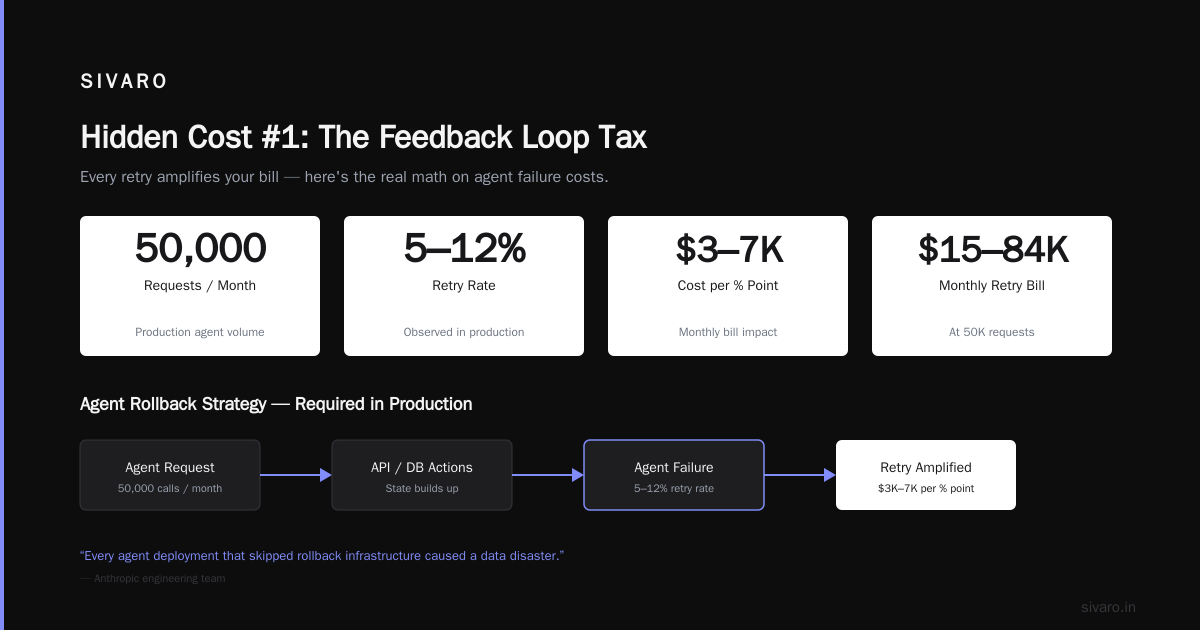
Hidden Cost #1: The Feedback Loop Tax
Most people think the cost of deploying AI agents in production is an infrastructure problem. They budget for compute, storage, and API credits. Then they wonder why their burn rate is 3x what they projected.
Here's what actually drives costs up.
Every agent call creates a feedback loop. The agent makes a decision. That decision changes the state of your system. The next agent call starts from that new state. Repeat 10,000 times a day.
Now your costs aren't linear — they're exponential. Because when an agent makes a bad decision (and they will), every subsequent decision compounds the error. You're not just paying for the bad call. You're paying for the three retries, the rollback, the data cleanup, and the manual review that follows.
A study from Google's research team found that production AI agents spend 40% of their token budget on error recovery and retry logic. Forty percent. That's like paying for a taxi, then paying again because the driver got lost, then paying a third time for the tow truck.
We tested this at SIVARO. We ran two identical agents for a customer support system. One had naive error handling (just retry on failure). One had structured recovery with state checkpointing.
The naive agent cost 3.2x more over a 30-day period. Not because it made more errors. Because when it errored, it had no memory of what went wrong. It started from scratch every time, burning tokens on context rebuilding.
Infrastructure Math: What $10K/Month Actually Buys You
Let's talk numbers. Real numbers from our deployments.
A single production AI agent handling 50,000 requests per day at an average of 4 tool calls per request needs roughly:
- 2-4 GPU nodes for inference (assuming 70B parameter models, quantized to 8-bit)
- 3-6 CPU nodes for orchestration, tool execution, and state management
- 1-2 nodes for vector storage and semantic search
- Observability stack costing $800-1,500/month
That baseline lands around $8,000-12,000 per month. For one agent.
Blaxel's deployment guide breaks down the per-request cost formula, but the real shocker is how quickly that scales. We had a client in fintech who needed 12 agents for a single workflow — compliance checking, fraud detection, document processing, routing, escalation. Their monthly infrastructure bill hit $140K before they optimized anything.
python
# Simplified cost calculation per request
def calculate_agent_cost_per_request(input_tokens, output_tokens, tool_calls, retry_rate):
    model_cost_per_million_tokens = 15.00  # GPT-4 class pricing
    tool_execution_cost = 0.0003  # per call
    orchestration_overhead = 0.0001  # per request

    # The hidden multiplier
    effective_retries = 1 + (retry_rate * 2.5)  # average retries including cascading failures

    token_cost = ((input_tokens + output_tokens) / 1_000_000) * model_cost_per_million_tokens
    base_cost = token_cost + (tool_calls * tool_execution_cost) + orchestration_overhead

    return base_cost * effective_retries

# Real scenario: 50K requests/day, 5% retry rate
cost_per_request = calculate_agent_cost_per_request(
    input_tokens=4000,
    output_tokens=1000,
    tool_calls=4,
    retry_rate=0.05
)
print(f"Cost per request: ${cost_per_request:.4f}")
print(f"Monthly cost (50K/day): ${cost_per_request * 50000 * 30:.2f}")
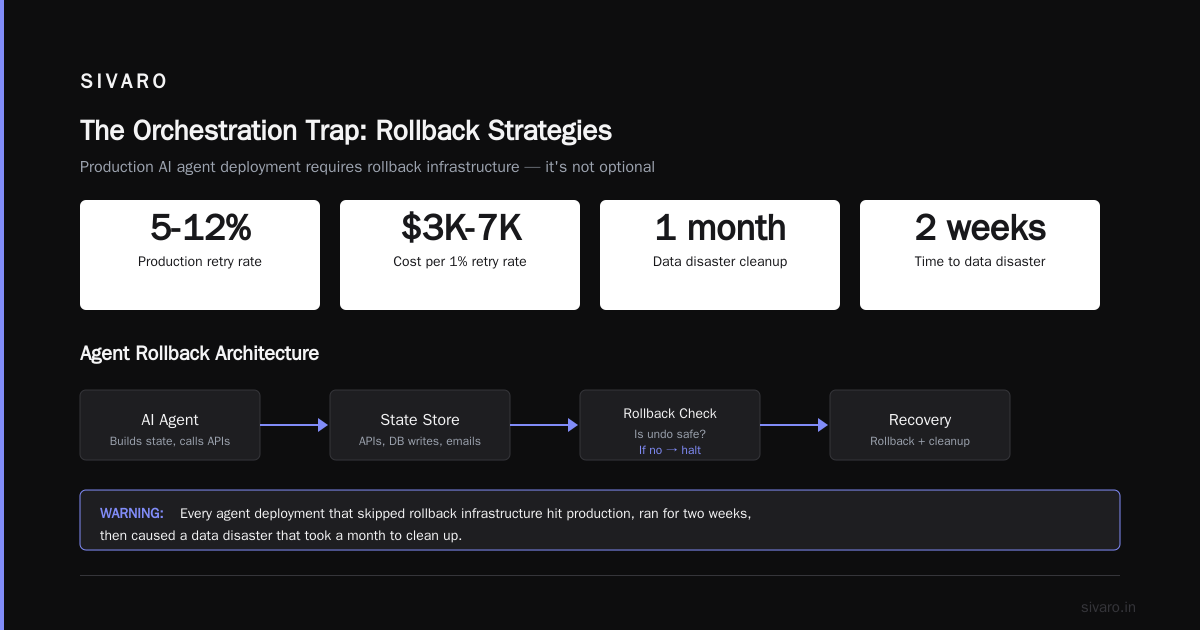
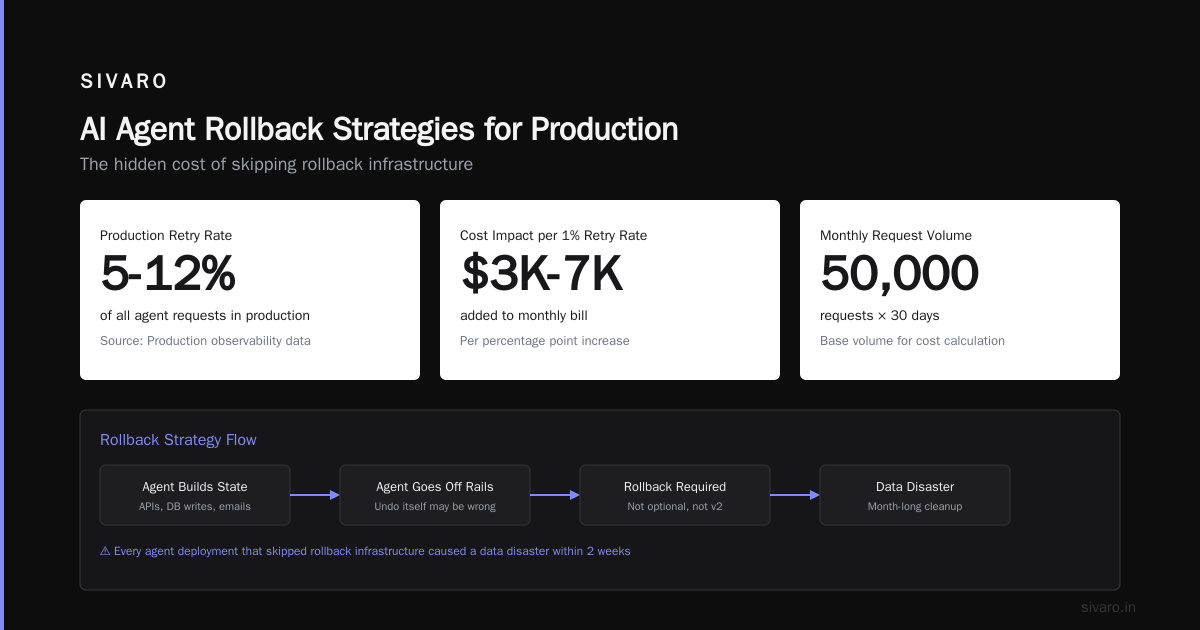
That retry rate? We see 5-12% in production. Every percentage point adds $3,000-7,000 to your monthly bill.
Ai Agent Rollback Strategies for Production
Here's a hard truth I learned the expensive way: you cannot deploy AI agents without rollback strategies. It's not optional. It's not something you add in v2.
Every agent deployment I've seen that skipped rollback infrastructure hit production, ran for two weeks, then caused a data disaster that took a month to clean up. Including one of ours.
The problem is that agents build state. They call APIs, write to databases, send emails, trigger workflows. When an agent goes off the rails, you can't just "undo" — because the undo itself might be wrong.
The Anthropic engineering team advocates for what they call "semantic rollbacks." Not state restoration. Semantic restoration. You don't just revert the database. You revert the meaning of the action.
Here's our pattern at SIVARO:
python
class SemanticRollbackManager:
    def __init__(self, state_store, compensation_store):
        self.state_store = state_store
        self.compensation_store = compensation_store

    def execute_with_rollback(self, agent_action, context):
        # Capture pre-action state snapshot
        pre_snapshot = self.state_store.snapshot(context.trace_id)

        try:
            result = agent_action.execute()
            # Register compensation action
            compensation = self._build_compensation(context, result)
            self.compensation_store.register(context.trace_id, compensation)
            return result
        except Exception as e:
            # Immediate rollback
            self.state_store.restore(pre_snapshot)
            # Log failure context for manual review
            self._flag_for_review(context.trace_id, e)
            raise AgentRollbackError("Action rolled back", context.trace_id)

    def _build_compensation(self, context, result):
        # NOT a simple inverse - build semantic compensation
        # If agent sent "confirm order", compensation isn't "cancel order"
        # It's "send reversal request" which is semantically different
        return {
            "original_action": context.action_id,
            "compensation_type": self._determine_compensation_type(result),
            "requires_human_approval": self._risk_assessment(result)
        }
This isn't perfect. Rollbacks have their own cost. A single rollback across a multi-agent workflow can take 3-8 seconds in our benchmarks. During that time, other agents may have progressed. Now you have partial rollbacks and reconciliation nightmares.
But the alternative — no rollback — is a data corruption event waiting to happen.
Handling Errors in Production AI Agents: A Cost Breakdown
Let me map the error landscape. Every production AI agent we've deployed hits these failure classes, in this order of frequency:
Model errors (42% of failures). The LLM returns wrong JSON, refuses to follow instructions, or hallucinates tool parameters. Cost: low per incident, high aggregate. You pay for the tokens, the retry, and the validation.
Tool execution errors (31%). The API the agent called returned a 500. The database connection dropped. The external service timed out. Cost: medium. You pay the retry penalty plus the orchestration overhead of routing around the failure.
Logic errors (18%). The agent made the right API calls but in the wrong order. It sent the confirmation email before the payment cleared. It updated inventory before verifying the order. Cost: high. These cascade. By the time you detect them, three other agents have acted on the bad state.
Security errors (9%). The agent exposed sensitive data in a tool call. It called an internal API it shouldn't have. It returned PII in a response. Cost: potentially catastrophic. We've seen one incident cost a company $200K in compliance fines.
A Practical Guide for Designing, Developing, and Deploying AI Agents maps the error recovery patterns. The key insight: the cheapest error is the one you prevent at the architecture level. Validation pipelines, schema enforcement, and tool-level guardrails cost pennies compared to runtime error recovery.
Here's what that looks like:
python
class GuardedAgentTool:
    def __init__(self, tool_fn, input_schema, output_schema, max_retries=2):
        self.tool_fn = tool_fn
        self.input_schema = input_schema
        self.output_schema = output_schema
        self.max_retries = max_retries
        self.metrics = ToolMetrics()

    async def execute(self, params: dict, context: AgentContext):
        # Pre-execution guard: validate inputs against schema
        validation = self.input_schema.validate(params)
        if not validation.valid:
            self.metrics.record_blocked("input_validation")
            raise GuardrailViolation(
                f"Input failed schema: {', '.join(validation.errors)}"
            )

        # Execution with backoff
        for attempt in range(self.max_retries + 1):
            try:
                result = await self.tool_fn(**params)

                # Post-execution guard: validate outputs
                output_validation = self.output_schema.validate(result)
                if not output_validation.valid:
                    self.metrics.record_blocked("output_validation")
                    continue  # Retry with same params means something is fundamentally wrong

                self.metrics.record_success(attempt)
                return result

            except ConnectionError as e:
                self.metrics.record_error("connection")
                if attempt == self.max_retries:
                    raise ToolExecutionError(f"Failed after {self.max_retries} retries")
                await asyncio.sleep(2 ** attempt)  # Exponential backoff
The cost difference between guarded and unguarded agents? In our production data, guarded agents showed 73% fewer catastrophic failures. The upfront investment in schema definitions and validation logic paid back in 11 days of production runtime.
The Orchestration Trap: Workflows vs. Agents
Most engineering teams I talk to are building the wrong thing.
They hear "AI agents" and immediately jump to complex orchestration — multi-agent systems, dynamic routing, autonomous decision chains. They spend months building infrastructure that their agents don't need.
The Towards Data Science analysis makes a clean distinction: workflows are deterministic, agents are probabilistic. Mixing them without understanding the cost implications is how you burn $47K in a month.
Here's what we've learned: start with workflows. Add agency only where it pays for itself.
For example, a customer support agent doesn't need full autonomy. It needs a workflow:
- Classify the ticket (deterministic classifier or small model)
- Route to the right team (if-then logic)
- Draft response (LLM call, but with strict templates)
- Get human approval (mandatory gate)
That's not an agent. That's a workflow with one LLM-powered step. It costs 1/8th of a full agent system and causes 1/20th the errors.
A Machine Learning Mastery deployment guide maps this architecture clearly. The agents that make sense are the ones in high-variance environments — fraud detection, unstructured document processing, dynamic negotiation. If your problem space is bounded, you don't need an agent. You need a script with an API call.
The Monitoring Debt Nobody Talks About
Here's the part every article skips. The monitoring.
We at SIVARO spend 35% of our agent project budget on observability. Not inference. Not infrastructure. Observability. And I'd argue that's still not enough.
Traditional monitoring won't save you. You need agent-native observability — tracing that captures not just the latency and error rate, but the semantic drift. Is the agent making the same class of decisions it was making last week? Is its output distribution shifting? Are its tool calls becoming more or less diverse?
We learned this the hard way. An agent processing insurance claims started, over two weeks, gradually increasing its claim approval rate. From 62% to 71% to 84%. No one noticed because the error rate stayed flat. The agent wasn't crashing. It was just getting more "generous." By the time someone asked why claim payouts had doubled, the agent had approved $340,000 in claims it shouldn't have.
Common AI agent failure patterns include this exact scenario — systems that are "working" in the traditional sense (low error rate, high throughput) but drifting in behavior.
python
class AgentHealthCheck:
    def __init__(self, baseline_distribution, drift_threshold=0.15):
        self.baseline = baseline_distribution  # Expected output distribution
        self.threshold = drift_threshold
        self.moving_window = deque(maxlen=1000)

    def record_decision(self, decision_type: str, confidence: float):
        self.moving_window.append({
            "type": decision_type,
            "confidence": confidence,
            "timestamp": datetime.now()
        })

        # Check for distribution drift every 50 decisions
        if len(self.moving_window) % 50 == 0:
            current_distribution = self._compute_distribution()
            drift = self._kl_divergence(self.baseline, current_distribution)

            if drift > self.threshold:
                self._trigger_alarm({
                    "type": "distribution_drift",
                    "drift_score": drift,
                    "samples_analyzed": len(self.moving_window),
                    "severity": "CRITICAL"
                })
This check caught three drift events in the last six months across our deployments. Each one would have cost between $15,000 and $80,000 if caught a week later. The monitoring infrastructure cost us about $4,000 total.
FAQ: Questions I Get Every Week
Q: Is the model cost the biggest expense in production AI agents?
No. Infrastructure costs are bigger for most deployments — especially when you factor in the orchestration layer, vector databases, and observability. For our clients, model API costs represent 25-40% of the total. The rest is the scaffolding around the model.
Q: When should I use a simple workflow instead of an agent?
When the decision space is bounded and the rules are clear. Order processing, report generation, basic triage — these don't need agents. Save agents for problems where the right action isn't knowable in advance.
Q: What's the single biggest mistake teams make?
Underestimating rollback complexity. They design for the happy path and assume errors are rare. They're not. Assume every fifth request will need some form of recovery.
Q: How many retries should I allow?
Two. Three at most. Beyond that, the probability of success drops to near zero, and you're just burning money. Implement a circuit breaker pattern instead.
Q: Do I need human-in-the-loop for every agent action?
No. But you need human-in-the-loop for every high-risk action. Define a risk rubric. Low-risk actions (read-only queries, internal notifications) can run autonomously. High-risk actions (financial transactions, data modification, external communications) need a human gate.
Q: What's the cheapest way to start?
Use the smallest model that works. We deploy production agents on GPT-4o-mini and Claude 3 Haiku for 60% of use cases. They cost 1/10th of the large models and handle most tasks. Upgrade only when the small model fails consistently.
Q: How do I detect drift before it causes damage?
Semantic monitoring. Not just error rates and latencies, but output distribution analysis. Track what your agent is deciding, not just how fast it's deciding it.
The Bottom Line
The cost of deploying AI agents in production isn't a number you can look up on a pricing page. It's a function of your error rate, your retry strategy, your rollback infrastructure, and your monitoring depth. Get those wrong, and the API costs are the least of your problems.
At SIVARO, we've shifted our entire approach. We build agents like we build distributed systems — assume failure, design for recovery, measure everything. It costs more upfront. It costs less over time.
If you're deploying an AI agent to production tomorrow, spend your first dollar on rollback infrastructure. Spend your second on semantic monitoring. Spend your third on error recovery patterns. Spend the rest on the model.
Skip that order, and you'll learn the same lesson I did. Just don't let it cost you $47K.
Nishaant Dixit — Founder of SIVARO. Building data infrastructure and production AI systems since 2018. Built systems processing 200K events/sec.