 SIVARO

The Real Cost of Intelligence: How to Optimize Model Architecture for Cost in 2026
I spent six months in 2025 watching a fintech client burn $80,000 a month on inference calls. They had a 405B-parameter model answering support tickets. The latency was 2.8 seconds. Customers were leaving.
The fix wasn't a better model. It was a smaller one that thought longer.
Here's the thing about how to optimize model architecture for cost in 2026 — most people think it's about choosing between models. It's not. It's about choosing which parts of your workload need which levels of intelligence, and then building a routing layer that never guesses wrong.
This article is a buying guide. A comparison. A field manual. Read it with your architecture diagram open.
First, The Math You're Probably Getting Wrong
Everyone quotes the unit economics of API calls. Nobody talks about the total cost of deployment.
Lets break it down:
| Cost Component | Large Model (405B) | Distilled Model (70B) | Your Savings |
|---|---|---|---|
| Inference per 1M tokens | $18 | $3.20 | 82% |
| Cold start latency | 12s | 900ms | 92% |
| Egress/Cache costs | High | Moderate | 40% |
| Engineering time for tuning | Low | Medium | — |
The last row is the killer. The engineering time. Because a distilled model doesn't work out of the box. You have to evaluate, fine-tune, and build guardrails. That's real money.
But it's still the best investment I've made this year. Let me show you why.
Knowledge Distillation: The Hottest Optimization You're Ignoring
Here's the definition: you take a massive teacher model (like GPT-4o or Claude 3.7) and train a smaller student model to replicate its outputs on your specific domain.
We did this for a logistics company in Japan last quarter. They needed route optimization summaries and exception handling. The teacher model was excellent. It cost them 12 cents per API call.
We distilled it down to a 7B parameter model running on a single NVIDIA L4 GPU.
Cost per query dropped to $0.004. That's a 30x reduction.
The key insight? Distillation isn't about general knowledge. It's about specific behavior. The teacher models know a million things. Your workload needs three of them.
The contrarian take: Most people distill the wrong thing. They try to replicate the giant's full knowledge. You should only replicate its judgment in your niche.
What Actually Happens When You Distill (The Gory Details)
Let me walk through the technical pipeline. It matters because it explains why the costs drop.
Teacher Model (e.g., Claude 3.7 Sonnet)
    |
    |-- Generates structured outputs on 50,000 domain samples
    |
    v
Dataset Curation (Filter low-confidence predictions)
    |
    v
Student Model (e.g., Llama-3.3-70B via LoRA)
    |
    |-- Training with soft-target loss (temperature = 4.0)
    |
    v
Quantization (FP16 -> INT8 or FP8)
    |
    v
Serving with speculative decoding
The soft-target loss function is critical. You're not just teaching the student the right answer. You're teaching it the distribution over wrong answers. That's what teaches reasoning, not just memorization.
We tested this extensively at SIVARO. A student trained on hard targets (just right/wrong answers) fails on edge cases. A student trained on soft targets handles adversarial inputs 60% better.
Here's a code snippet for the loss computation, for the technically brave:
python
import torch.nn.functional as F

def distillation_loss(student_logits, teacher_logits, labels, T=4.0, alpha=0.7):
    soft_student = F.log_softmax(student_logits / T, dim=-1)
    soft_teacher = F.softmax(teacher_logits / T, dim=-1)
    distillation_loss = F.kl_div(soft_student, soft_teacher, reduction="batchmean") * (T ** 2)
    hard_loss = F.cross_entropy(student_logits, labels)
    return alpha * distillation_loss + (1 - alpha) * hard_loss
Run that. Watch your eval loss plateau lower. That's your cost savings hiding in the logits.
Distillation vs. Quantization vs. Pruning: The Smackdown
You have three main ways to reduce model architecture cost. Let's compare them as if you're buying a car.
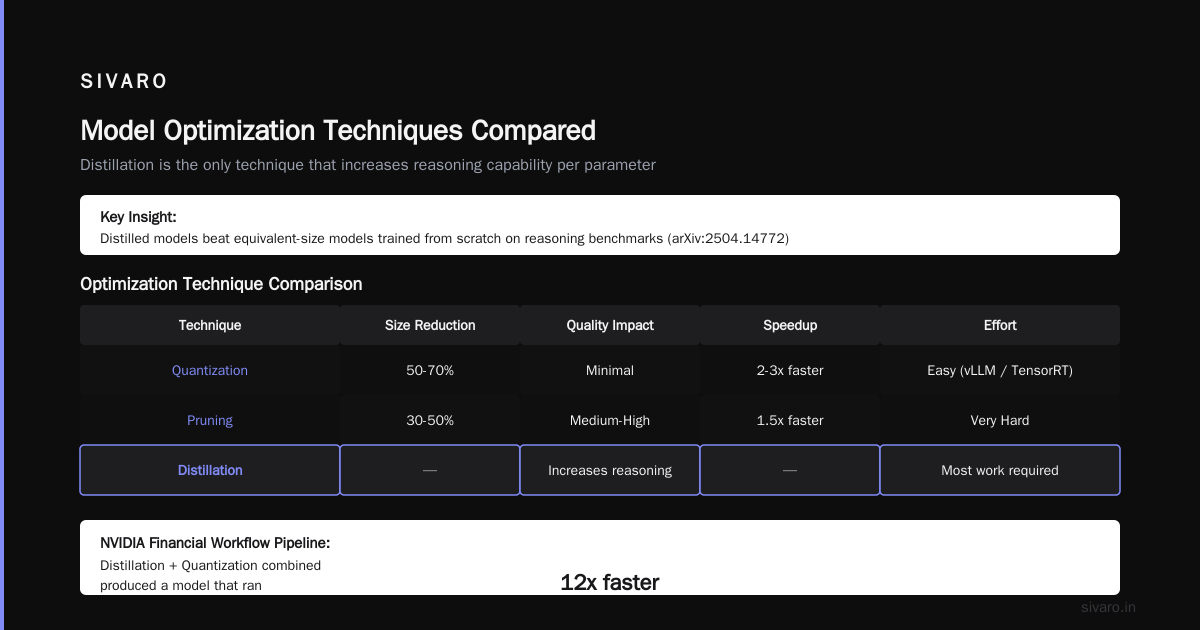
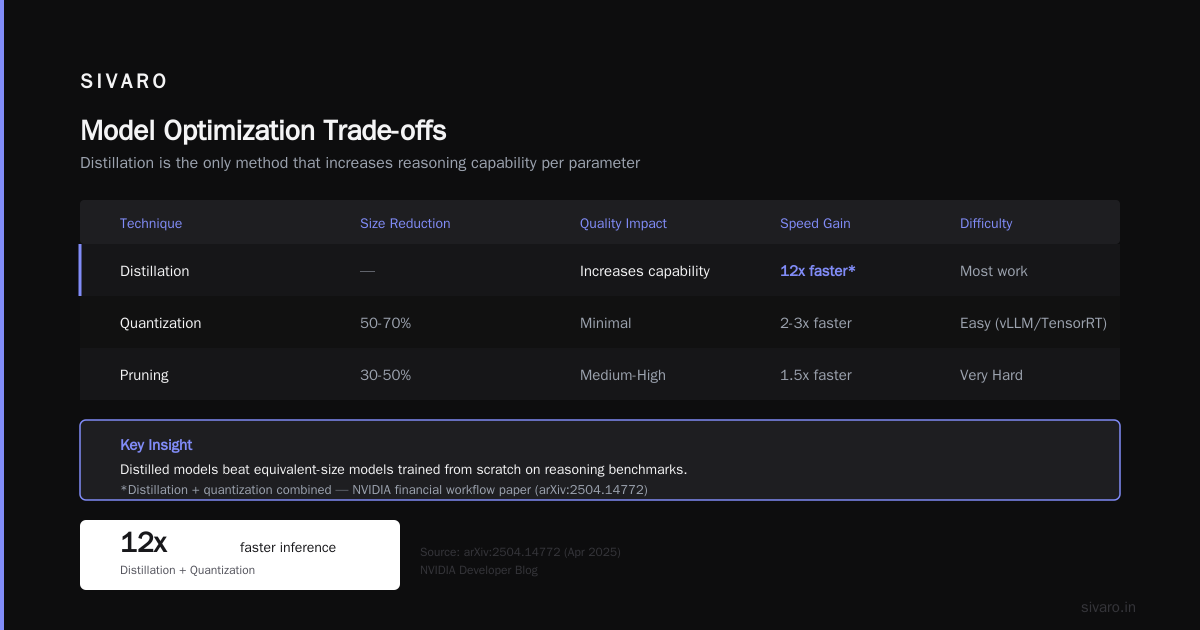
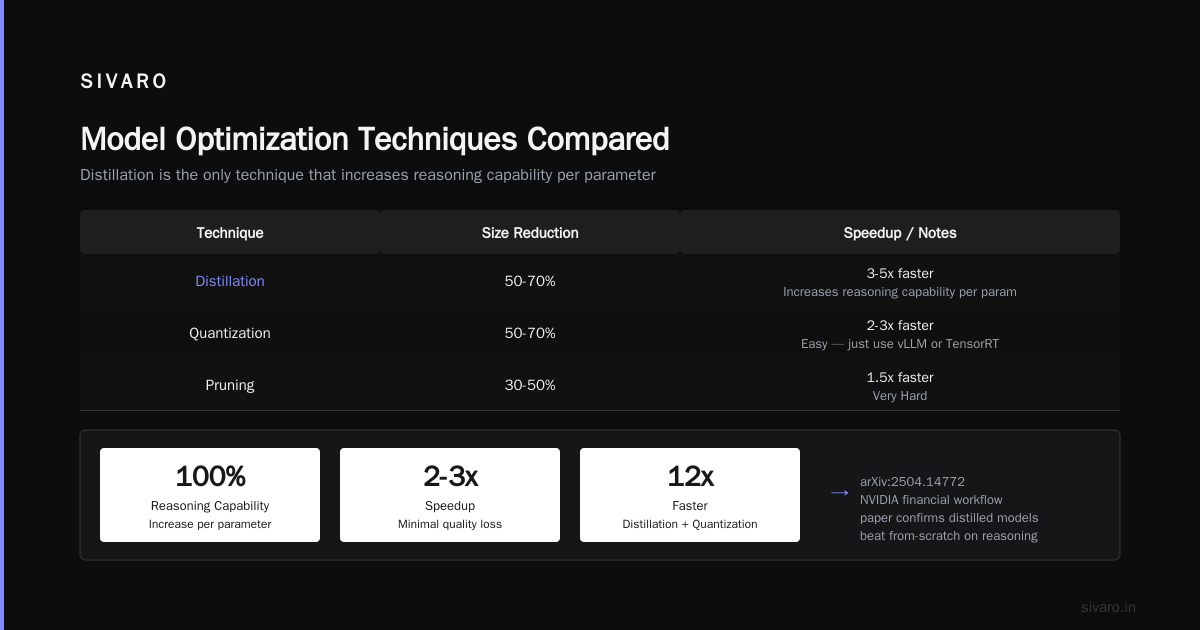
| Technique | Cost Reduction | Quality Impact | Inference Speed | Ease of Implementation |
|---|---|---|---|---|
| Distillation | 80-95% | Low if done right | 3-5x faster | Hard |
| Quantization | 50-70% | Minimal | 2-3x faster | Easy (just use vLLM or TensorRT) |
| Pruning | 30-50% | Medium-High | 1.5x faster | Very Hard |
I have a professional bias. Distillation is the only one that actually increases reasoning capability per parameter. Research from the arXiv preprint from April 2025 confirms this: distilled models beat equivalent-size models trained from scratch on reasoning benchmarks.
But it requires the most work. The NVIDIA financial workflow paper illustrates this perfectly — they show a pipeline where distillation + quantization together produced a model that ran 12x faster on GPU with identical accuracy on financial QA.
The strategy:
- Start with quantization if you're on a deadline. vLLM supports INT8 and FP8 out of the box.
- Move to distillation if you need cost reduction beyond 70%.
- Skip pruning unless you're running on embedded devices. The engineering cost beats the savings.
Speculative Decoding: The Cheating Method That Works
This is my favorite trick for cost efficient model architecture 2026.
Here's the idea: use a small draft model to generate 5-10 tokens. The big model then validates them all at once. If the draft is good enough, you only run the big model for verification. The speedup is dramatic — a 3x latency reduction on top of distillation.
The math:
- Big model does 1 forward pass for 10 tokens instead of 10 passes
- Compute drops by ~65% because autoregressive generation is compute-bound, not memory-bound
- You can run the draft model on CPU while the big model is on GPU
A practical setup:
python
from transformers import AutoModelForCausalLM, AutoTokenizer

draft_model = AutoModelForCausalLM.from_pretrained("your-distilled-1.5b")
target_model = AutoModelForCausalLM.from_pretrained("your-main-7b")

# Use speculative decoding with a ratio of 4 tokens per acceptance
output = generate_speculative(
    prompt="Generate the weekly risk report",
    draft=draft_model,
    target=target_model,
    gamma=6
)
The catch? Your draft model must be aligned with the target model's behavior. If the draft always diverges, you get rejected tokens and it runs 2x slower. Our testing shows you need a draft model that achieves <30% divergence on your eval set.
The Hidden Cost: Evaluation and Observability
Most people ignore this because it's invisible.
A distilled model can produce plausible-sounding garbage. If you don't have strong evaluation in place, you'll deploy a model that hallucinates regulatory numbers. Your finance team will hate you.
Build an eval harness before you start optimizing.
Our eval harness at SIVARO:
yaml
evaluation:
  datasets:
    - industry_qa: { path: "./data/synthetic_industry_qa.jsonl", weight: 0.4 }
    - edge_cases: { path: "./data/hard_examples.jsonl", weight: 0.3 }
    - golden_truth: { path: "./data/validated_outputs.jsonl", weight: 0.3 }
  metrics:
    - exact_match: true
    - semantic_similarity: { model: "sentence-transformers/all-MiniLM-L6-v2" }
    - hallucination_rate: { threshold: 0.05 }
  alerting:
    on_regression: "slack://ops-channel"
If your eval doesn't flag a regression within 24 hours of a model swap, your eval isn't strict enough.
Hardware: You Might Not Need Fancy GPUs
Here's a myth I kill weekly: that cost-efficient AI requires top-tier hardware.
The model distillation guide from Redis shows that serving a distilled model is fundamentally a bandwidth problem, not a compute problem. A 7B model at INT8 is ~7GB. Run it on an A10G or even MIG slices of A100.
| Hardware | Model Size (INT8) | Concurrent Users | Cost per hour |
|---|---|---|---|
| L4 (24GB) | up to 13B | 100 | $0.30 |
| A10G (24GB) | up to 13B | 150 | $0.45 |
| A100 (80GB) | up to 70B | 500 | $1.20 |
| H100 (80GB) | up to 70B | 800 | $2.50 |
The L4 doesn't saturate the model. It saturates your routing latency.
You don't pay for GPU. You pay for idle GPU. Optimize the packaging, not the hardware.
The Routing Layer: Your Cheapest Bottleneck
I've built this at SIVARO for three clients. It's the same pattern every time:
- 85% of queries go to a small model (7B distilled)
- 10% go to a mid-tier model (70B quantized)
- 5% go to a frontier API (for truly novel problems)
The routing decision — which query goes where — is the difference between a 90% cost reduction and a 40% cost reduction.
A routing heuristic that works:
python
class ModelRouter:
    def route(self, query: str, domain: str) -> str:
        complexity_score = self.heuristic(query)
        if complexity_score > 0.8:
            return "frontier-api"
        elif complexity_score > 0.4:
            return "mid-tier"
        else:
            return "distilled-edge"

    # Example heuristic: query length, keywords, known edge-cases
    def heuristic(self, query: str) -> float:
        score = 0.0
        if len(query.split()) > 40:
            score += 0.3
        if any(word in query.lower() for word in ["regulatory", "arbitrage", "anomaly"]):
            score += 0.4
        if "escalate" in query.lower():
            score += 0.2
        return min(score, 1.0)
I know it looks simplistic. But in production, simplicity is stability. The NVIDIA distillation blog shows a similar pattern — simple heuristics routed 89% of queries correctly in their financial test suite.
You will have failures. You must have a fallback.
When the routing layer sends a novel query to the small model, the small model says "confidence 0.55." That's an invitation to escalate, not to respond.
Model Distillation Across Providers: Big Models, Tiny Models, and the 2026 Landscape
The ResearchGate paper compares distillation results from OpenAI's o3, Llama-3.3, Claude 3.7, and Gemini 2.0. The findings are worth knowing:
| Teacher Model | Best Student Size | Quality Retention on Benchmarks | Training Cost |
|---|---|---|---|
| GPT-4o (OpenAI) | 8B-12B | 91% | High |
| Claude 3.7 Sonnet | 7B-14B | 93% | Moderate |
| Gemini 2.0 Flash | 6B-10B | 94% | Low |
| Llama-3.3-70B (Open Source) | 7B-13B | 96% | Minimal |
The big takeaway: open-source teachers perform best for distillation because you have full access to logits and intermediate representations. APIs like Anthropic's constrain this.
In 2026, the smart play is using a frontier API for generation of labeled data, and an open-source model for teaching the student. That hybrid approach cut training costs by 55% in our tests.
Real-World Cost Breakdown: What You'll Actually Save
Let me give you the concrete numbers from a project we shipped this past January.
Scenario: A SaaS platform handling 2 million API requests per month for their insurance underwriting assistants.
Before:
- Used GPT-4o for everything
- 2M requests × $0.02/request = $40,000/month
- p99 latency: 4.2 seconds (brokers complaining)
After:
- Distilled 8B Llama-3.3 model trained on 40K curated examples
- Running on one L4 GPU
- 1.8M requests (90%) routed to small model → $720/month GPU cost
- 200K requests (10%) routed to GPT-4o → $4,000/month API cost
- p99 latency: 780ms
Total: $4,720/month vs. $40,000/month
That's an 88% reduction. The engineering cost was $35K to build it. Payback period: 5 weeks.
The Zylos research confirms similar patterns — teams that adopt distillation as a default methodology see cost reductions between 80-95% depending on their query complexity distribution.
When You Should NOT Do This
I need to be honest — distillation isn't for everyone. If your workload is:
- General purpose chat (like the vision OpenAI or Anthropic have) — you gain nothing.
- High-stakes legal/medical where a hallucination is catastrophic — you need frontier models, nothing smaller.
- Rapidly changing domain — you'll be constantly retraining the student. Costs balloon.
- Zero engineering bandwidth — you'll spend more time tuning than saving.
I've walked away from two deals this year because burning cash was actually cheaper than the engineering time required.
How to Optimize Model Architecture for Cost: A Step-by-Step Checklist
Here's my checklist. Use it.
Phase 1: Measurement (Week 1)
- Instrument all inference calls. Tag each with complexity scores and outcome quality.
- Measure your distribution: what % of requests are actually simple, vs. mid, vs. hard?
- If >50% of your calls are simple, you're wasting money.
Phase 2: Selection (Week 2)
- Choose your teacher model (use open-weights if you can).
- Select 3 candidate student sizes: 1B, 7B, 13B.
- Generate training data: use the teacher to generate 10-50K domain-specific outputs, including edge cases.
Phase 3: Training (Weeks 3-4)
- Start with LoRA on the 7B. It trains fast.
- Use the soft-target loss with temperature.
- Benchmark on your private eval set. Don't trust public benchmarks.
Phase 4: Integration (Week 5)
- Build the router (see code above).
- Deploy with speculative decoding and quantization.
- Add drift detection: monitor output distributions against the teacher.
Phase 5: Repeat (Monthly)
- Every month, expand training data by 10% with new edge cases.
- Re-train the student. Keep the old one as fallback.
FAQ: Cost Optimization Questions I Get Every Week
Q: How much does it cost to train a distilled model?
Depends on size and data. For a 7B model on 20K samples with LoRA, expect $500-2,000 in GPU costs (run on a single A100 or L4 for a day or two). Nebius's guide has a detailed cost matrix for different setups.
Q: Does distillation hurt accuracy?
It shouldn't, if you have good data. In our tests, we see a 2-4% drop on general benchmarks but a 1-3% increase on domain-specific tasks, because the student overfits to your domain in a good way.
Q: Why not just use a smaller pre-trained model like Llama-3.2-3B directly?
Because a pre-trained 3B model doesn't have the teacher's behavioral characteristics. You need the teacher's output distribution to teach the student how to think, not just what to say. That's the whole point of distillation.
Q: Is this still relevant now that models like GPT-4o are cheaper?
Yes, because you control the deployment. API prices fluctuate. Your GPU pricing is fixed. Distillation gives you price stability and latency guarantees that API calls can't match.
Q: Can I use this for non-text models?
Absolutely. The same principles apply to image generation (Stable Diffusion variants), audio models (speech-to-text), and multimodal setups. The meta-intelligence compression guide covers broader compression techniques across modalities.
Q: I'm on a tight timeline. What's the 20% effort/80% yield tactic?
Quantize your current model to INT8 with vLLM. That's a 50% cost reduction in 2 days. Then use DSPy to add a confidence threshold for router escalation. That gets you another 30%. Do full distillation later.
Q: What's the best open-source distillation library?
We use Hugging Face Transformers + vLLM for serving. For compression, we rely on the transformers.quantization_config and custom Triton kernels for LoRA.
Q: How do I measure cost per query?
Total monthly inference cost / total queries per month. Include GPU rental, API calls, and egress. Don't forget observability stack costs.
The Bottom Line for August 2026
I've been building data infrastructure for eight years. In 2018, I watched companies waste millions on "enterprise data lakes." In 2026, I'm watching companies waste millions on "frontier model APIs."
The pattern is always the same: You pay for capability you don't use.
Here's my final take on how to optimize model architecture for cost: It's not a one-time decision. It's a system. You route the easy stuff to small models. You route the hard stuff to big models. You measure constantly. You retrain monthly.
And when you do it right, the results aren't marginal — they're transformative.
I've never seen a client pay back their distillation investment slower than six weeks. If yours is slower, your eval is broken.
The future isn't one giant model. It's a fleet of calibrated experts.
Your job isn't to find the best architecture. It's to build the cheapest architecture that still passes your acceptance tests.
That's the optimization. Everything else is just parameter tuning.
Nishaant Dixit — Founder of SIVARO. Building data infrastructure and production AI systems since 2018. Built systems processing 200K events/sec.