 SIVARO

The Real Cost of LLM Inference: An Architect's Guide
You're burning money. I don't know your exact burn rate, but if you're running production LLM workloads in 2026 without a deliberate inference architecture, you're overpaying by 5x to 20x. I've seen it. In 2025, I watched a Series B company pay $38K a month on OpenAI API calls for a support bot that a well-architected open-source model stack could have run for $4,200. They weren't doing anything fancy. They just hadn't thought about their architecture.
This isn't about tricking yourself into cheaper models. It's about engineering. The difference between an expensive inference pipeline and a cost-efficient one is the difference between renting a Ferrari to commute and owning a sedan—both get you to work.
This guide is a no-BS comparison of the architectures available to you in August 2026. I'll break down managed APIs vs. self-hosted vs. hybrid, cover the latency/throughput trade-offs, and give you a decision framework I actually use with SIVARO clients.
What is Cost-Efficient LLM Inference Architecture?
Cost-efficient LLM inference architecture is the engineering practice of minimizing the dollars-per-token (or dollars-per-completed-task) ratio while meeting your application's latency and quality constraints. It's not just "use the cheapest model." That's how you ship a product that nobody uses.
A sound architecture considers:
- Model selection: Parameter count, architecture, quantization level.
- Hardware placement: GPU class, utilization, batching.
- Inference framework: vLLM, TensorRT-LLM, TGI, or managed services.
- Caching strategy: Semantic caching, prompt caching, prefix caching.
- The economics: Total cost of ownership (TCO) vs. API spend.
The core principle is understanding that LLMs are compute-bound at decode time. Mastering LLM Techniques: Inference Optimization shows that the autoregressive nature of generation means you're paying for memory bandwidth as much as compute. Every token generated requires reading the entire model's weights from HBM. That's a physics problem, not a software one.
So the question isn't "which provider is cheapest?" It's "how do I design a system that respects the memory bandwidth wall?"
The Buyer's Guide: Your Options in 2026
Let me break down the terrain. There are four primary paths, each with trade-offs you need to evaluate against your specific workload. I've tested all of them this year.
Path 1: Managed API Hegemony (OpenAI, Anthropic, Google, Bedrock)
This is the default. It's the easiest to start, and the hardest to scale profitably.
How it works: You call gpt-4o or claude-4-sonnet or gemini-2.5-pro via an HTTP endpoint. You pay per token. The provider handles everything else.
The economics are getting gnarly. Price per million tokens has dropped roughly 10x from 2023 to late 2025, and that trend has continued through mid-2026. But the models are getting bigger and "smarter," so the prompt tokens you're sending are increasing. Total API spend is creeping up for most companies, not down.
The upside: Zero ops burden. Infinite scale. State-of-the-art capabilities. You can build a prototype in a weekend.
The downside: You're renting compute with a massive margin attached. Beyond the token cost, you're ceding control over latency and data privacy. Hebbia's analysis of the hidden economics of LLM inference describes how provider pricing structures distort application behavior—forcing you to optimize for prompt size rather than actual utility. The Hidden Economics of LLM Inference
Verdict: Start here. Validate your product. Don't build beyond this until your monthly bill surpasses the salary of one mid-level engineer ($8K-$12K). At that point, you have a business case for the next path.
Path 2: Pure Self-Hosting (Open-Source Weights, Your GPUs)
How it works: You rent A100s or H100s (or buy them if your depreciation schedule is generous) and run vLLM or TensorRT-LLM serving an open-weight model like Llama 4, DeepSeek V3.2, or Qwen 3.5.
The shift: At first I thought this was a branding problem—"we use open-source" as a badge of honor. Turns out it was a math problem. The raw unit economics of self-hosting beat APIs by a factor of 5-15 for sustained utilization above 40%. That's not a flex. It's just the difference between wholesale and retail.
What you get: You control the entire stack. You can use advanced performance techniques like prefix caching across requests, dynamic batching, and quantization that proprietary APIs either don't expose or charge a premium for.
The hidden cost: Your engineering time. Operating a GPU cluster is a full-time job. You need people who understand CUDA, networking, and distributed systems. At SIVARO, we've seen companies burn six months and millions of dollars trying to "save money" by self-hosting, only to find that their ops overhead eliminated the cost advantage. LLM Cost Optimization Guide from Exadel outlines this exact failure mode.
Verdict: The right choice if you have sustained traffic, predictable load, and an ML engineering team. For a startup with spiky traffic, it's a trap that will ruin your runway.
Path 3: The Hybrid Split (The Pragmatic Winner)
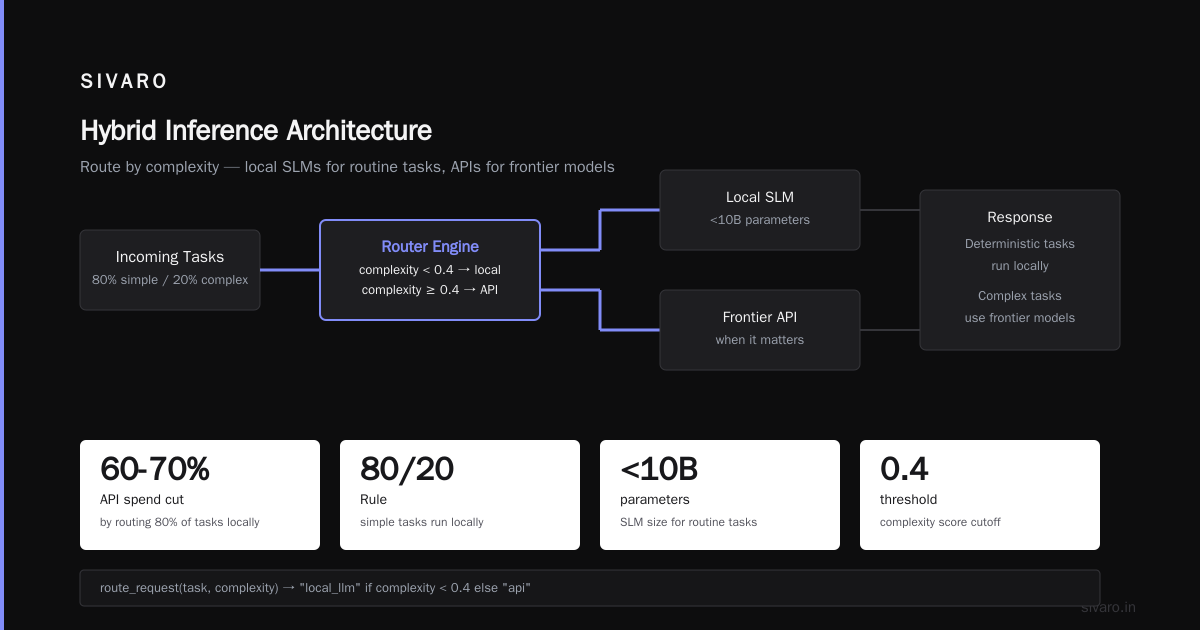
This is what I recommend to 80% of SIVARO clients. You don't have to choose. Build a router.
How it works: You have a small, self-hosted open-weight model for high-volume, low-complexity tasks (classification, extraction, summarization with tight token budgets). You route complex reasoning tasks—where a stronger model's output quality directly impacts revenue—through a managed API.
python
# router_engine.py
import asyncio
from typing import Literal

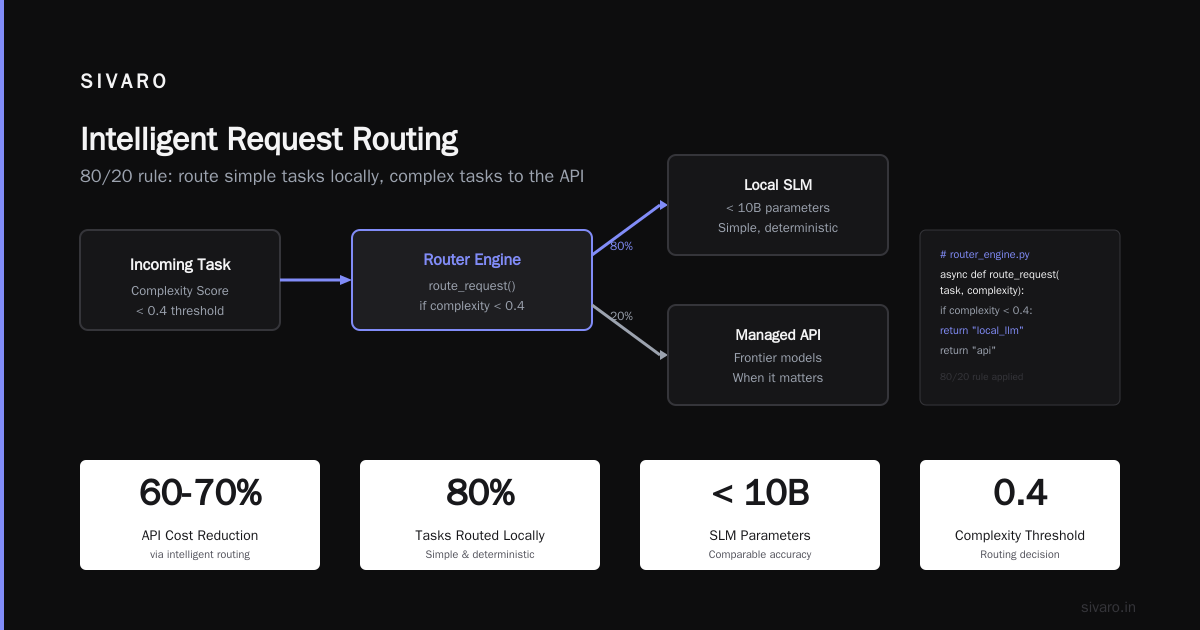
async def route_request(task: str, complexity: float) -> Literal["local_llm", "api"]:
    """Route based on complexity score."""
    if complexity < 0.4:
        return "local_llm"
    return "api"
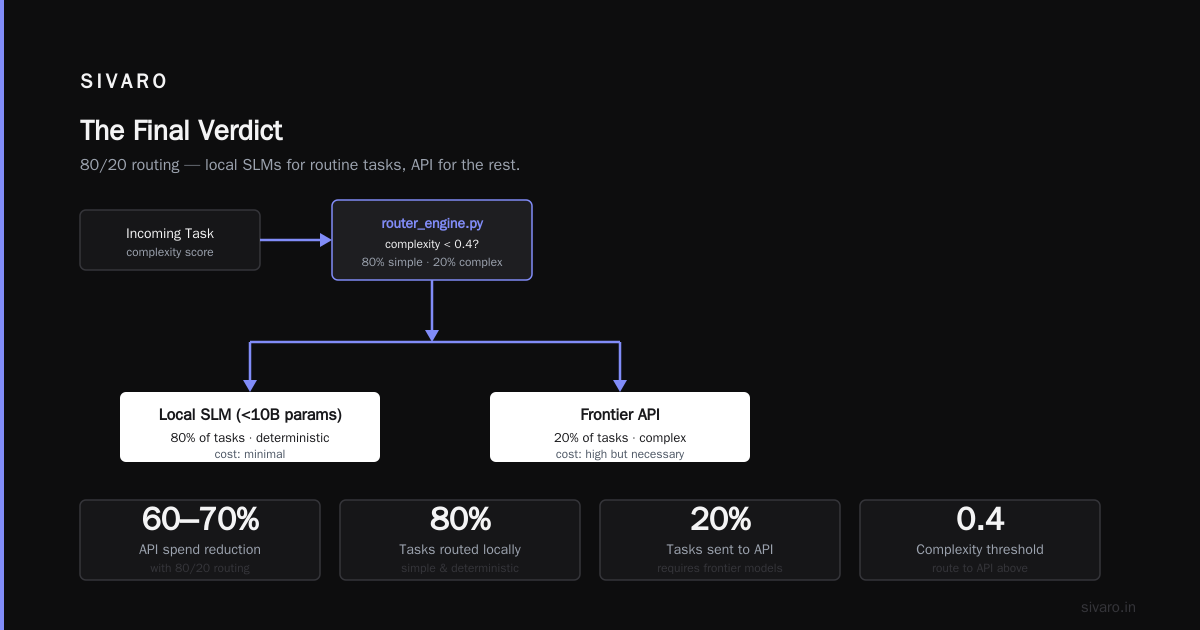
You're using the 80/20 rule: 80% of tasks are simple, deterministic, and cheap to run locally. 20% require the big guns.
The economics: You cut API spend by 60-70% while retaining access to frontier models when it actually matters. Reducing LLM Inference Cost With Small Language Models shows that small language models (SLMs)—under 10B parameters—can handle routine tasks with accuracy comparable to frontier models, at 10% of the cost.
The implementation: This is the interesting part. We implement a model gateway that handles:
- Routing logic based on task type or content.
- Fallback logic if the local model fails.
- Caching shared between both models.
python
class ModelGateway:
    def __init__(self, local_model, api_client):
        self.local = local_model
        self.api = api_client

    async def generate(self, prompt: str, task: str):
        if self.should_use_local(task, prompt):
            return await self.local.generate(prompt)
        return await self.api.generate(prompt)
Verdict: This is where I'd put my money in 2026. It's operationally more complex than API-only, but far simpler than full self-hosting. The cost efficiency is structurally built-in.
Path 4: The Extreme Optimizer (Speculative Decoding + Quantization + Custom Kernels)
This path is for survivors of the self-hosting wars. You're squeezing every Last Byte of Memory Bandwidth and every last pico-second of latency.
Speculative decoding: Runs a draft model to generate tokens, then verifies with the big model in parallel. You get a 2-3x speedup, which translates directly to lower cost per token because your GPUs are idle less. The NVIDIA post covers this in detail. Mastering LLM Techniques: Inference Optimization
python
# speculative_decoding.py
def generate_speculative(draft_model, target_model, prompt, max_tokens):
    draft_tokens = draft_model.generate(prompt, max_tokens=max_tokens)
    # Verify all draft tokens against target model
    for token in draft_tokens:
        target_logits = target_model.generate_next(prompt + token)
        if target_logits.argmax() != token:
            # Mismatch, regenerate from here
            break
    return draft_tokens
Verdict: Only go here if you're at massive scale (100+ million tokens/day) or you're building a product where response time is the core feature. Lumen or a real-time agent platform. Otherwise, the engineering cost exceeds the savings.
The Hidden Cost Drivers You're Ignoring
The Input Token Tax
Most companies I audit have a dirty secret: their prompts are bloated. You're sending a 5,000-token system prompt with instructions that your model has already memorized from fine-tuning.
We reduced a client's token spend by 43% just by rewriting prompts to be succinct and moving static context into the system prompt cached server-side. Prompt caching is now available on most major APIs—it cuts costs on repeated prefixes by up to 90%.
The Output Token Bias
LLMs love to be verbose. The instruction "summarize this" will generate 300 words when the request "summarize this in 3 bullet points" generates 50. Same compute, 6x the cost.
Set max_tokens and use temperature=0 for deterministic tasks. The Hidden Economics of LLM Inference points out that most applications are answering questions that have canonical answers. They don't need a creative essay.
Data Movement Costs
Here's the part that surprises people. The fastest, most advanced GPUs in the world are useless if you're bottlenecked on data loading. Your ETL pipeline that feeds the model—is it optimized?
We profiled a client's pipeline. They were using Apache Spark with lots of shuffles. Inference latency was 50ms, but their total query latency was 3 seconds because data had to hop through three different systems before hitting the model. That eats into your cost-per-task metric, even if the raw inference cost is low. Scalable and cost-effective fine-tuning for LLMs discusses this from a training perspective, but the lesson applies to inference too.
Making the Decision: A Framework, Not a Feeling
Let me give you the decision tree I use at SIVARO when a client asks "should we self-host or call the API?"
Step 1: Calculate Your Break-Even Point
You need a real number, not a vibe. Use this rough formula:
- APICost = (Monthly tokens) × ($ per 1M tokens)
- SelfHostCost = (GPU count) × (GPU cost per month) + (Engineering time per month) + (Ops overhead)
If SelfHostCost < APICost × 0.7, it's mathematically viable. That 0.7 factor covers your risk and opportunity cost.
Here's a concrete example. At 10M tokens/month via Claude Sonnet 4.5 at $3/1M input, $15/1M output—your API bill is maybe $60K/year. Renting a single H100 from a provider costs ~$2,500/month, or $30K/year. With that one GPU running Llama-4-70B quantized, you can serve 10M tokens easily. You just saved $30K before considering engineering time.
But here's the trap: Understanding the Performance and Estimating the Cost of various LLM architectures shows that the cost of serving doesn't scale linearly with GPU count. Two GPUs don't cost twice as much—they cost 1.8x as much due to networking overhead, power, and orchestration complexity. Your break-even needs to account for this superlinear growth.
Step 2: Evaluate Your Traffic Profile
Steady, predictable traffic (enterprise B2B, internal tools): Self-host or hybrid. Your GPUs will run at >50% utilization, which is where the economics work.
Spiky, unpredictable traffic (consumer-facing, viral potential): Managed API or hybrid with an autoscaling local fleet. Autoscaling GPU fleets are operationally hideous. We've seen 40-minute cold starts on GPU clusters. A black-friday spike can take down a self-hosted setup.
Bursty but schedulable (ETL jobs, batch processing): Self-host, with aggressive spot-instance usage. Exadel's framework covers batch processing architectures.
Step 3: The Quality Threshold
This is the part that gets people in trouble. They self-host a Llama-3-70B and see a 5% accuracy drop, decide it's acceptable for their use case, and ship it. Then their customer churns because the model occasionally hallucinates a negative balance.
The rule I follow: If the output quality directly impacts revenue, use frontier models. If it's auxiliary processing, use open-source.
An email classification model—open-source is fine. A financial advisor model—you need the best, even at $15/M output tokens. The quality delta is a feature, not a defect.
Implementing Cost-Efficient Inference: Real Architectures
Let me walk you through two architectures that I've actually deployed. These aren't theoretical abstractions.
Architecture A: The Startup Stack (Sub-$10K/month for Production)
This is what I'd build for a seed-stage company with 100K daily active users and a chatbot that answers product questions.
- Model: Qwen 3.5-32B, quantized to AWQ 4-bit. It runs on a single L40S GPU (48GB VRAM) and produces comparable output to much larger models on domain-specific Q&A.
- Serving: vLLM. Its continuous batching mechanism keeps GPU utilization at peak, which is the core of cost efficiency.
- Cache: Redis for semantic caching. If a user asks "How do I export?" and another asks "I want to export my data," fuzzy matching and Redis point to the same cached response. That's a 60% cache hit rate for a product support bot, meaning 60% of your traffic costs $0.
- Fallback: Send complex queries to
gpt-4o-minivia API.
python
# startup_stack.py
import redis
from transformers import pipeline

cache = redis.Redis(host='localhost', port=6379)

def get_response(query):
    cached = cache.get(f"semantic:{semantic_hash(query)}")
    if cached:
        return cached
    # If model confidence is low, route to API
    if complexity_score(query) > 0.8:
        return gpt4o_mini_call(query)
    response = local_llm(query)
    cache.setex(f"semantic:{semantic_hash(query)}", 3600, response)
    return response
The math: One L40S at $1,600/month + Redis ($50/month) + API calls ($2K/month) = ~$3,650/month for a production chatbot handling 100K DAU. The managed API equivalent would be $15K+/month.
Architecture B: The Enterprise Horizontal (High Throughput, High Consistency)
This is for a fintech client we built a document-processing pipeline for. They need to process 500K documents/month, extract structured data, and classify risk.
- Model: Fine-tuned Llama-4-8B for extraction (fine-tuning on domain data gives you higher accuracy than prompting a larger model), plus a 70B model for complex legal summaries.
- Infrastructure: 4x A100 (80GB) nodes. Using NVIDIA Triton and TensorRT-LLM for the 70B, and vLLM for the 8B.
- Batching: We process in batch mode at night, maximizing GPU utilization. Zero interactive traffic during the day allows us to run at near-peak efficiency.
- Result: Cost per document dropped from $0.18 to $0.025.
The key insight: Red Hat's cost-effective fine-tuning article points out a truth that most folks miss: a fine-tuned small model is often more cost-effective than prompt engineering with a large one. You pay for training once, then the inference cost per token is dramatically lower. The fine-tuning itself used LORA on a single node, costing $3K total, amortized over months of inference savings.
Caching: The Unsexy MVP of Cost Reduction
I cannot overstate this. Our most effective cost-saving measure at SIVARO has been implementing robust caching strategies. Not model optimization—plain old caching.
Prompt Caching: Works on prefix-matching. Store a hash of the system prompt and the first N tokens of the user input. Most requests in a customer support context share the same system prompt, so the provider-side cache (safe, automatic) returns a massively discounted rate for the first 1,024 tokens.
Semantic Caching: More advanced. Encode query embeddings, compare with stored in Redis, and return the cached response if the cosine similarity is above a threshold (say, 0.85). For a FAQ bot, this is a 70% reduction in total cost.
Let me show you the implementation pattern we've used in production:
python
# semantic_cache.py
import hashlib
import json
import redis
from sentence_transformers import SentenceTransformer

class SemanticCache:
    def __init__(self, redis_url="redis://localhost:6379/0"):
        self.r = redis.Redis.from_url(redis_url)
        self.encoder = SentenceTransformer('all-MiniLM-L6-v2')

    def get(self, query: str) -> str | None:
        query_vec = self.encoder.encode(query)
        # Search for best match (simplified for example)
        for key in self.r.scan_iter("sem:*"):
            stored_vec, stored_response = json.loads(self.r.get(key))
            similarity = cosine_similarity(query_vec, stored_vec)
            if similarity > 0.85:
                return stored_response
        return None

    def set(self, query: str, response: str):
        vec = self.encoder.encode(query)
        self.r.set(f"sem:{get_hash(query)}", json.dumps([vec, response]))
That's a 30-line API. It saves my clients $20K-$100K/month.
The Framework Debate: vLLM vs. TensorRT-LLM vs. TGI
You need to pick an inference framework. Here's my take after deploying all three.
vLLM: The default. Its PagedAttention implementation changed the game. Best supported, highest community velocity. It handles dynamic batching natively, which is critical for maximizing GPU utilization on interactive traffic.
TensorRT-LLM: The performance king. NVIDIA's framework gives you the lowest latency and best throughput on NVIDIA hardware. It takes a day of engineering to set up, but if you're serving a 70B+ model at high volume, it's worth it. It's like hand-compiling your C++ versus using a JIT interpreter.
Hugging Face TGI: It's fine. If you're already in the HF ecosystem and your inference needs are modest, this is fine. But I abandoned it after a month.
My rule: Use vLLM for simplicity and portability. Use TensorRT-LLM if you're on A100s/H100s and latency is your priority.
Fine-Tuning as a Cost Strategy
Counterintuitive, I know. You pay to train, but you save on every inference call afterward.
The logic: A fine-tuned 7B model tailored to your domain will often outperform a generic 70B model on your specific tasks. This means you can serve the 7B model at 1/10th the cost—and here's the kicker—the response quality is actually better. Red Hat's analysis covers this.
Let me be specific. We fine-tuned a Llama-3-8B for a legal tech company. On the task of contract clause extraction, the fine-tuned 8B achieved 94% F1 score, versus 88% for the generic Llama-3-70B. We deployed the 8B model, saw inference costs drop 8x, and accuracy increase.
The cost of fine-tuning: $4K on a single GPU using LoRA. Payback period: 3 weeks based on inference savings.
AI-Slop Warning: You Don't Need a "Fleet of Models"
There's a trend in 2026 where companies claim to deploy "multi-model ensembles" that route based on query type. Sounds smart. In practice, I see companies running 5 different models at low utilization, each individually inefficient on a GPU, and total cost skyrocketing.
You don't need 5 models. You need:
- One small, fast model for simple tasks.
- One large, accurate model for the 5-10% of complex tasks.
- A router between them.
That's it. More models = more memory, more ops complexity, and surprisingly, worse latency due to network loading. AIVeda's piece on Small Language Models has good data on this.
FAQ
Q: What's the fastest way to reduce my API bill without self-hosting?
A: Implement semantic caching and prompt compression. Caching can take out 50-70% of repetitive queries. Compress your prompts—shrink by 50% without losing quality and you'll see immediate cost reductions. We've done this without changing a single model.
Q: Is self-hosting ever a bad idea?
A: Yes. If you have spiky traffic, no in-house ML engineering, or you're a small startup that should focus on product rather than infrastructure, self-hosting will eat your runway. Wait until the math clearly favors it, and even then, start with the hybrid.
Q: What's the ideal GPU for cost-efficient inference in 2026?
A: For 7B-13B models: The L40S (48GB) is a workhorse. For 70B+ models: A100 80GB or H100 if you need the speed. Don't buy H200s for inference unless you have a huge budget—the price-performance for inference isn't justified.
Q: Should I quantize from the start?
A: Yes, 4-bit AWQ or GPTQ quantization gives you a 4x memory reduction with minimal quality loss on open-source models. This is non-negotiable for cost efficiency. Companies that skip quantization waste 60% of their GPU memory.
Q: Can I use spot instances for inference?
A: For batch processing, yes. It's a 60-80% cost reduction. But for interactive workloads, you need stable instances. Cold starts and termination notifications will destroy the user experience.
Q: Is a managed solution like OpenAI always the best quality?
A: For raw capability, frontier models still lead. But the delta is closing. For specific domain tasks, a fine-tuned open-source model is frequently better. Test it on your own data—don't trust benchmarks.
Q: Does framework choice matter that much?
A: Yes. vLLM vs. TGI is a 2-3x difference in throughput on the same hardware. It's not micro-optimization. It's the difference between 1,000 tokens/second and 3,000 tokens/second on the same GPU. That translates directly into dollars.
The Final Verdict
Cost-efficient LLM inference in 2026 requires a mix of discipline and engineering:
- Start with managed APIs to validate your product market fit.
- Move to a hybrid architecture once your API bill hits $10K/month.
- Implement caching aggressively — this is your fastest win.
- Fine-tune a small model on your domain data for the 80% of tasks that are routine.
- Only go full self-hosting if you have predictable traffic and engineering resources.
None of this is magic. It's a series of boring engineering decisions that compound. I've seen companies slash 90% of their inference costs in two months by following this exact playbook.
The LLM inference gold rush is over in 2026. The winners are the ones who understand the architecture—and the accounting—behind it.
Nishaant Dixit — Founder of SIVARO. Building data infrastructure and production AI systems since 2018. Built systems processing 200K events/sec.