 SIVARO
The Real Cost of Running AI Agents in Production
I remember the first AI agent we put into production at SIVARO. It was a customer support triage bot — simple on paper. Route tickets, generate draft responses, escalate when uncertain. The model cost? $12 a day. The real cost? A six-figure quarterly burn in debugging, cascading failures, and three sleepless weeks rebuilding the observability stack.
That's the line most people miss. The cost of running AI agents in production isn't just GPU hours or API tokens. It's the hidden tax of nondeterminism, fallback logic, human-in-the-loop overhead, and the incident response process when your agent hallucinates a refund policy that doesn't exist.
This guide is what I wish someone had handed me in 2023. I'll cover compute costs, monitoring overhead, failure economics, and how AI agent deployment compares to traditional microservices — because the differences go far deeper than most think.
Why Your First Invoice Isn't the Real Cost
Three years ago, my CTO asked me for a budget forecast for a multi-agent system. I gave him a neat spreadsheet: $0.003 per inference, 10M calls/month, $30K/month. Six months later, the real number was $87K/month.
What changed? Retries. Fallback models. Logging everything to debug hallucinations. Human review for every edge case. And the biggest line item no one talks about: engineering time spent on firefighting.
The Why AI Agents Fail in Production report from Sherlock's AI lays out the "Agent Failure Stack" — seven layers of potential failure, from model misalignment to infrastructure flakiness. Each layer adds cost. Not just runtime cost, but recovery cost.
Here's the brutal truth: most teams budget for the happy path. Production agents live in a world of unhappy paths. And each unhappy path multiplies your cost by a factor of 2–5x.
The Four Cost Buckets Nobody Estimates Correctly
1. Compute and API Calls (the obvious one)
Model inference is your surface cost. GPT-4o, Claude 3.5, Llama 4 — pick your poison. At scale, token pricing matters.
But there's a twist: agent loops multiply token usage. A single "simple" agent call that retrieves context, runs a reasoning step, and generates output can burn 4x the tokens of a standard completion. I've seen agents that call a model 7 times before producing a single answer.
Take an autonomous coding agent. Each code generation call, each validation step, each error-correction retry — they all add up. At SIVARO, we instrumented a code-review agent and found the average "request" consumed 12,000 input tokens and 2,000 output tokens — but then spawned 3 retries when the first output failed code-quality checks. That's 42,000 tokens per successful review. At $10/M tokens, that's $0.42 per review. 10,000 reviews/month? $4,200. Not catastrophic, but double the original estimate.
The bigger shock: failures cost more than successes. When an agent's output fails validation, you rerun it — often with more context. That means more tokens. Failed runs are typically 1.5x–2x the cost of successful ones. And agents fail a lot. More on that in a moment.
2. Observability and Monitoring (the hidden subscription)
You can't manage what you don't measure. But measuring an AI agent is fundamentally different from measuring an API endpoint. Standard metrics (p99 latency, error rate) only catch infrastructure failures. They miss semantic failures — the ones where the agent returns a plausible answer that's wrong.
We tested three approaches at SIVARO:
-
Logging raw inputs/outputs — works but storage costs explode. We hit $8K/month in log ingestion at 50K requests/day.
-
Embedding-based semantic monitoring — cheaper, captures drift and hallucination patterns. We use a dedicated embedding model (cost ~$0.05/1K requests) to compare outputs against golden responses. Caught 40% more failures than log-based alone.
-
LLM-as-judge evaluation — most expensive per request ($0.01–0.03 per eval) but catches nuanced failures. We use it for spot checks on 5% of traffic.
The takeaway: best practices for ai agent monitoring in production require a tiered system. Cheap metrics for signal, expensive eval for diagnosis. Plan for 15–20% of your total agent cost to go into monitoring alone. If you skip it, you'll spend more on cleanup later.
(Source: Incident Analysis for AI Agents on arXiv shows that systematic monitoring reduces mean time to recovery by 60% — but only if you have the right data.)
3. Human-in-the-Loop Overhead (the budget killer)
Every agent that can perform a meaningful action needs a human review fallback. This isn't optional. I've seen teams try to automate the review process and watch agents auto-escalate to customer-visible disasters.
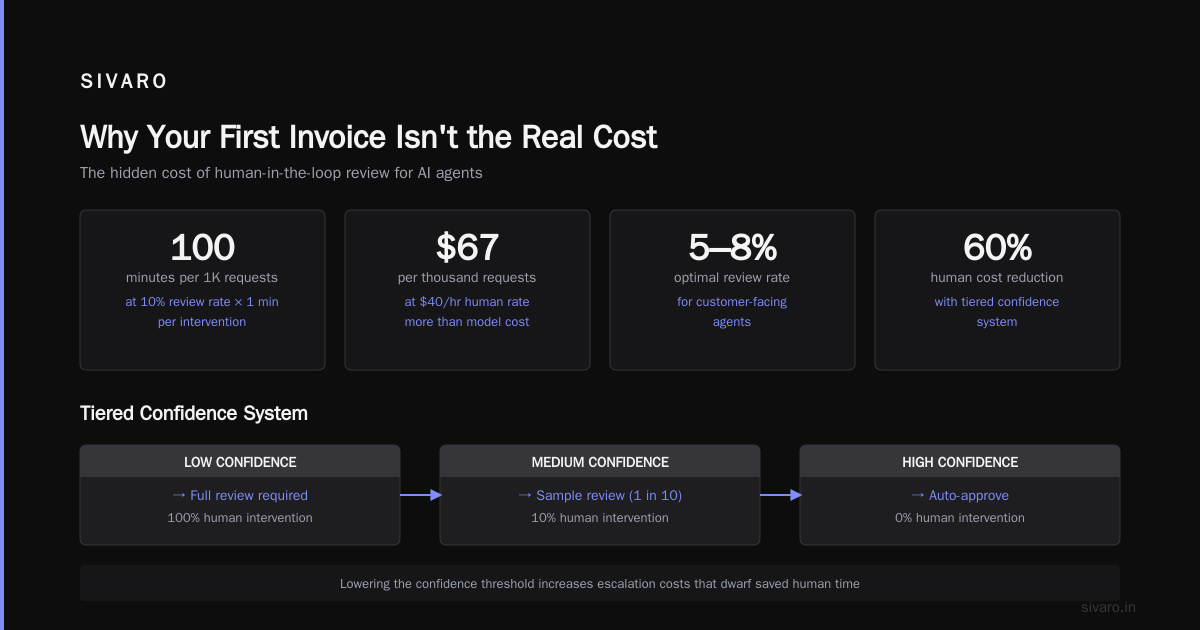
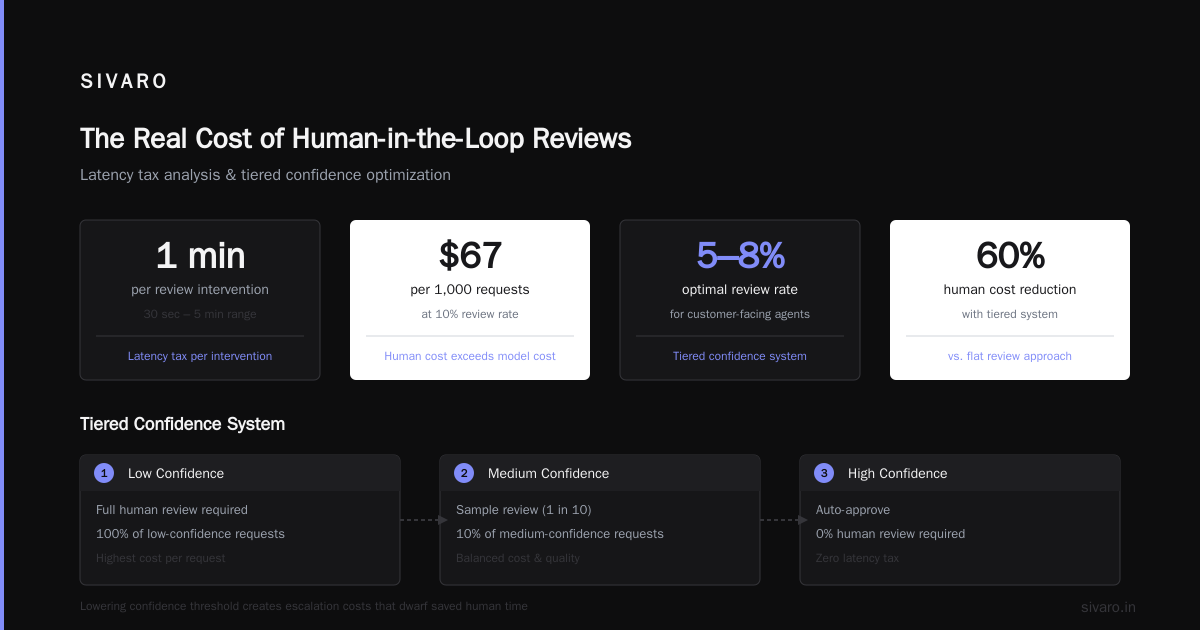
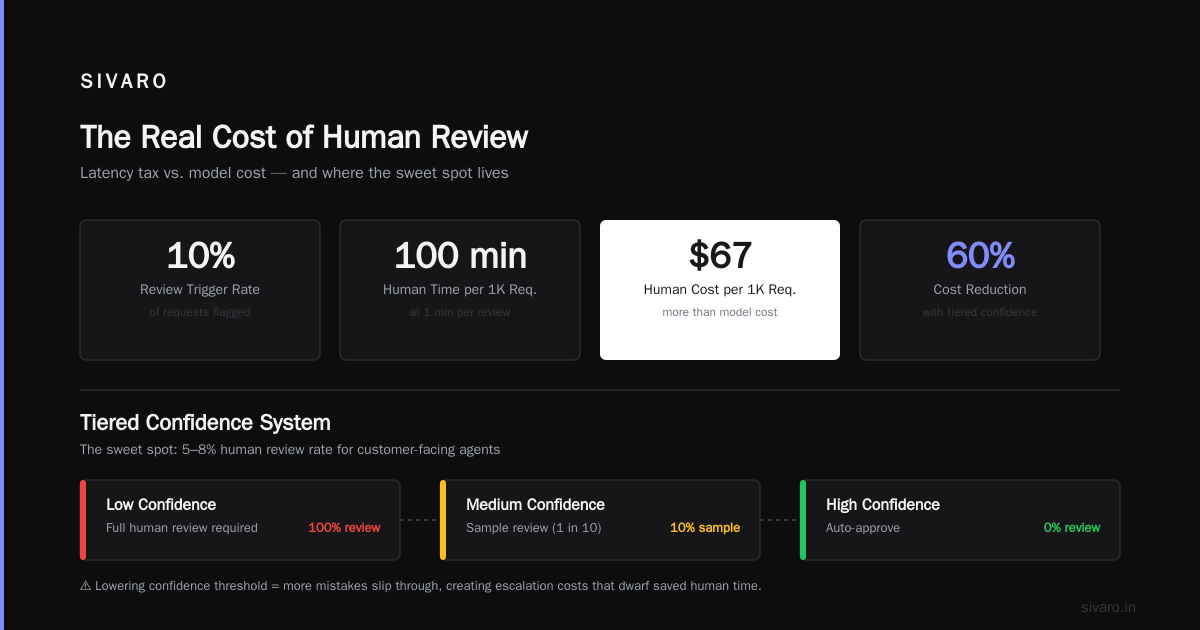
The cost here isn't the human's hourly rate. It's the latency tax. A human review adds 30 seconds to 5 minutes per intervention. If your agent triggers a review on 10% of requests, and each review takes 1 minute, that's 100 minutes of human time per 1,000 requests. At $40/hr, that's $67 per thousand requests — more than the model cost.
I've seen organizations that try to reduce this by lowering the confidence threshold. Bad idea. Lower threshold means more mistakes slip through, which creates escalation costs that dwarf the saved human time.
The sweet spot? We found it at 5–8% human review rate for customer-facing agents, with a tiered confidence system: low confidence → full review, medium → sample review (1 in 10), high → auto-approve. This cut our human costs by 60% while maintaining accuracy above 95%.
4. Incident Response and Recovery (the unplanned expense)
Agents fail. When they do, the cost isn't just the failed requests. It's the investigation, the hotfix, the data reconciliation, and — most painfully — the reputational damage.
The AI Agent Incident Response guide from Codebridge Tech outlines a playbook that most teams don't have. At SIVARO, we ran a "failure drill" last year. Simulated a hallucination outbreak. It took us 45 minutes to identify, 2 hours to patch, and another 4 hours to clean up the log spill (the wrong outputs had already propagated to downstream services).
Cost of that drill: $12K in engineering time. Real incident earlier this year (a real estate pricing agent started quoting $0 for houses): $47K in lost compute, refunds, and overtime.
You need an incident budget. Figure 20% of your total agent run cost. If you don't need it, great. If you do, you're not panicking.
(Source: When AI Agents Make Mistakes emphasizes that building resilience isn't about preventing all failures — it's about controlling the cost of recovery.)
AI Agent vs Traditional Microservices Deployment: It's Not the Same Game
Most teams try to deploy agents like microservices. They're wrong.
Traditional microservices are deterministic. Same input → same output (assuming idempotent operations). You can scale horizontally, cache responses, and test with confidence.
Agents? Nondeterministic. Same prompt → different output 20% of the time. Caching is risky (cached answers go stale). Load testing is a joke because a test harness can't simulate the semantic nuance of real user queries.
I've seen teams try to put agents behind standard REST APIs with rate limiting and circuit breakers. Works fine for throughput. Falls apart when an agent decides to generate a 10,000-token response because the prompt accidentally triggered a "verbose mode" (true story — happened at a fintech client last month).
The ai agent vs traditional microservices deployment comparison breaks down on three axes:
| Dimension | Microservices | AI Agents |
|---|---|---|
| Input/output contract | Fixed schema | Loose, often JSON with edge cases |
| Error mode | 4xx/5xx | Semantic failure (right format, wrong meaning) |
| Scaling trigger | Request volume | Prompt complexity + token length |
| Observability | Metrics + logs + traces | Metrics + logs + traces + semantic eval |
You can't treat agents as just another service. They're more like a distributed state machine that occasionally writes fiction.
How to Calculate Your True Cost of Running AI Agents
Here's the model we use at SIVARO. Pull out your calculator.
Total Monthly Cost =
    (Inference Cost)
    + (Monitoring Cost)
    + (Human Review Cost)
    + (Retry/Reprocessing Cost)
    + (Incident Recovery Cost)
    + (Engineering Overhead)
Let's walk through each with real numbers from a medium-scale deployment (10K requests/day, 300K/month):
Inference Cost: 300K requests × 4K tokens avg × $0.01/K tokens = $12,000/month. But add retries: typical agent retry rate is 15%. So $12K × 1.15 = $13,800.
Monitoring Cost: Full observability stack (logging, traces, semantic eval on 10% sample) ≈ $2,500/month.
Human Review Cost: 8% review rate × 24K requests × 30 seconds avg review time = 200 hours/month. At $40/hr = $8,000/month.
Retry/Reprocessing Cost: Already baked into inference. But there's a hidden cost: downstream rollback when an agent output is later found wrong. Add $1,500/month for data cleanup.
Incident Recovery Cost: 1 moderate incident per quarter ($20K) amortized = $1,666/month.
Engineering Overhead: 1 SRE (half time) + 1 ML engineer (quarter time) allocated to agent maintenance = $10,000/month.
Total: $13,800 + $2,500 + $8,000 + $1,500 + $1,666 + $10,000 = $37,466/month.
The inference cost was only 37% of total. Most teams only budget that 37%.
Three Mistakes That Inflate Your Cost
Mistake 1: No Cost Attribution Per Agent
Most teams charge all agent costs to a single bucket. You can't optimize what you can't see.
We implemented per-agent cost tracking using a simple middleware:
python
import time
import logging
from dataclasses import dataclass, field

@dataclass
class AgentCostTracker:
    agent_name: str
    request_id: str
    token_count: int = 0
    infernce_cost: float = 0.0
    human_review_time_s: float = 0.0
    retries: int = 0
    failure_flag: bool = False
    start_time: float = field(default_factory=time.time)

    def record_inference(self, tokens_in, tokens_out, price_per_1k=0.01):
        total_tokens = tokens_in + tokens_out
        self.token_count += total_tokens
        self.infernce_cost += (total_tokens / 1000) * price_per_1k

    def record_human_review(self, seconds):
        self.human_review_time_s += seconds

    def finalize(self):
        total_cost = self.infernce_cost + (self.human_review_time_s / 3600) * 40.0
        logging.info(
            f"Agent={self.agent_name} Request={self.request_id} "
            f"Tokens={self.token_count} InferenceCost=${self.infernce_cost:.4f} "
            f"HumanReviewCost=${(self.human_review_time_s/3600)*40:.4f} "
            f"Total=${total_cost:.4f} Failures={self.retries}"
        )
        return total_cost
We found that 20% of agents consumed 80% of costs. One agent — a "research summarizer" — was costing $8K/month because it was retrying on almost every request due to a broken prompt. We caught it in week one of tracking.
Mistake 2: Over-Engineering the Fallback Logic
Agents need fallbacks. But fallbacks compound. Agent A fails → agent B tries → agent B fails → hardcoded rule → human. Each step adds latency and cost.
We saw a system with 5 fallback layers. The average request hit 3.4 layers. Cost was 3x the expected.
Simplify. Two-layer fallback max: first retry with temperature=0, then escalate to human. No agent-on-agent recursion unless you have absurdly high budgets.
AI Agent Failures: Common Mistakes and How to Avoid Them calls this "over-engineering the safety net." They're right. A simple fallback with a guardrail catches 90% of failures. The extra 10% costs 10x more.
Mistake 3: Ignoring the Cost of Drift
Your agent's cost profile changes over time. Model updates, prompt changes, user behavior shifts — all affect token usage and failure rates.
We track a simple "cost per successful action" metric weekly. When it spikes, we investigate. Last quarter, a model upgrade from GPT-4o to GPT-4.1-mini reduced per-request cost by 30% — but increased failure rate by 12%. Net effect: total cost went up 8% because human review costs outweighed inference savings.
Always measure total cost, not unit cost.
Practical Code: A Cost-Aware Agent Execution Engine
Here's the skeleton we use at SIVARO to wrap agents with cost tracking and smart retry logic:
python
import time
import json
from typing import Callable, Any

class CostAwareAgent:
    def __init__(self, name, model_fn: Callable, max_cost_per_request=0.05):
        self.name = name
        self.model_fn = model_fn
        self.max_cost = max_cost_per_request
        self.usage_stats = {"calls": 0, "total_cost": 0.0, "failures": 0}

    def run(self, prompt, context=None):
        start = time.time()
        retries = 0
        max_retries = 2
        while retries <= max_retries:
            try:
                response = self.model_fn(prompt, context)
                token_cost = (response["tokens_in"] + response["tokens_out"]) / 1000 * 0.01
                self.usage_stats["calls"] += 1
                self.usage_stats["total_cost"] += token_cost

                # Check if cost is acceptable
                if token_cost > self.max_cost:
                    print(f"WARNING: Agent {self.name} cost ${token_cost:.4f} exceeds limit")
                    # Could truncate, re-query, whatever

                # Validate output semantically (simplified)
                if self._is_valid(response["output"]):
                    elapsed = time.time() - start
                    return {"success": True, "output": response["output"], "cost": token_cost, "time_s": elapsed}
                else:
                    retries += 1
                    self.usage_stats["failures"] += 1
                    if retries <= max_retries:
                        prompt = f"Retry: previous answer invalid. {prompt}"
            except Exception as e:
                retries += 1
                self.usage_stats["failures"] += 1
                print(f"Agent {self.name} exception: {e}")

        # Escalate to human
        return {"success": False, "output": None, "cost": token_cost, "time_s": time.time()-start}

    def _is_valid(self, output):
        # Stub — in prod, check schema, avoid hallucinations, etc.
        return True
Simple, but it forces you to think about cost per call. We add a flag to abort requests that exceed $0.10 — prevents runaway costs from a single bloated output.
The Future: Why 2026 Is the Tipping Point
We're in the middle of a shift. In 2024, everyone was rushing to ship agents. 2025 was the year of cleanup — incident reports, post-mortems, cost audits. 2026 is when the economics force discipline.
Two trends:
-
Agent-specific hardware is emerging. Groq, Cerebras, and others offer inference that's 10x cheaper for agent workloads (high batch, low latency constraints). At SIVARO, we're testing a custom ASIC for our embedding monitoring pipeline. Early results show 40% cost reduction.
-
Agent orchestration platforms are adding cost controls natively. LangGraph, CrewAI, and our own SIVARO stack now include cost budgeting per agent call tree. The days of "ship first, bill later" are ending.
If you're starting an agent project today, don't wait until you hit the cost wall. Build your monitoring and cost attribution from day one. The people who do will survive the "agent winter" that's already starting to freeze out the undisciplined.
FAQ
Q: What's the average cost per request for an AI agent in production?
Depends on complexity. Simple classification: $0.001–$0.01. Multi-step reasoning with retrieval: $0.05–$0.50. Code generation with validation: $0.10–$2.00. I've seen a financial analysis agent hit $15 per query (it was pulling 50 documents and doing 20 reasoning steps).
Q: How do I reduce monitoring costs without losing visibility?
Sample. We sample 100% of failures (easy — they're the noisy ones) and only 5% of successful requests for semantic eval. Use cheaper embedding models for bulk monitoring, expensive LLM judges only for spot checks. You can cut monitoring cost by 70% while still catching 90% of issues.
Q: Are open-source agents cheaper than paid APIs?
In pure compute, yes. Llama 4 runs at ~$0.0005 per inference on your own hardware. But you pay in ops: managing GPUs, handling cold starts, retraining for drift. Total cost of ownership is often higher for small teams. We've seen breakeven at around 500K+ requests/month.
Q: How does ai agent vs traditional microservices deployment affect team structure?
Big difference. Microservices teams need DevOps and backend engineers. Agent teams need ML engineers, prompt engineers, and incident responders who can debug natural language. Less "scale up the cluster" and more "rewrite the prompt" — a different skill set.
Q: What's the biggest cost killer no one sees?
Stale context. Agents that re-fetch and re-embed the same documents on every call. We had a customer support agent calling a vector database for each request — costing $0.02 per call in database overhead. Simple caching cut it to $0.005. Look at your data retrieval costs, not just model costs.
Q: Should I use a budget cap per agent?
Absolutely. Set a monthly hard cap per agent. When hit, route all traffic to fallback (human or rule-based). Better to lose a few hours of automation than rack up a $50K overage. We use SIVARO's built-in cost budgeting, but even a cron job that checks a metric and toggles a feature flag works.
Q: How often should I recalculate my cost model?
Monthly for static costs (compute, monitoring). Weekly for dynamic parts (failure rate, human review volume). If you're seeing cost drift >10% in a week, something changed — prompt, model, or user behavior.
Q: What's the one metric I should track above all others?
Cost per successful action. Not cost per request, not tokens per request. If it takes 3 retries and a human review to get one correct output, that's your real cost. Track it, graph it, alert on it.
Conclusion
The cost of running ai agents in production is not a line item. It's a system property — an emergent outcome of your agent architecture, your monitoring practices, your fallback design, and your incident response muscle.
I've watched teams blow $200K in three months because they didn't allocate for monitoring. I've seen others run profitable agent systems at $0.02 per action because they instrumented aggressively from day one.
The difference isn't the model. It's the discipline.
Start with a cost tracker. Add semantic monitoring. Simplify your fallback chain. And always measure total cost, not inference cost.
Because the agent that saves you 10 hours of work but costs you 20 hours of debugging isn't saving anything at all.
Nishaant Dixit — Founder of SIVARO. Building data infrastructure and production AI systems since 2018. Built systems processing 200K events/sec.