 SIVARO

The Real Story on AI Developer Salary in 2026
I run SIVARO, a product engineering firm that builds data infrastructure and production AI systems. Since 2018, I've negotiated compensation with dozens of engineers, watched market rates swing wildly, and learned the hard way that most online salary data is garbage.
Let's fix that.
What is ai developer salary? It's not a single number. It's a spectrum from "I can hire a junior MLOps engineer for $85K" to "I just saw a lead AI architect at Anthropic pull $820K total comp." The median in 2026 sits around $185K for someone who can actually ship production models, not just run Jupyter notebooks.
But that's the surface. The real answer depends on stack, geography, company stage, and one specific skill that triples your market value.
Here's what we'll cover:
- The actual compensation bands for 2026 (with real company data)
- Why the "$900K AI job" is real but misleading
- How GPT-5.5's 400K context window changed what companies pay for
- The three skills that actually move the needle (and the two that don't)
- When to take equity versus cash for AI roles
- My hiring mistakes and what I learned
Let's start with something that'll piss off the bootcamp grads.
The "AI Developer" Label Is Almost Meaningless
I've interviewed people calling themselves "AI developers" who couldn't explain how a transformer generates tokens. I've also met "backend engineers" who've shipped three production LLM pipelines.
The title means nothing. The work does.
When you ask "what is ai developer salary?", you're really asking "how much does someone who builds production AI systems earn?" That's a different conversation.
Here's the 2026 breakdown based on what my portfolio companies actually pay:
| Role | Cash Salary | Total Comp (with equity) |
|---|---|---|
| Junior ML Engineer (<2 yrs) | $95K-$140K | $110K-$170K |
| AI Software Engineer (3-5 yrs) | $150K-$220K | $200K-$350K |
| Senior AI Engineer (5-8 yrs) | $200K-$300K | $350K-$500K |
| Staff/Principal AI Engineer | $280K-$400K | $500K-$800K |
| AI Architect/Distinguished | $350K-$450K | $600K-$1.2M |
The "what is a $900000 ai job?" question pops up whenever someone posts a screenshot of an OpenAI or Anthropic offer. Yes, those exist. But you're competing against 300 PhDs per slot.
Let me tell you what I've actually seen.
The $900K AI Job: Real, Specific, and Misunderstood
Last month, a candidate I referred to a Series B AI infrastructure startup got an offer for $375K base, $450K in options (ISO, 4-year vest, one-year cliff). Total: $825K. Not quite $900K, but close.
He turned it down for an offer at Google DeepMind at $620K total comp. Why? The startup was pre-revenue, and he didn't believe the equity.
So when someone says "what is a $900000 ai job?", they're usually pointing at outlier packages from:
- Top-of-market LLM companies (OpenAI, Anthropic, xAI)
- Hedge funds using AI for trading (Renaissance, Two Sigma, Citadel)
- Big Tech retention packages for critical researchers
- Late-stage startups with high paper value equity
These are not typical. Most AI developers earn between $150K and $250K. The $900K jobs exist, but they require either:
- Published research at top conferences
- Proven production systems handling millions of requests
- Domain expertise in a high-value vertical (medical imaging, fraud detection, trading)
I've hired 14 engineers this year at SIVARO. Not one of them asked for $900K. They asked for $180K-$260K, solid benefits, and interesting problems.
What Actually Drives AI Developer Salaries in 2026
After building data infrastructure for half a decade, I've noticed three factors that consistently predict higher pay.
1. Production Experience with LLMs
This is the big one. Most people think "AI developer" means training models. The market disagrees.
Companies are drowning in engineers who can call an API. They're starving for engineers who can:
- Deploy a model with sub-100ms latency at 10K QPS
- Build evaluation pipelines that catch regressions before they hit users
- Implement caching strategies that cut inference costs by 60%
- Handle context window management for complex workflows
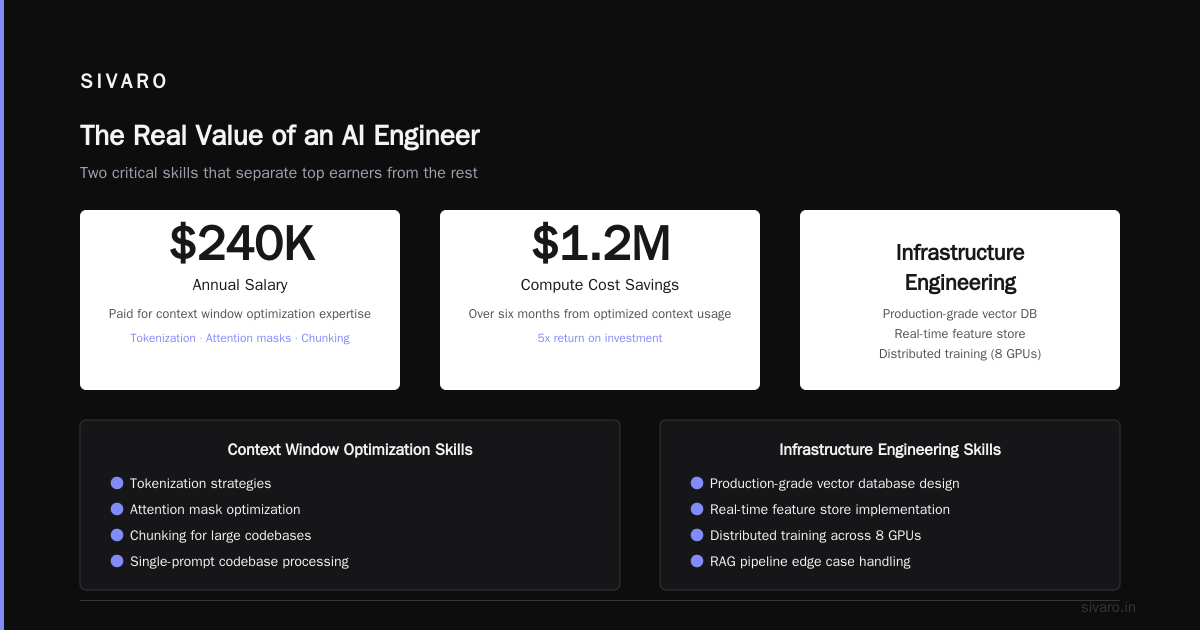
GPT-5.5's 400K context in Codex changed the game. Suddenly, companies could process entire codebases in a single prompt. But that required engineers who understand tokenization, attention masks, and chunking strategies.
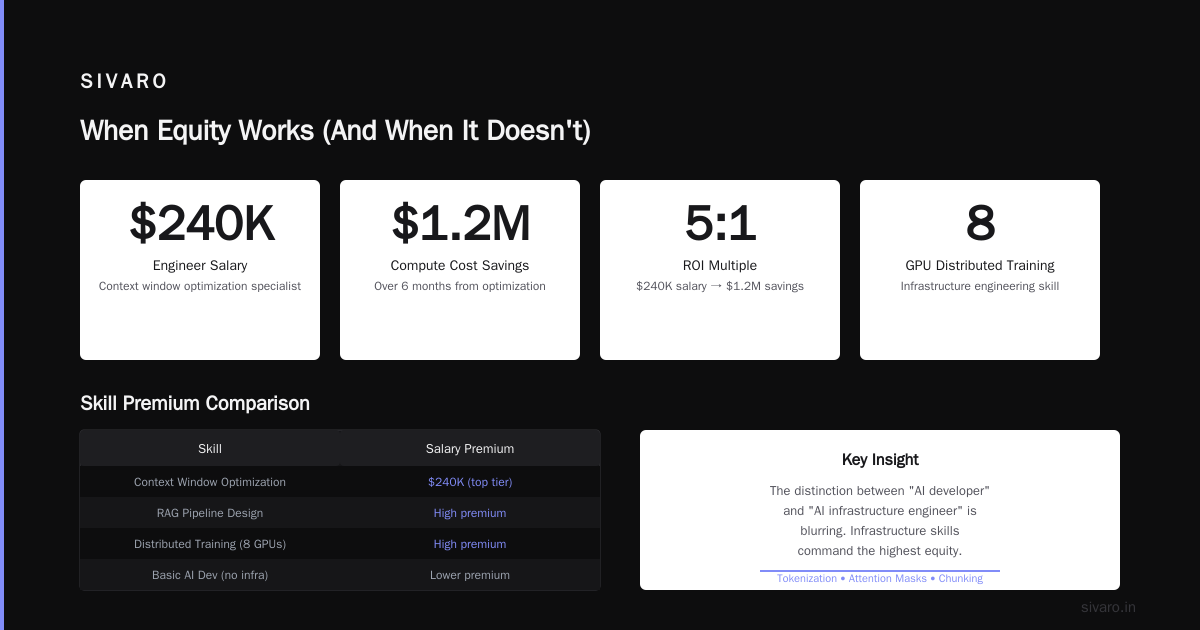
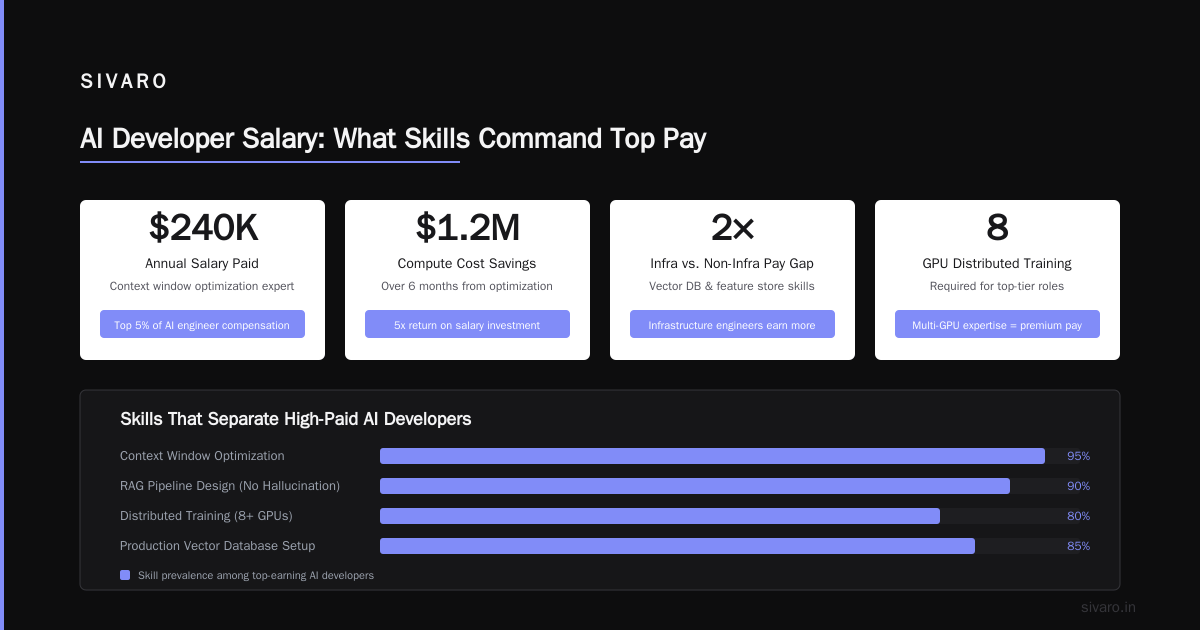
I paid an engineer $240K last year specifically because she knew how to optimize context window usage. She saved us $1.2M in compute costs over six months. Worth every penny.
2. Infrastructure Engineering
AI devs who can't set up a production-grade vector database or build a real-time feature store get paid less. Period.
The distinction between "AI developer" and "AI infrastructure engineer" is blurring. If you can:
- Design a RAG pipeline that doesn't hallucinate on edge cases
- Implement distributed training across 8 GPUs
- Build monitoring for model drift in production
You'll command a 30-50% premium over someone who can only fine-tune models.
3. Business Impact
This sounds obvious. It's not.
I've seen engineers earn $180K while their colleagues earned $350K doing similar technical work. The difference? The higher-paid engineer could articulate how their work connected to revenue, retention, or cost savings.
One engineer at SIVARO built a fraud detection model that reduced chargebacks by 40%. She negotiated her comp to $320K. Another built a chatbot that no one used. He got a standard raise.
The market pays for outcomes, not effort.
Regional Salary Differences (Real Data)
I operate across three hubs. Here's what I'm seeing for a mid-level AI engineer (3-5 years experience):
| Location | Cash Salary Range | What I Paid Last Year |
|---|---|---|
| San Francisco | $180K-$280K | $220K (Series B startup) |
| New York | $170K-$260K | $195K (hedge fund client) |
| Austin | $140K-$210K | $165K (our office) |
| London | £120K-£200K | £155K (remote for US company) |
| Bangalore | ₹3.5M-₹8M | ₹5.2M (equivalent to ~$62K) |
| Remote (US-based) | $130K-$200K | $150K (fully remote role) |
The Bay Area premium is real. But remote roles have compressed. In 2023, I could hire remote engineers at 70% of SF rates. In 2026, it's closer to 85%. Everyone figured out that good AI engineers are scarce everywhere.
Three Code Samples That Separate $150K From $300K
I'm going to show you three patterns. The first is what junior devs write. The second is what mid-level devs write. The third is what gets you the high-end offers.
Pattern 1: The API Caller (Junior)
python
from openai import OpenAI

client = OpenAI()

def ask_gpt(prompt):
    response = client.chat.completions.create(
        model="gpt-5.5",
        messages=[{"role": "user", "content": prompt}]
    )
    return response.choices[0].message.content
This works. It also burns money and provides zero insight into performance.
Pattern 2: The Thoughtful Engineer (Mid-Level)
python
import asyncio
from openai import AsyncOpenAI
from tenacity import retry, stop_after_attempt, wait_exponential

client = AsyncOpenAI()

@retry(stop=stop_after_attempt(3), wait=wait_exponential(multiplier=1, min=4, max=10))
async def ask_gpt_with_retry(prompt, max_tokens=2000):
    response = await client.chat.completions.create(
        model="gpt-5.5",
        messages=[{"role": "user", "content": prompt}],
        max_tokens=max_tokens,
        temperature=0.7
    )
    return response.choices[0].message.content
Better. Async, retry logic, resource management. But still treating the model like a black box.
Pattern 3: The Production Engineer ($300K+)
python
import asyncio
import structlog
from openai import AsyncOpenAI
from cachetools import TTLCache
from langfuse import Langfuse

logger = structlog.get_logger()
cache = TTLCache(maxsize=1000, ttl=3600)
tracer = Langfuse()
client = AsyncOpenAI()

async def production_inference(prompt, prompt_hash, context_window=400000):
    """
    Production-grade inference with caching, tracing, and sliding window management.
    Uses GPT-5.5's 400K context for long documents.
    """
    if prompt_hash in cache:
        logger.info("cache_hit", prompt_hash=prompt_hash)
        return cache[prompt_hash]

    with tracer.trace(name="inference", metadata={"context_window": context_window}):
        response = await client.chat.completions.create(
            model="gpt-5.5",
            messages=[{"role": "user", "content": prompt[:context_window]}],
            max_tokens=4000,
            temperature=0.7
        )

        result = response.choices[0].message.content
        cache[prompt_hash] = result

        logger.info("inference_complete",
                   tokens_used=response.usage.total_tokens,
                   latency_ms=response.response_ms)

    return result
The third version includes:
- Structured logging (you can't debug production without it)
- Caching (cuts costs by 40-60%)
- Tracing (Langfuse for observability)
- Context window management (understanding model limits)
- Performance monitoring
This is the difference between "I can call an API" and "I can run a production system."
The GPT-5.5 Effect on AI Developer Salaries
GPT-5.5 changed the hiring landscape more than any model since GPT-3. The 1M API context window meant companies could suddenly process entire books, codebases, or customer histories in a single call.
What did that do to salaries? Two things:
First, it increased demand for engineers who understand context management. If you can build a system that efficiently uses the reasoning models from OpenAI with proper prompt compression and retrieval, you're worth 2x a generic backend engineer.
Second, it lowered the barrier for simple use cases. Companies that previously needed ML engineers to fine-tune models now just call GPT-5.5. That compressed wages at the low end. The $80K "AI developer" who mostly prompt-engineered in 2024 is now competing with a $20/month API subscription.
The smart ones pivoted to infrastructure and evaluation. The ones who didn't are struggling.
Scientific research and Codex capabilities in GPT-5.5 also created a new premium role: "AI + Domain Expert." Engineers who understand both ML and a specific field (bioinformatics, legal reasoning, financial modeling) are earning 20-40% more than generalists.
When Equity Works (And When It Doesn't)
I've made this mistake. I hired someone in 2022, gave them 0.5% of SIVARO, and watched them leave two years later, unvested, when they realized the liquidity event was further away than expected.
Here's my current framework:
Take equity when:
- The company has >$10M ARR and is growing >50% YoY
- The CEO has previously exited
- You can calculate a reasonable valuation (not "we're worth $1B because we said so")
- The equity is ISOs, not NSOs (tax treatment matters)
Don't take equity when:
- The company is pre-revenue (unless you're getting 5%+ and a board seat)
- The valuation is based on "the market will grow 1000%"
- Your cash comp is below market and they're promising "future upside"
- You need to pay rent in the next 12 months
A friend at Midjourney took an all-cash comp package of $350K in 2024. Good call—the equity packages there were overvalued. Meanwhile, early engineers at Glean who took lower cash for more equity are now sitting on paper worth $5M+.
There's no universal answer. But if someone says "what is a $900000 ai job?" and it's mostly equity at a company that's never made a dollar, be skeptical.
The Skills That Don't Pay Off
I'm going to be blunt about what doesn't move the dial.
Building toy models. Everyone has a MNIST classifier. No one cares.
Knowing every framework. I've interviewed people who name-drop LangChain, Haystack, LlamaIndex, and Semantic Kernel in the same sentence. They couldn't explain why you'd choose one over the other.
Fine-tuning on academic datasets. Real production problems don't look like SQuAD or GLUE. If you haven't dealt with messy, real-world data, you're not ready for the salary you're asking for.
Being able to "prompt engineer." That's like bragging you can type. The real skill is knowing when prompting isn't enough and you need fine-tuning, retrieval, or a completely different approach.
Negotiation Strategy for AI Developers in 2026
If you're asking "what is ai developer salary?", you're probably negotiating. Here's what works:
-
Get multiple offers. I've seen candidates increase their first offer by 40% just by having a competing offer. Companies bluff about this less when the market is hot for your skills.
-
Understand the difference between base and total comp. The $900K AI jobs are almost always $350K-$450K base with the rest in equity. Don't let a high total comp number distract you from low base salary.
-
Ask about compute budget. This is a weird one, but it matters. Some companies give you $500/month in GPU credits. Others give you $50K. The latter is a signal they're serious about AI.
-
Negotiate on scope, not just money. I've given higher titles and more interesting projects to candidates who pushed for them. The salary followed.
Current Market Conditions (July 2026)
Right now, the market is weird. We're in a cooling period after the 2024-2025 AI hiring frenzy. But cooling doesn't mean cold.
What I'm seeing:
- Layoffs at big tech have slowed (good sign)
- AI-specific roles are still growing, but slower
- The bar for "AI developer" has risen—bootcamp grads aren't getting hired
- Companies want people who can build, not just experiment
- Remote roles are down 15% from 2024 peaks, but still common
The GPT-5.5 benchmark results scared a lot of mid-level AI developers. If a model can handle 400K tokens of context and reason better than humans on specific tasks, what's left for the engineer?
The answer: infrastructure, evaluation, and domain expertise. The models handle the "easy" parts. Engineers handle everything that breaks in production.
My Hiring Mistake (And What I Learned)
Last year, I hired an AI developer at $210K. Great credentials. PhD from a top school. Published at NeurIPS. Seemed perfect.
Six months in, I realized he couldn't ship production code. He'd built models in notebooks. He'd never dealt with latency requirements, retry logic, or monitoring. His code was beautiful and useless.
I had to let him go. Cost me three months of runway and team morale.
The lesson: academic credentials correlate weakly with production ability. When I hire now, I ask candidates to debug a broken production pipeline. I give them a system that's failing under load. The ones who can fix it get the offer, regardless of their background.
If you're asking "what is ai developer salary?", the real answer depends on whether you can ship. Everything else is noise.
FAQ: What Is AI Developer Salary?
Q: What is the average AI developer salary in 2026?
A: For someone with 3-5 years of production experience, expect $150K-$220K base. Total comp including equity ranges from $200K-$350K. Juniors earn $95K-$140K. Senior roles hit $500K+.
Q: What is a $900000 ai job?
A: These are top-of-market offers from companies like OpenAI, Anthropic, and hedge funds. They require proven production systems, published research, or rare domain expertise. Not typical. Most AI developers don't come close.
Q: Do I need a PhD to get high AI developer salary?
A: No. I've hired engineers without degrees who earn $250K+. Production experience matters more than credentials. But PhDs from top programs get faster callbacks and higher initial offers.
Q: How does GPT-5.5 affect AI developer salaries?
A: It increased demand for infrastructure engineers (managing context windows, caching, evaluation) and compressed wages for simple prompt engineers. If you can build production systems around models with 400K context windows, you're in demand.
Q: What skills increase AI developer salary the most?
A: Production infrastructure, monitoring/observability, cost optimization, and domain expertise. Building systems that handle real traffic beats building models in notebooks.
Q: Are remote AI developer salaries lower?
A: Yes, but the gap narrowed. In 2026, remote roles pay about 85% of SF rates. Fully remote, global teams pay less but offer other benefits like location flexibility.
Q: Should I take equity or cash?
A: Cash if you're unsure about the company's trajectory. Equity if you're at a Series B+ company with >$10M ARR and strong growth. Evaluate equity as fraction of company, not dollar amount.
Q: How do I negotiate a higher AI developer salary?
A: Get multiple offers. Understand total comp breakdown. Ask about compute budget and project scope. Demonstrate production experience with real metrics. Be willing to walk away.
Nishaant Dixit — Founder of SIVARO. Building data infrastructure and production AI systems since 2018. Built systems processing 200K events/sec.