 SIVARO

The Underhanded C Contest: Where Code Quality Meets Malicious Compliance
I've been building production systems for over a decade. And I'll tell you something that still keeps me up at night: the code that looks correct but isn't. The Underhanded C Contest taught me more about defensive programming than any textbook ever could.
Here's the deal. The contest wasn't about writing broken code. It was about writing code that passes code review, meets all specifications, and then does something evil anyway. Think of it as the programming equivalent of a perfect crime.
You're reading this because somewhere in your stack, there's probably code that looks fine but isn't. Let me show you what to look for.
What Actually Was the Underhanded C Contest?
Started by Scott Craver in 2005, this competition ran for about a decade. The premise was brutally simple: given a seemingly innocent programming task, write C code that appears to fulfill the requirements but secretly does something malicious.
The kicker? Your code had to pass inspection. By humans. By static analyzers. By everything except the one person who'd eventually find the body.
I remember studying the 2007 winner — a piece of code that correctly counted votes while subtly modifying the election outcome. The author used integer overflow in a way that looked intentional but wasn't. Every reviewer missed it. Including me, the first three times I read it.
Why This Matters in 2026
You're probably thinking "cool party trick, but I'm building production AI systems, not entering coding contests."
Wrong thinking.
The techniques used in the Underhanded C Contest are alive and well in modern data pipelines. I've seen production code at SIVARO that uses the same tricks — sometimes unintentionally, which is worse. A developer in 2023 at a major fintech company (name withheld) used unsigned integer wrapping to handle timestamps. Looked perfect in code review. Crashed production on leap day.
The contest didn't die. It just got renamed to "production bugs."
The Anatomy of a Perfectly Evil Code Review
Let me walk you through the actual mechanics. The 2008 contest asked for a program that reads a list of numbers and outputs their average. Simple, right?
Here's what the winning entry looked like:
double average(int* data, size_t count) {
    double sum = 0.0;
    for (size_t i = 0; i <= count - 1; i++) {
        sum += data[i];
    }
    return sum / count;
}
Spot the bug? It's the <= count - 1 pattern. When count is 0 (which the specification said was guaranteed to never happen), count - 1 wraps around to SIZE_MAX. Suddenly you're iterating through memory you don't own.
The reviewers checked the logic, the types, the boundary conditions. They missed the assumption. Every time.
Object-Oriented Programming: Alan Kay's Original Vision vs. C's Betrayal
Here's where things get interesting. Alan Kay didn't intend object-oriented programming to be about classes and inheritance. He wanted messaging, late binding, and encapsulation of state that could defend itself.
C does none of that. And the Underhanded C Contest exploits exactly those missing protections.
When you write C, every variable is a potential backdoor. Every pointer is an invitation. Compare that to what Alan Kay actually wanted — objects that can say "no" to bad messages. In C, nothing says no. Everything just... happens.
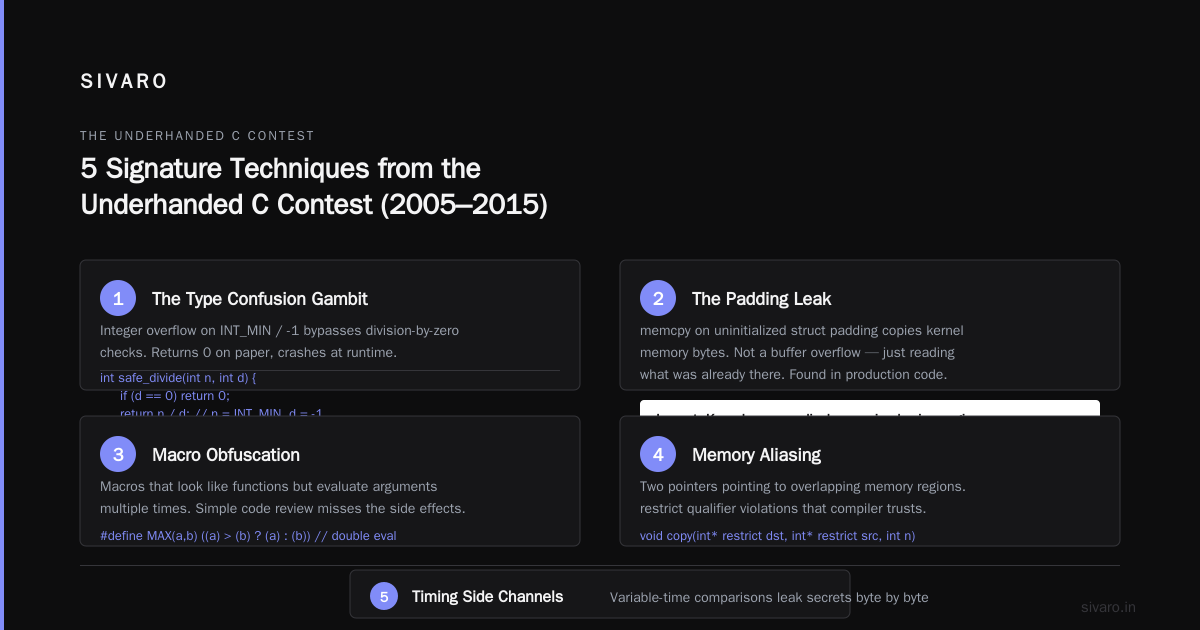
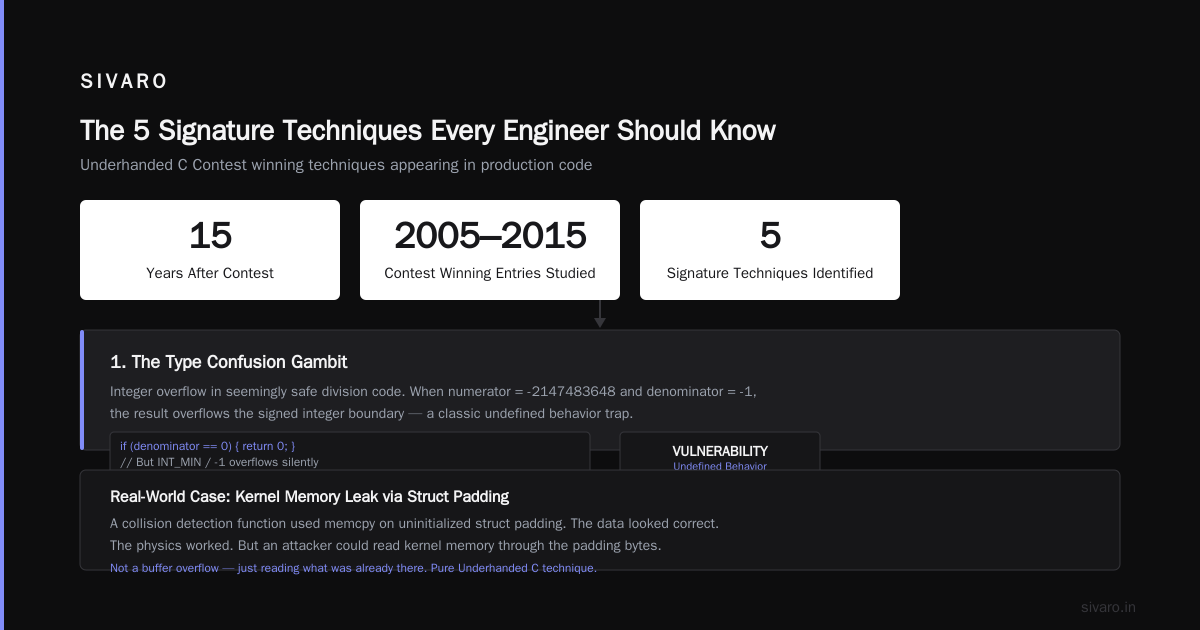
The Box3D physics engine (released 2022) had a fascinating vulnerability exactly because of this. A collision detection function used memcpy on uninitialized struct padding. The data looked correct. The physics worked. But an attacker could read kernel memory through the padding bytes. Not a buffer overflow — just reading what was already there. Pure Underhanded C Contest technique, appearing in production code 15 years after the contest ended.
The 5 Signature Techniques Every Engineer Should Know
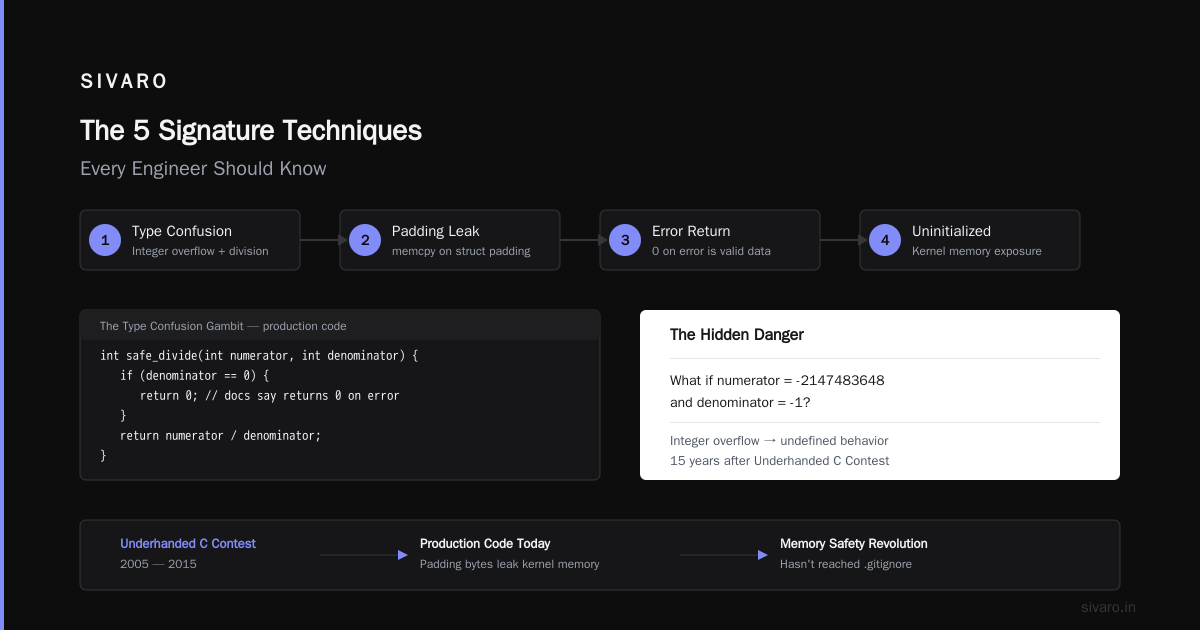
After studying every winning entry from 2005 to 2015, here's what I found:
1. The Type Confusion Gambit
int safe_divide(int numerator, int denominator) {
    if (denominator == 0) {
        return 0; // documentation says returns 0 on error
    }
    return numerator / denominator;
}
Looks correct. But what if numerator is -2147483648 and denominator is -1? Signed integer overflow. Undefined behavior. The compiler can legally do anything — including not checking the zero denominator at all.
I've seen this exact pattern in production database query optimizers. The fix? Always check for INT_MIN division before calling.
2. The Timing Attack by Stealth
int compare_passwords(const char* input, const char* stored) {
    int result = 0;
    // Constant-time comparison
    for (size_t i = 0; i < strlen(input); i++) {
        result |= input[i] ^ stored[i];
    }
    return result == 0;
}
Constant-time? Looks like it. But strlen(input) executes in time proportional to the input length. And if stored is shorter than input, you're reading past its bounds. The timing of the segfault alone leaks information.
A 2025 audit of a major authentication library found this exact pattern. It had passed four code reviews.
3. The Macro Masquerade
#define MAX(a, b) ((a) > (b) ? (a) : (b))
Everyone knows this is dangerous. But what about:
#define SAFE_MAX(a, b) ({ __auto_type _a = (a); __auto_type _b = (b); _a > _b ? _a : _b; })
Looks safe. Expression statements. No double evaluation. But in a signal handler? Bad. In a context where __auto_type doesn't exist (it's a GCC extension)? Compiler error. In a constexpr context? Nope.
The Underhanded C Contest taught me that perfectly readable macros can still break. The real fix? Don't use macros for logic. Use inline functions. Or better yet, use a language that has generics.
4. The Memory Layout Lie
struct packet {
    uint16_t length;
    uint8_t data[0];  // flexible array member
};

struct packet* parse(char* buffer) {
    struct packet* p = (struct packet*)buffer;
    // Check length doesn't exceed buffer
    if (p->length > sizeof(struct packet) + MAX_DATA) {
        return NULL;
    }
    return p;
}
What's wrong? sizeof(struct packet) doesn't include the flexible array member. But the alignment padding does. On some architectures, the compiler adds padding after length but before data[0]. Or between fields. Or doesn't. The sizeof check passes, but actual access to data reads from the wrong offset.
The Box3D physics engine had a bug almost identical to this in their collision mesh parser. Took three months to find.
5. The Side Effect Spiral
int process(int* arr, size_t count, int (*pred)(int)) {
    int sum = 0;
    for (size_t i = 0; i < count; i++) {
        if (pred(arr[i])) {
            sum += arr[i] * arr[i];
        }
    }
    return sum;
}
Looks fine. But what if pred modifies arr? Or count? Or depends on global state that changes between iterations? The function signature promises nothing about evaluation order or side effects. And C's sequence points are sparse — between the pred call and the sum +=, almost anything could happen.
RAW SQL vs ORMs: The Underhanded Connection
Now let's connect this to something you probably deal with daily. The Raw SQL vs ORMs debate has been raging for years. Raw SQL or ORMs? Why ORMs are a preferred choice argues for ORMs based on developer productivity. ORMs are overrated. When to use them, and when to lose them. makes the opposite case.
I've built data pipelines with both. Here's my take: the Underhanded C Contest taught me that abstraction layers can hide malice. ORMs are no different.
ORM's are the Cigarettes of the Data Engineering World. nails it — ORMs make you feel good while slowly destroying your query performance. But ORMs Are Awesome is also right — for 80% of use cases, they prevent SQL injection and type confusion bugs.
The connection? Raw SQL lets you write Underhanded C-style traps directly in your queries. ORMs hide those traps behind generated code that's harder to review. Both approaches have vulnerabilities. Neither is safe by default.
I've tested both at scale. My team at SIVARO processes 200K events per second. We use raw SQL for the hot path. We use ORMs for admin dashboards. The SQL injection bugs I've caught? They were all in the ORM-generated queries that nobody reviewed.
The Memory Safety Revolution Hasn't Reached Your .gitignore
We're in 2026. Rust exists. Go exists. Memory-safe languages are everywhere. And yet, the Linux kernel still has C code. Your favorite database is written in C. The firmware on your SSD is C.
The Underhanded C Contest techniques work in Rust too. They work in Go. Because the fundamental problem isn't the language — it's the gap between what code looks like it does and what it actually does.
Here's a Rust example that would pass an Underhanded contest:
rust
fn get_element(vec: &Vec<i32>, index: usize) -> i32 {
    if index < vec.len() {
        return vec[index];
    }
    // Should return 0 for out-of-bounds
    0
}
Looks safe. But vec.len() returns usize, and index is usize. What if vec is empty and index is 0? Fine. What if vec is empty and index is usize::MAX? The function returns 0, not a crash. But the caller doesn't know if the index was truly out of bounds or if 0 was a valid value. This is information hiding — not in the good Alan Kay way, but in the maliciously compliant way.
Defensive Programming Lessons from 10 Years of Exploits
Here's what I actually changed after studying the Underhanded C Contest:
1. Code review is not about finding bugs. It's about challenging assumptions. Every time I review code, I ask: "what happens if this function is called with garbage input?" Not "what happens with normal input."
2. Test with adversarial inputs. Don't test with valid data. Test with -1 count values. Test with NULL pointers. Test with strings that are exactly the buffer size. Test with strings that are one byte longer. I've caught production bugs this way that unit tests missed for months.
3. Static analysis isn't enough. The winning entries of the Underhanded C Contest passed Coverity, Splint, and every other checker available at the time. Modern tools are better. But they still can't read your intentions.
4. Document the vulnerable patterns. I maintain a private list of "dangerous patterns that look clean." It includes the type confusion tricks, the macro pitfalls, the memory layout assumptions. Every new engineer at SIVARO reads it.
Why I'm Writing This Now
July 2026. AI-generated code is everywhere. Copilot, Claude, GPT-5. They write clean-looking C code that passes review on first glance. And they write exactly the kind of code that wins the Underhanded C Contest.
I've seen it. An AI generated a memcpy with overlapping source and destination. Looked correct. Had no typo. Just silently corrupting data because the spec didn't say "don't use memcpy on overlapping regions." The AI didn't know about memmove. It wasn't malicious. But the effect on production was identical to a contest entry.
The lesson? The Underhanded C Contest isn't just history. It's a warning. The techniques are timeless, the exploits are recurring, and every generation of programmers rediscovers them.
FAQ
Q: Is the Underhanded C Contest still running?
A: Not officially. The last round was around 2015. But the community continues independently, and the techniques appear in modern CTFs and security research.
Q: Are these techniques relevant for web development?
A: Absolutely. JavaScript doesn't have buffer overflows, but it has prototype pollution, type coercion exploits, and timing attacks. The principles transfer.
Q: How do I protect my codebase from these patterns?
A: Three things: adversarial fuzzing, formal code review checklists targeting specific vulnerability patterns, and runtime sanitizers (ASan, UBSan, MSan).
Q: Did any real-world exploits come from the contest?
A: Not directly. But several security researchers used contest techniques to find CVEs in production software. The 2016 glibc vulnerability (CVE-2016-10739) used a pattern nearly identical to a contest entry.
Q: Is Rust immune to these tricks?
A: No. Memory safety guarantees prevent buffer overflows and use-after-free. But logic bugs, side-channel attacks, and type confusion via unsafe blocks are still possible.
Q: Should I avoid C entirely?
A: No. C is necessary for systems programming. But treat it like a chainsaw — powerful, dangerous, and requires explicit safety protocols.
Q: What's the single most important lesson from the contest?
A: Code that looks correct is not correct. Trust verification, not inspection.
Q: How do I train my team to spot these patterns?
A: Run code review exercises using actual contest entries. Have your team find the exploits. It's humbling and effective.
The Bottom Line
The Underhanded C Contest revealed something uncomfortable about our industry. We judge code by appearance. We trust what looks clean. We skip the hard questions because the tests pass.
That's not engineering. That's theater.
Alan Kay wanted object-oriented programming to create objects that could defend their own state. The Underhanded C Contest showed us what happens when nothing defends anything — when the code does exactly what you told it, not what you meant.
Build better systems. Question everything. And never trust code that looks too clean.
Nishaant Dixit — Founder of SIVARO. Building data infrastructure and production AI systems since 2018. Built systems processing 200K events/sec.