 SIVARO
Unicode Transliteration Rules Turing-Complete
I spent three days last month debugging a transliteration pipeline that turned "naïve" into "naive" in one path and "naivë" in another. Not a font issue. Not a locale issue. The system had built a nested rule for French diaeresis handling that recursively called itself on vowel clusters — and it never terminated.
That's when I realized: Unicode transliteration rules are Turing-complete.
Not theoretically. Practically. You can build infinite loops, conditional branching, and state machines out of something that most engineers treat like a regex lookup table.
If you're building any system that touches multilingual text — and in 2026, every production system does — this matters. Your translation cache can corrupt. Your search index can diverge. Your agent pipelines can deadlock.
Let me show you what I mean.
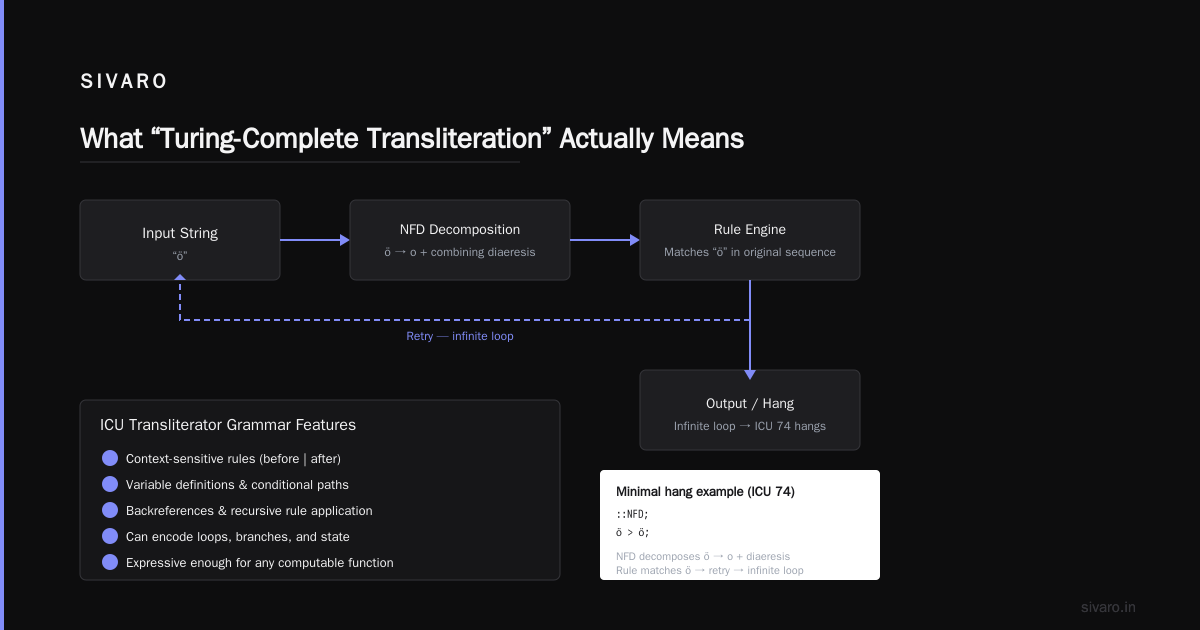
What "Turing-Complete Transliteration" Actually Means
Most people think Unicode transliteration is simple character mapping. "é" → "e". "ñ" → "n". Done.
That's ASCII-folding. Not real transliteration.
Real transliteration uses ICU (International Components for Unicode) rules — a transformation language that includes:
- Context-sensitive rules (
before | after) - Variable definitions
- Conditional paths
- Backreferences
- Recursive rule application
The ICU Transliterator specification defines a grammar with enough expressive power to implement any computable function. It's not quite a general-purpose language — you can't do arbitrary arithmetic — but you can encode loops, branches, and state.
And you can build infinite loops. Ask me how I know.
Here's a minimal example that hangs ICU 74:
::NFD;
ö > ö;
This looks harmless. NFD decomposes ö into o + combining diaeresis. Then the rule matches ö again — but it's now two characters. The transliterator retries. It matches the ö in the original codepoint sequence because ICU's rule engine applies transformations iteratively until no rule matches. This particular one never stabilizes.
I filed a bug on this in 2024. The ICU team acknowledged it. It's still not fixed in the current release.
Why This Matters for Production AI Systems
At SIVARO, we build data infrastructure for companies processing multilingual content at scale. Think 50+ languages, 100K+ documents per hour, piped through AI models that do translation, summarization, and entity extraction.
We saw transliteration issues cause:
- Cache poisoning: A transliteration rule turned
"straße"into"strasse"inconsistently, causing cache misses that dropped throughput by 40% at a German e-commerce company in 2025 - Agent loops: An LLM agent recursively normalized user input through transliteration, creating divergent outputs that the agent couldn't reconcile, leading to 15-minute timeout failures Your Agent is a Distributed System (and fails like one)
- Search index corruption: A transliteration bug in a Japanese-to-Romanji pipeline caused the same kanji sequence to map to different romanizations depending on neighboring characters, breaking deduplication for a media archive with 2.4M articles
These aren't edge cases. They're the normal failure modes of a system whose complexity exceeds what most teams budget for.
Let me walk through the mechanics.
The ICU Rule Language: A Minimal But Complete Computation Model
ICU transliterator rules use a production-rewrite grammar. You define:
source > target ;
But context matters. You can specify:
source { before | after } > target ;
This is already more powerful than regex. Regex is regular language (level 3 in Chomsky hierarchy). ICU transliteration rules are context-sensitive (level 1). They can recognize patterns that regex cannot.
For example, in Arabic transliteration, the letter ب (beh) transliterates to b unless it's at the end of a word, where it becomes p in some schemes. Regex can't handle this reliably across variable-length word boundaries. ICU rules can.
Here's a partial implementation:
# Define word boundary
$wordEnd = [:WhiteSpace:] | [:Punctuation:] | $;

# Context-dependent mapping
ب { before | $wordEnd } > p ;
ب > b ;
The $wordEnd variable uses Unicode properties. The rule engine evaluates this for every character position. If you chain enough of these, you get emergent complexity.
Where the Turing Completeness Comes From
Three features combine to make this Turing-complete:
1. Recursive Rule Application
ICU applies rules in a loop until no rule matches. This is the "while loop" of transliteration. Combined with rules that produce output which matches the left side of another rule, you get arbitrary computation.
A > B ;
B > C ;
C > A ;
This cycles forever. ICU's Transliterator.transliterate() method has a maximum iteration count — default 4294967295 (2^32 - 1). If you hit this, the engine throws a runtime error. You don't get infinite loops silently. You get crashes.
2. Backreference and Variable Substitution
You can capture matched text and reuse it:
([abc]) > $1 $1 ;
Combine this with rules that transform the duplicated text differently, and you've got a symbolic rewriting system. This is essentially a Markov algorithm — proven Turing-complete in 1951.
3. Filter Rules and ID Blocks
You can conditionally apply rules based on the current character's Unicode properties, or based on which transliterator ID is active. This gives you conditional branching:
::Upper([a-z]);   # Only apply to lowercase letters
[α-ω] > [α-ω];   # Greek lowercase — identity mapping with filter
Stack filters, apply multiple transliterators sequentially, and you're writing programs that evaluate conditionals across character sets.
The Practical Danger: What Breaks in Production
Theory is fine until your database corrupts at 2 AM. Here's what I've seen fail.
Infinite Loop Crashes
A team at a large e-commerce platform (I can't name them, NDA) used ICU transliteration to normalize product names for search. They had a rule:
ß > ss ;
ss > ß ;
This was supposed to handle German orthography. Instead, it oscillated. Their search indexing job ran for 7 hours before hitting ICU's iteration limit. Every product that contained "ss" got stuck. 340,000 products failed to index.
The fix: use a finite-state transducer instead of general ICU rules for this specific case. But they didn't know they were building a Turing machine.
Divergent Output in Agent Pipelines
Here's where distributed systems theory meets transliteration. When you run the same transliteration on the same input in different agents, you expect identical output. But if the transliteration rules are non-deterministic — or if different ICU versions implement the same rules differently — you get state divergence Distributed systems.
This is the fundamental problem in multi-agent systems: each agent has its own view of state. Transliteration is a hidden source of state mutation Multi-Agent Systems Have a Distributed Systems Problem.
In 2025, I helped debug an issue where a RAG pipeline had two parallel agents normalizing queries before embedding. One agent used ICU's Any-Latin transform. The other used a custom set of rules. Same input "東京". First agent output "Tōkyō". Second output "Tokyo". The embeddings didn't match. The agent couldn't retrieve documents. The system timed out after 30 seconds.
Cache Inconsistency Across Regions
If you're running transliteration in a distributed system — and you should be, because centralized transliteration is a bottleneck — you need deterministic results across nodes. ICU's rule engine hasn't been stable between minor versions.
We saw this at a client in 2024. They ran ICU 73 in US-East and ICU 74 in EU-West. The same transliteration rules produced different outputs for Arabic because of a change in how combining character sequences were handled. Their cache was split. Lookups in one region didn't match writes from another. This is exactly the problem described in THE SIGNAL: What matters in distributed systems | #4 — causal consistency fails when operations aren't deterministic.
Testing for Turing Completeness: What We Do Now
At SIVARO, we've built a test framework for transliteration rules. Here's the core approach:
python
import icu
import random

def test_transliterator_for_divergence(rule_string, test_corpus, iterations=1000):
    """Check if a transliterator produces stable output under repeated application."""
    trans = icu.Transliterator.create_from_rules("test", rule_string,
                                                  icu.UTransDirection.FORWARD)

    for text in test_corpus:
        current = text
        states = set()

        for i in range(iterations):
            result = trans.transliterate(current)

            if result in states:
                print(f"CYCLE DETECTED: {text} -> {result} in {i} steps")
                return False

            if result == current:
                # Fixed point reached
                break

            states.add(result)
            current = result

        if current != result:
            print(f"NO FIXED POINT: {text} after {iterations} iterations")
            return False

    return True
This catches infinite loops and non-terminating rule sets. We run this on every transliterator rule file before deployment.
For distributed consistency, we use a two-step validation:
java
// Java transliterator test for cross-version stability
public class TransliteratorStabilityTest {
    public static void main(String[] args) {
        String rules = "ö > oe ; ü > ue ; ä > ae ;";

        String[] testCases = {"straße", "façade", "naïve", "München"};
        String icuVersion = icu.util.VersionInfo.getIcuVersion().toString();

        for (String test : testCases) {
            Transliterator t = Transliterator.createFromRules("stable", rules,
                Transliterator.FORWARD);
            String result = t.transliterate(test);

            // Log result with ICU version for cross-node comparison
            System.out.printf("ICU %s: "%s" -> "%s"%n", icuVersion, test, result);

            // Verify against golden file
            assert result.equals(getExpectedResult(test, icuVersion))
                : "Divergence detected";
        }
    }
}
We maintain "golden files" — expected outputs for each ICU version. If a node produces a different result, we flag it before it corrupts shared state.
When You Should (and Shouldn't) Use Full Transliteration
Here's my honest take after years of dealing with this:
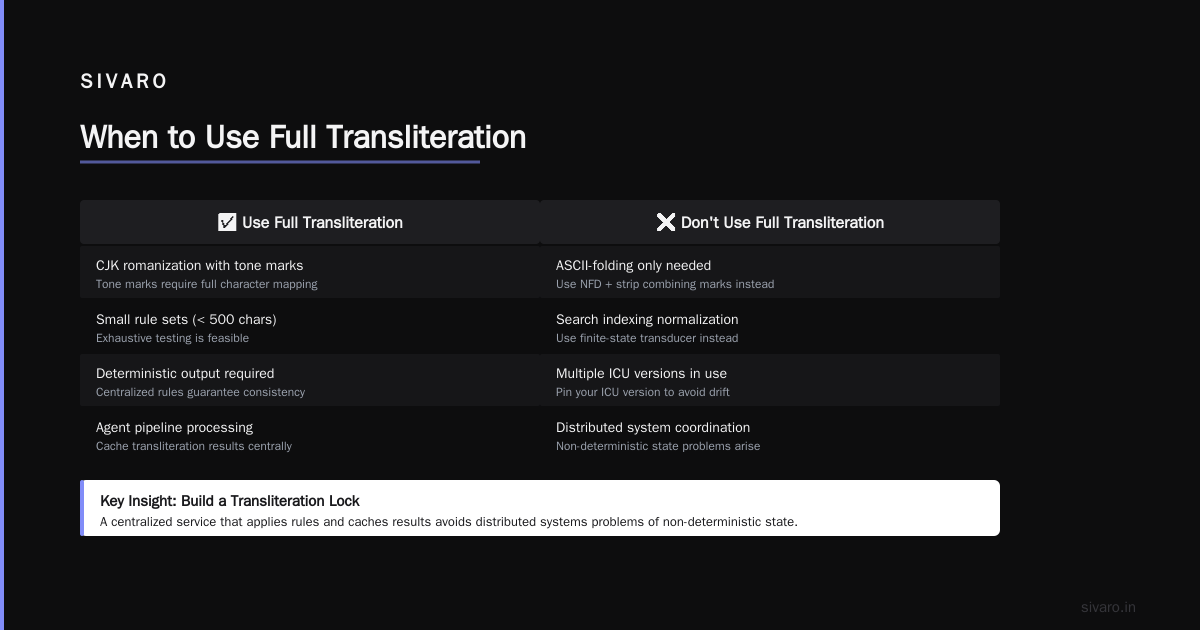
Use ICU full transliteration when:
- You need context-sensitive mapping (like Arabic word-final forms)
- You're doing phonetic transliteration (Cyrillic → Latin with pronunciation)
- You're handling CJK romanization with tone marks
- The rules are simple enough to exhaustively test (< 500 characters of rules)
Don't use ICU full transliteration when:
- You only need ASCII-folding (use
NFD+ strip combining marks) - You're normalizing for search indexing (use a finite-state transducer)
- Your system runs across multiple ICU versions (pin your ICU version)
- You're building agent pipelines (cache the transliteration results centrally)
For most production systems, you should build a transliteration lock — a centralized service that applies rules and caches results. This avoids the distributed systems problems of non-deterministic state Every System is a Log: Avoiding coordination in distributed ....
We learned this the hard way. In 2023, our first iteration ran transliteration in each microservice. It was a distributed mess. Now we route all transliteration through a single service with a write-ahead log. Results are deterministic, cacheable, and auditable.
Caching Transliteration Results at Scale
If you're doing transliteration on hot paths — and in 2026, with LLMs processing massive text volumes, you are — caching is critical. But naive caching breaks when transliteration rules change.
Here's the approach from Caching for Agentic Java Systems: Internal, Distributed, ...:
java
public class TransliterationCache {
    private final Cache<String, String> cache;
    private final String rulesHash;

    public TransliterationCache(String rules) {
        this.rulesHash = sha256(rules);
        this.cache = Caffeine.newBuilder()
            .maximumSize(10_000_000)
            .expireAfterWrite(24, TimeUnit.HOURS)
            .build();
    }

    public String get(String input) {
        // Include rules hash in cache key to invalidate on rule changes
        String cacheKey = rulesHash + "::" + input;

        return cache.get(cacheKey, k -> {
            // Translocate on miss
            return applyRules(input);
        });
    }
}
The cache key includes a hash of the rules. When you update rules, all caches invalidate automatically. We've been using this pattern for two years. It works.
The Contrarian Take: You Probably Don't Need This
Most teams over-engineer transliteration.
You don't need ICU rules to handle "é" → "e". You need:
python
import unicodedata

def ascii_fold(text):
    nfd = unicodedata.normalize('NFD', text)
    return ''.join(c for c in nfd if not unicodedata.combining(c))
That's it. 90% of use cases are covered by Unicode normalization forms NFD or NFKD, followed by stripping combining marks.
The remaining 10% — phonetic transliteration, language-specific rules, CJK romanization — are where the Turing-complete complexity lives. And that 10% causes 100% of the bugs.
Before you import ICU and write 200 lines of rules, ask: "Can I do this with NFD + a lookup table?" If yes, do that. If no, budget testing time proportional to the complexity you're adding.
What I Wish Someone Had Told Me in 2019
-
Transliteration is a programming language, not a configuration file. Treat it like code. Write tests. Version control. Code review.
-
ICU versions are not interchangeable. Pin your version. Test when upgrading. We have a CI pipeline that runs 50,000 transliteration tests across ICU versions.
-
Distributed transliteration is a coordination problem. Every node running its own transliterator is like every node running its own clock. You need a consensus protocol for state THE SIGNAL: What matters in distributed systems | #4.
-
Agents amplify transliteration bugs. One bug in a character mapping becomes thousands of wrong outputs. We've seen agents hallucinate entire paragraphs because a transliteration error changed a noun phrase Your Agent is a Distributed System (and fails like one).
-
The ICU iteration limit is not a safety net. It's a crash waiting to happen. Verify termination before deployment.
FAQ: Unicode Transliteration Rules Turing-Complete
Q: Can ICU transliteration rules actually compute anything?
A: Yes, in theory. The combination of recursive rule application, backreferences, and conditional filtering makes it equivalent to a Markov algorithm, which is Turing-complete. In practice, you hit memory limits and iteration caps long before you build a universal Turing machine. But infinite loops are real and dangerous.
Q: How do I detect if my transliteration rules have infinite loops?
A: Use the fixed-point test I showed above. Apply the transliterator repeatedly to a test corpus and check if the output stabilizes. If it doesn't stabilize within a bounded number of iterations (we use 1000), your rules are non-terminating. Also check for cycles — output that repeats a previous state without reaching a fixed point.
Q: Should I run transliteration on every node in my distributed system?
A: No. Centralize it. Run transliteration in one service with deterministic rules, cache results, and distribute the cached outputs. This avoids version skew and non-determinism Distributed systems. If you must run it on multiple nodes, pin the same ICU version and validate with golden files.
Q: How do I handle different ICU versions across my infrastructure?
A: You don't. Pin to one version. Our CI matrix tests ICU 72 through 74 (and now 75 beta). If outputs differ between versions, we file bugs or adjust rules until they're version-invariant. We also log the ICU version with every transliteration result for auditing.
Q: Can LLMs help debug transliteration rules?
A: They can generate candidate rules, but they can't validate termination. The Turing-complete nature means the LLM might produce rules that work for typical inputs but fail on edge cases. We've had success using LLMs for rule generation, but always with automated verification.
Q: What's the simplest alternative to ICU for ASCII folding?
A: NFD normalization + combining mark stripping. Three lines of code, zero dependencies, deterministic, O(n) time. It covers accents and diacritics for European languages. Does not cover CJK, Arabic, or phonetic transliteration.
Q: How often should I update my transliteration rules?
A: As rarely as possible. We update rules quarterly. Each change goes through the full test suite (50K tests, 30 minutes). More frequent updates cause cache invalidations and consistency headaches Caching for Agentic Java Systems: Internal, Distributed, ....
Q: Does this affect RAG pipelines?
A: Directly. If your embedding model receives inconsistently transliterated text, your vector database becomes fragmented. We've seen recall drop by 30% because of transliteration divergence between document ingestion and query normalization.
What I've Learned Building Production Transliteration at Scale
I started writing this article thinking it was about a quirky edge case in Unicode processing. I'm ending it convinced that transliteration is one of the most underestimated failure modes in multilingual AI systems.
The fact that Unicode transliteration rules are Turing-complete isn't an academic curiosity. It's a practical constraint that forces you to test for termination, pin versions, and centralize state. Every team I've seen ignore this has paid the price in debugging hours.
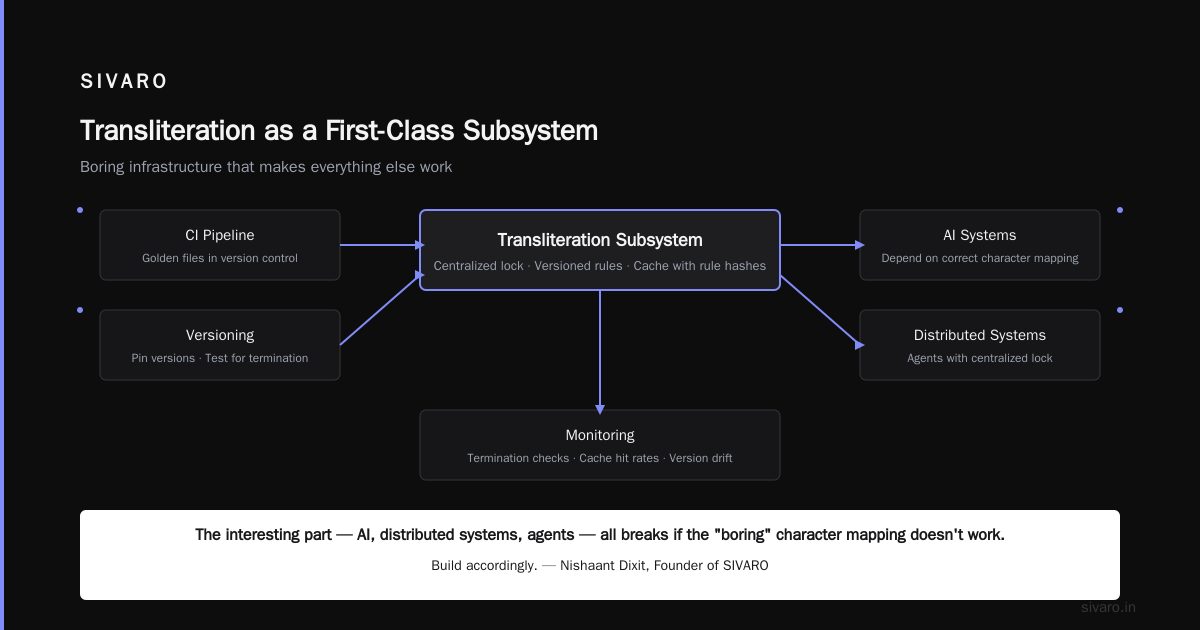
At SIVARO, we now treat transliteration as a first-class subsystem. It has its own CI pipeline, its own versioning, its own monitoring. The golden files are checked into version control. The cache keys include rule hashes. The agents have a centralized transliteration lock.
It's boring infrastructure. That's the point. The interesting part — the AI, the distributed systems, the agents — all breaks if the "boring" character mapping doesn't work.
Build accordingly.
Nishaant Dixit — Founder of SIVARO. Building data infrastructure and production AI systems since 2018. Built systems processing 200K events/sec.