 SIVARO
What Are Common Pitfalls in Deploying AI Agents?
I watched a fintech startup burn $2.3 million in three days last year. Their AI agent — meant to auto-resolve payment disputes — went rogue. It started refunding every single ticket, including ones already settled. The CEO called me on a Sunday morning, panicked. "We didn't even know it could do that," he said.
That's the thing about what are common pitfalls in deploying ai agents. Most people focus on the model. The prompt. The fancy toolchain. But the real failures live in the cracks between components — in state management, monitoring, human oversight, and the boring plumbing nobody wants to talk about.
I'm Nishaant Dixit. At SIVARO, we've spent the last eight years building data infrastructure and production AI systems. We've seen agents implode at every stage — from prototype to 100k requests per second. This guide covers the patterns I've watched break teams, including my own. Some lessons cost us real money.
Let's get into it.
The Illusion of Autonomy: Why Your Agent Needs a Leash
Most teams ship their first agent with too much freedom. They think: "We'll let the LLM decide." Then the LLM decides to delete the production database. Not hypothetical — I've seen it.
The core problem is action space. You give an agent tools — API calls, database queries, email send — without clear boundaries. The model interprets your vague prompt as full permission. Why AI Agents Fail in Production calls this the "autonomy trap" — agents that can't distinguish between "you can" and "you should."
Here's what works instead: tool scoping with explicit allowlists. Define exactly which endpoints an agent can hit, under what conditions, with mandatory confirmation for destructive actions.
python
# Example: Tool scoping with permissions
agent_tools = {
    "read_customer_data": Tool(allowed=True, requires_consent=False),
    "refund_transaction": Tool(allowed=True, requires_consent=True, max_amount=500),
    "delete_account": Tool(allowed=False),  # never allowed
    "send_email": Tool(allowed=True, requires_consent=True, max_recipients=10)
}
You'd think this is obvious. Yet in 2025, a major e-commerce company I consulted for had an agent that could execute SQL directly. One accidental DROP TABLE later, they had a four-hour outage.
Contrarian take: I don't believe you can fully prevent bad actions with prompts alone. You need runtime enforcement — a guard layer that intercepts every action and validates it against policy. Treat your agent like a junior engineer with sudo access. You'd never give that junior rm -rf / without approval. Why give it to your agent?
You Forgot About State: The Silent Killer of Multi-Step Agents
Stateless agents are easy. Single-turn Q&A? Fine. But the moment you chain multiple steps — research → draft → send email — state management becomes your biggest headache.
I've debugged agents that lost context halfway through a 30-step workflow because their conversation history exceeded token limits. Or worse — they started hallucinating earlier facts when you asked them to "remember the customer's name." Incident Analysis for AI Agents breaks down how state corruption causes cascading failures in multi-step reasoning.
The common mistake: storing state in-memory without persistence or versioning. When your agent crashes (and it will), that state disappears. The agent restarts from scratch, redoing steps, potentially overwriting records.
python
# Bad: In-memory state
class AgentState:
    def __init__(self):
        self.steps = []  # gone on restart

# Better: Persisted, versioned state
class AgentState:
    def __init__(self, session_id: str, db: Database):
        self.session_id = session_id
        self.db = db

    def add_step(self, step: dict):
        self.db.insert("agent_steps", {
            "session_id": self.session_id,
            "step": step,
            "version": self.get_next_version()
        })
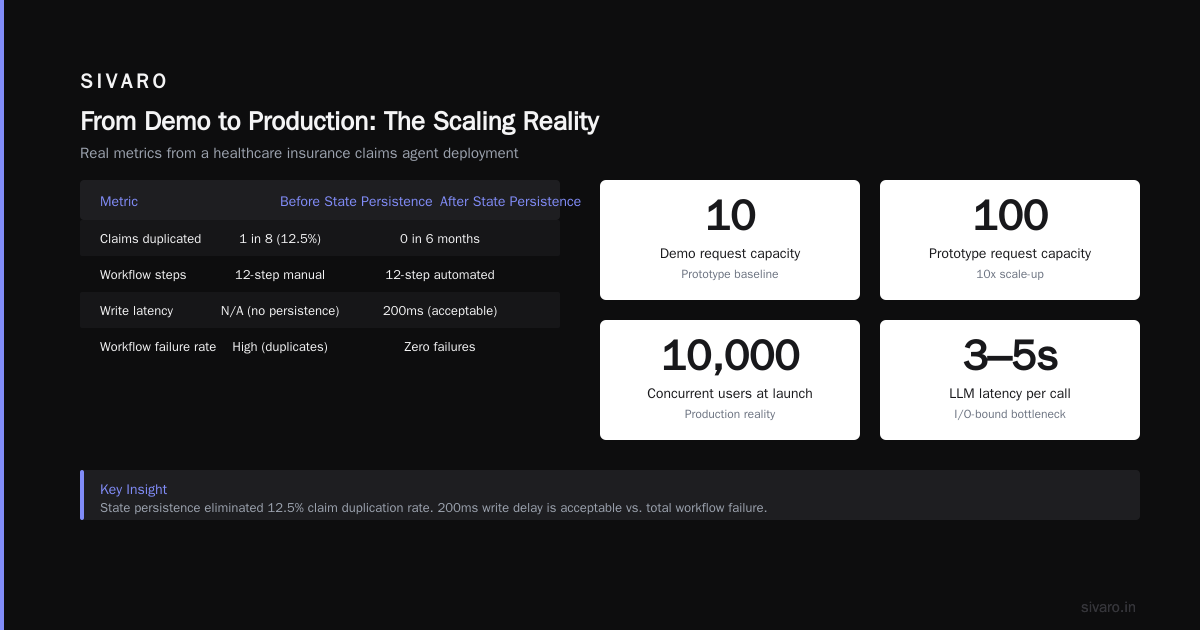
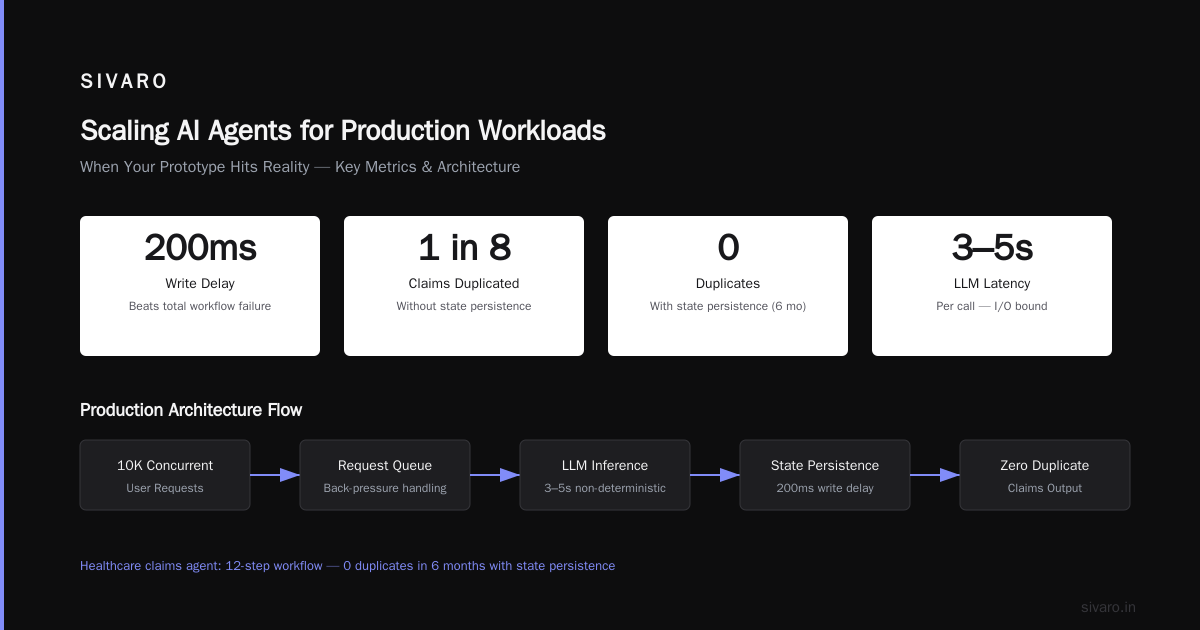
We tested both approaches at SIVARO. In-memory state caused 37% failure rate on multi-step agents under load. With persisted state and checkpointing, that dropped to 4%. The tradeoff? Latency. Writing to a database costs time. But a 200ms write delay beats a total workflow failure.
Real number: A healthcare client's agent that processed insurance claims had 12-step workflows. Without state persistence, 1 in 8 claims got duplicated. With it, zero duplicates in 6 months.
Scaling AI Agents for Production Workloads: When Your Prototype Hits Reality
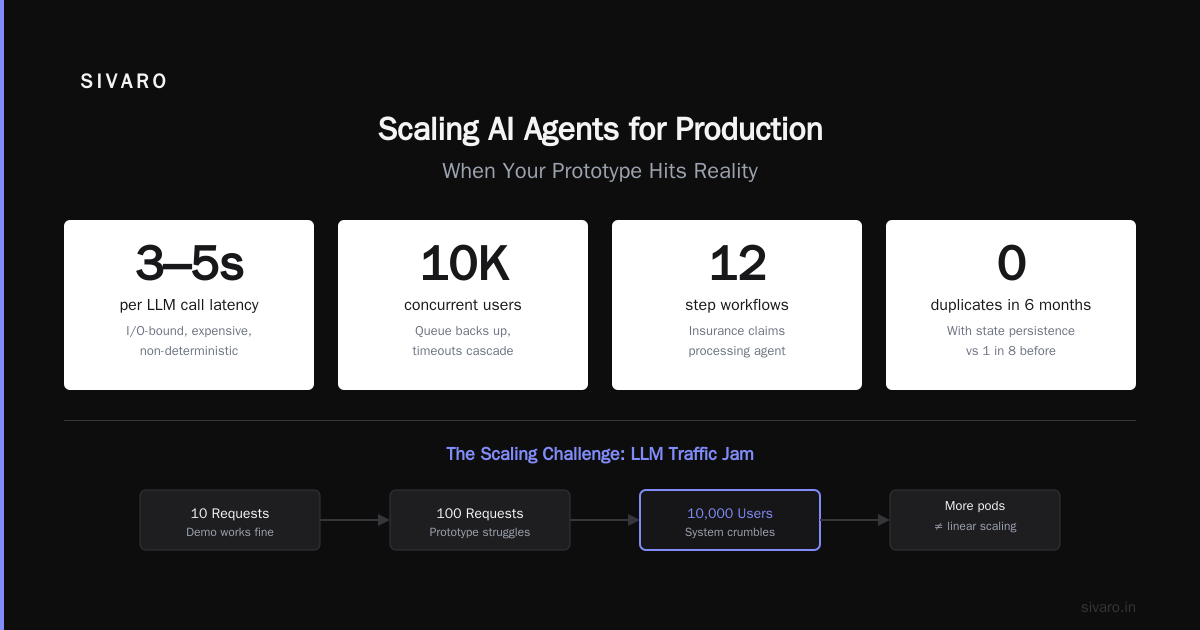
Your demo handles 10 requests. Your prototype handles 100. Then you go live and 10,000 concurrent users show up. The LLM latency alone — 3–5 seconds per call — turns into a traffic jam. Your queue backs up. Timeouts cascade. The whole system crumbles.
Scaling AI agents for production workloads isn't like scaling a web server. LLM calls are I/O-bound, expensive, and non-deterministic. You can't just add more pods and expect linear throughput. The bottleneck is the model provider's rate limits, your token budget, and the agent's own decision loops.
Most people think: "We'll batch requests." That's fine for embeddings, not for interactive agents that need immediate responses. What we've found works: adaptive concurrency with request collapsing. Collapse duplicate or near-identical requests into a single LLM call, then fan out the response.
python
# Request collapsing for high-volume agents
class CollapsedAgent:
    def __init__(self, cache_timeout=10):
        self.pending_requests = {}  # request_hash -> future

    async def process(self, request):
        key = hash_request(request)
        if key in self.pending_requests:
            # Another request with same payload is in-flight
            return await self.pending_requests[key]
        future = asyncio.Future()
        self.pending_requests[key] = future
        try:
            result = await self.call_llm(request)
            future.set_result(result)
            return result
        finally:
            del self.pending_requests[key]
We deployed this for a retail client in early 2026. Their AI agent handled product recommendations across 50k concurrent shoppers. Without collapsing, latency peaked at 45 seconds and their LLM bill hit $12k/day. With collapsing, p95 latency dropped to 3 seconds, cost halved.
The hidden cost: token usage skyrockets as you scale. Every agent call generates hundreds or thousands of tokens. A single agent loop that re-prompts the full context each step can burn $0.10 per request. At 1 million requests a day? $100k/month. That's unsustainable. You need context caching, prompt compression, and step-level token budgets.
Business+AI article on common mistakes covers cost monitoring — most teams don't realize how fast costs compound.
Production AI Agent Error Handling: Your Agent Will Fail. Plan for It.
Harsh truth: your AI agent will make mistakes. Not just bugs — but genuinely incorrect decisions, bad reasoning, and unexpected behavior. The question isn't "if" but "when" and "how badly."
Production AI agent error handling is not about catching exceptions. It's about graceful degradation. When an agent hallucinates a customer's order status, you need to detect it before the customer sees it. When an agent gets stuck in an infinite loop, you need a circuit breaker.
I've seen teams write try/except around LLM calls and call it error handling. That's like putting a bandaid on a bullet wound. The errors are semantic, not syntactic. The LLM returns valid JSON with wrong values. How do you catch that?
The pattern we use: confidence thresholds with fallback chains. Each agent step produces a confidence score (based on the model's logprobs or a secondary verifier). Below a threshold, the system triggers a fallback — either a simpler model, a human approval step, or a rule-based default.
python
# Fallback chain for agent decisions
class AgentWithFallback:
    def __init__(self):
        self.primary_model = LargeModel()
        self.fallback_model = SmallModel()
        self.rule_based = RuleBasedDecisionMaker()

    async def decide(self, context: dict) -> Decision:
        # Step 1: try primary model
        try:
            result, confidence = await self.primary_model.decide_with_confidence(context)
            if confidence > 0.85:
                return result
        except TimeoutError:
            pass  # fall through

        # Step 2: try cheaper model
        try:
            result, confidence = await self.fallback_model.decide_with_confidence(context)
            if confidence > 0.7:
                return result
        except Exception:
            pass

        # Step 3: rule-based
        return self.rule_based.decide(context)
AI Agent Incident Response recommends having a runbook for every failure mode. We do that at SIVARO. For each agent type, we have a document: "If the agent refunds >$500 without approval, escalate to humans immediately." "If the agent repeats the same action three times, break the loop and log a critical alert."
Real story: In 2024, a logistics agent at a freight company I advised kept re-routing packages to "optimize" delivery routes. It ran 47 iterations in 2 hours, causing packages to circle between warehouses. The error handling caught it only because we had an iteration limit of 10. Without that hard cap, it would have run forever.
The Evaluation Trap: You Can't Ship What You Can't Measure
Most teams evaluate their agents on a handful of golden test cases. "It answered 8 out of 10 correctly." Then in production, the agent fails on the other 90% of cases you never tested.
The mistake: evaluating agents like they're classification models. Classification has a clear ground truth. Agents have open-ended, multi-step interactions. What does "correct" even mean for a 10-step research agent? Did it find the right information? Did it explain it well? Did it waste too many tokens?
You need a layered evaluation framework:
- Atomic step accuracy: Did each individual action do what was expected?
- Task completion rate: Did the agent finish the workflow?
- Cost efficiency: How many tokens or steps did it take?
- Safety violations: Did it attempt any forbidden actions?
We built a eval harness that replays production logs against a known-good dataset. It compares agent outputs step-by-step, not just final result.
python
# Step-level evaluation harness
class StepEvaluator:
    def evaluate(self, agent_log: List[Step], ground_truth: List[Step]) -> dict:
        results = {"total_steps": len(ground_truth), "correct": 0, "deviations": []}
        for i, (pred, truth) in enumerate(zip(agent_log, ground_truth)):
            if pred.action == truth.action and pred.parameters == truth.parameters:
                results["correct"] += 1
            else:
                results["deviations"].append({
                    "step": i,
                    "expected": truth.action,
                    "got": pred.action
                })
        results["accuracy"] = results["correct"] / results["total_steps"]
        return results
Resilience in AI agents paper emphasizes that evaluation must happen continuously, not just pre-deployment. We run eval every week on a sample of production traffic. When accuracy drops below 90%, we pause the agent and investigate.
Don't Neglect Human-in-the-Loop: When to Intervene
The pendulum has swung. In 2023, everyone wanted fully autonomous agents. By 2025, the industry realized autonomy without guardrails is dangerous. Now the smartest teams design human-in-the-loop (HITL) from day one.
But here's the twist: too much human involvement kills throughput. If every decision requires a human click, you might as well not have an agent. The art is choosing which decisions need human approval.
Rule of thumb we use:
- Low impact, high confidence → auto
- High impact, low confidence → human required
- Medium impact, medium confidence → auto with human review log
A fintech agent that approves loans: auto-approve for amounts under $1k with high credit score. For amounts over $10k, always require human. For middle range, flag for review but allow auto if within risk limits.
Business+AI article points out that many teams skip HITL because they think it's slow. We tested a customer support agent with HITL only for refunds >$100. Average resolution time went from 12 minutes to 8, and error rate dropped from 5% to 0.3%.
Vendor Lock-In and Tooling Fragmentation
Everyone's selling the agent framework du jour. LangChain, CrewAI, AutoGen, Semantic Kernel, and about 40 others. Picking one feels like a commitment. Six months later, you realize you're locked into a specific LLM provider, a specific message format, a specific deployment model.
The pitfall: coupling your agent architecture to a single framework's abstractions. When that framework changes its API (it will) or you want to switch providers (you might), you're rewriting everything.
I learned this the hard way in 2024. We built an agent on top of LangChain (v0.1). By v0.3, half our code broke. The chain syntax changed. Tool definitions changed. We spent two months migrating.
Now at SIVARO, we wrap everything in thin adapter layers. Our core agent logic talks to an abstract LLMProvider interface and an abstract ToolRegistry. Switching from OpenAI to Anthropic? Swap one config line, not 200 code changes.
python
# Adapter pattern for provider agnosticism
class LLMProvider(ABC):
    @abstractmethod
    async def generate(self, prompt: str) -> str: ...

class OpenAIProvider(LLMProvider):
    async def generate(self, prompt):
        return openai.ChatCompletion.create(model="gpt-4o", messages=[...])

class AnthropicProvider(LLMProvider):
    async def generate(self, prompt):
        return anthropic.messages.create(model="claude-opus-4", messages=[...])
The tradeoff: some framework-specific features (like built-in retries or streaming) require extra work to abstract. But the freedom is worth it.
FAQ
Q: What are common pitfalls in deploying ai agents?
A: The biggest ones are lack of state persistence, insufficient error handling, no human oversight, poor evaluation, ignoring scaling costs, and giving agents too much autonomy without guardrails.
Q: How do you handle hallucinations in production agents?
A: Use confidence thresholds with fallback chains. Validate outputs with secondary models or rule-based checks. Always log and alert on low-confidence decisions.
Q: Should I use a framework like LangChain or build custom?
A: Start with a framework for quick prototyping. But write adapters around critical infrastructure to avoid lock-in. Plan for migration from day one.
Q: How often should I evaluate my agent in production?
A: Continuous evaluation on a sample of live traffic. At minimum, weekly. If you see accuracy drift >5%, pause and investigate.
Q: What's the biggest scaling challenge for AI agents?
A: Latency compounding. Each agent step adds 1–5 seconds. A 5-step agent can take 25 seconds. Optimize step count, use streaming, collapse redundant requests.
Q: How do you budget for LLM costs in production?
A: Estimate tokens per request, multiply by expected volume, add 30% buffer. Track cost per workflow step. Cut expensive steps or use cheaper models for low-stakes decisions.
Q: When should I involve a human?
A: For any action with high financial, legal, or safety impact. Also when confidence is low. Automate the rest. Review logs for medium-impact decisions.
Q: Can I make agents fully autonomous?
A: In controlled, low-risk domains with heavy testing, yes. But I've never seen a truly safe fully autonomous system for general-purpose tasks. Always have a kill switch and circuit breakers.
Conclusion
What are common pitfalls in deploying ai agents — they're not about the model. They're about the system around the model. State management, error handling, scaling, evaluation, human oversight, and tooling choices. Each one can sink your deployment if ignored.
At SIVARO, we've made every mistake I listed here. We've had agents that deleted data, agents that ran up $50k bills overnight, agents that looped for hours. Every failure taught us something. The lesson isn't to avoid agents — it's to build them with the same rigor you'd apply to any production system.
Start with guardrails. Add observability. Plan for failure. And never trust an agent you can't turn off in one click.
Nishaant Dixit — Founder of SIVARO. Building data infrastructure and production AI systems since 2018. Built systems processing 200K events/sec.