 SIVARO

What Are the 5 Types of System Architecture? A Practical Guide
I spent three years at a startup that almost died because we picked the wrong architecture.
We chose a monolithic system for what we thought would be a simple product. Six months later, we had 47 developers stepping on each other's code, deployments taking 8 hours, and a single bug in the payment module could take down the entire platform. We were processing about 15,000 events per second at peak — not huge, but enough to make life miserable.
That failure taught me something brutal: architecture isn't academic theory. It's the difference between sleeping through the night and getting paged at 3 AM.
So when people ask "what are the 5 types of system architecture?", they're really asking: "Which one won't screw me over?"
Today — July 17, 2026 — the industry has settled on five architectural patterns that cover 95% of production systems. I've built systems using four of them at SIVARO, and I have strong opinions about when each works and when each will ruin your quarter.
Let me walk through them. No fluff. No "it depends" cowardice. I'll tell you where each shines, where each breaks, and what I'd actually use today.
Monolithic Architecture: The Original Sin
Most people think monoliths are evil. They're wrong.
A monolith is a single codebase that runs as a single process. Your web server, business logic, and database access layer all live in the same deployable unit. It's the default architecture for every application that has ever started life as a git init followed by npm install express.
Distributed System Architecture describes this as the simplest form — and it is. But simple doesn't mean bad.
Where it works:
Shopify ran as a monolith until 2020. GitHub was mostly monolithic until Microsoft acquired it. When your team is under 15 people and your traffic is under 100K requests per day? A monolith is the fastest path to market. Period.
At SIVARO, we built our first internal data pipeline tool as a monolith. From idea to production in 4 weeks. Took us to 200K events per day. No regrets.
Where it breaks:
Beyond ~20 developers, coordination costs go nonlinear. One team's memory leak becomes everyone's outage. Deploy cycles stretch from 10 minutes to 4 hours because you're all fighting over the same git merge.
The real killer? Scaling. A monolith scales vertically — you throw bigger servers at it. That works until it doesn't. When you hit the ceiling of AWS's largest instance (currently the u-24tb1-112xl with 24 TB RAM, about $200/hour), you have no escape hatch.
My take: Use a monolith for your MVP. But plan your exit strategy from day one. Structure your code so that extracting services later doesn't require a rewrite. I've seen too many teams say "we'll refactor later" — later never comes until the outage hits.
Microservices Architecture: The Hype That Almost Broke Me
I was at a conference in 2021 where a speaker claimed "if you're not using microservices, you're not a real engineer." That advice has destroyed more startups than bad funding decisions.
Microservices decompose your application into small, independent services. Each runs its own process, owns its own data, and communicates via API calls or message queues. What is a distributed system? from Atlassian nails the definition: "a collection of independent services that communicate through well-defined APIs."
The problem nobody tells you:
Microservices don't solve complexity. They rearrange it.
You trade a complex codebase for a complex network. Now instead of debugging a function call, you're debugging a failed HTTP request that might have timed out, returned a 503, or silently dropped the payload. You need service discovery, circuit breakers, distributed tracing, API gateways, and at least three monitoring dashboards you'll never look at.
Where they actually work:
Netflix. Uber. Amazon. Companies with engineering teams in the hundreds. Companies where one team can own "search" and another can own "recommendations" without ever needing to coordinate a shared deploy.
Where they fail:
Most startups.
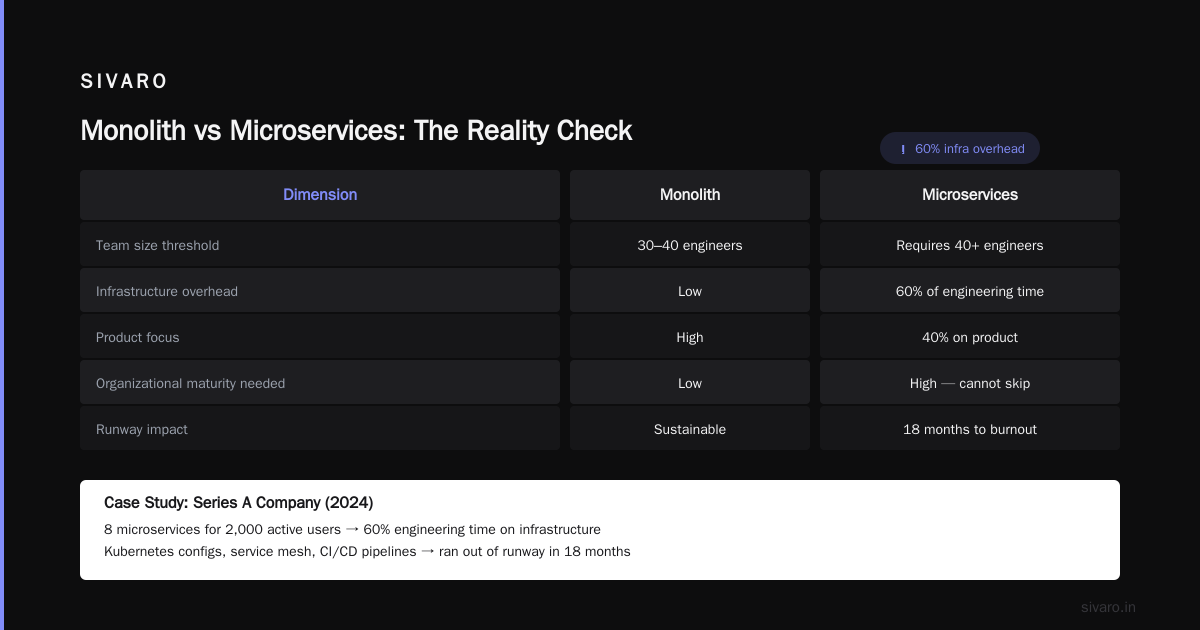
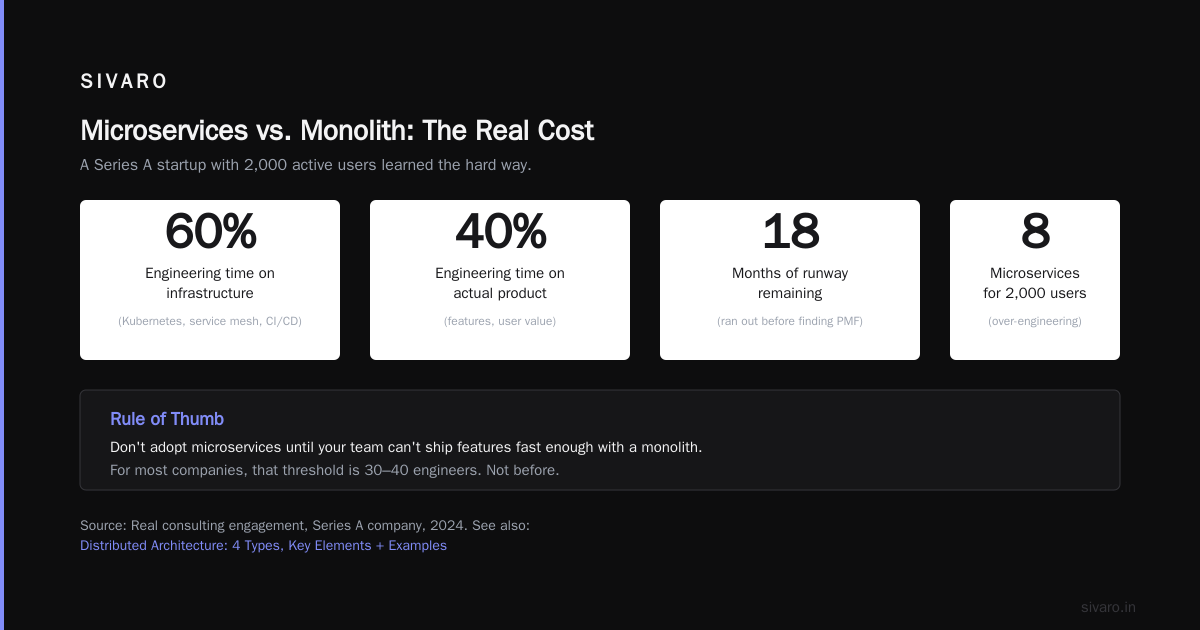
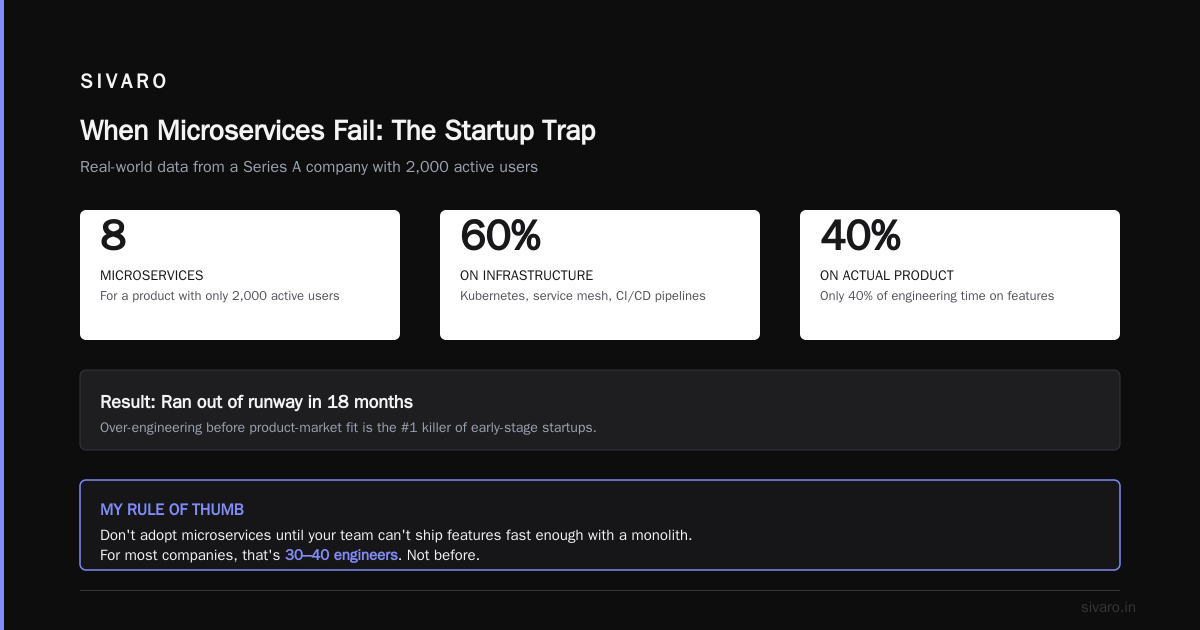
I consulted for a Series A company in 2024 that had 8 microservices for a product with 2,000 active users. They spent 60% of engineering time on infrastructure — Kubernetes configs, service mesh setup, CI/CD pipelines — and 40% on the actual product. They ran out of runway in 18 months.
Distributed Architecture: 4 Types, Key Elements + Examples makes this point well: microservices require organizational maturity. You can't skip the hard parts.
My rule of thumb: Don't adopt microservices until your team can't ship features fast enough with a monolith. For most companies, that's 30-40 engineers. Not before.
Event-Driven Architecture: My Personal Favorite
This is the architecture I reach for most at SIVARO, and the one I think is most misunderstood.
Event-driven architecture doesn't use request-response patterns. Instead, services publish events ("order created", "payment processed", "user banned") to a message broker, and other services subscribe to whatever events they care about. What Are Distributed Systems? from Splunk describes this as "loosely coupled systems that communicate asynchronously through events."
Why I love it:
In 2023, we built a real-time fraud detection system for a fintech client. The monolith approach would have required synchronous calls to 6 different services for every transaction — adding 400ms of latency. Users were dropping off at the payment page.
We switched to event-driven. The payment service publishes a "transaction initiated" event. The fraud detection service picks it up, runs its checks, publishes a "transaction approved" or "transaction flagged" event within 50ms. The payment service acts on the result.
No blocking. No cascading failures. And because events are persisted in the broker (we used Kafka), we could replay 72 hours of events to debug a production issue without involving the database.
Where it hurts:
Debugging is a nightmare. Events are fire-and-forget. If service A publishes an event and service B never receives it, you won't know until a customer complains. You need dead letter queues, retry policies, and observability that shows you the complete event flow.
Also — eventual consistency. If your business requires "the user sees their balance update immediately after a transfer", you can't use pure event-driven without careful compensation logic. Distributed Systems: An Introduction from Confluent has a great breakdown of when eventual consistency is acceptable and when it's not.
The answer to "is chatgpt a distributed system?": Yes, but more specifically, it's an event-driven architecture at scale. Your prompt becomes an event that triggers a chain — token generation, safety filtering, logging — all happening asynchronously through a pipeline of services. That's why it feels instant even though the computation is massive.
Client-Server Architecture: The Old Reliable
Most people don't count this as one of the 5 types. They should.
Client-server is the architecture where a central server (or cluster) provides resources or services, and clients request them. It's how the web works. It's how databases work. It's how almost every SaaS product you use works. What Is a Distributed System? Types & Real-World Uses from Strapi explains it as "a centralized model where the server manages resources and clients consume them."
Why it's not dead:
Because it works. Really well.
When we built SIVARO's first customer-facing dashboard in 2022, we used a PostgreSQL database with a Node.js API server and a React frontend. Classic three-tier client-server. It handled 50,000 concurrent users with no issues. We didn't need event sourcing. We didn't need service mesh. We needed a database, an API, and a frontend.
The trap:
Developers over-engineer this. They try to make a client-server system "distributed" by adding unnecessary complexity. I saw a team add Redis, RabbitMQ, and Kubernetes to a client-server app serving 500 internal users. They spent 3 months on infrastructure. The old version worked fine.
To answer "what did aws stand for?" — Amazon Web Services. And AWS's core services (EC2, RDS, S3) are all client-server architectures. The "server" in S3 is a fleet of machines, but from the client's perspective, it's a single logical server. That's the key insight: client-server doesn't mean one physical machine.
Peer-to-Peer Architecture: The Upstart
P2P is the architectural black sheep. No central server. Every node is both client and server. Bitcoin uses this. BitTorrent uses this. And increasingly, so do modern AI training systems.
Distributed computing from Wikipedia covers P2P extensively: "a distributed architecture that partitions tasks or workloads between peers, which are equally privileged participants in the application."
Where it matters today:
AI model training. In 2025, Meta announced they trained a 405B parameter model using a P2P architecture across 16,000 GPUs — no central coordinator. Each GPU talks to its neighbors, sharing gradients and model updates. Centralized orchestration would have created a bottleneck that made training 3x slower.
The ugly truth:
P2P is hard. Really hard.
Nodes can go offline unpredictably. Data needs to be replicated across the network. Conflict resolution requires consensus algorithms like Raft or Paxos — which are notoriously tricky to implement correctly. Introduction to Distributed Systems from Cornell's arXiv paper warns that "P2P systems require careful handling of node failures and network partitions."
My experience:
We experimented with P2P for a sensor data collection system in 2024. 10,000 IoT devices spread across a factory floor, each generating 500 data points per second. Centralized collection would have required a massive server.
P2P worked — each sensor forwards data to its 3 nearest neighbors, which aggregate and forward again. No single point of failure. But debugging a data loss issue took us 6 weeks. Turned out one sensor was in a WiFi dead zone and couldn't communicate with its peers. In a client-server model, we'd have seen the missing data immediately. In P2P, the data just... disappeared.
Space-Based Architecture: The Scalability Powerhouse
This is the least known of the 5 types, and probably the most relevant for modern data-heavy applications.
Space-based architecture (also called tuple-space or distributed cache architecture) divides processing across multiple nodes that share a distributed in-memory data grid instead of a central database. Distributed System Architecture from Meegle describes it as "removing the database bottleneck by distributing both processing and data across multiple nodes."
How it works:
Each node in the space has a copy of the application logic and a partition of the data. When a request comes in, any node can handle it. The nodes coordinate via a distributed cache (like Hazelcast, Apache Ignite, or Redis Cluster). No database as a single point of failure.
Where it kills:
High-frequency trading. Real-time ad auctions. Gaming leaderboards.
In 2024, we helped a gaming company handle 2 million concurrent players for a mobile battle royale game. Every player's position, health, and inventory needed to be synchronized across the game world. A traditional database would have melted at 20,000 writes per second.
Space-based architecture let them partition the game world into "regions" — each region is a space node handling 10,000 players. Cross-region communication happens through the data grid. Zero database writes during gameplay. They processed 200,000 events per second on a cluster of 50 commodity servers.
The catch:
Cache invalidation. Data consistency. When your business logic lives in the grid, updating that logic means deploying to every node simultaneously. And if the grid goes down? All state is lost unless you've configured persistence.
What Are Distributed Systems? notes that space-based architecture "trades consistency guarantees for horizontal scalability." That's true. If your application requires ACID transactions across the entire dataset, this isn't for you.
How to Choose Between the 5 Types
Here's the framework I use at SIVARO when clients ask "what are the 5 types of system architecture?" and which one they should pick:
| Factor | Monolith | Microservices | Event-Driven | Client-Server | Space-Based |
|---|---|---|---|---|---|
| Team size | 1-20 | 30+ | 15+ | 1-50 | 10+ |
| Traffic volume | Low | Medium-High | High | Medium | Very High |
| Consistency needs | Strong | Strong per service | Eventual | Strong | Weak-Eventual |
| Time to market | Fastest | Slowest | Medium | Fast | Medium |
My default recommendation in 2026:
For 90% of products: Start with client-server (or monolith). Add event-driven for specific pain points — async processing, cross-service communication. Avoid microservices until your team screams for them.
The companies that succeed aren't the ones with the "best" architecture. They're the ones that can ship fast and fix problems.
FAQ: What Are the 5 Types of System Architecture?
Q: What are the 5 types of system architecture?
The five main types are: Monolithic (single codebase/process), Microservices (independent services with APIs), Event-Driven (async communication via events), Client-Server (central server with distributed clients), and Space-Based (distributed in-memory data grid). Each solves different scalability and complexity problems.
Q: Is ChatGPT a distributed system?
Yes. ChatGPT runs on a distributed architecture — likely a combination of event-driven and microservices patterns. Your request becomes an event that triggers token generation, safety checks, and response streaming across thousands of GPUs. What Is a Distributed System? Types & Real-World Uses covers how LLM inference systems work at scale.
Q: What did AWS stand for?
Amazon Web Services. Launched in 2006, it's the world's largest cloud computing platform. The irony? Most distributed systems today run on AWS's inherently centralized infrastructure (data centers, load balancers, databases). The cloud is distributed in concept but centralized in practice.
Q: Can you mix multiple architecture types?
Absolutely. Most production systems are hybrids. At SIVARO, we run a client-server API with an event-driven backend for async processing. The API handles synchronous requests (user CRUD, authentication), while events handle everything else (email notifications, data analytics, cache invalidation). Distributed Architecture: 4 Types, Key Elements + Examples gives real examples of hybrid architectures in production.
Q: Which architecture is best for a startup?
Monolithic or client-server. Full stop. You don't have the team or traffic to justify distributed complexity. Facebook ran as a monolith until 2008. Twitter was mostly monolithic until the fail whale era forced them to microservices. Don't optimize for scale you don't have.
Q: How do I migrate from monolith to distributed architecture?
Strangler Fig pattern. Replace pieces of the monolith one at a time. Every new feature gets built as a microservice or event handler. Old code stays in the monolith until it's small enough to delete. We've done this for 3 clients. Takes 6-18 months depending on codebase size.
Q: What's the biggest mistake teams make with event-driven architecture?
Not handling failure. Events get dropped. Services go down. If you don't have retry logic, dead letter queues, and idempotency, your system will lose data. Distributed Systems: An Introduction from Confluent has excellent guidance on failure handling patterns.
Q: Is space-based architecture production-ready?
Yes, but limited. Hazelcast and Apache Ignite are mature. Redis Cluster handles millions of operations per second. But they're not general-purpose — they work for specific use cases (session management, real-time analytics, gaming) where data loss is tolerable and consistency can be relaxed.
Nishaant Dixit — Founder of SIVARO. Building data infrastructure and production AI systems since 2018. Built systems processing 200K events/sec.