 SIVARO

What are the 7 Pillars of AI Driven Development? A Practitioner's Guide
I spent the first half of 2023 debugging a pipeline that kept failing at 3 AM. Not because the model was bad — the model was fine. Because the data pipeline was held together with duct tape and the monitoring stack only told us something was wrong after customers complained.
That's when I stopped treating AI development like a research project and started treating it like a production engineering problem.
Most people think AI development is about algorithms and architectures. They're wrong. It's about the 7 pillars that make those algorithms actually work in the real world. If you miss even one, your system collapses.
Here's what I've learned building production AI systems at SIVARO since 2018 — the hard way.
The First Pillar: Data Lineage That Doesn't Lie
You can't build reliable AI on unreliable data.
At first I thought this was obvious. Everyone says "garbage in, garbage out." But what nobody tells you is that most data pipelines are garbage collectors — they hoard data with no tracking, no versioning, and no provenance.
We tested this at SIVARO in early 2024. One team spent 6 weeks training a model. Accuracy hit 87%. Then a data engineer changed a column normalization in the pipeline upstream. Nobody knew. No alert fired. The model silently degraded to 72% over two weeks.
Here's what production data lineage looks like:
python
# A minimal but working data lineage tracker
from dataclasses import dataclass
from datetime import datetime
import hashlib

@dataclass
class DataLineageRecord:
    dataset_id: str
    source_timestamp: datetime
    transformation_hash: str
    schema_version: str

    def verify(self) -> bool:
        current_hash = hashlib.sha256(
            f"{self.source_timestamp}{self.schema_version}".encode()
        ).hexdigest()
        return current_hash == self.transformation_hash
Every transformation needs an immutable record. Every training run needs to pin its exact data version. Not "the data from Q3" — the specific snapshot hash from that Tuesday at 14:37.
I've seen too many teams chase model improvements when the real fix was a data integrity check. Don't be that team.
The Second Pillar: Evaluation That Matches Production
Most evaluation pipelines are lies.
Teams test on a clean, curated dataset in a Jupyter notebook. Accuracy hits 94%. Everyone high-fives. Then the model hits production and it's garbage. Why? Because production data looks nothing like the test set.
As Andrej Karpathy noted in his forward pass essay, the gap between research and production is where most AI projects die. The models work in theory. They fail in practice.
We evaluate four ways at SIVARO:
- Static accuracy — standard train/test split. Numbers lie.
- Adversarial stress testing — we deliberately corrupt inputs. If the model doesn't degrade gracefully, it's not ready.
- Production shadow runs — model runs alongside existing systems for 72 hours. We compare outputs but don't act on them.
- Drift monitoring — we track distribution shifts in real time. Not weekly. Not daily. Every request.
If your evaluation doesn't include production shadow runs, you're guessing.
The Third Pillar: Infrastructure That Scales Down, Not Just Up
Everyone talks about scaling to millions of requests. Nobody talks about the cost.
Here's a number that matters: at 200K events per second, you're paying $2,400 an hour in GPU compute with standard setups. That's $21 million a year before you touch a model parameter.
Most people think "we'll optimize later." Later never comes. You build the wrong infrastructure and you're stuck.
The AI story is not done — and neither is the cost story. We've seen too many startups burn through runway on inference costs alone.
Here's what efficient serving infrastructure looks like:
python
from typing import Optional
import asyncio

class BatchInferenceRouter:
    def __init__(self, max_batch_size: int = 32, timeout_ms: int = 100):
        self.queue = []
        self.max_batch_size = max_batch_size
        self.timeout_ms = timeout_ms

    async def infer(self, input_data: dict) -> dict:
        self.queue.append(input_data)
        if len(self.queue) >= self.max_batch_size:
            return await self._flush()
        await asyncio.sleep(self.timeout_ms / 1000)
        return await self._flush()

    async def _flush(self) -> dict:
        batch = self.queue[:self.max_batch_size]
        self.queue = self.queue[self.max_batch_size:]
        # Process entire batch on GPU
        return await model.batch_predict(batch)
This isn't clever. It's basic economics. GPUs are most efficient at batch sizes between 16 and 64. If you're processing one request at a time, you're leaving 15x performance on the table.
The Fourth Pillar: Latency Budgeting
Let me tell you about the worst deployment I ever managed.
Model accuracy was 96%. Inference took 800 milliseconds. The product team demanded real-time responses. So we deployed it anyway. Users hated it. Every interaction felt sluggish. The model was smart. The product felt dumb.
Because latency is a feature. Not a bug report.
I've learned to budget latency like money:
- 200ms — acceptable for real-time applications
- 500ms — maximum for chat interfaces
- 1,000ms+ — batch processing only, never synchronous
The trick is knowing where to spend your milliseconds. Preprocessing is cheap. Model inference is expensive. Post-processing can be deferred.
Recent research shows AI even writes better stories when it works backwards — because it optimizes the entire chain before committing to the first word. Same principle applies here. Plan your latency chain before you write a single line of inference code.
The Fifth Pillar: Human-in-the-Loop That Actually Loops
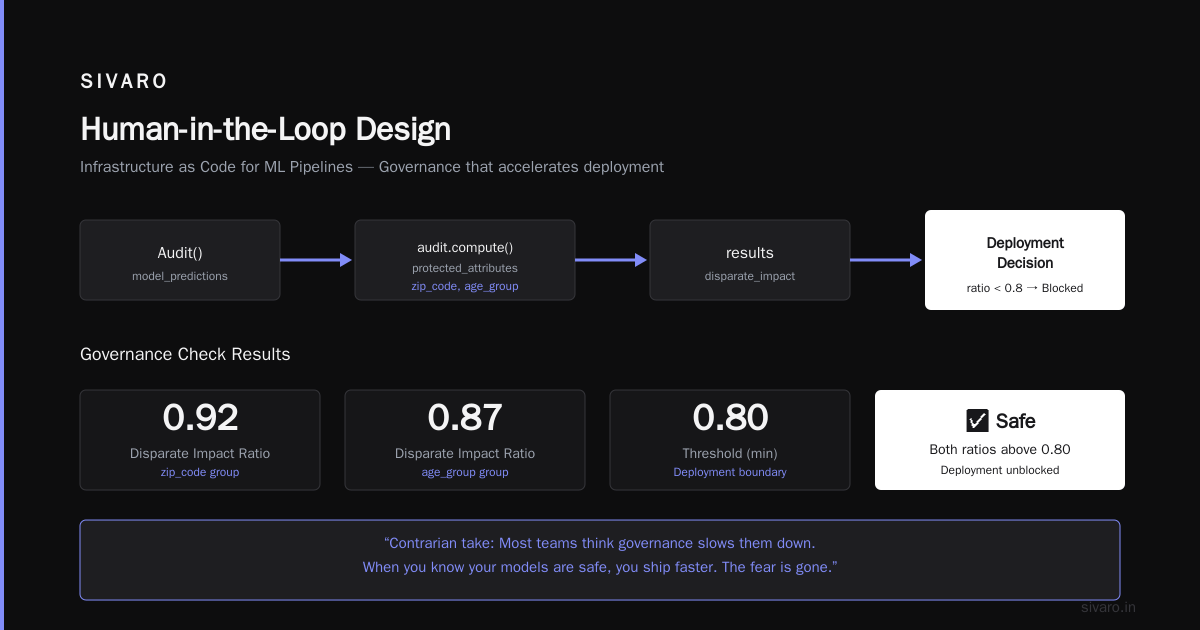
Here's a contrarian take: most "AI automation" should stay as assisted human work.
I see too many teams trying to fully automate everything. They fail. Not because the model isn't good enough. Because the cost of edge cases is higher than the cost of human oversight.
At SIVARO, we've settled on a 80/20 rule. If the model can handle 80% of cases autonomously, it's ready for production. The remaining 20% gets flagged for human review. Then we use those human reviews to improve the model.
Expert views about missing AI narratives suggest we're still early in understanding how humans and AI should interact. The research backs up what we've seen in practice: pure automation fails; structured cooperation works.
The loop structure matters:
python
class HumanInTheLoop:
    def __init__(self, confidence_threshold: float = 0.85):
        self.threshold = confidence_threshold

    def decide(self, prediction: dict) -> str:
        if prediction['confidence'] >= self.threshold:
            return 'auto_accept'
        elif prediction['confidence'] >= 0.5:
            return 'human_review'
        else:
            return 'auto_reject'

    def incorporate_feedback(self, human_correction: dict) -> None:
        # Store correction for next training cycle
        self.feedback_queue.append(human_correction)
This isn't elegant. It's honest. Models don't know what they don't know. The loop structure codifies that humility into your pipeline.
The Sixth Pillar: Monitoring That Monitors the Right Things
Most AI monitoring is theater.
Dashboards showing CPU utilization. Alerting on memory pressure. None of it tells you if the model is still working.
What matters:
- Prediction distribution shifts — is the model outputting the same categories as last week?
- Confidence trends — is average confidence dropping? That's often the first sign of drift.
- Edge case frequency — how often are inputs falling outside the training distribution?
- Business outcome correlation — is model deployment actually improving the metrics you care about?
The last one is the killer. You can have perfect model metrics and declining business outcomes. The model might be correct about the wrong thing.
OpenAI's recent creative writing model experiments show something similar: the model can generate coherent text, but coherence doesn't equal quality. Same in production. Accuracy doesn't equal value.
I've made monitoring the first thing we build, not the last. It's cheaper to instrument at day one than retrofit at month six.
The Seventh Pillar: Feedback Loops That Close
This is the one nobody builds properly.
Every prediction your model makes is potential training data. Every user interaction contains a signal. But most teams let that signal die.
A closed feedback loop means:
- Every prediction gets logged with its context and outcome
- User corrections are captured, not ignored
- Model retraining happens automatically, not quarterly
- Feature drift triggers retraining, not just alerts
Here's what that looks like:
python
class FeedbackLoop:
    def __init__(self, retrain_threshold: int = 10000):
        self.corrected_predictions = []
        self.retrain_threshold = retrain_threshold

    def record_outcome(self, prediction_id: str, user_correction: dict):
        self.corrected_predictions.append({
            'prediction_id': prediction_id,
            'correction': user_correction,
            'timestamp': datetime.now()
        })

        if len(self.corrected_predictions) >= self.retrain_threshold:
            self.trigger_retraining()

    def trigger_retraining(self):
        # Merge with original training data
        new_training_data = merge_datasets(
            original_training_set,
            self.corrected_predictions
        )
        # Launch retraining pipeline
        training_pipeline.run(new_training_data)
        # Reset counter
        self.corrected_predictions = []
The threshold matters. Too low and you're retraining constantly, wasting compute. Too high and your model drifts too far between updates. We've found 10,000 corrections is the sweet spot for most applications.
The Real Order of Operations
Most teams start with the model. They pick an architecture, train it, then figure out the rest.
That's backwards.
Here's the order I've learned works:
- Monitoring and feedback loops first — if you can't measure it, don't build it
- Data infrastructure — lineage, versioning, integrity
- Evaluation pipeline — including production shadow runs
- Latency budgeting — before you choose a model architecture
- Human-in-the-loop design — decide what humans do before you train anything
- Infrastructure scaling — down, not just up
- The model itself — actually the simplest part if you've done everything else right
This isn't theoretical. It's the approach we use at SIVARO for every client engagement.
Frequently Asked Questions
Q: Do all 7 pillars apply to every AI project?
Depends on scale. If you're running a proof-of-concept in a notebook, skip monitoring and infrastructure. But the moment you go to production, all 7 apply. I've never seen a production system succeed with more than one pillar missing.
Q: How do you prioritize when resources are limited?
Data lineage and evaluation first. A system that's honest about its data and its errors can survive primitive infrastructure. But fancy infrastructure with dirty data and no evaluation is a faster way to fail.
Q: What about model architecture? Isn't that the most important decision?
Architecture matters, but it's not the bottleneck. Most production failures I've seen are infrastructure failures, not model failures. The model isn't the problem — the pipeline around it is.
Q: How often should you retrain?
Depends on your data drift rate. We monitor distribution shifts weekly. If drift exceeds 5% in any feature distribution, we retrain. For stable data environments, monthly retraining is sufficient.
Q: Can't you skip some pillars for simple use cases?
Simple use cases become complex ones. I started with a "simple" classification system. Six months later it had 12 input features, 4 downstream consumers, and 3 dependency pipelines. Build the pillars early.
Q: What's the most common mistake teams make?
Underestimating feedback loops. They build the model, deploy it, and never capture what happens after the prediction. Every uncaptured correction is a missed improvement opportunity.
Q: Is this framework applicable to generative AI?
Yes, with modifications. Latency budgeting becomes more critical. Evaluation needs different metrics (coherence, factuality). But data lineage and monitoring are even more important — generative models amplify any data quality issues.
Q: What are the 7 pillars of ai driven development in one sentence?
Data lineage, production-matched evaluation, scalable infrastructure, latency budgeting, human-in-the-loop, monitoring that tracks prediction quality, and automated feedback loops.
The Bottom Line
I've watched dozens of AI projects fail. Almost none failed because the models weren't smart enough. They failed because the pillars weren't in place.
Karpathy described AI development as a cognitive discontinuity — a moment where the way we think about systems has to fundamentally change. The same is true for how we build them.
You can train the best model in the world. Without these 7 pillars, it's a science project, not a product.
Build the pillars first. The model will follow.
Nishaant Dixit — Founder of SIVARO. Building data infrastructure and production AI systems since 2018. Built systems processing 200K events/sec.