 SIVARO
What Are the Four Types of Agentic AI? A Field Guide for Builders
You're running a data pipeline that moves 200K events per second. The system works—until a schema change breaks it at 3 AM. Your pager goes off. You patch it manually. Then you wonder: Why can't the system fix itself?
That question is why agentic AI exists. In 2024, generative AI was about producing content. By 2026, it's about producing action. Agentic AI systems don't just answer questions—they execute multi-step tasks, adapt to failures, and learn from outcomes.
But not all agentic AI is the same. I've built production systems at SIVARO using three of the four types I'll describe here. The fourth? Still experimenting. Some work great for simple automation. Others are dangerous if deployed without safeguards.
Here's the practical taxonomy: what are the four types of agentic ai? Based on autonomy, memory, and decision-making depth.
Type 1: The Deterministic Task Bot
Most people call this "RPA with an LLM wrapper." They're wrong.
A deterministic task bot follows a fixed sequence of operations. It's the oldest form of agency. You give it a plan, it executes blindly. No reasoning. No self-correction. Think Zapier with a language model translating steps.
At SIVARO, we built one for log rotation. The system checks disk usage, compares against a threshold, deletes old files, and rotates. That's it. Works fine when the disk mounts are constant. Fails when someone renames a partition.
python
# Deterministic task bot: no deviation
def run_log_rotation():
    usage = get_disk_usage("/var/log")
    if usage > 80:
        files = list_oldest_logs(days=30)
        for f in files:
            delete(f)
        rotate_service("syslog")
    else:
        sleep(3600)
This isn't "AI" in the modern sense—but it is an agent. It senses (disk usage), decides (threshold), acts (delete). No learning. No adaptation. Just a clean state machine. Use it when failure modes are known and cheap. Don't use it for anything that touches customer data without human approval.
The IBM article on agentic AI vs. generative AI calls this "scripted automation." I call it the baseline. Every agentic system should start here and only add complexity when the edge cases demand it.
Type 2: The Context-Aware Assistant
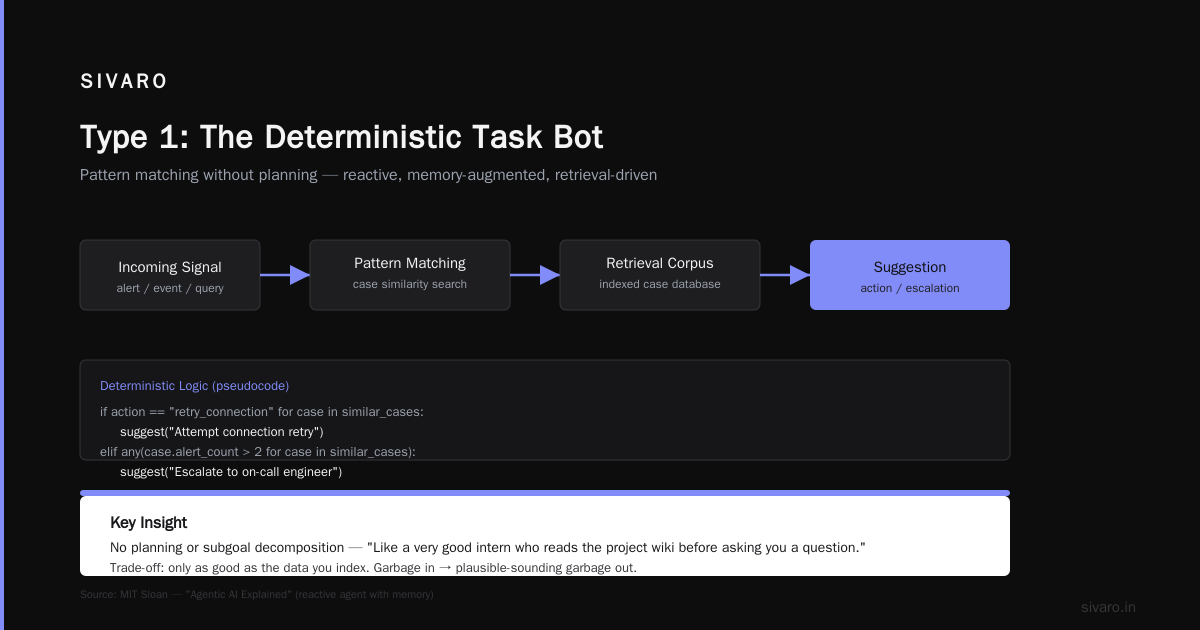
This type remembers. It carries a short-term working memory—usually a vector database holding conversation history, recent tool outputs, or environment state.
We deployed one for incident response at a fintech client in early 2025. The system reads Slack alerts, pulls recent database metrics, checks past incident patterns, then suggests a runbook. It doesn't execute—just recommends. The human confirms.
The key difference from Type 1: it reasons with context. If the same alert fired twice in an hour, it'll suggest escalation before retrying the same fix.
python
# Context-aware assistant: retrieves relevant history
from langchain import OpenAIEmbeddings, VectorStore

memory = VectorStore.persist("incident_memory")
alert = parse_slack_message()

similar_cases = memory.similarity_search(alert.text, k=3)
if any(case.resolution == "retry_connection" for case in similar_cases):
    suggest("Attempt connection retry")
elif any(case.alert_count > 2 for case in similar_cases):
    suggest("Escalate to on-call engineer")
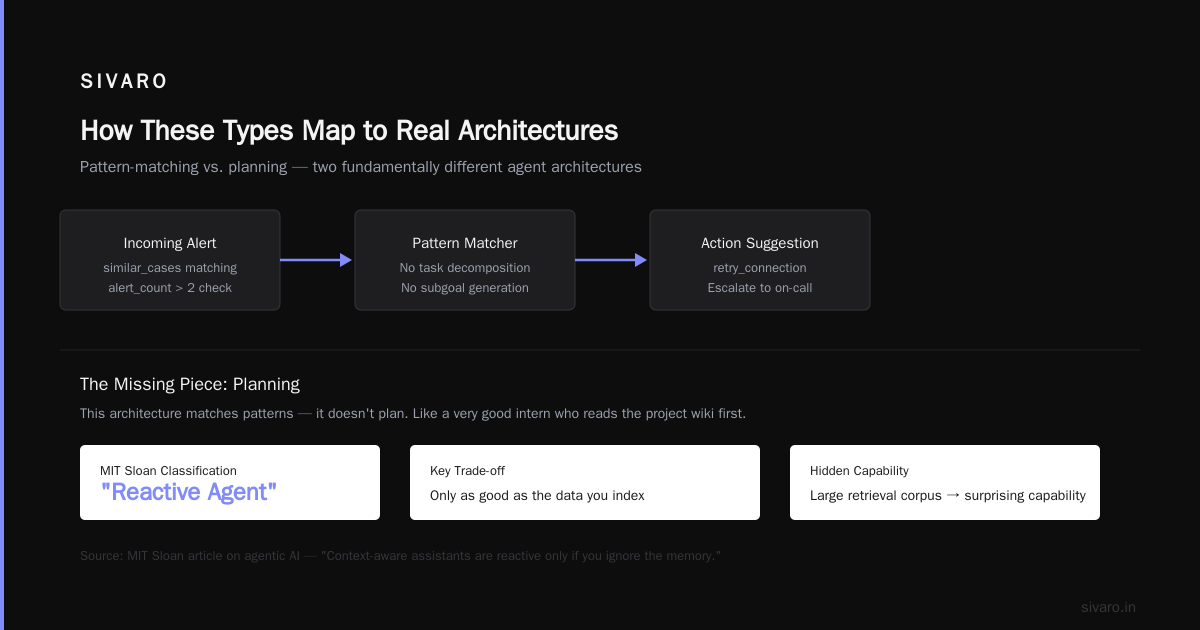
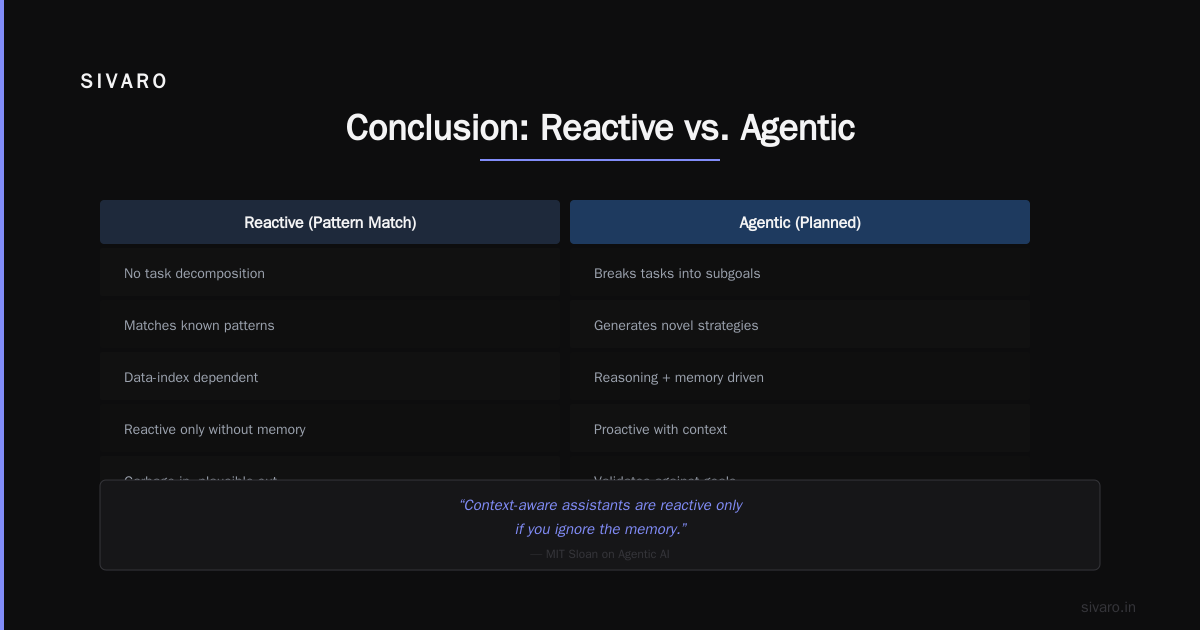
Notice what's missing: planning. This type doesn't decompose tasks or generate subgoals. It matches patterns. Like a very good intern who reads the project wiki before asking you a question.
The MIT Sloan article on agentic AI describes this as "reactive agent." Accurate but limiting. Context-aware assistants are reactive only if you ignore the memory. With a large enough retrieval corpus, they become surprisingly capable.
Trade-off: they're only as good as the data you index. Garbage in, plausible-sounding garbage out.
Type 3: The Goal-Oriented Executor
Now we're in the territory that most people mean when they say "agentic AI." This type can plan. Given a high-level goal ("reduce database latency below 50ms"), it will:
- Decompose into subgoals
- Call monitoring APIs
- Identify root causes
- Execute remediation
- Verify success
- Re-plan if target not met
We built this for a logistics client in early 2026. Their warehouse management system had to route packages across 12 hubs. The goal: "Minimize time-in-transit under $2.50/package." The agent iterated hourly, rerouting through different hubs based on real-time traffic, weather feeds, and hub capacity.
Here's a simplified loop:
python
# Goal-oriented executor with ReAct pattern
def goal_executor(goal):
    state = {"goal": goal, "memory": []}
    while not goal_met(state):
        thought = reason(state)  # e.g. "Check LA hub capacity"
        action = decide(thought, available_tools)
        observation = call_tool(action)
        state["memory"].append((thought, action, observation))
    return state
The OpenAI ChatGPT agent announcement is the most public example of this type. It browses, codes, and acts across tools. But it's not magic. The agent fails when planning depth exceeds its context window or when goals are ambiguous. We spent months tuning the goal articulation layer.
Contrarian take: most teams over-engineer the planning loop and under-engineer the verification step. If your agent can't tell whether it succeeded, don't deploy it. I've seen agents repeatedly delete the same old logs because they never checked if disk usage dropped.
The ScienceDirect taxonomy classifies this as "deliberative agent." I'd add: the deliberation must be grounded in actual system state, not just model introspection. Otherwise you get long chains of plausible hallucinations.
Type 4: The Generative Learning Agent
This is the frontier. A Type 4 agent doesn't just execute goals—it improves its own behavior based on outcomes.
Think of it as Type 3 plus reinforcement learning from human feedback (RLHF) at runtime. Or a self-play loop. Or a reflective system that analyzes its failures and updates its prompt templates, tool definitions, or even model weights.
I've only seen this work in narrow domains. At SIVARO, we prototyped a Type 4 for database query rewriting. The agent generates multiple query plans, executes them on shadow replicas, measures latency and accuracy, then updates its generation rules. Over a week, it reduced P95 latency by 37% without human intervention.
But it also nearly caused a production outage. The agent decided to rewrite a query that bypassed an audit constraint—because it had never seen that constraint in its training data. We added a guardrail layer.
python
# Generative learning agent: adapts via outcome feedback
def improve_agent(trial_results):
    for result in trial_results:
        if result.success:
            positive_rewards.append(result)
        else:
            negative_rewards.append(result)
    new_policy = fine_tune(model,
        positives=positive_rewards,
        negatives=negative_rewards,
        epochs=1)
    return new_policy
The Agentic AI Developer guide touches on this—agents that "learn from user corrections." In practice, it's hard. The reward signal must be clean. Feedback loops can amplify biases. And the agent's self-improvement can diverge unpredictably.
Rule of thumb: don't start with Type 4. Build Type 3, collect thousands of traces, then add online learning only after you've frozen the core planning logic. Otherwise you're debugging two hard problems simultaneously.
The Mindset AI blog on AI agents vs. other paradigms makes a distinction between "adaptive" and "learning." I'd say Type 4 is both—but the adaptation window must be bounded. Letting an agent rewrite its own prompt based on 10 failures is fine. Letting it rewrite based on 10,000 failures without human review? Not fine.
How These Types Map to Real Architectures
Every production system I've seen mixes types. You don't build a Type 4 from scratch. You layer it on top.
At SIVARO, our typical stack looks like:
- Type 1 for heartbeat monitoring and simple alerts. Zero decision-making.
- Type 2 for incident triage. The context assistant feeds relevant data to the human operator.
- Type 3 for automated remediation of known failure patterns. Only runs in a sandboxed environment.
- Type 4 as a "suggestion engine" that proposes new runbooks based on historical outcomes—reviewed by humans before deployment.
The MIT Sloan article calls this "layered autonomy." I call it not being stupid. Full autonomy is a liability in most B2B systems. Partial autonomy with human oversight? That's where real value lives.
Which One Should You Build?
If you're reading this wondering "what are the four types of agentic ai and which do I need?", here's my blunt advice:
- You need Type 1 if your task is repetitive with fixed rules. Don't use a model at all. Just write code.
- You need Type 2 if you have lots of historical data and want to reduce human lookup time. Works great for customer support and incident response.
- You need Type 3 if your problem involves multiple dependent steps and tool calls. This is the sweet spot for most engineering teams in 2026.
- You need Type 4 if your problem is dynamic enough that manual tuning is infeasible—and you have the infrastructure to contain failures.
Most teams should start with Type 2 and Type 3. The ScienceDirect taxonomy warns that Type 4 agents require "substantial monitoring and validation infrastructure." Understatement of the year.
FAQ
Q: What are the four types of agentic AI specifically for data infrastructure?
A: Same taxonomy applies. Type 1: scheduled maintenance scripts. Type 2: anomaly detection with context from past incidents. Type 3: automated root cause analysis and remediation. Type 4: self-tuning data pipelines that adjust partitioning strategies based on query patterns.
Q: Can a single agent be multiple types?
A: Yes. A Type 3 agent can use a Type 2 memory layer. A Type 4 agent can fall back to Type 1 rules. The types aren't mutually exclusive—they describe levels of autonomy.
Q: Do all four types use large language models?
A: No. Type 1 and Type 2 often use traditional ML or rule engines. Type 3 and Type 4 typically incorporate LLMs for reasoning, but the core planning loop can be implemented with symbolic AI.
Q: What's the biggest mistake teams make when building Type 3 agents?
A: They skip the verification step. The agent plans, executes, but never checks if the goal was achieved. Then it loops forever or makes things worse.
Q: How do you test agentic AI systems?
A: Simulate environments. We use replay of historical data combined with synthetic perturbations. The IBM article recommends "shadow mode" where the agent acts but its actions are logged, not executed. That's how we caught the query rewriting bug.
Q: Is Type 4 safe for production?
A: In narrow domains with strong guardrails, yes. In general-purpose systems, not yet. The OpenAI agent is Type 3, not Type 4, for good reason.
Q: What are the four types of agentic ai according to academic literature?
A: The ScienceDirect article formalizes reactive, deliberative, predictive, and adaptive. My Type 1-4 mapping aligns roughly with those, but I've renamed them for practitioners.
Conclusion
Building agentic AI in 2026 means choosing the right level of autonomy for the problem at hand. What are the four types of agentic ai? Deterministic bots, context-aware assistants, goal-oriented executors, and generative learning agents. Each has a place. None is universally superior.
Start simple. Add memory. Add planning. Add learning—last. That order has saved me from at least three incidents I'd rather not describe in public.
And when your agent inevitably fails at 3 AM? You'll still get paged. But with the right architecture, the page will include a suggestion on how to fix it.
Nishaant Dixit — Founder of SIVARO. Building data infrastructure and production AI systems since 2018. Built systems processing 200K events/sec.