 SIVARO
What Are the Top 10 Agentic Frameworks? A Practitioner’s Guide to 2026
You’re building something with agents. Maybe it’s a customer support system that actually resolves tickets. Maybe it’s a research assistant that can read a thousand documents and write a summary you trust. Maybe you’re just tired of hearing “agentic AI” at every conference and want to know what actually works.
I’ve been there. At SIVARO, we spent the last 18 months shipping production agent systems for clients in fintech, healthcare, and logistics. We broke things. We learned hard lessons. And we settled on a shortlist of frameworks that survive contact with the real world.
What are the top 10 agentic frameworks? That’s the question everyone’s asking in mid-2026. The answer isn’t a list of winners — it’s a map of trade-offs. No framework is perfect. Every choice buys you something and costs you something.
Here’s what I’ve learned from building at scale.
Why This Question Matters Now
July 2026. We’re past the hype cycle. The companies that shoved GPT wrappers into production in 2024 are either rewriting or dead. The survivors discovered something uncomfortable: agents aren’t just a bigger LLM. They’re a new category of infrastructure.
The agentic frameworks market has matured fast. AI Agent Frameworks: Choosing the Right Foundation for ... lists over 60 options. That’s choice paralysis. I’m here to cut through it.
Most people think the framework choice is about features. It’s not. It’s about your constraints: latency budget, reliability demands, team skill, and how much of your stack you want to own.
Let’s get into the ten frameworks that matter.
LangChain / LangGraph — The Default (For Now)
LangChain isn’t just a framework. It’s a category. In 2025, it felt like every agent tutorial started with “pip install langchain.” By 2026, the backlash is in full swing, but the reality is more nuanced.
What it does well: LangChain + LangGraph gives you the most complete agent construction kit. Chain building, tool integration, memory, multi-agent orchestration, state machines. Their How to think about agent frameworks piece is actually good — they’re honest that agents are a systems problem, not a prompt problem.
Where it hurts: The abstraction layer is thick. Debugging a LangChain trace feels like untangling Christmas lights. We had a client who hit a 12-second latency wall because the framework was doing 9 internal LLM calls they didn’t know about.
Our take: Use it for prototyping and early production. Rip it out when you hit scaling pain. We’ve done exactly that — started with LangGraph, then replaced the state machine with a custom DAG in Rust when throughput mattered.
python
# LangGraph agent skeleton — works for simple cases
from langgraph.graph import StateGraph, END
from typing import TypedDict

class AgentState(TypedDict):
    messages: list

def router(state):
    last = state["messages"][-1]
    if "tool_call" in last:
        return "execute_tool"
    return "respond"

builder = StateGraph(AgentState)
builder.add_node("route", router)
# ... add nodes, edges, compile
app = builder.compile()
CrewAI — Multi-Agent Made Accessible
CrewAI exploded in 2025 because it solved a real pain: getting multiple agents to cooperate without writing a distributed systems thesis.
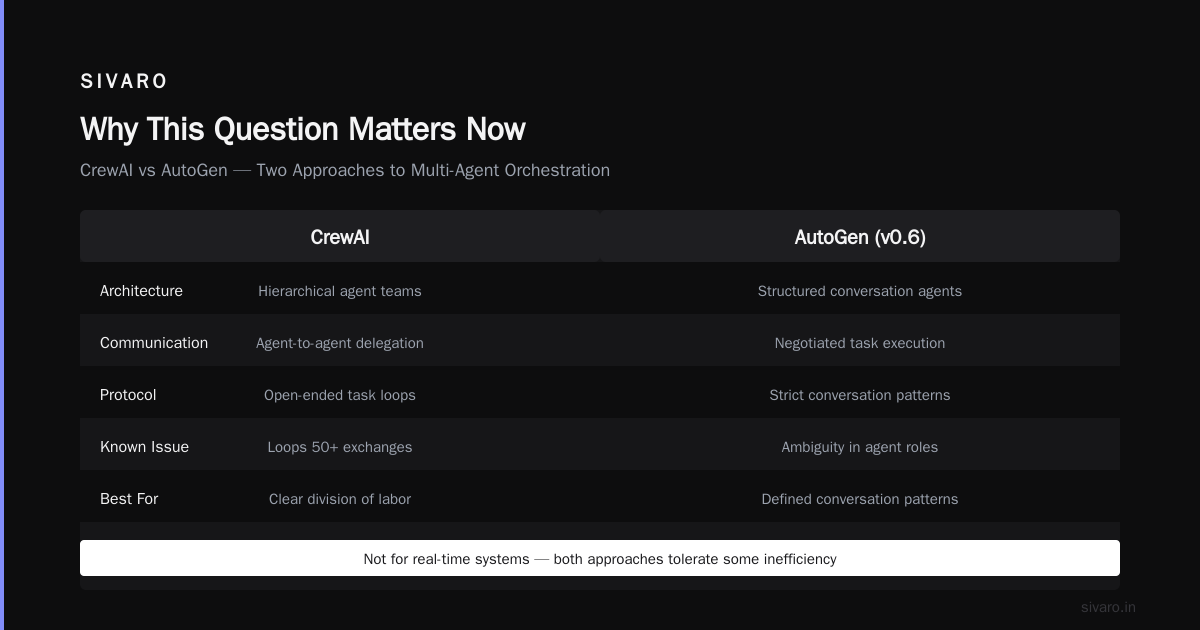
The good: You define roles (“researcher,” “writer,” “critic”) and CrewAI handles the back-and-forth. For content generation workflows, it’s genuinely productive. One of our clients built a due diligence agent team that reduced analysis time from 6 hours to 40 minutes.
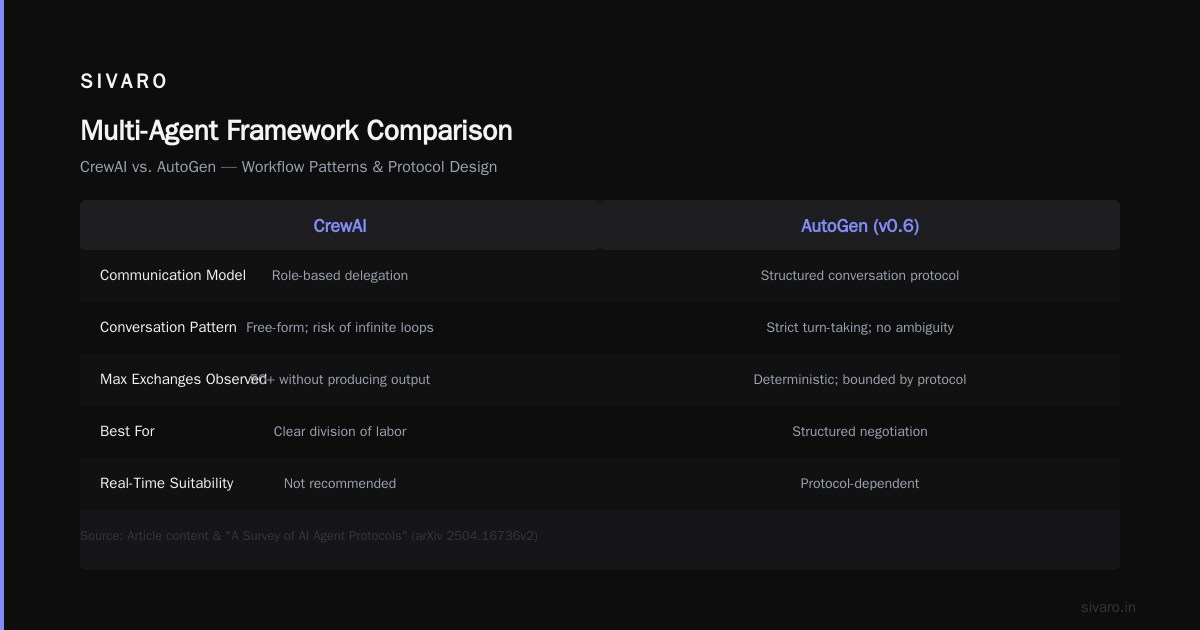
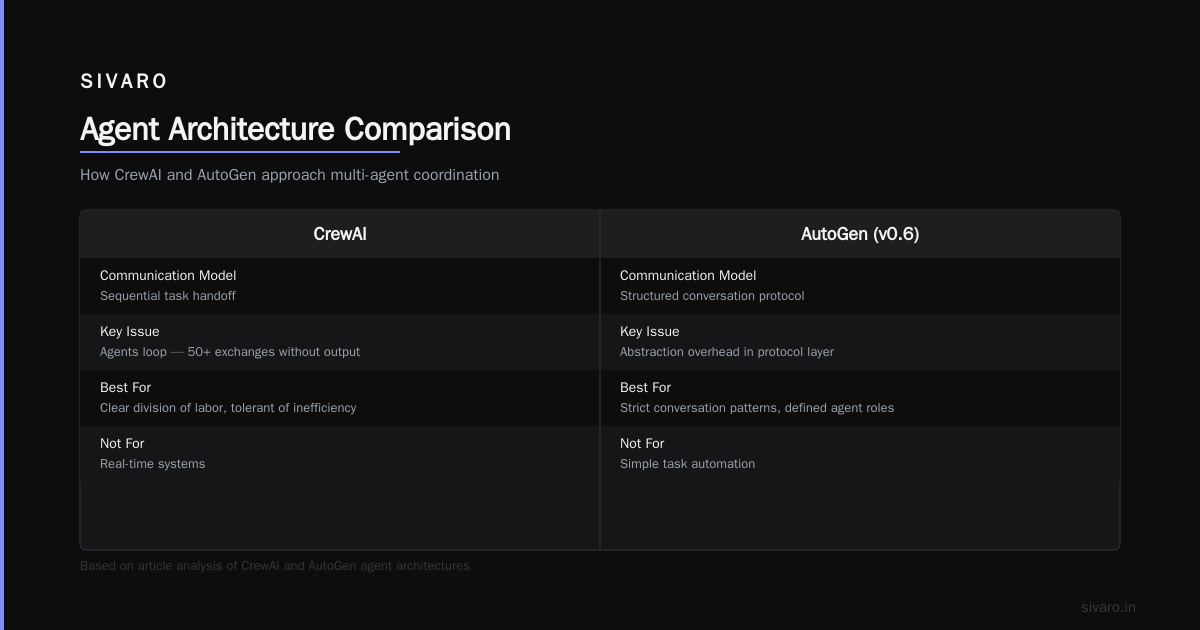
The bad: Role-based coordination assumes your problem maps to predefined roles. When it doesn’t? You’re fighting the abstraction. Also, CrewAI agents love to loop. We’ve seen conversations run 50 exchanges without producing output.
When I’d pick it: You have a clear division of labor and can tolerate some inefficiency. Not for real-time systems.
AutoGen — Microsoft’s Bet on Conversational Agents
Microsoft’s AutoGen (now at v0.6) takes a different approach: agents communicate through structured conversation. Each agent has capabilities, and they negotiate task execution.
Where it shines: The agent-to-agent protocol layer is thoughtful. You can define strict conversation patterns — no ambiguity about who talks to whom. A Survey of AI Agent Protocols shows how AutoGen’s approach compares to other protocol models.
The pain point: Documentation is academic. I’ve had engineers spend three days trying to understand “agent group chat” dynamics. Also, the error handling is weak — if one agent misbehaves, the whole conversation graph can corrupt.
Interesting use case: We saw a hedge fund use AutoGen for trade reconciliation across 12 internal systems. The structured conversation model matched their existing workflow.
python
import autogen

assistant = autogen.AssistantAgent(
    name="analyst",
    llm_config={"config_list": [{"model": "gpt-4o", "api_key": "..."}]}
)

user = autogen.UserProxyAgent(
    name="user",
    code_execution_config={"work_dir": "coding"}
)

# Two agents talking — simple but effective
user.initiate_chat(assistant, message="Analyze this data")
Semantic Kernel — Microsoft’s Enterprise Play
If AutoGen is the research project, Semantic Kernel is the production sibling. Microsoft’s betting big on this as the agent framework for Azure customers.
Strengths: Deep Azure integration. If you’re on Microsoft’s stack, this gives you managed memory, plugin ecosystems, and enterprise auth out of the box. The planner component is genuinely smart about breaking tasks into steps.
Weaknesses: Vendor lock-in is real. Moving away from Semantic Kernel means rewriting everything. Also, the C# roots show — Python support is second-class.
Our verdict: Great for Microsoft shops. Painful for everyone else.
Dify — The Low-Code Contender
Dify rode the wave of “visual agent builder” tools. You connect blocks — LLM calls, tools, knowledge bases — on a canvas.
The elevator pitch: Non-engineers can build agent workflows. And for simple use cases, that’s true. A marketing team at a retail client built a product description generator in 90 minutes.
The hard truth: Visual workflows hit a complexity ceiling fast. Debugging is a nightmare — try tracing a bad output through a visual graph. And you can’t version control a canvas.
Best for: Internal tools, small-scale automation, demos. Not for production at scale.
Haystack — The Retrieval Specialist
Haystack started as a search framework. It’s evolved into a full agent framework, but its superpower remains retrieval.
Why it matters: Agents are only as good as their context. Haystack’s pipeline architecture for RAG (retrieval-augmented generation) is best-in-class. You can chain retrievers, rerankers, and readers with surgical precision.
The limitation: It’s not designed for multi-agent scenarios. You can hack it, but it fights you. Haystack is a laser for RAG workflows — but a laser that only cuts one thing.
python
from haystack import Pipeline
from haystack.components.retrievers import BM25Retriever
from haystack.components.generators import OpenAIGenerator

pipe = Pipeline()
pipe.add_component("retriever", BM25Retriever(document_store))
pipe.add_component("llm", OpenAIGenerator())

# The RAG chain — clean, debuggable
pipe.connect("retriever.documents", "llm.documents")
Langflow — Visual Flow with Developer Escape Hatches
Langflow is Dify’s more technical cousin. Visual builder, but you can drop into code when the visual canvas isn’t enough.
Where it wins: The export-to-code feature is genuinely useful. Build visually, then export Python and customize. We’ve used it for rapid prototyping with clients who need to see the flow before approving.
The catch: Performance overhead from the visual layer. For high-throughput systems, skip it.
PraisonAI — The Multi-Agent Workflow Builder
PraisonAI took over the “agent YAML” niche. Define agents, tasks, and tools in a structured config file. No code required.
Why people like it: Configuration as code. You can version control, diff, and review agent definitions. It’s the infrastructure approach to agents.
The reality: Simple tasks work beautifully. Complex tasks expose the config language’s limitations. When your logic needs conditionals, loops, or error recovery, you hit walls.
Best for: Teams that want to define agent workflows declaratively. Small to medium complexity.
Agno (formerly Phidata) — The Data-First Framework
Agno takes a unique angle: agents are data processing pipelines with LLMs as transformation steps.
What’s different: Instead of “agent orchestrates tools,” it’s “data flows through agent transformations.” This maps well to ETL, data validation, and analytics use cases.
Our experience: We tried Agno for a financial reconciliation pipeline. The data-first model matched the problem beautifully. But the framework is young — documentation gaps and breaking API changes slowed us down.
Watch this space. If they stabilize, it could be the best choice for data-intensive agent systems.
Smolagents — Hugging Face’s Minimalist Contender
Hugging Face released Smolagents in early 2026 as an antidote to framework bloat. Minimal dependencies, direct model calls, maximum transparency.
The philosophy: Agents should be thin layers over good models. No abstractions to debug. Your agent is a loop: observe, think, act.
Why it’s my dark horse: For teams that understand what they’re doing, less framework is more. Smolagents forces you to understand the underlying mechanisms. That’s uncomfortable for beginners. But for production systems where every millisecond counts, it’s liberating.
The cost: You build everything yourself — memory, tool integration, error handling. Smolagents gives you a skeleton, not a solution.
python
# Smolagents — brutally simple
from smolagents import Agent, Tool

class SearchTool(Tool):
    name = "web_search"
    def forward(self, query: str) -> str:
        return f"Results for {query}"

agent = Agent(tools=[SearchTool()])
result = agent.run("Find the latest AI papers")
The Protocol Layer: What Purpose Do Agent-to-Agent Protocols Serve?
Midway through this list, you might be asking: what is the purpose of agent-to-agent protocols?
Short answer: interoperability. Agents built in different frameworks need to talk to each other. Without protocols, you’re writing custom glue code for every pair of agents.
The AI Agent Protocols: 10 Modern Standards report identifies the key standards emerging in 2026. A2A from Google. MCP from Anthropic. Open Agent Protocol from the community. Agentic AI Frameworks: Top 10 Options in 2026 covers how these protocols interact with frameworks.
At SIVARO, we’ve standardized on MCP for internal agent communication. It’s not perfect, but it’s the closest thing to a lingua franca.
A Question That Confuses Everyone: Is ChatGPT an Agent or LLM?
Is ChatGPT an agent or LLM? I hear this every week.
ChatGPT is a product built on an LLM. The underlying model (GPT-4, GPT-4o, whatever OpenAI ships) is the LLM. The product layer — memory, tool use, file handling, web browsing — makes it behave like an agent.
But it’s not an agent framework. You can’t build custom agent behaviors inside ChatGPT. It’s a black box that consumes prompts and produces responses. Top 5 Open-Source Agentic AI Frameworks in 2026 draws the distinction clearly: frameworks give you control; products give you convenience.
If you’re asking “what are the top 10 agentic frameworks?” you’re past the ChatGPT stage. You need control.
How to Choose: My Decision Framework
After building agent systems for 18 months, here’s my cheat sheet:
| Your situation | Pick this |
|---|---|
| Moving fast, need prototyping | LangChain / LangGraph |
| Enterprise Microsoft shop | Semantic Kernel |
| Multi-agent content workflows | CrewAI |
| RAG-heavy applications | Haystack |
| Data pipelines with LLM steps | Agno |
| You hate abstraction | Smolagents |
| Visual workflows for stakeholders | Langflow or Dify |
The contrarian take: Most teams should start by not picking a framework. Start with raw LLM calls and a while loop. Add framework when you feel the pain of missing features, not before.
I’ve seen too many teams adopt CrewAI for a problem that needed a single agent with good tools. They spent weeks fighting the framework. The raw approach would have worked in two days.
The Bigger Picture
Agentic frameworks are infrastructure. They’re as important as databases or message queues for your system’s architecture. But they’re younger and less stable.
Expect consolidation. In 2027, I predict 3-4 frameworks will dominate, protocols will standardize, and the “build vs buy” question will shift. How to think about agent frameworks nails this: think of frameworks as evolving scaffolds, not permanent foundations.
FAQ
Q: What are the top 10 agentic frameworks in 2026?
A: LangChain/LangGraph, CrewAI, AutoGen, Semantic Kernel, Dify, Haystack, Langflow, PraisonAI, Agno, and Smolagents. Each solves a different slice of the agent problem.
Q: What is the purpose of agent-to-agent protocols?
A: Interoperability. Protocols like A2A and MCP let agents built in different frameworks communicate. Without them, you write custom integration code for every pair of agents.
Q: Is ChatGPT an agent or an LLM?
A: ChatGPT is a product built on an LLM. It exhibits agent-like behavior (memory, tools) but isn’t a framework for building custom agents.
Q: Which framework is best for production?
A: Depends on your stack. For raw performance, Smolagents or custom-built. For rapid development, LangGraph. For enterprise Microsoft environments, Semantic Kernel.
Q: Why is everyone moving away from LangChain?
A: Performance overhead and debugging difficulty. LangChain is great for prototypes but adds latency at scale. Many teams use it as a stepping stone, then replace.
Q: Should I build my own agent framework?
A: Yes, if your team has strong systems engineering skills and your requirements are specific. No, if you need to ship something working within weeks.
Q: How do multi-agent frameworks handle failures?
A: Poorly, generally. Most assume agents behave predictably. In practice, agent loops, stall, or produce garbage. You need monitoring, timeouts, and fallback logic.
Q: Which protocol wins long-term?
A: Too early. MCP has momentum from Anthropic. A2A has Google’s weight. Expect fragmentation for 12-18 more months.
Nishaant Dixit — Founder of SIVARO. Building data infrastructure and production AI systems since 2018. Built systems processing 200K events/sec.