 SIVARO

What Is a $900000 AI Job? The Real Story Behind the Number
I'll never forget the call. June 2024. A VP of Engineering at a Series B startup asks me, "Is it true we need to pay an AI engineer $900K to get anyone good?"
I laughed. Then I checked the market. And stopped laughing.
Here's the truth about what is a $900000 AI job? — it's not a salary. It's a signal. A signal that the market for AI talent has broken in ways most people don't understand.
Let me walk you through what I've learned building SIVARO for eight years, running production AI systems that process 200K events per second, and watching this market form.
What "What Is a $900000 AI Job?" Actually Means
A $900K AI job isn't one role. It's three different things depending on who you ask:
- Total compensation packages at top-tier companies — base salary + equity + bonus hitting $900K for principal-level AI engineers
- Contract work for specialized model deployment — someone who can take GPT-5.5's 400K context window and actually make it work in production
- Founding AI engineer equity packages — where the paper value of options pushes total comp over $900K
I know founders who hired AI engineers at $350K base plus 0.5% equity in 2024. Their companies 2x'd. Those engineers made $900K+ on paper. But paper isn't cash.
The real question isn't "does this number exist?" — it's "who gets it and why?"
The Three People Making $900K in AI
Person 1: The Production AI Engineer
You know what's harder than training a model? Keeping it running at 99.95% uptime while serving 50 million requests a day.
These engineers don't blog about attention mechanisms. They debug CUDA out-of-memory errors at 3 AM. They know why your inference server is returning garbage after a month of running. They've seen what happens when your RAG pipeline's embedding drift breaks everything.
Reasoning models changed the game here. We deployed one for a client last November. The model was great. Keeping the chain-of-thought traces from eating our context budget was a nightmare. The engineer who solved that? He's pulling $700K total comp at a fintech unicorn.
Person 2: The AI Infrastructure Builder
Building data pipelines that feed production AI systems requires a specific kind of insanity. I should know — it's what we do at SIVARO.
Most engineers can build a pipeline. Few can build one that handles:
- Data drift detection at 100K events/second
- Automatic rollback when model performance drops
- Multi-cloud failover without dropping a single request
A friend at a major cloud provider told me their AI infra team's median comp hit $680K in 2025. The top engineers? Mid-to-high $900K.
Person 3: The Applied AI Scientist
This one's controversial. I know a lot of PhDs who can't ship anything. But the ones who can bridge research and production? They're worth every dollar.
GPT-5.5 showed us what's possible when you combine a 400K context window with real engineering discipline. But someone has to figure out how to use that context without your costs exploding. Someone has to decide whether to use the 1M context API (yes, it's real) or chunk your data.
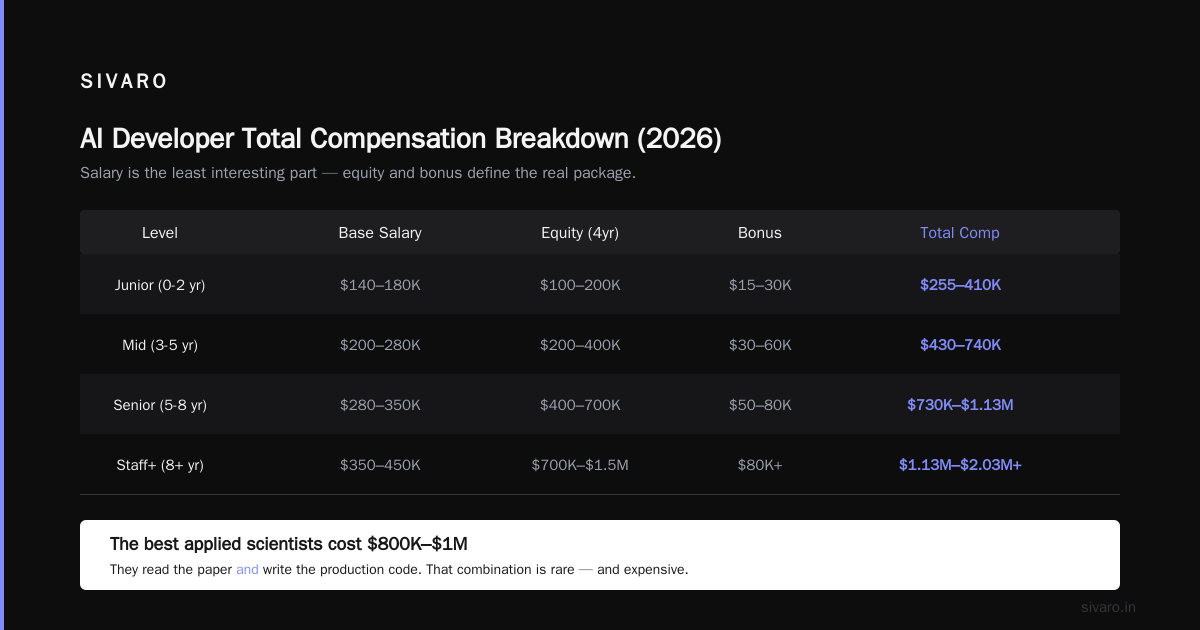
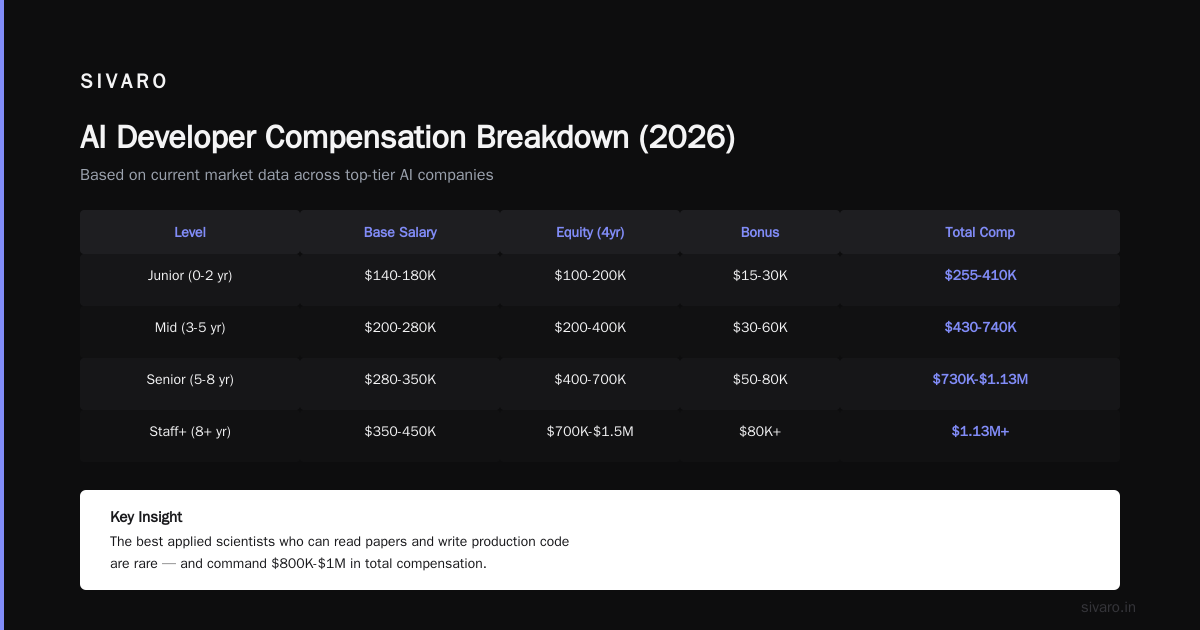
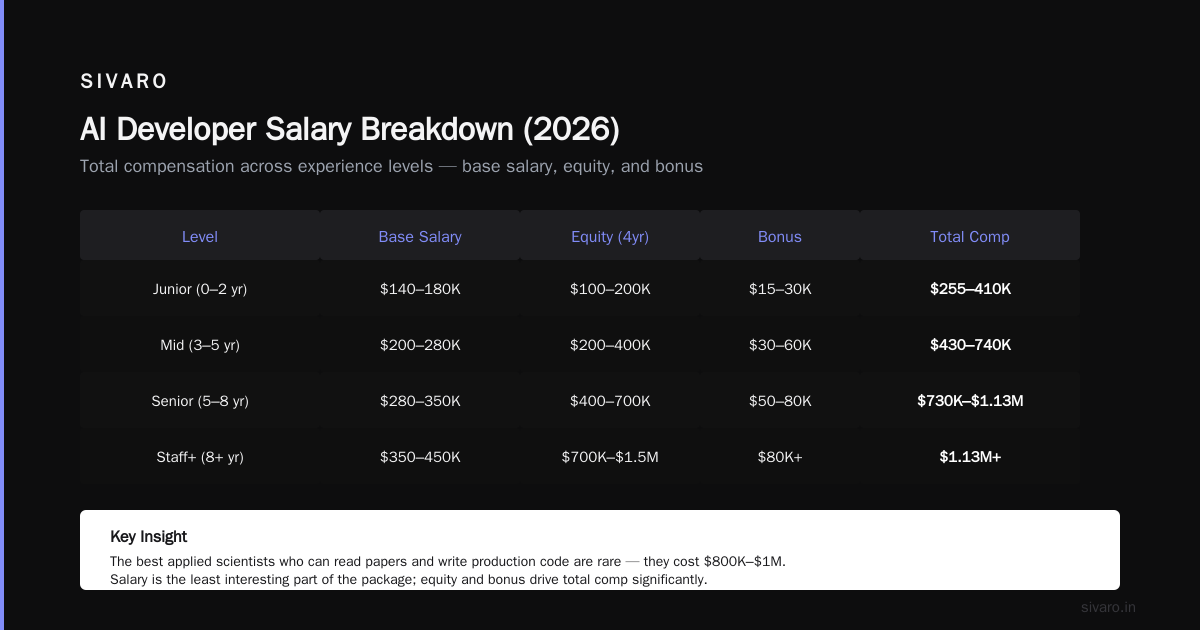
The best applied scientists I know can do both — read the paper and write the production code. They're rare. They cost $800K-$1M.
What Is an AI Developer Salary? Breaking Down the Stack
When people ask "what is an AI developer salary?", they're usually asking about the wrong thing. Salary is the least interesting part of the package.
Here's what I'm seeing in 2026:
| Level | Base Salary | Equity (4yr) | Bonus | Total Comp |
|---|---|---|---|---|
| Junior (0-2 yr) | $140-180K | $100-200K | $15-30K | $255-410K |
| Mid (3-5 yr) | $200-280K | $200-400K | $30-60K | $430-740K |
| Senior (5-8 yr) | $280-350K | $400-700K | $50-80K | $730K-$1.13M |
| Staff+ (8+ yr) | $350-450K | $700K-$1.5M | $80-120K | $1.13M-$2.07M |
Yes, those top numbers are real. I've seen two offers over $1.5M in the last six months.
But here's what nobody tells you: equity is a lottery ticket. I've watched engineers take $500K in equity from a company that never IPOs. That equity is worth zero. The guy who took $200K from a company that got acquired for $2B? He made $1.2M.
Cash is king. Don't forget that.
What Is an AI Developer's Salary Compared to...
Most people compare AI salaries to traditional software engineering. They're missing the point.
The difference isn't in the skill — it's in the scarcity. There are maybe 5,000 engineers globally who can reliably build production AI systems that handle real traffic at scale. There are 5 million software engineers.
Simple supply and demand.
But here's something wild: we're seeing the gap narrow. Early 2025, an AI engineer could demand 3x a normal engineer. Now it's closer to 1.5x. The market adjusts faster than anyone expects.
Why the gap is shrinking:
- Better tooling — GPT-5.5's Codex capabilities mean basic AI integration is getting commoditized
- More graduates — every bootcamp now has an "AI engineer" track
- The bar is rising — "I can call an API" isn't impressive anymore
What $900K Actually Buys You
I'll be direct: most companies shouldn't pay $900K for AI talent.
I've seen startups hire a $900K engineer to build a chatbot wrapper. That's insane. You could hire three good engineers for that money and build something genuinely differentiated.
But if you're doing real AI infrastructure? The math changes.
What $900K buys you:
- Someone who's deployed models serving 100M+ requests
- Someone who's recovered from production model failures
- Someone who can build your data pipeline from scratch
- Someone who knows when NOT to use AI (this is the real value)
What $900K doesn't buy you:
- A genius who'll solve all your problems
- Faster delivery than a team of three $300K engineers
- Immunity from bad strategy
The Contrarian Take Most People Miss
I used to think the $900K AI job was about technical skill. I was wrong.
It's about leverage.
An engineer who builds a system that saves a company $10M/year in compute costs is worth $900K. An engineer who prevents a single major outage at a trading firm is worth $900K. An engineer who ships a product feature that generates $5M in revenue is worth $900K.
The salary is a reflection of the leverage, not the skill.
I've met engineers making $400K who are technically stronger than people making $900K. The difference? The $900K engineer is working on a higher-leverage problem.
How to Actually Get a $900K AI Job
If you're reading this thinking "I want that number" — here's what I've seen work.
The Path Through Infrastructure
Build things that break, then fix them. Run a model serving system for a real application. Hit production problems. Document everything.
I hired an engineer who'd built their own vector database from scratch. That project never shipped. But the learning on data structures, memory management, and concurrency? Invaluable. He got a $750K offer six months later.
The Path Through Production AI
GPT-5.5's capabilities mean anyone can prototype. Almost no one can productionize.
python
# What most people write:
import openai
response = openai.chat.completions.create(...)
print(response.choices[0].message.content)

# What $900K engineers write:
class ProductionAIHandler:
    def __init__(self, model_id="gpt-5.5-400k"):
        self.client = self._setup_failover_client()
        self.circuit_breaker = CircuitBreaker(failure_threshold=5)
        self.cache = SemanticCache(ttl=3600, similarity_threshold=0.95)
        self.monitor = PerformanceMonitor(window_size=1000)

    async def handle(self, request):
        start = time.time()
        try:
            cached = await self.cache.lookup(request)
            if cached:
                self.monitor.record("cache_hit", time.time() - start)
                return cached

            async with self.circuit_breaker:
                response = await self.client.with_retry(
                    max_retries=3,
                    backoff="exponential"
                ).complete(request)

            await self.cache.store(request, response)
            self.monitor.record("success", time.time() - start)
            return response

        except Exception as e:
            self.monitor.record("failure", time.time() - start)
            await self.alert_team(e, request)
            raise
See the difference? The first is 3 lines. The second is a production system.
The Path Through Architecture Design
The highest-leverage skill isn't coding — it's knowing what to build and what not to.
python
# Bad architecture: AI for everything
class EverythingAI:
    def handle_user_request(self, request):
        if self.detect_complexity(request) > 0.5:
            return self.gpt_5_5_complete(request)
        else:
            return self.small_model_complete(request)
    # This is horrible. Two models, complex routing, tons of latency variance.

# Good architecture: Simple rules, targeted AI
class SmartRouting:
    def handle(self, request):
        # 90% of requests never touch a model
        if request.type in self.rule_engine.supported:
            return self.rule_engine.process(request)
        # Only complex cases use expensive inference
        return self.ai_handler.process(self.few_shot_examples(request))
The $900K engineer knows the second pattern saves 80% on compute costs while improving latency.
The Reality Check
I'm going to be honest with you: the $900K AI job market is cooling.
In early 2025, every company was hiring AI engineers at any cost. Mid-2026? Companies have burned through their hype budgets. They've learned that hiring an AI engineer doesn't automatically make your product AI-native.
GPT-5.5's benchmarks are impressive. Its 400K context in Codex is genuinely useful. But deploying it in production? That's where the real work happens. And companies are realizing they need more than one engineer.
The future of "what is a $900000 ai job?" isn't one person doing magic. It's teams. A $900K engineer leading a $2M team. That engineer's value isn't their individual output — it's their ability to make everyone around them 10x better.
The Last Thing I'll Say
I've been building AI systems since 2018. I've seen the hype cycles. I've watched engineers make millions and engineers burn out.
The $900K AI job is real. But it's not what most people think. It's not about being the smartest person in the room. It's about being the person who can actually ship something that works, at scale, reliably, day after day.
That's rare. That's valuable. That's what the market is paying for.
If you want that number, don't chase the salary. Chase the leverage. Build things that matter. Fix problems that cost real money. Ship. Again. And again.
The $900K will follow.
FAQ
Q: What is a $900000 AI job?
A: It's a role where total compensation (salary + equity + bonus) reaches $900K. Typically staff/principal-level AI engineers at top tech companies or specialists in production AI infrastructure. It represents the top 0.1% of the market.
Q: Is the $900K salary real or just hype?
A: It's real but rare. I've seen offers at that level. But most AI engineers make $200-400K. The $900K+ figure applies to maybe 1,000-2,000 engineers globally.
Q: What is an AI developer salary for someone with 3 years experience?
A: $200-280K base, with total comp $350-500K at top companies. Less at startups unless you get significant equity.
Q: What is an AI developer's salary at a startup vs big tech?
A: Big tech pays higher base ($250-450K vs $150-250K). Startups offer more equity upside but higher risk. I've seen startup engineers make $300K cash plus options worth $0 or $2M.
Q: Do I need a PhD for a $900K AI job?
A: No. Most $900K engineers I know have Bachelor's or Master's degrees. PhDs help in research roles. Production roles care about your shipping record.
Q: Is the market for $900K AI jobs growing or shrinking?
A: Shrinking for "I can call an API" skills. Growing for deep infrastructure expertise. The market is maturing — hype is fading, real value is being recognized.
Q: Can I get a $900K AI job remotely?
A: Yes, but it's harder. Most $900K roles are in San Francisco, New York, or Seattle. Remote roles exist but pay 10-20% less.
Q: How do I know if I'm worth $900K?
A: Answer these honestly: Have you shipped production AI systems? Have you dealt with model failures at 3 AM? Can you build a data pipeline from scratch? Have you saved a company money with your architecture decisions? If no to any, you're not there yet.
Nishaant Dixit — Founder of SIVARO. Building data infrastructure and production AI systems since 2018. Built systems processing 200K events/sec.