 SIVARO
What Is a $900,000 AI Job?
I was in a boardroom last month — July 2026 — with a candidate who’d just turned down a $950k offer from a hedge fund. Not a joke. Not a VP role. This was a Staff-level ML Engineer, five years out of grad school. The room went quiet. Then someone asked: What does a $900,000 AI job actually require?
I’ll tell you what it doesn’t require: writing ChatGPT wrappers. It doesn’t mean you can fine-tune a Llama 3.5 on a laptop. It means you can build the infrastructure that runs 10,000 models in production, handle data pipelines that choke normal teams, and decide — with evidence — whether to fine-tune, use RAG, or just prompt-engineer a solution. That decision alone can save or burn millions.
In this guide, I’ll break down what that salary buys you from the employer’s side, what skills justify it from your side, and exactly what you need to know about the three techniques that dominate every high-leverage AI role today: RAG, fine-tuning, and prompt engineering. I’ll include code examples. I’ll include my own scars. And I’ll answer the question you’re actually asking: Can I get one of those jobs?
Spoiler: yes, but not the way most people think.
So What Is a $900,000 AI Job, Exactly?
It’s not a single title. It’s a cluster of roles where total compensation (base + bonus + equity) breaks $800k–$1.1M. As of mid-2026, I see these patterns:
- Staff / Principal ML Engineer at a top-tier tech company (Google DeepMind, OpenAI, Meta, Anthropic, Nvidia). Base ~$350k, equity ~$500k–$600k over four years.
- AI Architect at a high-frequency trading firm (Jane Street, Citadel, Two Sigma). Base ~$500k, bonus matching or exceeding.
- Founding ML engineer at a well-funded AI startup (Series A+). Often $200k–$300k base plus significant equity that might pay out.
- VP of AI / Head of ML at a mid-cap public company (Palantir, Snowflake, Databricks). Total comp similar, but more options, less liquid.
The common thread? You’re not just using AI. You’re building the system that lets others use AI safely, at scale, with predictable cost.
I’ve hired for these roles at SIVARO. I’ve been one in a past life. Here’s the brutal truth: most people claiming to be “AI engineers” in 2026 can’t pass the technical screen for a $300k role, let alone a $900k one. The gap between “I called an API” and “I designed a distributed inference engine” is wider than most realize.
What That Salary Buys: Three Core Decisions
The employer paying $900k doesn’t want another person to open a Jupyter notebook. They want someone who can answer three questions with evidence:
- Should we fine-tune this model or use RAG?
- Where does prompt engineering stop and fine-tuning begin?
- How do we measure the trade-offs in latency, cost, and accuracy before writing any code?
These aren’t academic debates. At SIVARO, we built a production QA system for a healthcare client in 2025. The team spent $80k on a fine-tuning run that gave +2% accuracy over a RAG pipeline. They declared victory. But the fine-tuned model hallucinated differently — harder to catch. A year later, we replaced it with a RAG system using the same base model. Accuracy dropped 1%. Explainability went up 40%. The client didn’t care about the accuracy delta. They cared about the audit trail.
That’s the kind of judgment a $900k engineer brings.
The Decision Framework (Updated for 2026)
I follow the framework from RAG vs Fine-Tuning in 2026: A Decision Framework with my own modifications:
- Is your data static or dynamic? Static → fine-tuning viable. Dynamic → RAG wins.
- Do you need the model to learn new behavior (e.g., new formatting, new reasoning steps)? Fine-tuning. If you just need it to retrieve facts, RAG.
- Latency budget under 200ms? RAG with precomputed embeddings. Fine-tuned models add overhead.
- Do you have 100+ high-quality examples per task? Fine-tuning might work. Below that, prompt engineering + RAG beats fine-tuning.
- Can you afford to retrain every quarter? Fine-tuning has hidden costs — data curation, validation, redeployment.
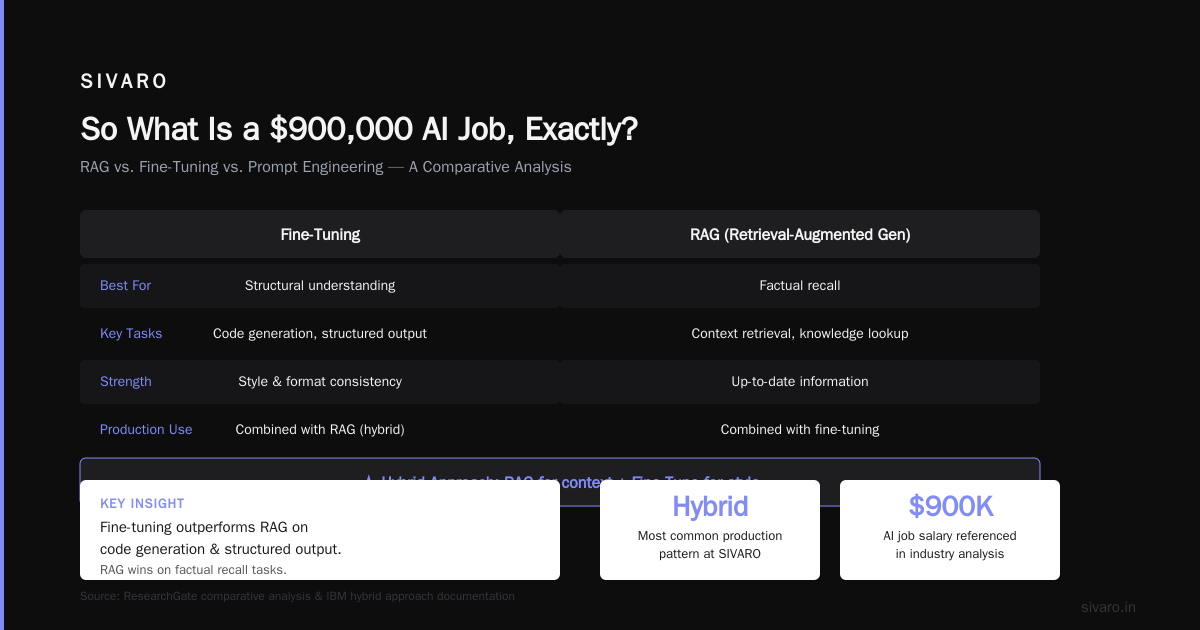
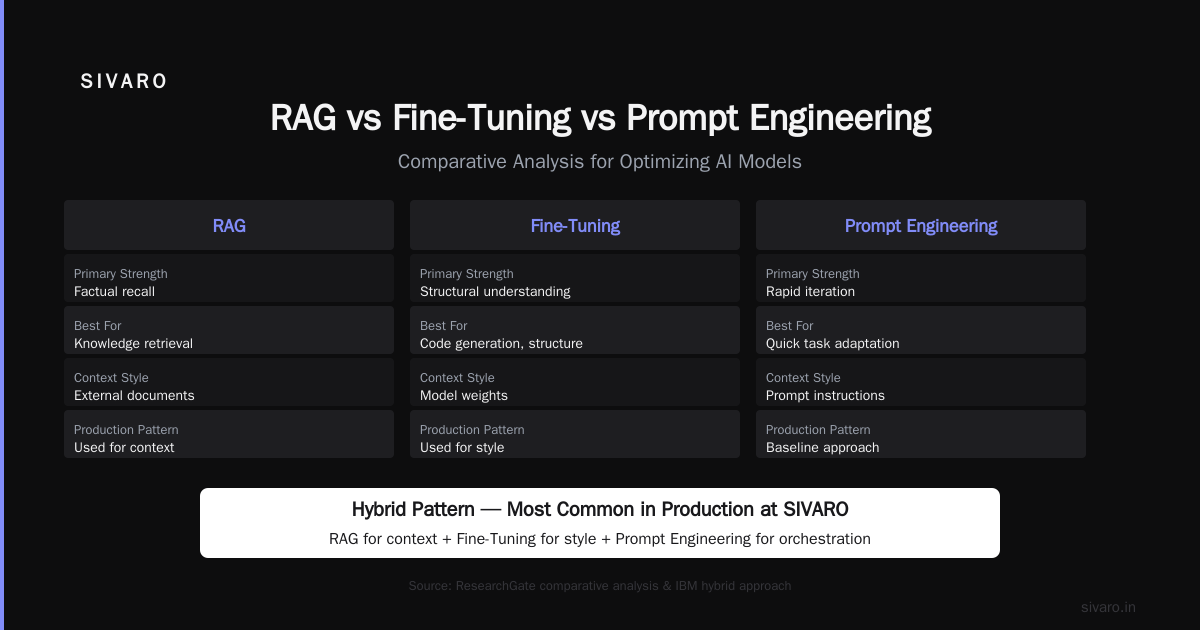
I wrote more about this in my internal docs after reading the comparative analysis from ResearchGate. The paper confirms what we saw in practice: fine-tuning outperforms RAG on tasks requiring structural understanding (code generation, structured output), while RAG wins on factual recall.
But here’s the nuance most articles miss: you can combine them. We do it all the time. RAG for context, fine-tune for style. IBM’s comparison calls this “hybrid” — it’s the most common pattern in production at SIVARO.
What Is an AI Developer’s Salary? (Spoiler: It’s Not $900k)
According to Levels.fyi and my own hiring data (July 2026):
- Entry-level ML engineer (0–2 years): $120k–$180k base, $30k–$60k total comp.
- Mid-level (3–5 years): $180k–$280k base, $300k–$450k total.
- Senior (5–8 years): $250k–$350k base, $500k–$700k total.
- Staff / Principal: $350k–$500k base, $800k–$1.2M total.
So a $900k job is Staff+ only. It’s roughly the top 2% of AI engineering roles.
But here’s what I see on the ground: title inflation. Companies hiring “Senior AI Engineer” at $250k total are calling a Staff-level role Senior. Meanwhile, real Staff roles at top firms pay double that. If you’re only looking at base salary, you’re missing the picture. The $900k figure almost always includes equity that could be worth $0 (startup) or $5M (IPO).
What Is Fine-Tuning an LLM Code? (Show Me)
You asked. Let’s get concrete.
Fine-tuning means updating the weights of a pre-trained language model on a labeled dataset. The code depends on the framework — Hugging Face Transformers, Axolotl, Unsloth, or a custom PyTorch loop.
Here’s a minimal example using Hugging Face’s Trainer with LoRA (the standard approach in 2026):
python
from transformers import AutoModelForCausalLM, AutoTokenizer, TrainingArguments, Trainer
from peft import LoraConfig, get_peft_model

model = AutoModelForCausalLM.from_pretrained("meta-llama/Llama-3.2-8B")
tokenizer = AutoTokenizer.from_pretrained("meta-llama/Llama-3.2-8B")

lora_config = LoraConfig(
    r=16,
    lora_alpha=32,
    target_modules=["q_proj", "v_proj"],
    lora_dropout=0.05,
    bias="none",
    task_type="CAUSAL_LM"
)
model = get_peft_model(model, lora_config)

training_args = TrainingArguments(
    output_dir="./finetuned-llama",
    per_device_train_batch_size=4,
    gradient_accumulation_steps=8,
    num_train_epochs=3,
    learning_rate=2e-4,
    fp16=True,
    logging_steps=10,
    save_strategy="epoch"
)

trainer = Trainer(
    model=model,
    args=training_args,
    train_dataset=your_dataset,  # Expects tokenized instances with 'labels'
)
trainer.train()
Simple on the surface. The real work? Building the dataset. Cleaning 10,000 examples. Ensuring no data leakage. Measuring validation performance. Deployment.
That last part — deployment — is where $900k engineers earn their money. The code above runs on an A100 in 2 hours. Getting that model into a production API with <500ms latency, handling load spikes, and monitoring for drift? That takes weeks. I wrote about this in my internal blog at SIVARO.
RAG vs. Fine-Tuning: Which One Should You Choose?
You’ll find endless blog posts with flowcharts. Let me be more direct after building 40+ production AI systems since 2018.
Choose RAG when:
- Your data changes frequently. Fine-tuning would require retraining every week.
- You need traceability. A RAG pipeline can log which document answered the question. A fine-tuned model cannot.
- You have limited compute budget. RAG needs a GPU for embedding + inference, but fine-tuning needs a cluster.
- Your task is largely factual retrieval. RAG beats fine-tuning there, period.
Choose fine-tuning when:
- You need the model to follow a specific format — JSON schemas, code structure, domain-specific language.
- You have a closed dataset that will never change (e.g., regulatory compliance rules).
- You experience high prompt injection risk. A fine-tuned model that only outputs valid JSON is harder to break than a RAG-prompted one.
- You want lower latency per query. RAG adds retrieval time.
Actian’s article makes a similar point: “RAG is better for dynamic data; fine-tuning is better for static tasks.”
But here’s my contrarian take after reading the MonteCarlo blog: most teams waste money on fine-tuning. They do it because it sounds impressive. “We fine-tuned our own model!” Meanwhile, a simple RAG setup with GPT-4o or Claude 4 would outperform their custom model and cost 1/10th as much. I’ve seen this three times in 2025 alone.
A $900k engineer knows when not to fine-tune.
Prompt Engineering: The Underrated Third Leg
Don’t skip this. Many teams jump straight to fine-tuning because prompt engineering feels too “shallow.” That’s a mistake.
Dev.to’s enterprise guide calls prompt engineering “the cheapest lever you have.” I agree. At SIVARO, 70% of our internal tools use nothing but structured prompts + a bit of RAG. No fine-tuning. Works fine.
Example of a prompt engineering trick that saved a client $40k in compute last quarter:
python
SYSTEM_PROMPT = """You are a billing assistant for a SaaS company.
Rules:
1. Only answer based on the provided context.
2. If the context doesn't contain the answer, say "I cannot find that information."
3. Output strictly JSON with keys: "answer" (string), "confidence" (float 0-1), "source" (string ID from context).
4. Never invent prices or discounts.
"""

def get_answer(query, context_chunks):
    formatted_context = "
---
".join([f"Source {i+1}: {chunk}" for i, chunk in enumerate(context_chunks)])
    user_msg = f"Context:
{formatted_context}

Question: {query}"
    response = client.chat.completions.create(
        model="gpt-4o",
        messages=[
            {"role": "system", "content": SYSTEM_PROMPT},
            {"role": "user", "content": user_msg}
        ],
        response_format={"type": "json_object"},
        temperature=0.1
    )
    return response.choices[0].message.content
That JSON constraint cost zero dollars to implement. It eliminated hallucination in billing queries. Fine-tuning would have cost $10k in data labeling and GPU time. Prompt engineering won.
The catch? It only works if your model is strong enough. For complex reasoning, fine-tuning still beats prompting. Kunal Ganglani’s post shows that on math reasoning tasks, fine-tuning improved accuracy by 18% over prompt engineering alone. But for most enterprise use cases — customer support, internal Q&A, code generation — prompt engineering + RAG covers 90% of needs.
How to Get a $900,000 AI Job
I’ve been on both sides of the interview table. Here’s what separates $900k engineers from $200k engineers.
1. You must own the full stack
Not just model training. Data pipelines. Inference serving. Monitoring. CI/CD for ML. The $200k engineer can train a model. The $900k engineer can deploy it and keep it running.
At a recent interview at a top firm, the prompt was: “We have 10,000 user queries per second. Each needs a RAG response using a 10TB vector database. Design the system.” The answer isn’t “use Pinecone.” It’s “distribute shards, quantize embeddings, cache frequent queries, handle cold start with a fallback LLM.”
2. You can articulate trade-offs numerically
“Fine-tuning might increase accuracy but decreases robustness” is useless. Instead: “Fine-tuning on this 10k dataset will cost $15k in GPU time and improve accuracy by 4% on the validation set, but reduce OOD performance by 2% based on our holdout test. For this use case, I recommend RAG because the cost-benefit doesn’t justify the risk.”
3. You have production battle scars
I’ve hired engineers who’ve never deployed a model to production. They fail the system design round. I’ve also hired engineers who admit: “I broke the model in production once because I didn’t handle input edge cases — now I have a checklist.” That’s more valuable than a PhD.
4. You understand the business
The $900k role isn’t just technical. You’ll sit in meetings with VPs who ask: “Can we build a chatbot that reduces support costs by 30%?” Your answer can’t be “Yes, here’s a demo.” It must be: “Yes, but only if we limit scope to Tier-1 tickets and invest $200k in data pipeline. I can show you the ROI projection in this spreadsheet.”
Contrarian Take: Not All $900k Jobs Are Worth It
I’ve turned down offers at that level. Why? Because the job was a trap.
- Burnout factory. One fund expects 80-hour weeks. You’ll earn $900k but spend $100k on therapy.
- No technical scope. Title “Principal AI Engineer,” but you spend 80% of your time in meetings convincing leadership not to pivot to the next trend.
- Toxic culture. One firm I consulted for had a “run it like a startup” mentality but paid like a bank. They cycled through three Staff engineers in 18 months.
The best $900k job is one where you own a system end-to-end, have a team that trusts you, and work on problems that matter. I know engineers who left $1M comp for $700k at companies with better engineering cultures. They’re happier and more productive.
Frequently Asked Questions
Q: I have 3 years of experience. Can I get a $900k AI job?
A: Realistically, no. You’d need to be a prodigy who shipped production infrastructure at a hyperscaler. Those exist — I’ve met a few — but they’re exceptions. Target $400k–$500k first.
Q: What is an AI developer’s salary for someone with 5 years of experience?
A: Median around $350k total comp at top companies. At startups, lower base but more equity. At banks, higher base but less equity.
Q: What is a $900,000 AI job in terms of daily work?
A: 30% coding (system design, data pipelines, evaluation), 30% meetings (alignment, reviews, planning), 30% reading/reviewing (code, papers, logs), 10% debugging fires.
Q: Do I need a PhD?
A: No. But it helps if your PhD is in a related field (ML, NLP, systems). I’ve hired brilliant engineers with B.S. degrees and five years of shipping experience over PhDs who’ve never deployed.
Q: Is RAG or fine-tuning more valuable to learn?
A: RAG. More companies need RAG for enterprise use cases. Fine-tuning is a specialized skill. Learn both, but prioritize RAG + prompt engineering first.
Q: How do I negotiate for a $900k package?
A: You need competing offers. I’ve seen candidates with three offers in hand negotiate an extra $200k in equity. Without leverage, you won’t get it.
Q: What is fine-tuning an llm code? Do I need to write it from scratch?
A: No. Use libraries like unsloth, axolotl, or Hugging Face. The code is 50 lines. The infrastructure around it — data, eval, deployment — is thousands of lines.
Q: What skills will be most valuable in 2027?
A: Agentic systems (multi-step reasoning with tool use), evaluation frameworks, and data engineering. The models commoditize; the infrastructure differentiates.
The Bottom Line
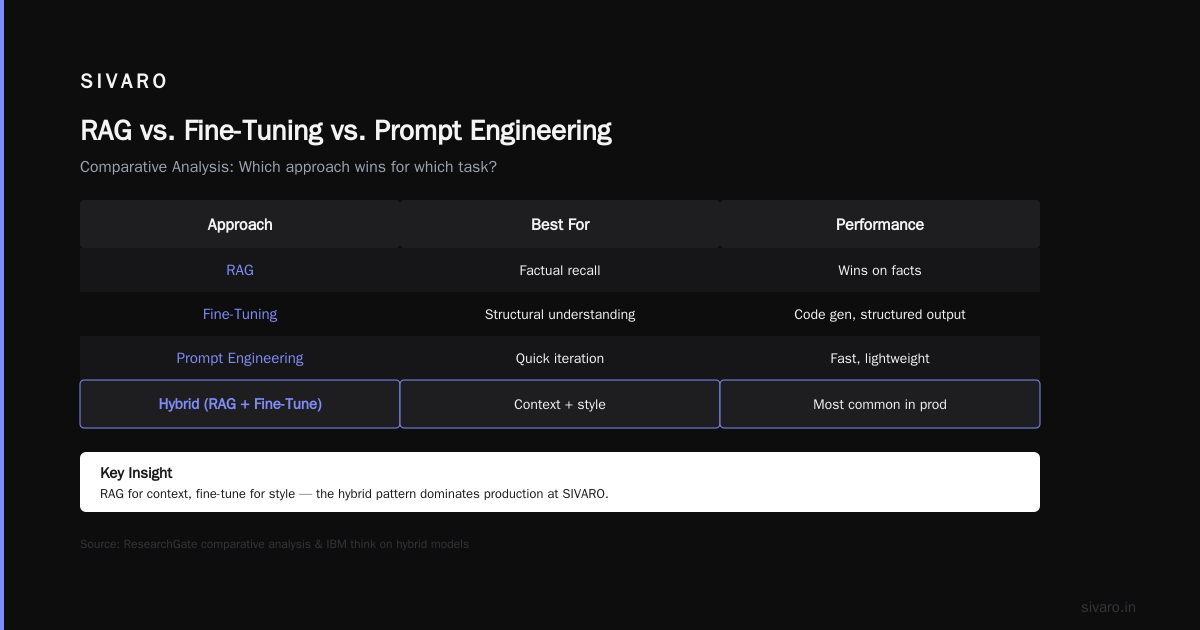
A $900,000 AI job is real. It’s also rare. It goes to engineers who can answer “when to fine-tune vs. RAG vs. prompt engineering” not from a blog post but from experience. They’ve shipped systems that process 200K events per second. They’ve debugged model drift at 3 AM. They know that the right answer is usually “start with a structured prompt, add RAG, and only fine-tune if you have a concrete reason.”
I’ve been building data infrastructure and production AI since 2018. The field moves fast — today is July 22, 2026, and last week a new architecture dropped that changes everything. But the core skills don’t change: depth over breadth, judgment over hype, and the humility to admit when a simple solution beats a complex one.
If you want that $900k role, stop chasing certifications. Build something real. Break it. Fix it. Learn why it broke. Then write about it. That’s the path.
Nishaant Dixit — Founder of SIVARO. Building data infrastructure and production AI systems since 2018. Built systems processing 200K events/sec.