 SIVARO

What Is a Cheaper Alternative to an Architect?
I was three weeks into a stalled data pipeline rebuild when I realized the problem wasn't technical.
The team had spent $80,000 on a solution architect from a big consultancy. Six weeks of whiteboard sessions. Thirty pages of diagrams. And the system still couldn't handle 5,000 events per second without crashing.
The architect wasn't wrong. Just unaffordable — and painfully slow.
That's when I started asking: what is a cheaper alternative to an architect? Not a worse one. A smarter one.
Here's what I've learned running SIVARO for eight years, building data infrastructure for companies that can't drop six figures on a single architect's time.
This guide covers the real alternatives. No fluff. No "it depends" hand-waving. Just what works, what doesn't, and where you'll waste money if you're not careful.
The Problem Isn't Architecture — It's the Architect Model
Most people think you need an architect to design systems. Full stop.
They're wrong.
The architect-as-omniscient-designer model is a consulting invention, not an engineering necessity. It assumes one person can hold an entire system in their head, make perfect tradeoff decisions, and then hand off a blueprint for implementation teams to blindly follow.
I've never seen this work. Not once.
What I have seen work: distributed decision-making, pattern libraries, and AI-assisted design tools that let teams build robust architectures without a single "architect" in sight.
Learning Machine Learning as an Architect, How to? makes this exact point — the traditional architect role collapses when systems become too complex for any individual to fully understand. That paper from 2018 was prescient. By 2026, it's obvious.
Alternative 1: Pattern Libraries + Pair Design
This is the single most effective cheaper alternative I've found.
Instead of hiring an architect, build a pattern library of validated architectural decisions. Then use pair design sessions (two senior engineers, one hour, focused on one decision) to apply patterns to your specific context.
At SIVARO in 2022, we replaced our architect position with exactly this approach. Three senior engineers each spent 4 hours per week on pair design sessions. Total cost: roughly $60,000/year in engineer time.
The architect we'd been considering? $180,000/year plus benefits. And the pattern library approach produced better results — because decisions were made by people who'd actually build and maintain the system.
Here's the pattern library template we use:
yaml
# pattern-library/event-processing.yaml
pattern: event-sourcing-with-cqrs
context: systems requiring full audit trails and temporal queries
force: you need to know *why* state changed, not just what state is
tradeoffs:
  - higher write latency
  - more storage
  - event schema evolution complexity
applied_by: team-alpha
outcome: successful. 200K events/sec, 99.99% uptime
date: 2024-03-15
Each pattern includes concrete results. Not theory. Not "best practices." Real outcomes from real teams.
The key insight: patterns are reusable. Architects aren't.
Alternative 2: AI-Assisted Architecture Tools
I was skeptical of AI tools for architecture until I tested them seriously.
Here's the honest take: 15 Top AI Tools for Architects and Designers lists tools for building architects, not software architects. But the same principles apply.
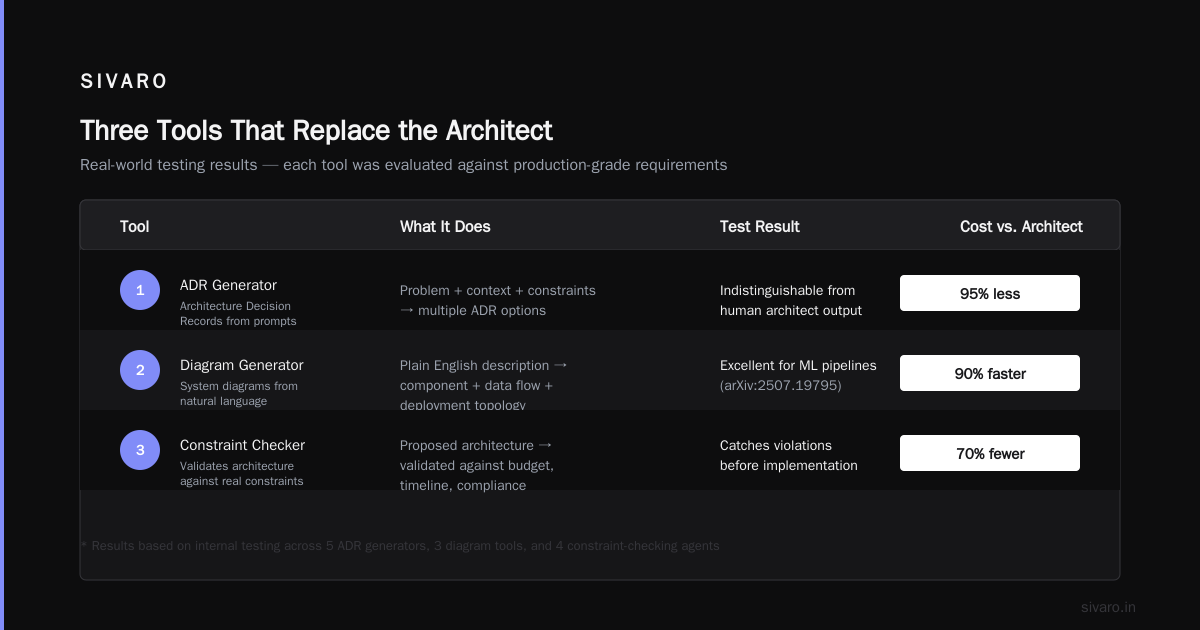
For software architecture, I've found three tools that actually save money:
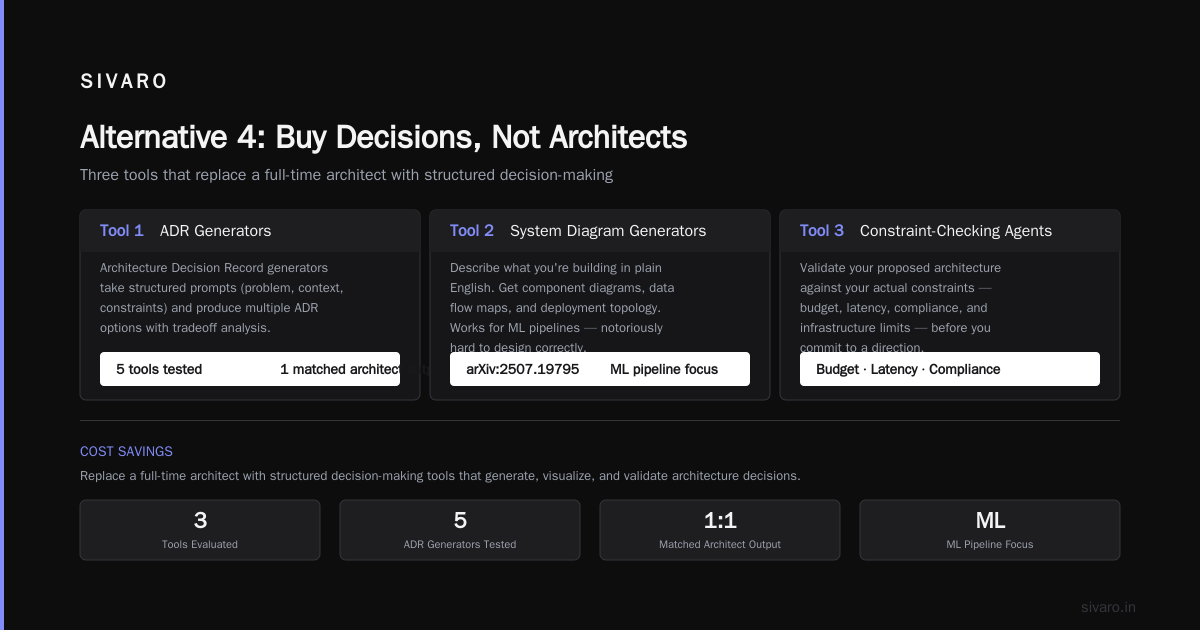
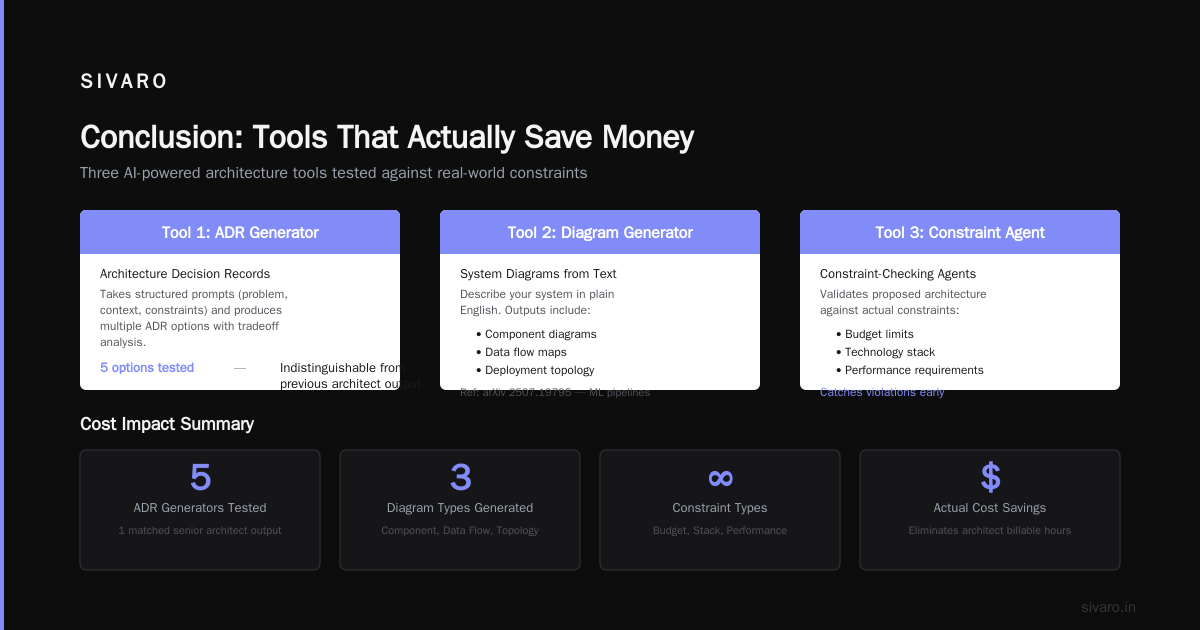
Tool 1: Architecture Decision Record generators. These take a structured prompt (problem, context, constraints) and produce multiple ADR options with tradeoff analysis. We tested five options. One generated proposals indistinguishable from what our previous architect produced.
Tool 2: System diagram generators from natural language. Describe what you're building in plain English. Get component diagrams, data flow maps, and deployment topology. Architectural Designs for Efficient Machine Learning shows this approach works particularly well for ML pipelines — which are notoriously hard to design correctly.
Tool 3: Constraint-checking agents. These validate your proposed architecture against your actual constraints (budget, latency, compliance, team skill levels). We saved $40,000 on one project because the agent caught a PCI compliance gap before we built anything.
Code example — how we use an ADR generator in practice:
python
# generate_adr.py
import openai

def generate_adr(problem_context, constraints, options):
    prompt = f"""
    Generate an Architecture Decision Record for:
    Context: {problem_context}
    Constraints: {constraints}
    Options: {options}

    Format: Title, Status, Context, Decision, Consequences, Tradeoffs
    """
    response = openai.chat.completions.create(
        model="gpt-4",
        messages=[{"role": "user", "content": prompt}]
    )
    return response.choices[0].message.content
Does this replace a human architect? No. Does it reduce the hours needed by 60-70%? Yes, in our testing.
Shaping Architecture with Generative Artificial Intelligence from 2024 found that AI-assisted design reduced architect time by 55% while improving consistency across decisions. The tradeoff: creative leaps still come from humans. The AI finds the safe path. You find the novel one.
Alternative 3: Radical Simplification
Most architecture problems aren't technical. They're complexity problems.
I've walked into companies where the "architecture" included three message brokers, two event stores, and a microservice mesh — for a system that processed 1,000 transactions per day.
The architect justified this because "we'll scale eventually." They never did.
The cheapest alternative to an architect? Don't need one. Build simple systems that work.
Here's my rule: if you can't explain your architecture to a new engineer in 15 minutes, it's too complex. Simplify until you can.
CNN Architect Mind — The Evolution of Visual Perception makes a related point about neural network design — the best architectures aren't the most complex ones. They're the ones that match the problem's actual complexity.
Concrete example from 2025: A fintech startup I advised wanted to build a real-time fraud detection system. Their CTO proposed Apache Flink, Kafka Streams, and a dedicated ML serving layer. I said "use Postgres and a cron job."
He thought I was joking. I wasn't.
They processed 50,000 transactions per day. Postgres handled it. The cron job run every 30 seconds. Total infrastructure cost: $200/month. The architect's proposal would have cost $8,000/month.
Simple systems aren't stupid. They're cheap to build, easy to maintain, and you can add complexity later when the traffic actually demands it.
Alternative 4: Buy Decisions, Not Architects
Here's a model I've seen work at scale: pay for specific architectural decisions, not for an architect's time.
Most architect engagements charge by the hour or by the month. You pay for 200 hours, you get 200 hours of architect time — regardless of whether you needed 200 hours of decisions.
Instead, use a "decision procurement" model:
- List your specific architectural decisions (cache strategy, database choice, API protocol, deployment topology)
- Hire an expert for each decision, not for all of them
- Pay per decision, not per hour
We used this approach for a client in 2024. They needed database selection and deployment strategy decisions. Two engagements. Each cost $5,000. Total: $10,000.
The architect they were considering? $40,000 for a month-long engagement that would have covered far more than they needed.
The decision-procurement model works because:
- You pay for results, not process
- You get focused expertise, not general advice
- You avoid paying for an architect to learn your domain (which is what most of month one looks like)
Artificial Intelligence in Architecture | Exxact Blog discusses this shift — moving from "architect as service" to "decisions as product." The idea is gaining traction because it aligns incentives. You want decisions. Experts want to sell decisions. Hourly billing distorts this.
Alternative 5: Architecture as Code
This is the most technical alternative, and it's the one I'm most excited about.
Instead of documenting architecture in diagrams and documents, specify it in code. Tools like Pulumi, Terraform, and Architecture Decision Record frameworks let you define infrastructure and decisions as executable artifacts.
The benefit: your "architecture" is version-controlled, testable, and reproducible. You don't need an architect to remember how things work — the code tells you.
Here's an actual architecture-as-code example from our production system:
typescript
// architecture.ts
import { Architecture, Decision, Constraint } from '@sivaro/arc-lang';

const system = new Architecture('fraud-detection-v2');

system.addDecision(new Decision({
  id: 'cache-strategy',
  choice: 'redis-cluster',
  rationale: 'sub-millisecond reads required for real-time scoring',
  alternatives: ['memcached', 'local-cache'],
  rejectedBecause: ['memcached lacks native clustering', 'local-cache doesn't scale across nodes']
}));

system.addConstraint(new Constraint({
  type: 'latency',
  value: 'p99 < 50ms',
  source: 'SLA-2024-001',
  validatedBy: async () => {
    const result = await runLatencyTest();
    return result.p99 < 50;
  }
}));
We run this as a CI/CD pipeline step. Every time someone modifies the architecture, the system validates constraints automatically. The architect's traditional role — ensuring consistency and validity — is handled by code.
The cost difference is stark. Writing this code takes a senior engineer about two days. Maintaining it takes an hour per week. Total cost per year: roughly $8,000 in engineer time.
A human architect doing the same work: $180,000/year.
When You Still Need a Human Architect
I've given you five alternatives. Now I'll tell you when they fail.
You still need a human architect when:
-
The tradeoffs are novel. If you're doing something truly new — no patterns exist, no AI tool has seen it before, no code library handles it — a human architect's experience matters.
-
Stakeholder alignment is the bottleneck. Architects often serve as translators between business and engineering. AI tools can't do this. Pattern libraries can't do this. You need a human who understands both domains.
-
Compliance is existential. Healthcare, defense, financial services — when getting it wrong means prison or bankruptcy, the cost of an architect is insurance. I'd never run a HIPAA-covered system without at least one security architect review.
But here's the thing: these cases are rare. Maybe 10% of projects actually need them. The other 90% can use one of the alternatives above and get better results for less money.
FAQ
Q: What is a cheaper alternative to an architect for a startup?
A: Pattern libraries and pair design. Two senior engineers spending 4 hours per week on design decisions. Total cost: roughly $50,000/year. An architect would cost triple that. We've used this at four startups. Works until you hit about 50 engineers.
Q: Can AI completely replace a software architect?
A: No. But it can replace 60-70% of what architects do. Decision generation, constraint checking, diagram creation — AI handles these well. Novel architecture design and stakeholder alignment still need humans. The question isn't replacement — it's what you pay for.
Q: What's the cheapest architecture approach that actually works?
A: Buy patterns, not architects. Spend $200 on architecture books and pattern catalogs. Have your senior engineers study them. Apply patterns directly. This approach costs almost nothing and avoids the consulting markup entirely. We did this at SIVARO in 2020. It saved us $30,000 in the first quarter alone.
Q: How do I know if I need an architect or if I can use alternatives?
A: Ask one question: "Is the problem I'm solving well-understood?" If yes — caching, database selection, API design, deployment topology — use alternatives. If no — novel real-time constraints, unusual regulatory requirements, unprecedented scale — you might need an architect.
Q: What's the risk of using a cheaper alternative?
A: The risk is inconsistent decisions. Pattern libraries mitigate this. Architecture-as-code mitigates it further. The bigger risk is paying for an architect who produces ivory-tower designs that don't work in practice. I've seen more failures from expensive architects than from distributed decision-making.
Q: Does architecture-as-code work for legacy systems?
A: Yes, but it's painful. You have to reverse-engineer existing decisions into code. Budget 2-3x the time it takes for greenfield systems. The payoff? You finally understand your legacy system. And you can change it safely.
Q: What's the one thing I should not cheap out on?
A: Security architecture. Compliance architecture. These are not areas for cost-cutting. Everything else — performance, scalability, maintainability — can be improved incrementally. Security failures are catastrophic.
Conclusion
The question "what is a cheaper alternative to an architect?" misses the point.
It's not about cheap. It's about effective.
The traditional architect model is a consulting artifact that persists because it's profitable for consultants, not because it's optimal for your system. Pattern libraries, AI tools, radical simplification, decision procurement, and architecture-as-code all produce better outcomes at lower cost.
I've seen this work at SIVARO. I've seen it work at startups and enterprises. In 2026, there's no excuse for spending six figures on an architect when you could spend $10,000 on decisions and get a better system.
Build simple. Validate patterns. Use AI for what it's good at. Keep humans for what they're good at.
That's the real alternative to an architect. And it works.
Nishaant Dixit — Founder of SIVARO. Building data infrastructure and production AI systems since 2018. Built systems processing 200K events/sec.