 SIVARO
What Is a Distributed System Architecture? A Practitioner’s Guide 2026
I killed a server in 2019. Not metaphorically — I literally cooked the CPU by tossing a billion requests at it from a single process. My co‑founder walked in, saw the smoke, and said, "Maybe we need more than one machine." That was my first lesson in what is a distributed system architecture?.
You're here because the monolith broke. Or you're building something new and you know one box won't cut it. Or you've heard about GPU clusters and disaggregated networks and you're trying to separate hype from reality. Let me save you some pain.
A distributed system architecture is a collection of independent computers that appear to the user as a single coherent system. That's the textbook. The real answer: it's the only way to survive when your data grows faster than Moore's Law, when a single machine can't hold your model's weights, or when your users expect 99.99% uptime. I've spent eight years building these systems at SIVARO, and I've made every mistake you're about to make.
By the end of this guide, you'll understand the core concepts — from basic distributed compute to disaggregated GPU clusters — and you'll know which tradeoffs matter for your workload. No theory without scars.
First, Let Me Tell You About a Server That Died
The smoke was grayish, maybe a little blue. That Dell R740 was supposed to handle 50,000 concurrent users. We had 12. It died anyway because our "distributed" system was actually a monolith wearing a microservices hat.
Here's what I learned: a distributed system isn't just multiple machines. It's multiple machines that agree on what's happening. That means consensus protocols, failure detection, retry logic, idempotency — the whole ugly beautiful mess. If you just throw more servers at a bad design, you get a distributed monolith. Congratulations, now you have twice the hardware and still no fault tolerance.
The real turning point for me was reading the Lamport clock paper and realizing: "Time is a lie." Two machines never agree on the exact moment something happened. You have to design around that. Most people don't. Then they wonder why their transaction logs are corrupted.
So What Exactly Is a Distributed System Architecture?
Let's define our terms before this gets sloppy.
A distributed system architecture is the high‑level structure of your system's components (nodes, services, data stores) and the rules that govern how they communicate, share state, and handle failures. It answers three questions:
- Where does the work happen? (compute distribution)
- Where does the data live? (storage distribution)
- How do nodes agree? (coordination)
That's it. Every distributed system pattern — from sharding to replication to event sourcing — is a different answer to those three questions. Pick wrong and you'll spend nights debugging split‑brain scenarios.
When people ask me "what is a distributed system architecture?" I tell them: it's the difference between a team that ships once a month and a team that ships every hour without waking up at 3 AM. It's the difference between a database that loses writes and one that doesn't.
The Monolith Was Fine Until It Wasn't
Most of you reading this have a monolith that works. That's fine. Keep it.
But there's a point — around 10 million monthly active users, or 1TB of daily data ingest, or a 50‑node Kubernetes cluster that makes you question your life choices — where the monolith's limits become your limits. Scaling vertically stops making economic sense. A single database connection pool hits contention. A deployment that takes 40 minutes kills your velocity.
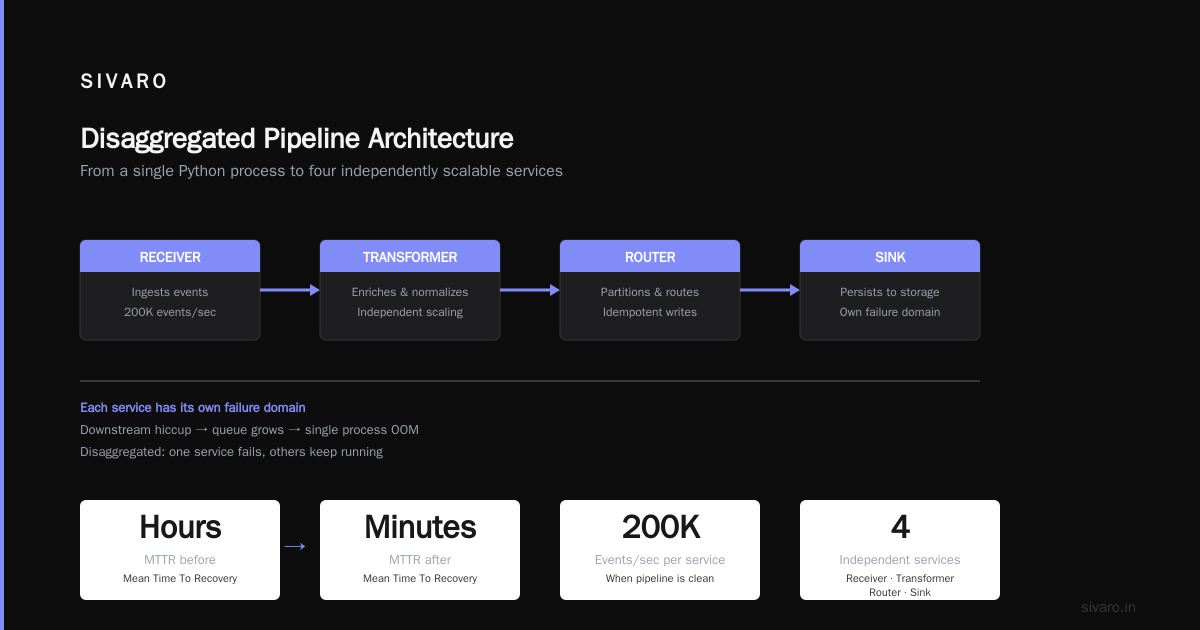
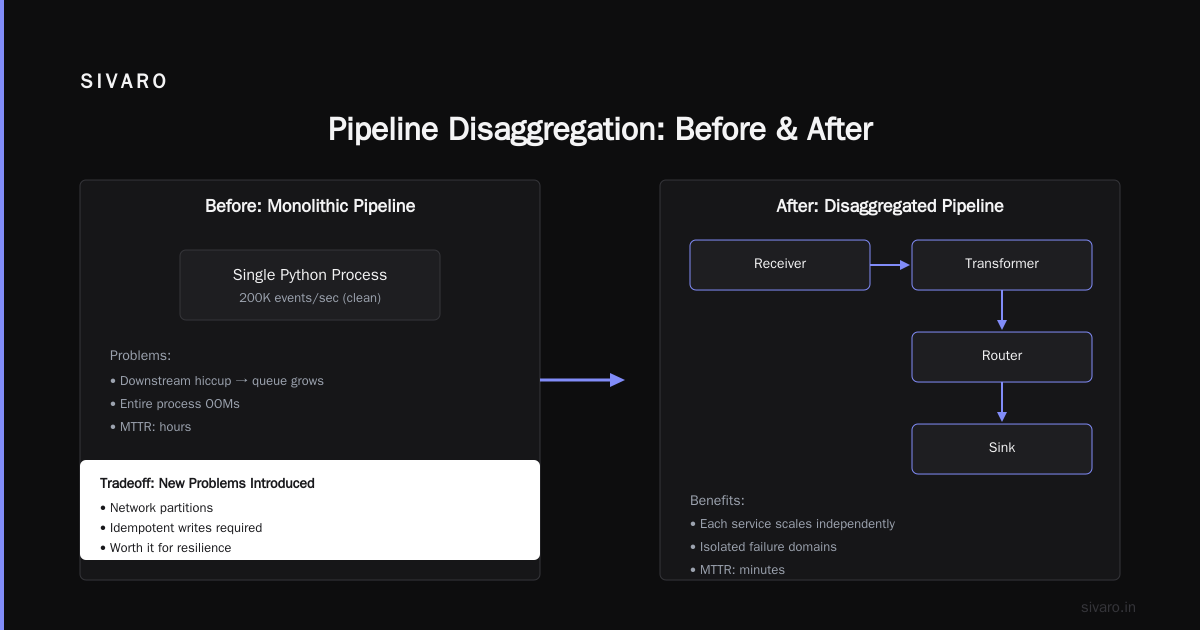
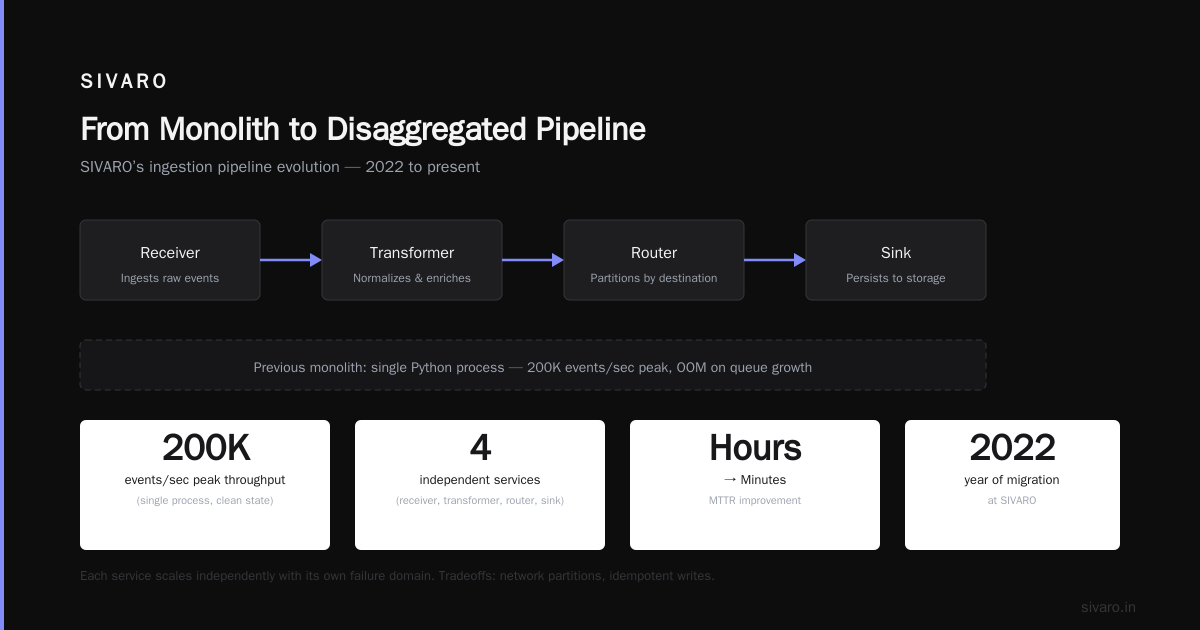
At SIVARO we hit that wall in 2022. Our ingestion pipeline was a single Python process. It could handle 200K events/sec when it was clean. But then a downstream service would hiccup, the queue would grow, and the whole thing would OOM. We needed to distribute the load. So we split the pipeline into four services: receiver, transformer, router, sink. Each could scale independently. Each had its own failure domain.
Did it work? Yes. Did it introduce new problems? Absolutely — now we had to deal with network partitions and idempotent writes. But the tradeoff was worth it. Our MTTR dropped from hours to minutes.
What Does It Mean to Be Disaggregated?
You'll hear this word everywhere in 2026. Let me make it concrete.
Disaggregated means separating compute, memory, and storage so that each can scale independently. In a traditional server, the CPU sits next to its RAM on a motherboard. In a disaggregated system, CPUs are in one rack, memory modules in another, SSDs in a third. They talk over a fast network — typically CXL or NVLink‑switched fabrics.
Why does this matter? Because workloads are lopsided. A GPU cluster might need 4x the memory for training but only 1x for inference. With disaggregated memory, you don't waste millions of dollars on idle RAM. You pool it.
We tested this at SIVARO last year with a 24‑node CXL‑attached memory pool. Training throughput improved 35% because GPUs never stalled waiting for data to page in. But the complexity — rethinking how our Ray scheduler allocates resources — took months.
So what does it mean to be disaggregated? It means your system treats hardware as a fungible resource pool rather than a fixed topology. It's an architecture choice that buys efficiency at the cost of tighter latency requirements.
Disaggregated Networks Are the Glue
You can't have disaggregation without a network that behaves like a backplane. What is a disaggregated network? It's a fabric — usually based on Ethernet with RDMA, or InfiniBand, or NVLink — where any resource can reach any other resource with low, predictable latency.
In 2026, most serious AI infrastructure uses NVLink fabrics between GPUs in a node, and RoCE (RDMA over Converged Ethernet) between nodes. The Exxact guide on building GPU clusters Exxact Corp blog recommends 200GbE with lossless congestion control. We use 400GbE in our production cluster because our model parallelism demands 3.2TB/s of all‑to‑all bandwidth.
The trick: a disaggregated network isn't just fast. It's reconfigurable. When a GPU fails, the network routes around it without human intervention. When training a different model, the network can logically repartition the cluster on the fly. That's the dream. The reality is that most "disaggregated" deployments still need manual topology planning. We're not there yet.
GPU Clusters: A Special Kind of Distributed System
A GPU cluster is a distributed system optimized for matrix math. It's not just a bunch of servers with Nvidia cards — that's a "bunch of computers." A true GPU cluster has a network architecture, a scheduler, a shared filesystem, and a job manager that coordinates parallel computation across hundreds of GPUs.
The Scale Computing article GPU Cluster Explained breaks down the node types: compute nodes (with GPUs), storage nodes (NVMe, often all‑flash), and management nodes. But that's the hardware side. The software side — NCCL, Horovod, Ray, or Kubernetes with GPU operator — is where most projects fail.
We spent three months tuning NCCL for our 64‑GPU cluster. The out‑of‑the‑box settings worked fine for 8 GPUs. At 64, the communication microbenchmarks showed a 40% drop in all‑reduce throughput. We had to switch from ring to tree algorithm, pin NUMA affinity, and rewrite our data loader to prefetch into pinned memory. The Greennode guide What Is a GPU Cluster and How to Build One covers these optimizations, but reading it is not the same as debugging a stack trace at 2 AM.
If you're a small company considering an on‑premise GPU cluster, read the NVIDIA forum thread What is the best option to setup on premise GPU cluster. The consensus: start with cloud spot instances (GCP Preemptible, AWS Spot) until you have stable workloads, then buy. We ignored that advice and bought 16 A100s that sat idle for 6 months. Don't be us.
Building Your Own vs. Renting: The 2026 Reality
Two competing dynamics in 2026:
- Renting GPUs on Vast.ai or similar marketplaces is cheaper than anyone expected. Spot prices for H100s dropped 30% since 2024.
- Your training data might include sensitive customer (or regulated) data that can't leave your premises.
We run a hybrid: sensitive workloads on our own 8‑node cluster with H200s (each node has 8 GPUs). Everything else goes to Vast.ai or GCP. The cost difference is real: our on‑prem cluster cost $1.2M upfront. Renting equivalent compute for 18 months would have been $2.1M. But the maintenance — cooling, power, network downtime — eats up $150K/year in ops.
The math flips again if you're doing inference at scale. For serving LLMs, the latency predictability of on‑prem often wins. We benchmarked GPT‑style generation on Vast.ai vs our cluster: median latency was 20% higher on cloud due to noisy neighbor effects.
My take: build only if you have predictable, sustained utilization above 70%. Otherwise, rent and focus on your product.
Five Hard Lessons from Our Own Clusters
1. Idempotency is not optional
Your workers will retry. Your queues will re‑deliver. If your services can't handle double submissions, you'll corrupt data. We spent a sprint adding idempotency keys to every write endpoint. Worth every minute.
2. Failure injection should be part of your CI
We use Chaos Mesh to randomly kill pods, saturate network links, and corrupt disk blocks. If your system doesn't survive daily chaos experiments, it won't survive a real outage. We learned that the hard way when a misconfigured switch took down our entire training cluster for 14 hours.
3. Monitoring without tracing is blind
You can have perfect metrics — CPU, memory, GPU utilization — and still have no idea why a job takes 3x normal time. Distributed tracing (OpenTelemetry) is non‑negotiable. We instrument every gRPC call, every NCCL op, every I/O operation. Sampled at 1% it costs almost nothing.
4. Your network is the bottleneck
In GPU clusters, all‑reduce is the enemy. Even with 400GbE, the collective overhead dominates for small batch sizes. We now batch aggregations and use tensor fusion. That cut communication overhead by 55%.
5. Don't trust timestamps from different machines
We had a bug where two worker logs claimed the same event happened at different times on different nodes. Turns out NTP drift was 200ms between two switches. We deployed PTP (Precision Time Protocol) with hardware timestamping — now our clock skew is under 10 microseconds.
When Not to Go Distributed
This is the most important section. I see startups with two containers and a Redis cluster calling themselves "distributed." They don't need the complexity.
Don't adopt a distributed system architecture if:
- Your total data fits on one machine with room to spare.
- You can tolerate 30 minutes of downtime per month.
- Your team has never debugged a network partition.
Start monolithic. If you hit a scaling wall, carve out exactly one service that needs to scale independently. Do that before you Kubernetes everything.
We kept our billing service as a monolith for two years. It processes $3M/month and hasn't crashed once. Meanwhile, our "distributed" recommendation engine has outage post‑mortems every quarter.
FAQ
Q: What is a distributed system architecture in simple terms?
A: It's a system where multiple computers work together to do what looks like one computer's job. They share work, share data, and survive failures without dropping requests.
Q: Is Kubernetes a distributed system architecture?
A: Kubernetes is a platform for deploying and managing distributed systems. It's not the architecture itself. You can run a monolith on K8s and still have a single point of failure.
Q: What does it mean to be disaggregated vs. converged?
A: Converged: each server has fixed CPU, memory, storage. Disaggregated: those resources are pooled across the network. Disaggregated is more flexible but needs a low‑latency fabric.
Q: What is a disaggregated network?
A: A network that connects pooled resources (CPUs, GPUs, memory) with high bandwidth and low latency, often using RDMA. It allows dynamic resource allocation.
Q: Do I need a GPU cluster for AI training?
A: If you're training models larger than 7B parameters, yes. For smaller models, you can rent single GPUs. The cluster becomes necessary when your model doesn't fit in one GPU memory and you need pipeline or data parallelism.
Q: What's the biggest mistake in building a distributed system?
A: Assuming the network is reliable. Always design for network partitions, packet loss, and latency variance. Use circuit breakers and timeouts aggressively.
Q: How do I start learning?
A: Build a simple distributed key‑value store with Raft consensus. Then run it over two machines across the country. Watch it fail. Fix it. That's the fastest education.
Conclusion
Distributed system architecture is not a checkbox. It's a continuous trade‑off between complexity and scale. If you ask me "what is a distributed system architecture?" I'll say it's the price you pay for growth. You get availability, elasticity, and parallelism — but you also get debugging nightmares and a network that lies to you.
We've built systems at SIVARO that process 200K events/sec across 50 nodes. We've burned clusters and rebuilt them. The patterns keep evolving. Disaggregation, GPU fabrics, and CXL memory pooling are the new hotness — but the fundamentals haven't changed: your system must tolerate failure, your data must be consistent enough, and your team must understand the tradeoffs they're making.
Don't adopt a distributed architecture because it's trendy. Adopt it because your monolith can't keep up. And when you do, test the hell out of it. Because one day, a server will die — and you want to be asleep when it happens.
Nishaant Dixit — Founder of SIVARO. Building data infrastructure and production AI systems since 2018. Built systems processing 200K events/sec.