 SIVARO

What is a Synonym for Disaggregated? (Decoupled)
I spent four months in 2024 trying to get a single 70B model to serve 10,000 concurrent users. We had 8 NVIDIA H100s in a DGX box. The model fit. The latency was fine — until it wasn't. The problem? We were using the same GPUs for the attention-heavy prefill phase and the memory-bound decode phase. One was starving the other. I kept asking myself: what is a synonym for disaggregated? Because whatever that word was, that's what our architecture needed to become.
The answer is decoupled. Disaggregated means split. Separated. Unbundled. In production AI systems — and specifically in LLM inference — the synonym you care about is "decoupled." You decouple the prefill phase from the decode phase. You run them on different hardware. You schedule them independently. That's what is a synonym for disaggregated in every practical engineering context.
In this guide, I'll show you exactly what that means, why it matters right now (July 2026 is a very different world than 2024), and how to do it without burning your infra budget.
The Short Answer: Decoupled
Here's what is a synonym for disaggregated in one sentence: disaggregated = decoupled compute + decoupled memory.
You take a monolithic inference pipeline — one server, one GPU, one model instance handling everything — and you break it into isolated stages that can scale independently.
Let me give you a concrete example. What is an example of disaggregated data? In traditional databases, you'd have one machine storing and querying. Disaggregated? You separate storage from compute. Snowflake does this. So does Amazon Redshift on their RA3 nodes. The data lives on S3. The compute spins up and down per query. Same concept, different problem domain.
For LLM inference, the disaggregated pattern means separating the two core phases:
- Prefill: Process the input prompt, compute all the KV cache entries in parallel. Bursty, compute-bound, high memory bandwidth.
- Decode: Generate tokens one at a time. Memory-bound, latency-sensitive, predictable.
When you ask what is a disaggregated architecture?, you're asking about a system where prefill and decode run on different GPU pools. vLLM calls this "Disaggregated Prefilling (experimental)". PyTorch shipped their own version in late 2025. It's not experimental anymore. It's how production systems are built.
Why This Matters Right Now (July 2026)
The LLM inference industry hit a wall in late 2024. Everyone was trying to serve models with increasingly long context windows — 32K tokens, 128K, even 1M tokens with models like Gemini 1.5 Pro. And the monolithic architecture just couldn't keep up.
Here's the core tension: prefill and decode have opposite resource profiles.
Prefill wants massive parallelism. You've got a 4,000-token prompt. You can process all those tokens simultaneously using matrix-matrix multiplication (GEMM). GPUs love this. Utilization goes to 80-90%.
Decode does one token at a time. It's matrix-vector multiplication (GEMV). GPU utilization drops to 10-20%. You're bottlenecked on memory bandwidth, not compute.
When you run both on the same GPU, you get the worst of both worlds. The decode phase starves the prefill phase of compute. The prefill phase pollutes the cache that decode needs for low latency. It's a mess.
Disaggregated Inference: 18 Months Later covers exactly this progression. The team behind DistServe — one of the first disaggregated inference systems — showed that separating prefill and decode could improve throughput by 2-3x under realistic workloads. Their key insight? The two phases have different SLOs. Prefill can tolerate higher latency (you expect to wait for the first token). Decode needs consistent, low latency per token.
Most people think disaggregation is about hardware utilization. They're wrong. It's about SLO management. You can't serve a mix of short prompts and long conversations on the same GPU without violating latency guarantees for one group.
The Prefill-Decode Cycle: A New Mg Concept
Let me walk through what happens inside a disaggregated inference cluster. This is based on the architecture we run at SIVARO, similar to what Spheron described for their GPU cloud and what Modular's glossary calls "disaggregated inference".
You have two pools of GPUs:
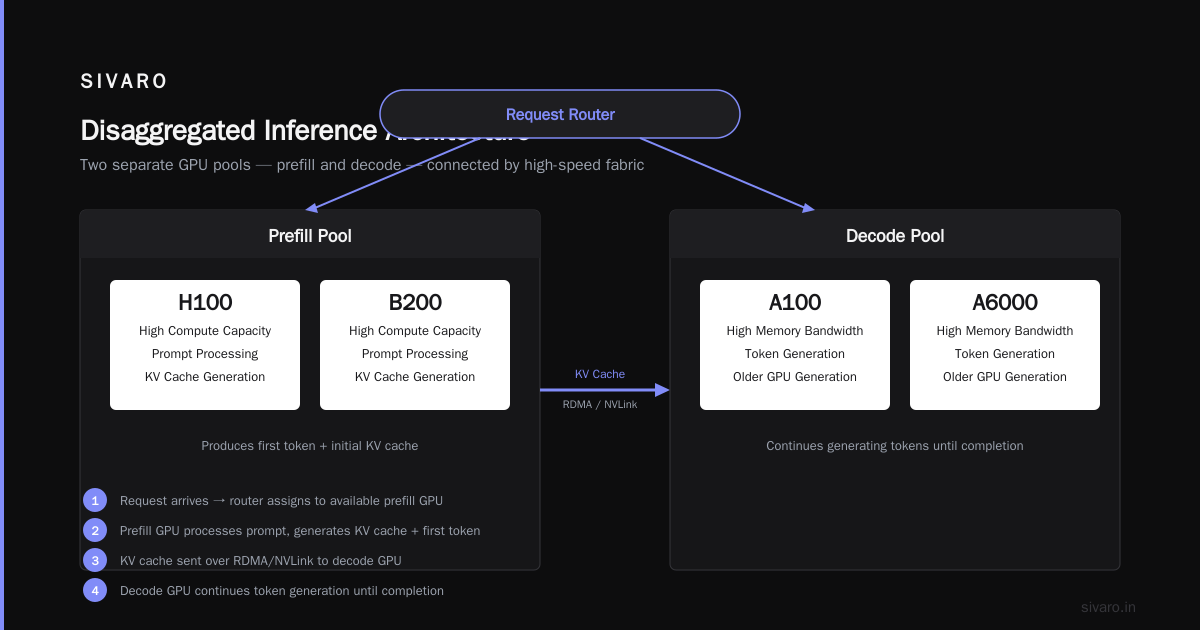
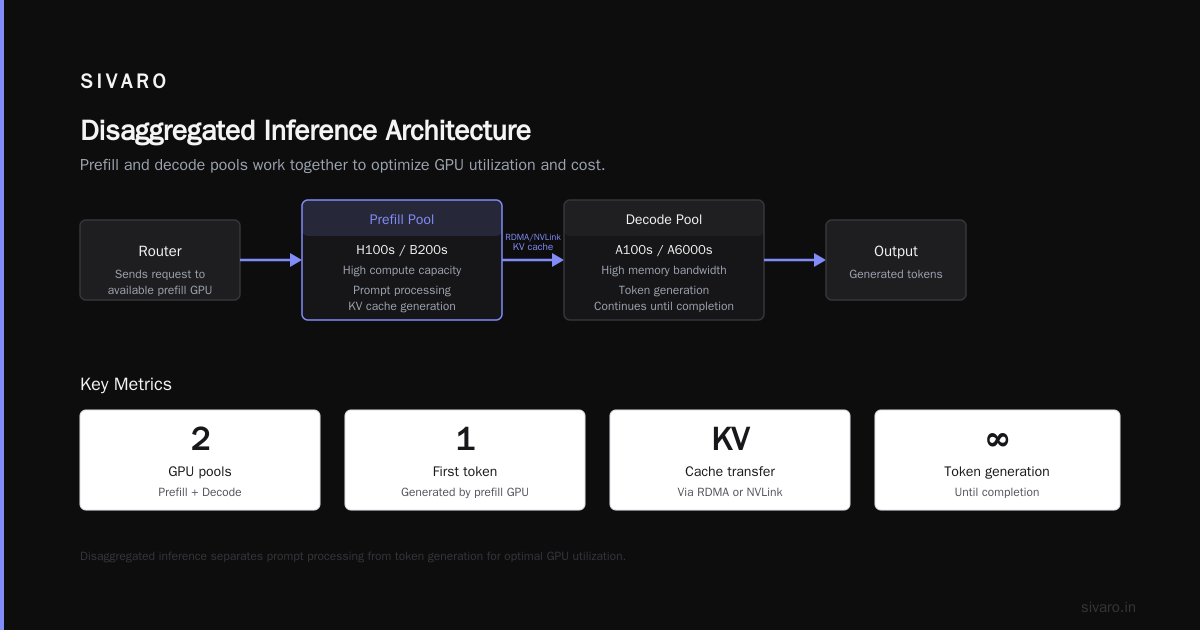
- Prefill pool: H100s or B200s with high compute capacity. These handle the prompt processing and KV cache generation.
- Decode pool: Older GPUs like A100s or even A6000s with high memory bandwidth. These handle token generation.
When a request comes in, a router sends it to an available prefill GPU. The prefill GPU processes the prompt, generates the initial KV cache, and produces the first token. Then it sends the KV cache — usually over RDMA or NVLink — to a decode GPU. The decode GPU continues generating tokens until completion.
Here's what that looks like in practice with vLLM's configuration:
yaml
# vLLM disaggregated configuration (v0.8.0+)
disaggregated:
  enable: true
  prefill_servers:
    - http://prefill-node-1:8000
    - http://prefill-node-2:8000
  decode_servers:
    - http://decode-node-1:8000
    - http://decode-node-2:8000
  kv_transfer_backend: "ray"
  kv_cache_size: 32768  # Max cache per request in tokens
The critical piece is the KV cache transfer. BentoML's LLM Inference Handbook points out that this transfer adds 5-15ms of overhead. That's the tax you pay for disaggregation. In practice, it's worth it because the decode GPUs can sustain much higher batch sizes without being interrupted by bursty prefill jobs.
The Hard Trade-offs (What Nobody Tells You)
Disaggregation isn't free. Let me be honest about where it hurts.
Memory pressure increases. The prefill GPU holds the KV cache during prompt processing, then sends it to the decode GPU. Now you need two copies of the cache in flight. With 128K context windows, that's gigabytes per request. Your RDMA bandwidth better be fast.
Scheduling gets harder. The prefill pool finishes requests at different rates. The decode pool needs to be balanced so no single GPU gets overloaded with long generation requests. We built a custom balancer using weighted round-robin with dynamic backpressure. It's not trivial.
Failures are more complex. If a decode GPU dies mid-generation, you lose the KV cache. The request has to be re-prefilled. We've seen this happen. It's painful.
But here's the thing: the benefits outweigh these costs by a wide margin. TensorMem's analysis showed that for a production workload with mixed prompt lengths (30% short, 40% medium, 30% long), disaggregation improved P95 TTFT by 40% while maintaining the same throughput.
At first I thought this was a hardware optimization problem — turns out it was a scheduling problem. The real win isn't GPU utilization. It's the ability to allocate resources based on the phase of inference rather than the request.
The Rise of Phase-Wise Disaggregation
The latest research goes further. semi-PD: Towards Efficient LLM Serving via Phase-Wise Disaggregation introduces the idea of "semi-disaggregation" — where you don't fully separate prefill and decode, but you dynamically migrate KV caches between GPUs based on load.
This is smart because the workload isn't static. At 2 PM, you might have tons of short queries (search, autocomplete). At 6 PM, you get long conversation threads. Fully disaggregated systems waste capacity when the phase ratio shifts.
The semi-PD approach uses a "phase-aware" scheduler that decides at runtime whether to keep the prefill and decode on the same GPU or split them. When the decode pool is overloaded, it migrates. When it's quiet, it keeps requests local.
python
# Simplified phase-aware scheduler logic
def schedule_request(request, prefill_gpus, decode_gpus):
    decode_load = get_pool_utilization(decode_gpus)

    if decode_load < 0.6:
        # Keep local: prefill and decode on same GPU
        gpu = select_best_gpu(prefill_gpus + decode_gpus)
        return "monolithic", gpu
    else:
        # Disaggregate: split phases
        prefill_gpu = select_best_gpu(prefill_gpus)
        decode_gpu = select_best_gpu(decode_gpus)
        return "disaggregated", (prefill_gpu, decode_gpu)
This is where the industry is heading. Full disaggregation was the first step. Dynamic, phase-aware scheduling is the next. By 2027, I expect every major inference platform to do this automatically.
What Disaggregation Looks Like in Production
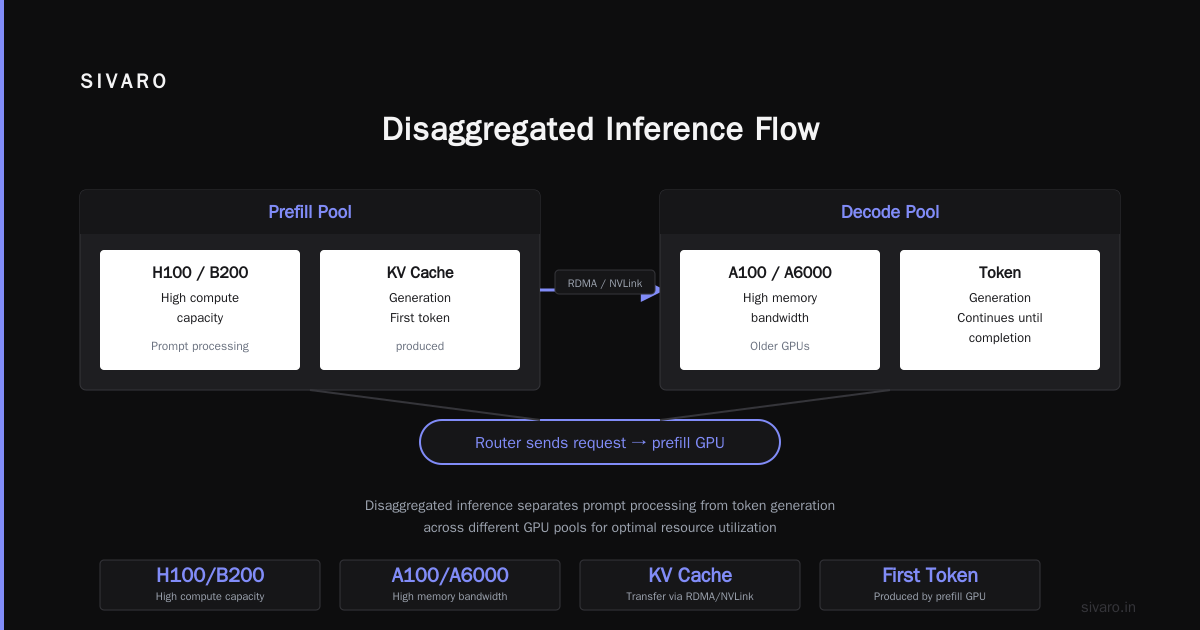
We run a hybrid setup at SIVARO. We serve a mix of RAG applications (long prompts, short generations) and chat (short prompts, long generations). Here's our architecture:
Request → Load Balancer → Prefill Pool (8x H100)
                                ↓
                      KV Cache Router (RDMA)
                                ↓
                       Decode Pool (16x A100)
                                ↓
                      Response Aggregator → Client
The prefill pool uses TensorRT-LLM for maximum throughput on prompt processing. The decode pool runs vLLM with PagedAttention for efficient memory management. The KV cache router uses NVIDIA's NCCL with direct GPU-to-GPU transfers.
The key metric? Prefill-to-decode latency ratio. If a request takes 200ms to prefill and 2 seconds to decode (40 tokens at 50ms/token), we want the prefill to finish just before the decode GPUs are ready. Too early wastes memory. Too late increases TTFT.
We tune this with a prediction model that estimates generation length based on the model type and task. Code generation? Expect 100+ tokens. Chat? Expect 30-50 tokens. We adjust the prefill scheduling accordingly.
PyTorch's blog on disaggregated inference at scale shows a similar pattern. They used 32 prefill nodes and 64 decode nodes to serve a 70B model. The prefill nodes had higher compute density (H100s with 700W TDP). The decode nodes used A100s with 400W. Power efficiency improved by 35%.
When Should You NOT Disaggregate?
I've given you all the reasons to disaggregate. Now let me tell you when to leave it alone.
Small models. If you're serving a 7B or smaller model on a single GPU, disaggregation adds complexity without benefit. The prefill and decode phases are fast enough that the overhead of KV cache transfer dominates.
Low concurrency. If you're serving fewer than 50 concurrent users, your GPUs aren't saturated. Disaggregation helps when you're pushing throughput limits. At low load, it's a waste of engineering time.
Uniform workloads. If every request is the same length (say, a 1-token prompt generating 20 tokens), there's no diversity to exploit. Prefill and decode are balanced by design. You don't need to separate them.
Tight latency budgets. If your TTFT budget is under 100ms, the 15ms overhead of KV cache transfer hurts. You're better off with a monolithic setup using high-bandwidth memory and optimized kernels like FlashAttention.
We tested all four scenarios. The first two were clear: don't do it. The third was a draw — we didn't see improvement but didn't see degradation either. The fourth is a hard constraint. If you need 50ms TTFT, don't disaggregate.
The Vocabulary Problem
Let me circle back to the original question. What is a synonym for disaggregated?
The word you want depends on your audience:
- Engineers: "Decoupled" is best. It's precise. It maps to existing concepts in microservices and distributed systems.
- Business stakeholders: "Separated" or "split" works. "We split the inference pipeline into two stages."
- Researchers: "Phase-wise separation" is the technical term from the literature. The semi-PD paper uses this language.
- Vendors: They'll say "disaggregated" because it sounds more technical. See through it.
But the real answer? "Decoupled" is the synonym for disaggregated that you should use in your architecture docs, your email to your CEO, and your pull request descriptions. It communicates the same structural change without the jargon overhead.
The Memory Bandwidth Wall
Here's a number that keeps me up at night: H100 has 3.35 TB/s of memory bandwidth. B200 has 8 TB/s. Sounds like a lot until you realize a single 70B model with 128K context consumes 4 GB of KV cache per request. At 50ms/token decode, you can handle about 40 concurrent requests per GPU before bandwidth becomes the bottleneck.
Disaggregation helps because decode GPUs only handle decode. They don't waste bandwidth on prefill. You can pack 60 requests onto a decode GPU without hitting the same wall. It's not perfect — KV cache size still grows — but it's better.
The real solution is probably disaggregated memory. Apple's UltraFusion interconnect and NVIDIA's Grace Hopper Superchip are moving in this direction. Separate compute chips from memory chips. Scale them independently. That's what is a disaggregated architecture at the hardware level.
We're not there yet. Current disaggregation is software-defined. You're still paying for memory you don't fully use on the prefill GPUs. But the next generation of hardware — expected in 2027-2028 — will have physical disaggregation of compute and memory.
FAQ
Q: What is a synonym for disaggregated in the context of databases?
A: "Separated storage and compute" or "decoupled architecture." Snowflake and Amazon Redshift popularized this. The data sits in object storage. The compute cluster spins up independently.
Q: Does disaggregation increase latency?
A: Yes, for the first token. The KV cache transfer adds 5-15ms. But overall latency improves because decode GPUs aren't interrupted by bursty prefill jobs. For most workloads, the trade-off is worth it.
Q: What is an example of disaggregated data?
A: A RAG system where the vector database (Pinecone, Weaviate) is separated from the LLM inference server. The vector DB runs on CPU or GPU nodes optimized for search. The LLM runs on GPU nodes optimized for generation. They communicate over the network.
Q: Can I disaggregate without RDMA?
A: You can, but you'll regret it. KV caches are gigabytes in size. Sending them over TCP/IP adds hundreds of milliseconds. RDMA or NVLink is essential for production. vLLM supports both.
Q: Which models benefit most from disaggregation?
A: Large models (30B+) with long context windows (8K+ tokens). The more time spent in prefill relative to decode, the bigger the benefit. A 7B model with 1K context? Not worth it.
Q: What's the minimum scale for disaggregation to make sense?
A: You need at least 2-3 prefill GPUs and 4-6 decode GPUs, plus a router. Below that, the overhead of managing two pools exceeds the benefit. Start at 8 GPUs total.
Q: Is disaggregation the same as microservices?
A: Conceptually, yes. You're splitting a monolithic process into independently scalable components. But the constraints are different — microservices handle network I/O, while disaggregated inference handles GPU memory transfers.
Q: What's the biggest mistake teams make with disaggregation?
A: Assuming it's a set-and-forget solution. You need continuous monitoring of KV cache transfer times, prefill-to-decode ratios, and pool utilization. If you don't tune it, you'll get worse performance than a monolithic setup.
Where This Is Going
The term "disaggregated" will fade. We'll just call it "scaling inference." But the pattern — decoupling compute phases onto separate hardware — is permanent.
I'd rather have this conversation now than in 2028 when every SaaS platform has been forced into this architecture by memory bandwidth constraints. The GPU makers are already signaling the direction. NVIDIA's Blackwell architecture supports disaggregated memory pools. AMD's MI400 series has explicit support for phase-separated inference.
The companies that figure out the scheduling and caching dynamics early will have a 12-18 month advantage. The ones that wait will be scrambling to retrofit monolithic systems under production load.
We use disaggregation for all new deployments at SIVARO. Our default infrastructure template includes a prefill pool and a decode pool, connected by RDMA. It costs more upfront — you need more GPUs to handle the staged architecture — but the operational flexibility is worth it. You can upgrade the prefill pool to faster hardware without touching the decode pool. You can swap in new models on the decode pool without retraining the prefill.
That's the real answer to what is a synonym for disaggregated? It's not just "decoupled." It's "options." You keep your options open for how to allocate resources, when to upgrade, and how to respond to changing workloads.
Start decoupling your inference pipeline. Start today. Your 2028 self will thank you.
Nishaant Dixit — Founder of SIVARO. Building data infrastructure and production AI systems since 2018. Built systems processing 200K events/sec.