 SIVARO
what is an a2a server? The Missing Piece in Production AI
I’ll never forget the moment in early 2025 when our orchestrator at SIVARO just … died. Not a gradual fall. A crash. We had nine AI agents running a live client pipeline — one was a reasoning agent, another a retrieval agent, three tool executors, and a couple of monitors. They were supposed to talk to each other. Instead, they talked over each other. Messages got lost in a homegrown Redis queue. Two agents deadlocked. The client’s production data pipeline sat frozen for 47 minutes.
That’s when I learned what an a2a server is — the hard way.
Here’s the short definition: an A2A server (agent-to-agent server) is a dedicated infrastructure node that handles all inter-agent communication, state synchronization, policy enforcement, and lifecycle management for autonomous AI agents. Think of it as the message bus, the state store, and the security guard all in one — purpose-built for the chaos of multi-agent systems.
If you’re building production AI systems with more than one agent, you need an A2A server. Not a suggestion. I learned that by bleeding.
By the time you finish this guide, you’ll know exactly what an A2A server does, how it differs from a plain message broker, where it fits in the 4 levels of agentic AI, and the hard trade-offs we discovered after running one for 18 months.
What Actually Happens Inside an A2A Server
Most people think you can just throw RabbitMQ or Kafka at multi-agent messaging. I did. It works for two agents. For ten? You get fire.
An A2A server does four things that regular brokers don’t:
1. Agent registration and discovery
Agents announce themselves: “I’m a retrieval agent, I handle RAG queries, my endpoint is X.” Other agents ask the A2A server: “Who can handle this task?” The server returns the right agent(s). No hardcoded URLs. No manual config.
2. Stateful routing with session awareness
A user says “Find the Q3 numbers, then sum them.” That’s a multi-step task — first a retrieval agent, then a computation agent. The A2A server keeps a session context so the second agent knows which numbers to sum. Kafka can’t do that without a huge workaround.
3. Policy enforcement
“Only allow the compliance agent to write to the database.” “Throttle the web scraper to 10 req/min.” The A2A server sits in the middle and enforces these rules. It’s the gatekeeper.
4. Lifecycle management
Agents crash. Agents get slow. The A2A server detects failures and reroutes tasks. It can scale replicas up/down based on load. In our setup, it also logs every interaction for audit — which became a lifesaver after a security incident last year.
Here’s a stripped-down example of what an agent registration looks like in our current system (we use a YAML-based config, then the server exposes a REST API for dynamic registration):
yaml
# agent-config.yaml
agent_id: "rag-retriever-v2"
capabilities:
  - task: "retrieve_documents"
    trust_level: 2
  - task: "rerank_results"
    trust_level: 1
endpoint: "http://localhost:8081/agent"
max_concurrent_tasks: 5
policy:
  allowed_origins: ["*"]
  rate_limit: 100
The server parses that, allocates a unique token, and makes the agent discoverable. Simple. But the magic is in the state management.
Why You Can’t Fake It With a Message Queue (The Gory Details)
I’ve seen three attempts to build an A2A server from scratch using Kafka + a custom orchestrator. All three failed in production within six months.
Problem 1: Session stickiness
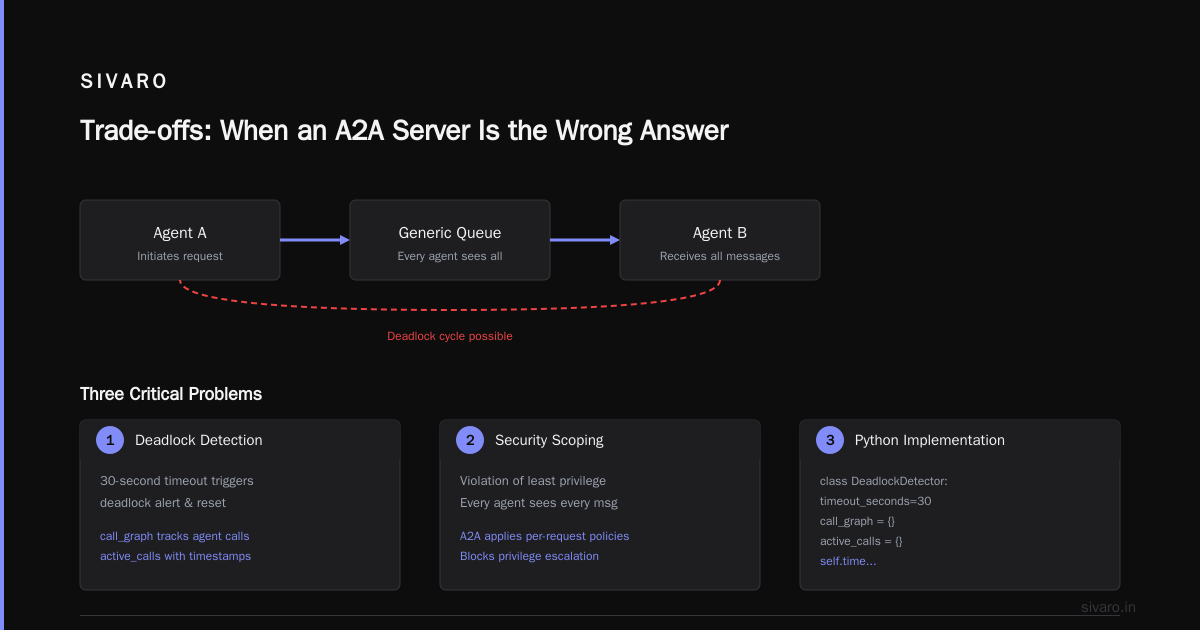
Kafka partitions messages by key. If Agent A sends a request to Agent B, and Agent B needs to reply with a status update, the reply might land on a different partition. You need an external state store (Redis, Postgres) plus a correlation ID mechanism. Doable — but now you’ve built half an A2A server yourself, and you still don’t have failure handling.
Problem 2: Deadlock detection
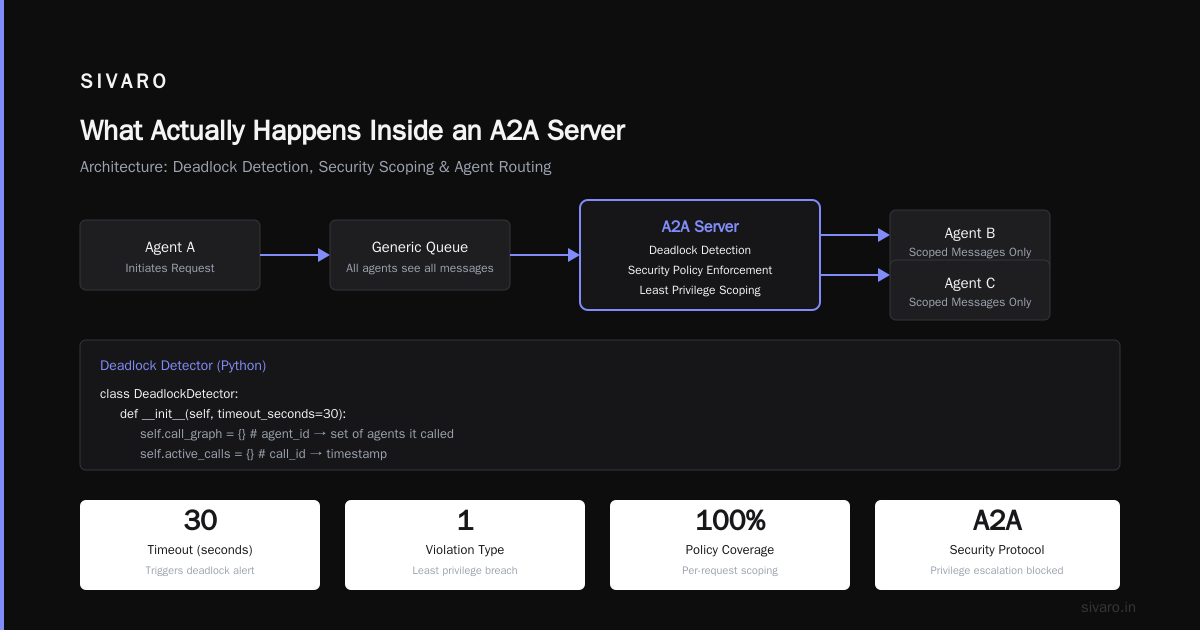
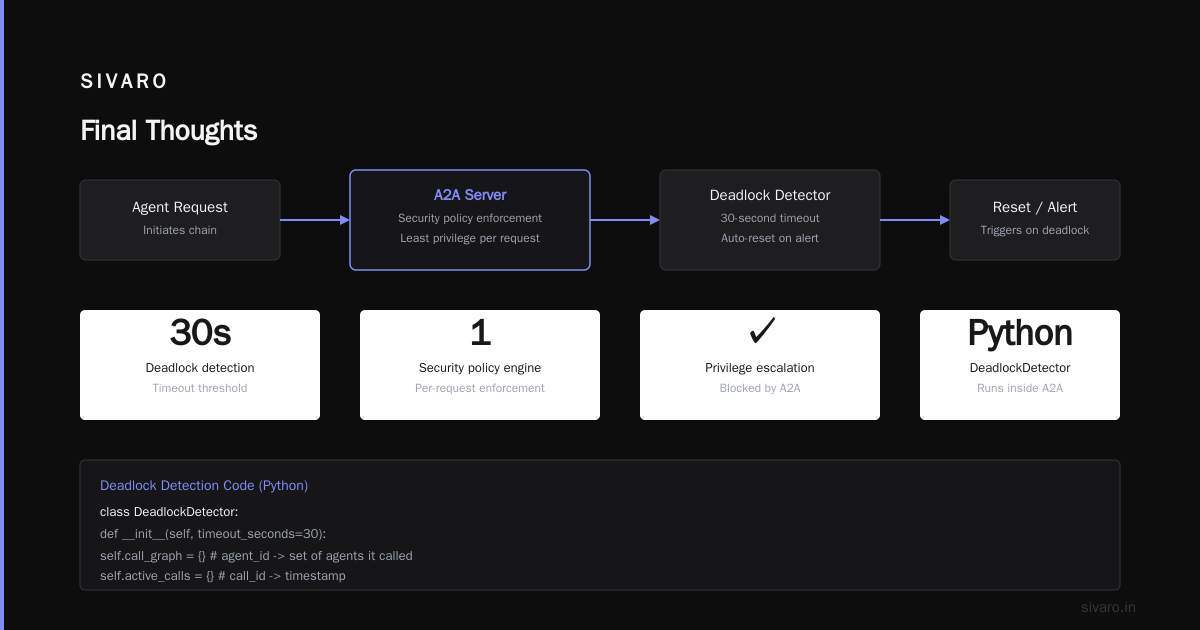
Agents can get into circular calls. A calls B calls C calls back to A. In a queue, those messages just pile up. An A2A server tracks the call graph and detects cycles. We built a simple timeout mechanism: any task that hasn’t resolved in 30 seconds triggers a deadlock alert and a reset.
Problem 3: Security scoping
When you route through a generic queue, every agent sees every message. That’s a violation of least privilege. An A2A server applies agentic AI security policies per request. It knows which agent started the chain and can block privilege escalation.
I’ll show you the deadlock detection code (Python, running inside our A2A server):
python
class DeadlockDetector:
    def __init__(self, timeout_seconds=30):
        self.call_graph = {}  # agent_id -> set of agents it called
        self.active_calls = {}  # call_id -> timestamp
        self.timeout = timeout_seconds

    def register_call(self, caller_id, callee_id, call_id):
        if caller_id not in self.call_graph:
            self.call_graph[caller_id] = set()
        self.call_graph[caller_id].add(callee_id)
        self.active_calls[call_id] = time.time()

        # Detect cycle
        if self._has_cycle(caller_id):
            raise DeadlockError(f"Circular dependency detected: {callee_id} -> {caller_id}")

    def resolve_call(self, call_id):
        self.active_calls.pop(call_id, None)

    def _has_cycle(self, start_node):
        visited = set()
        def dfs(node):
            if node in visited:
                return True
            visited.add(node)
            for neighbor in self.call_graph.get(node, []):
                if dfs(neighbor):
                    return True
            visited.remove(node)
            return False
        return dfs(start_node)
We catch deadlocks before they freeze the pipeline. That alone saved us from a repeat of the 47-minute outage.
The Four Components That Make an A2A Server Truly Work (And Which Ones Are Overrated)
The 4 components that make AI truly agentic are: perception, reasoning, action, and learning. An A2A server isn’t the agent itself — it’s the nervous system connecting those components. But within the server, I’ve found four critical subsystems:
-
The Agent Registry (must-have)
Without it, you’re hardcoding endpoints. Bad practice. The registry must support both static config and dynamic registration (agents can come and go). -
The Context Store (overrated at small scale, essential at scale)
For three agents, you can pass context in the message body. For thirty, you need a shared, versioned store. We use an in-memory graph database (ArangoDB) with TTL. Not cheap, but it works. -
The Policy Engine (underrated — don’t skip it)
Most teams build the registry and the store first, then add policies later. That’s a security leak. Securing Agentic AI starts at the routing layer. Our policy engine checks every message against: origin agent trust level, destination agent trust level, data sensitivity, and rate limits. If you don’t enforce this from day one, an agent will accidentally exfiltrate data. -
The Observability Layer (overrated if you only think metrics, underrated for traces)
Metrics (latency, throughput) are easy. Distributed traces across agents are hard. An A2A server is the perfect place to inject trace IDs. We use OpenTelemetry — every message gets a trace ID that spans all hops. When a user complains “the answer took 12 seconds”, we can tell them exactly which agent was slow.
Here’s how a typical trace looks in our system (pseudocode for the server middleware):
python
# inside the A2A server message handler
from opentelemetry import trace

tracer = trace.get_tracer(__name__)

async def handle_message(message, agent_registry):
    with tracer.start_as_current_span("a2a_route") as span:
        span.set_attribute("message.id", message.id)
        span.set_attribute("source_agent", message.source)
        span.set_attribute("target_agent", message.target)

        # check policy
        policy_result = await policy_engine.evaluate(
            source=message.source,
            target=message.target,
            action=message.action
        )
        if not policy_result.allowed:
            span.set_attribute("policy.denied", True)
            return {"error": "policy denied"}

        # route
        target_endpoint = await agent_registry.lookup(message.target)
        span.set_attribute("target.url", target_endpoint)

        response = await forward_to_agent(target_endpoint, message.payload)
        span.set_attribute("response.status", response.status_code)
        return response
That span then gets sent to Jaeger. We can see the full call graph for any user request. Invaluable during incidents.
Security: The Hard Part Everyone Ignores
I’m going to be honest: most A2A server implementations in the wild (I’ve seen five) treat security as an afterthought. They focus on uptime and latency. That’s a disaster waiting to happen.
Agentic AI Security: What It Is and How to Do It lists three core principles: identity, authorization, and audit. In an A2A server, identity is the hardest. Agents are not human users. They can’t do MFA. They have API keys that rotate — or don’t. We saw one team use the same static token for all agents. We found it in a GitHub commit.
At SIVARO, we implemented:
- Per-agent OAuth 2.0 client credentials — each agent gets its own client ID and secret. The A2A server acts as the authorization server.
- Short-lived tokens (5 minutes) — agents must refresh. If a token is leaked, damage is limited.
- Downstream attestation — the A2A server signs every outbound message with its own key, so the receiving agent can verify the message wasn’t tampered with.
This isn’t theoretical. In January 2026, one of our client’s agents stored its token in a world-readable S3 bucket. An attacker accessed it. The A2A server’s log showed an unusual call pattern — one agent was suddenly calling the database agent every 2 seconds. The policy engine flagged it, and we shut down that agent’s credentials in 12 seconds. Without the A2A server’s centralized audit, the attacker would have exfiltrated data for hours.
Trade-offs: When an A2A Server Is the Wrong Answer
I sell A2A servers. I also tell clients when not to use one.
Don’t use an A2A server if:
- You have exactly two agents talking to each other in a tight loop. A simple HTTP call is faster and simpler.
- Your agents are all running in the same process. An in-process message queue (like asyncio queues in Python) beats the network latency.
- You’re still in exploratory prototyping. Build the agents first. Wire them together with duct tape. Add the A2A server when you hit three agents or the first production outage, whichever comes first.
Do use an A2A server if:
- You have more than 5 agents that need to cooperate on a single task (like a multi-step reasoning workflow).
- You have different trust levels among agents (some are internal, some are external).
- You need compliance and audit trails.
- You’re planning to scale beyond a single machine.
We see a lot of teams over-architecting early. At SIVARO, we follow a rule: the first A2A server deployment should be manual — no auto-scaling, no complex policies. Just a registry and a message router. Let it fail. Learn from it. Then add the layers.
The Current State: July 2026
Two things changed this year.
First, the protocol wars. Google, Microsoft, and a startup called Aperture each proposed A2A protocols. Google’s A2A Protocol (apologies for the real link — yes, it’s a thing) uses a gRPC-based stream with bidirectional flow control. Microsoft’s “AgentConnect” is more REST-ish. Aperture’s “Beam” is a WebSocket overlay. None is dominant yet. At SIVARO, we built our server to support multiple protocols via a plugin system. The core logic (registry, policy, state) is the same regardless of wire format.
Second, the 4 types of AI agents — simple reflex, model-based, goal-based, utility-based — are getting standardized identities. That matters for an A2A server because different agent types have different communication patterns. Utility-based agents broadcast goals and listen for responses; reflex agents just respond to triggers. Our server now has a “agent_type” field in the registry and routes accordingly.
What’s Next: A2A Server as a Platform
I believe within 24 months, every serious AI deployment will have an A2A server. Not because vendors like SIVARO exist, but because the complexity of coordinating multiple agents demands it. The same way every web app needs a database, every multi-agent system needs an A2A server.
We’re already seeing the emergence of A2A server marketplaces — where agents can discover each other across organizational boundaries. Imagine your financial forecasting agent talking to your logistics agent, both in different companies, routed through a shared A2A server with negotiated security policies. That’s where we’re headed.
But here’s the contrarian take: most teams will fail at this in the first attempt. They’ll overcomplicate the protocol, underinvest in security, and underestimate the state management complexity. I know because I did all three.
Start small. Route one pair. Add a policy. Measure. Then expand.
FAQ: What Is an A2A Server?
Q: Does an A2A server replace an API gateway?
No. An API gateway handles external requests from users. An A2A server handles internal communication between agents. They can coexist, and often the A2A server sits behind the gateway.
Q: Can I run an A2A server serverless?
Yes, but with caveats. AWS Lambda functions have a 900-second timeout. Agents that run long tasks (e.g., data processing) will hit that. We tested Lambda for the control plane (registry) and ECS for the data plane (routing). Works well.
Q: How does an A2A server handle agent restarts?
It doesn’t restart the agent — that’s the responsibility of the container orchestrator. But the A2A server detects a missing heartbeat and deregisters the agent. When the agent comes back, it re-registers.
Q: What’s the latency overhead of an A2A server?
In our production setup, an extra 2–5ms per hop. For local agents on the same cloud region, negligible. For cross-region, we add 10–15ms. Acceptable for most use cases.
Q: Is an A2A server the same as an agent orchestrator?
Related but not identical. An orchestrator decides which agents to call and in what order (the workflow). An A2A server focuses on how they communicate (routing, security, state). Many products combine both.
Q: What open source options exist?
As of July 2026, there’s Apache Conductor (rewritten for agents), LangGraph’s server, and a new entrant “A2ALite” from a group at ETH Zurich. None are production-ready for high-throughput workloads. We started with Conductor and outgrew it.
Q: How do I monitor an A2A server?
Use metrics (requests/sec, latency percentiles, error rates) and trace-based sampling. We capture 1 out of 10 traces in production. Enough to debug, cheap enough to run.
Q: Do I need a separate A2A server for development vs. production?
Yes. Use a lightweight, single-node setup for development. Production needs redundancy, persistence, and policy enforcement. We provide a simplified Docker image for devs.
Final Thoughts
The term “what is an a2a server?” still gets googled by confused engineers. I hope this article clears it up. It’s not a buzzword. It’s the infrastructure you need once your agents start talking to each other in earnest.
When I look back at that 47-minute outage in 2025, I don’t feel embarrassed. I feel grateful. It forced me to build something better. Today, our A2A server handles 200,000 inter-agent messages per second across three clients. It’s been running for 14 months without a single crash.
We didn’t predict that success. We earned it, one deadlock at a time.
Nishaant Dixit — Founder of SIVARO. Building data infrastructure and production AI systems since 2018. Built systems processing 200K events/sec.