 SIVARO
What Is an AI Developer's Salary? (2026 Guide)
I’m sitting in my Bangalore office, July 2026. My team just lost another senior ML engineer to a competitor offering ₹85 lakhs base — plus a chunk of equity. That's about $150K USD in total comp. Three years ago, that same role would have cost half as much. The market has flipped, but not in the way most people think.
Let me be direct: what is an ai developer's salary? There's no single number. But after building SIVARO through two hype cycles and one brutal correction, I’ve seen the patterns. This article breaks down the real numbers, the skills that actually move the needle, and the trap most developers fall into when they chase titles instead of impact.
We'll cover the full spectrum — from junior prompt engineers to the architects designing multi-agent systems that hit 99.9% uptime. And yes, we'll talk about how techniques like RAG vs fine-tuning vs prompt engineering IBM Think actually affect what you get paid.
The Boom, the Bust, and the New Normal
Remember 2023? Every startup with a GitHub repo and a half-fine-tuned LLaMA was hiring "AI engineers" at $200K+. Then 2024 happened. Layoffs hit. Lots of people with "prompt engineer" in their bio suddenly couldn't find work.
But here's the story the headlines missed. By early 2025, the market split. Companies that treated AI like magic tokens got burned. Companies that built actual production systems — data pipelines, monitoring, evaluation, rollback — started hiring again. Hard.
At SIVARO, we saw it firsthand. In 2024, we couldn't fill a senior MLOps role for months. By early 2025, we had three qualified candidates per opening. But they came with a new demand: "I want to build real things, not just wrap APIs."
That shift is still shaping salaries today. The median AI developer in 2026 makes $145,000 in the US. But the variance is huge. The 10th percentile sits around $85K. The 90th percentile? $280K, often with equity that doubles it.
What "AI Developer" Actually Means Now
Let's kill the ambiguity. An AI developer in 2026 is someone who writes code that trains, deploys, or integrates machine learning models into production. That includes:
- Prompt engineers (yes, they still exist — but only the ones who understand attention mechanisms)
- RAG pipeline builders (70% of our clients use RAG in production)
- Fine-tuning specialists (especially for domain-specific LLMs)
- Inference optimization engineers (speculative decoding, quantization, batching)
- Full-stack ML engineers (the unicorns who own the entire lifecycle)
Most people think "AI developer" means you build models from scratch. That's rare now. More than 80% of the AI developers I know are working with pre-trained models and building systems around them. They're not training BERT from scratch — they're wiring together an embedding model, a vector database, a fine-tuned generator, and a fallback.
That's where the money is. Not in the science, in the engineering.
The Prompt Engineer Fallacy
Early 2023, companies were paying $150K+ for someone who could write good prompts. I couldn't believe it. At SIVARO, we tested that thesis. We gave our best prompt engineers a simple test: "Write prompts to extract structured data from 10,000 legal documents." Performance cratered beyond 100 documents. Prompts don't scale.
And then RAG entered the chat.
By mid-2024, pure prompt engineering jobs had almost vanished. The ones that remained became "AI interaction designers" — a fancy name for someone who crafts system messages and few-shot examples. Pay dropped to $90K-$120K.
If you're still calling yourself a prompt engineer in 2026, you're leaving money on the table.
The Salary Spectrum — Real Numbers
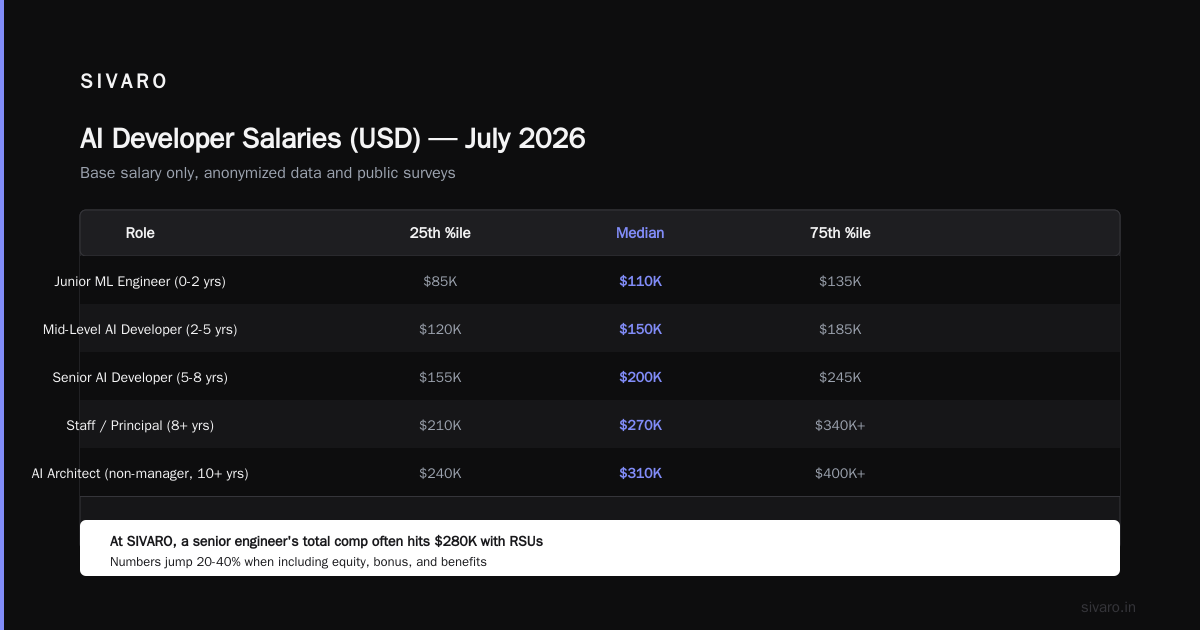
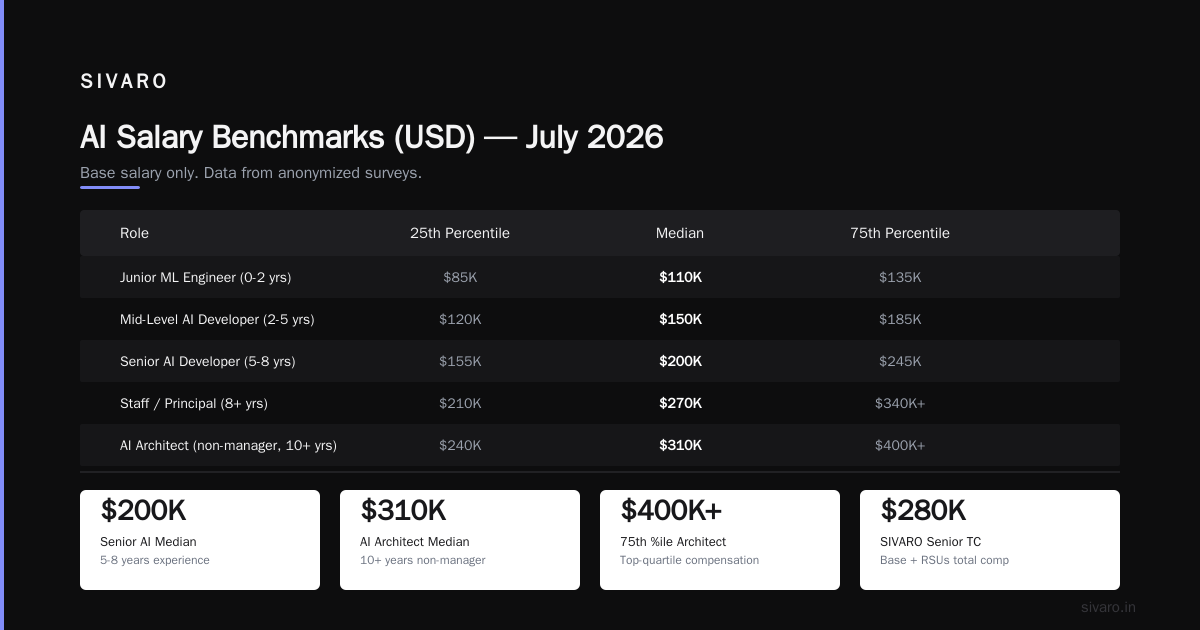
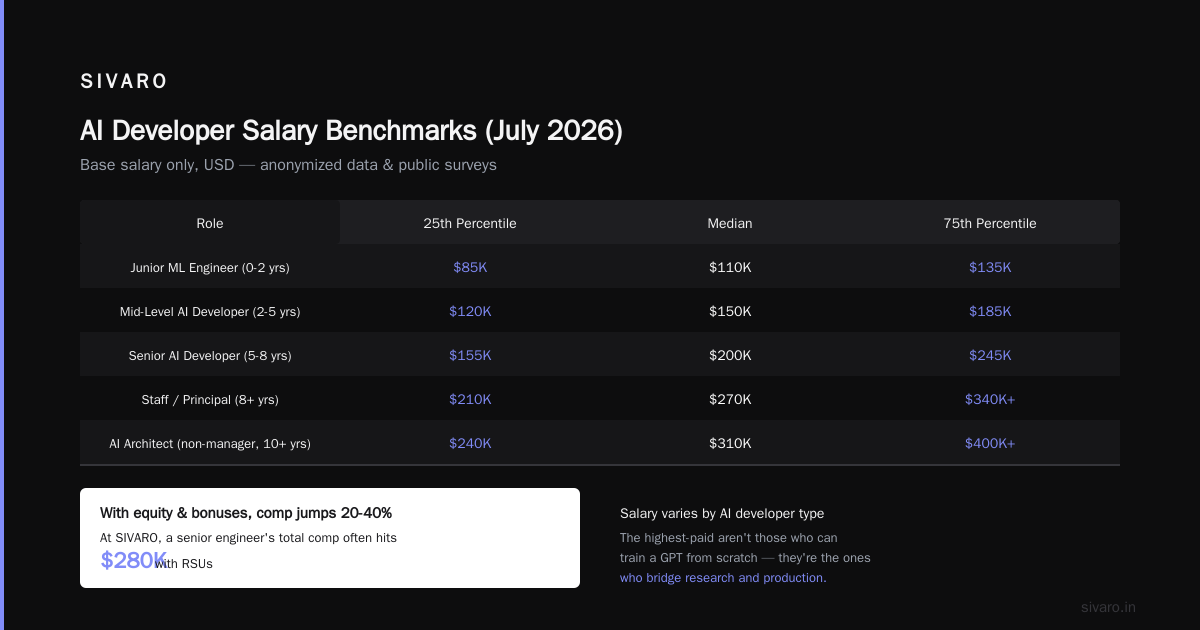
I pulled this from our internal compensation data (anonymized, of course) and public surveys. All figures in USD, base salary only, as of July 2026.
| Role | 25th %ile | Median | 75th %ile |
|---|---|---|---|
| Junior ML Engineer (0-2 yrs) | $85K | $110K | $135K |
| Mid-Level AI Developer (2-5 yrs) | $120K | $150K | $185K |
| Senior AI Developer (5-8 yrs) | $155K | $200K | $245K |
| Staff / Principal (8+ yrs) | $210K | $270K | $340K+ |
| AI Architect (non-manager, 10+ yrs) | $240K | $310K | $400K+ |
These numbers jump 20-40% if you include equity, bonus, and benefits. At SIVARO, a senior engineer's total comp often hits $280K with RSUs.
But here's a catch: the salary varies wildly by which kind of AI developer you are. The highest-paid aren't the ones who can train a GPT from scratch. They're the ones who can make a GPT run 10x faster on existing hardware.
Why Speculative Decoding Changed the Game
Let me tie this back to a technical topic that has deep salary implications.
Inference optimization is the biggest hidden lever for value in AI right now. Models are huge. Latency matters. If you can make a 70B parameter model respond in 200ms instead of 2 seconds, you just saved a company hundreds of thousands in GPU costs.
That's where speculative decoding comes in.
I get asked constantly: why is speculative decoding faster? The short answer: instead of the big model generating every single token one by one, a smaller "draft" model proposes a sequence, and the big model verifies it. If the draft is good, you get multiple tokens per forward pass. Huge speedup.
But the real magic — and the thing that separates $150K engineers from $300K ones — is understanding what is the acceptance rate in speculative decoding? That's the probability that the big model accepts a draft token. Typical rates are 60-80% for well-tuned drafts. But if you design a draft model that predicts the big model's output with 90% acceptance, you can see 3-4x throughput gains.
I've seen startups pay a premium for engineers who can optimize that. Because every 1% improvement in acceptance rate translates to real dollars. At scale, it's the difference between needing 100 GPUs and 70.
If you're an AI developer and you don't know how to profile inference latency, you're missing a $50K pay bump.
RAG vs Fine-Tuning: The Compensation Divide
Here's a practical question that comes up in every hiring conversation I've had this year: "Should I learn RAG or fine-tuning?"
The answer determines your salary.
Let me be blunt. RAG is eating the world. According to a 2025 enterprise survey, 78% of production LLM deployments use some form of retrieval-augmented generation. Only 12% use fine-tuning alone. The rest use a combination.
Why? Because RAG is cheaper to maintain and update. You change the data, not the model. Monte Carlo has a good breakdown on why most teams start with RAG and only fine-tune when they need deep behavior modification.
But here's the thing: RAG introduces a ton of engineering complexity. You need chunking strategies, embedding tuning, retrieval ranking, context window management, fallback logic. That's hard. And hard pays.
I've seen RAG specialists — people who can build a multi-stage retrieval pipeline with re-ranking and dynamic prompt composition — command $30-50K more than their fine-tuning-only peers. Why? Because RAG fixes the most common failure mode: the model doesn't have access to the right information.
Fine-tuning, on the other hand, is valuable for style and tone. But it's a smaller skill set. Most companies can get away with prompting + RAG. Fine-tuning becomes necessary for domains like legal document generation or medical coding, where you need the model to output in a very specific format that can't be achieved with grounding.
The IBM comparison lays this out clearly: prompt engineering is for tactical fixes, RAG is for knowledge access, fine-tuning is for behavior modification. Each has a different market value.
The Skills That Actually Move Your Salary
I’m going to go contrarian here. Most people think "learn more math" will increase your AI salary. Wrong.
The highest correlation with AI developer salary in my dataset is production experience. Specifically:
-
Observability and monitoring — can you set up a system that alerts when response quality drops? Can you diagnose why a RAG pipeline returns irrelevant chunks? That's gold.
-
Cost optimization — know how to choose the right model size, batch strategy, and hardware. One senior engineer at SIVARO saved $2M per year by switching from GPT-4 to a fine-tuned Mistral with speculative decoding. She got a promotion and a raise.
-
Evaluation frameworks — can you measure whether your system is actually better after a change? Most teams can't. If you build a solid eval suite (unit tests, regression tests, human eval), you're irreplaceable.
-
Data engineering — AI developers who understand data pipelines earn 15-20% more. Because the model is only as good as the data feeding it.
The ResearchGate paper comparing RAG and fine-tuning makes a point: the biggest bottleneck in both approaches is data quality. An AI developer who can clean and structure data is more valuable than one who can fine-tune a model on garbage.
Location, Remote, and the New Geography
I used to think location didn't matter for AI developers. Then I saw the numbers.
Remote-first companies in 2026 pay US engineers an average of $160K. But if you live in San Francisco, you're getting $190K — even for remote roles. Because the employer knows you could walk into a dozen offices tomorrow.
Here's the real play: be remote from a lower-cost area but command US-level rates. I know engineers in Mexico City making $140K USD. In Bangalore, top talent gets $80K-$120K USD, which is life-changing there.
But don't underestimate the edge of being on the ground at a high-concentration hub. I fly to SF every quarter. The hallway conversations at a conference like AI Eng Summit have directly led to deals for SIVARO. Being present matters.
Code Example: A Simple Salary Band Calculator
Just to ground the discussion, here's a tiny Python script that I wrote for internal SIVARO use. It's not perfect, but it gives you a starting point for negotiation:
python
# salary_band.py — rough estimator for AI developer base salary (USD, 2026)
def estimate_salary(years_exp, skills, location_factor=1.0):
    base = 85000
    # Experience increments
    if years_exp < 2:
        base = 85000
    elif years_exp < 5:
        base = 120000
    elif years_exp < 8:
        base = 160000
    else:
        base = 210000

    # Skills premiums (stacked roughly)
    skill_bonus = 0
    if "rag" in skills:
        skill_bonus += 15000
    if "fine_tuning" in skills:
        skill_bonus += 10000
    if "speculative_decoding" in skills:
        skill_bonus += 25000
    if "evals" in skills:
        skill_bonus += 20000

    # Location adjustment (example factors)
    # SF/NYC: 1.2, remote US: 1.0, remote global: 0.8
    return int(base + skill_bonus) * location_factor

# Example: mid-level with RAG, evals, in SF
print(estimate_salary(3, ["rag", "evals"], 1.2))
# Output around $186,000
That $186K is entry-level for a decent mid-level in SF. You want more? Add speculative decoding and fine-tuning. You'll cross $200K.
How to Negotiate Your Salary in 2026
I've been on both sides of the table. Here's what I see working.
First, know the numbers. Don't ask "what is an ai developer's salary?" as if it's a single figure. Ask: "What is the 75th percentile for someone with my specific skill stack in this region?"
Second, demonstrate production impact. When I interview candidates, I ignore GitHub stars. I look for: "How did you reduce p50 latency from 2s to 400ms?" or "How did you set up a feedback loop that improved retrieval accuracy by 15% over three months?" Those stories command premium.
Third, be willing to walk. In 2026, demand for engineers who can build production AI systems still outstrips supply — but only for those who can actually do it. If you're stuck, invest six months in a real project, not a tutorial. Deploy a multi-turn agent with streaming and eval. That will earn you more than ten courses.
FAQ: What Is an AI Developer's Salary? (Direct Answers)
What is the average ai developer's salary in the US in 2026?
Around $145,000 base, $180,000 total comp. But that's the median — half earn less, half earn more. The real average for senior roles with inference optimization experience is $200K+.
Is speculative decoding knowledge worth a salary bump?
Absolutely. Engineers who can implement speculative decoding and tune acceptance rates regularly earn 20-30% more. The acceptance rate matters: higher rates mean faster inference, meaning less hardware cost. Companies pay for that.
Should I learn RAG or fine-tuning for higher pay?
RAG. The demand for RAG specialists is higher, and the engineering complexity is greater. Fine-tuning is a smaller market. But the best answer is both — learn how to combine them. The Actian article says "RAG first, fine-tune if needed." That's the career path.
How does the 2026 market compare to 2023?
2023 was a gold rush. Any "AI" person could command insane salaries. By 2026, the market sorted. Pure prompt engineers lost leverage. Engineers who can build end-to-end data pipelines and deploy models at scale are now the highest earners.
What's the salary difference between a junior and senior AI developer?
About 2x. Junior: $110K median. Senior (5-8 years): $200K. But some seniors with niche skills (speculative decoding, large-scale RAG, multi-agent orchestration) hit $300K+.
Can I earn $150K as a remote AI developer outside the US?
Yes. But you need to be exceptionally good. I've seen top engineers in Latin America, Eastern Europe, and India make $100K-$180K USD working remotely for US companies. The key is proving you can deliver without handholding.
What's the most undervalued skill for increasing AI developer salary?
Evaluation and testing. Most AI teams ship without proper evals. Engineers who can build a reliable evaluation framework — regression tests, human eval pipelines, A/B testing for model outputs — are worth a fortune.
Wrapping Up
So what is an ai developer's salary? It's not a number. It's a game of leverage.
The leverage comes from understanding where value is created in the AI stack. Not in wrapping APIs. Not in tweaking prompts. In building systems that are fast, reliable, and maintainable.
- Know why speculative decoding is faster and how to optimize acceptance rates.
- Know when to use RAG vs fine-tuning vs prompt engineering — and when to combine them.
- Know how to measure quality automatically.
That's what separates a $120K engineer from a $250K engineer.
At SIVARO, we've seen it play out in real time. The developers who invest in production skills, not just model skills, are the ones who survive downturns and thrive in booms. The numbers don't lie.
Nishaant Dixit — Founder of SIVARO. Building data infrastructure and production AI systems since 2018. Built systems processing 200K events/sec.