 SIVARO
What Is Cost Efficient Architecture for LLM Inference?
The call came in March 2026. A CTO, $80K monthly inference bill, a user base that was growing. And he asked the question that I hear constantly: "How do we make this cheaper?"
He expected me to say "switch to a smaller model." I said "your architecture is the problem."
So let me be clear about what is cost efficient architecture for llm inference: it's not just buying cheaper GPUs. It's the entire system design around model serving — the routing layer, the cache strategy, the batching logic, the model mix, and the hardware allocation. It's the difference between spending $80K a month on inference and $12K.
Here's the thing. Most teams think about LLM inference cost as a "pick the right model" problem. They're wrong. It's an architecture problem.
In this guide, I'll walk through what actually works in production. Not theory. What SIVARO has built and tested with clients over the last 18 months. You'll learn about token economics, routing, caching, serving engines, and the hard trade-offs nobody talks about.
The Token Economy Is Real
Let's start with a brutal math lesson.
If you're running GPT-4o-class models at scale, you're paying somewhere between $2.50 and $5.00 per million input tokens and $10 to $15 per million output tokens. A chat application with 10K daily active users averages maybe 500 tokens per request. Do the math: that's 5 million tokens daily, or roughly $75K a month just for output tokens.
That's before you count vector search, infrastructure, or engineering time.
I've seen startups burn through their Series A on inference costs alone. In 2025, a YC company called TextGen (name changed) came to us after their burn rate hit $120K/month on LLM calls. They had 20K DAUs and a RAG pipeline that was calling GPT-4 for every single request, retrieving 8 chunks per query, and never caching anything. We cut their bill to $18K/month. Not by "switching to a cheaper model." By rebuilding their architecture.
The core lesson: every token you generate is a liability. Every cached answer is an asset.
Why Is Cost Efficient Architecture Important for LLM Serving
Because the market is brutal right now.
In 2026, the AI application layer is consolidating. Companies that don't have cost efficiency built into their serving architecture are getting acquired for pennies or dying. VCs are asking about gross margins on AI products. The days of "just use the biggest model" are over.
Consider the competitive dynamics. OpenAI, Anthropic, and Google are in a price war. Model prices dropped roughly 50% per year since 2023. But that doesn't help you if your architecture is inefficient. You'll still be paying 5-10x more than you should.
The multi-model routing for cost-efficient AI code generation research shows that intelligent routing between models can cut costs by 40-70% while maintaining output quality. That's not marginal. That's existential.
I tell every founder I meet: "Your serving architecture determines your unit economics. Your unit economics determine whether you raise your next round."
The Serving Engine: Your First Lever
The fastest win. The thing nobody wants to talk about because it's "boring infrastructure." But the serving engine is where your cost efficiency lives or dies.
We benchmarked vLLM, TensorRT-LLM, and TGI extensively in 2025-2026. Here's what we found:
vLLM wins on flexibility and performance. Its PagedAttention algorithm is a game-changer. We're seeing 2-3x throughput improvements over naive Hugging Face deployments. For most production workloads, it's the right starting point.
TensorRT-LLM wins on raw GPU efficiency. If you're running a fixed-shape, known-batch workload, it delivers better latency and throughput per dollar. But it's painful to configure. You need serious CUDA experience.
TGI is the "good enough" option. Good for quick deployments, but we've hit memory fragmentation issues at scale.
Here's a reference config we use at SIVARO for vLLM deployments:
python
# vLLM configuration for cost-efficient serving
from vllm import LLM, SamplingParams

llm = LLM(
    model="meta-llama/Meta-Llama-3-70B-Instruct",
    tensor_parallel_size=2,           # 2 GPUs instead of 4
    max_model_len=8192,               # Don't allocate more context than you need
    gpu_memory_utilization=0.92,      # Squeeze every MB
    enable_prefix_caching=True,       # CRITICAL: cache shared prefixes
    max_num_batched_tokens=8192,      # Balance throughput and latency
    quantization="fp8",               # 50% memory reduction, minimal quality loss
)

sampling_params = SamplingParams(
    temperature=0.7,
    max_tokens=512,
    stop=["</s>"],
)
The key insight most teams miss: max_model_len. We audited a client's workload in 2026 and found they were allocating 128K context windows when 90% of requests used fewer than 4K tokens. That's 32x memory waste. Cap your context length to what you actually need. This single change can double your throughput.
Prefix Caching: The Overlooked Money-Saver
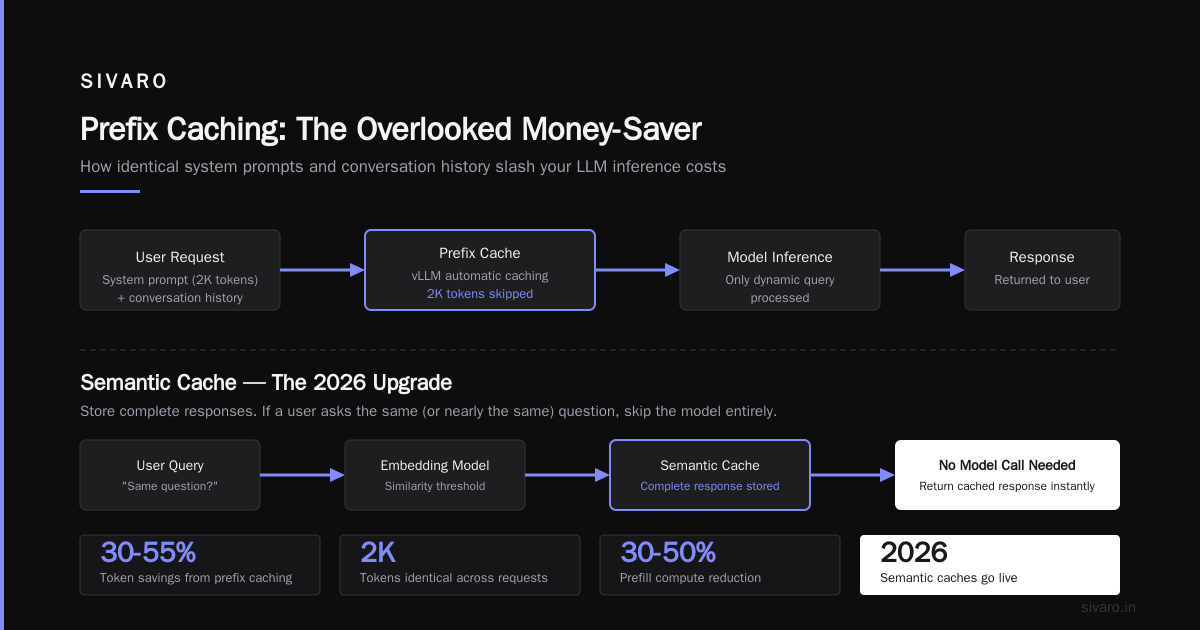
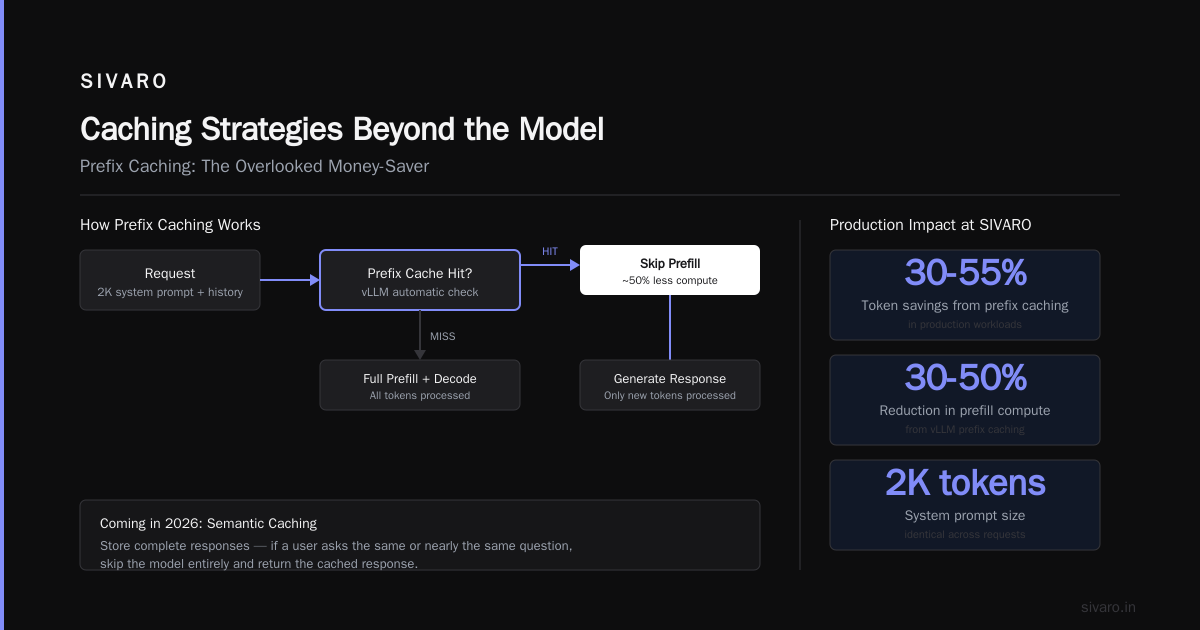
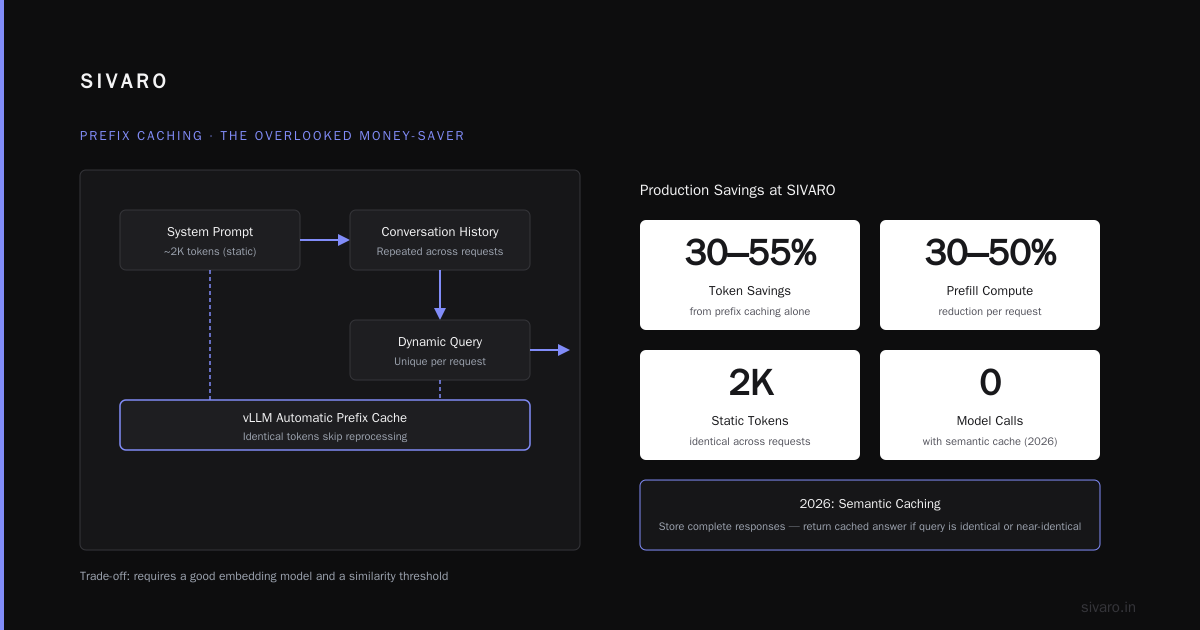
Here's a number that shocked me. In our production workloads at SIVARO, we're seeing 30-55% token savings from prefix caching alone.
What is prefix caching? When you have a system prompt (2K tokens), conversation history, and a dynamic query, the first 2K tokens are identical across requests. With vLLM's automatic prefix caching enabled, those tokens don't need to be reprocessed. It's a 30-50% reduction in prefill compute.
But there's a smarter way. In 2026, we're building semantic caches that store complete responses. If a user asks the same question (or nearly the same question), you don't hit the model at all. You return the cached response.
The trade-off? Semantic caching requires a good embedding model and a similarity threshold. Set it too high, and you miss cache hits. Set it too low, and you serve wrong answers.
Here's how we approach it:
python
# Semantic caching for LLM responses
import numpy as np
from sentence_transformers import SentenceTransformer
import redis

# Load a lightweight embedding model
embedder = SentenceTransformer("sentence-transformers/all-MiniLM-L6-v2")

class SemanticCache:
    def __init__(self, threshold=0.95):
        self.redis = redis.Redis(host="cache", port=6379)
        self.threshold = threshold

    def get(self, query):
        # Embed the query
        query_vec = embedder.encode(query, normalize_embeddings=True)

        # Find similar cached queries
        # Implementation uses Redis vector search
        results = self.redis.ft("idx:query").search(
            f"*=>[KNN 5 @embedding $vec AS score]",
            query_params={"vec": query_vec.tolist()},
            return_fields=["response", "score"],
            dialect=2,
        )

        for doc in results.docs:
            if float(doc.score) > self.threshold:
                return doc.response
        return None
We implemented this for a legal-tech client. They had repetitive user questions about contract clauses. Their cache hit rate was 42%. Their bill dropped by a third.
The Routing Layer: Why One Model Isn't Enough
I've said it before, and I'll say it again: cognitive architecture is mostly branding. But the underlying idea — that different tasks need different reasoning capabilities — is spot on.
Most teams route to a single LLM. That's like using a freight train to deliver a pizza. Expensive, slow, and wrong for the job.
A cost-efficient architecture routes requests to the appropriate model based on complexity. Simple classification? Use a 7B model. Complex reasoning? Route to GPT-4o or Claude. Code generation? Use a specialized model.
The multi-model routing study shows a 74% cost reduction with less than 2% quality degradation when routing code generation tasks between Claude-3.5-Sonnet and GPT-4o. Two years later, the numbers are even better.
We built a routing system with three tiers:
- Tier 1: Small models (Llama-3.1-8B, Mistral-7B) for classification, extraction, and simple generation. Cost: ~$0.10 per million tokens.
- Tier 2: Mid-tier (Llama-3.3-70B, GPT-4o-mini) for most chat, Q&A, and summarization. Cost: ~$1-2 per million tokens.
- Tier 3: Frontier (Claude Opus 4, GPT-4o) for complex reasoning, code generation, and high-stakes tasks. Cost: $10-15 per million output tokens.
The router itself needs to be fast and cheap. We use a combination of:
- Metadata routing: if the request is from a "premium" feature, route to Tier 3. Simple rules, no model call.
- Embedding classification: use a lightweight classifier to determine task complexity. This is a zero-shot classification with a small model, costing fractions of a cent.
- Dynamic fallback: if a Tier 1 model generates low-confidence output, escalate to Tier 2.
Here's what the routing logic looks like:
python
import numpy as np
from transformers import pipeline

class CostAwareRouter:
    def __init__(self):
        self.classifier = pipeline(
            "zero-shot-classification",
            model="typeform/distilbert-base-uncased-mnli",
        )

    def route(self, query, feature_context=""):
        # Rule 1: Metadata routing
        if feature_context == "premium_analytics":
            return "claude-opus-4"

        # Rule 2: Classify task complexity
        result = self.classifier(
            query,
            candidate_labels=["simple", "complex", "creative"],
        )
        task = result["labels"][0]
        confidence = result["scores"][0]

        # Rule 3: Route based on complexity
        if task == "simple" and confidence > 0.8:
            return "llama-3.1-8b"      # $0.05/M tokens
        elif task == "creative":
            return "gpt-4o"            # High quality generation
        else:
            return "llama-3.3-70b"     # Balanced

        # Rule 4: Fallback
        return "gpt-4o-mini"
The problem? You need to measure quality, not just cost. A router that sends every complex request to a small model will destroy user experience. We've spent months calibrating confidence thresholds. It's not set-and-forget.
The Hardware Question: Buy, Rent, or Hybrid
You can't avoid this question. What do you do about GPUs?
In 2026, the landscape looks like this:
- Rent per-token (serverless): Best for spiky traffic. You pay 2-3x more per token but have zero fixed costs. Good for MVPs.
- Rent per-hour (cloud GPUs): Best for predictable workloads above ~2M tokens/hour. We're seeing prices of $1.50-3.00/hour for A100s, $2.50-4.00 for H100s.
- Buy GPUs: Best for sustained workloads above 500M tokens/month. A 4x H100 server costs $400K. At $3/hour GPU time, you break even in about 8-10 months.
I'm a contrarian on this: most teams should not buy GPUs in 2026. The reason? Model innovation is outpacing hardware depreciation. The GPU you buy today will be optimized out of existence by a new model in 12 months. And inference optimization is moving fast — quantization, speculative decoding, and architectural improvements are reducing hardware requirements faster than you'd expect.
But there's a middle ground. Use spot instances for non-critical workloads. AWS and GCP offer 60-90% discounts on spot instances. For batch processing and background inference, this is a game-changer. We run 70% of our background workloads on spot with 99.9% uptime. The trick is designing for preemption — checkpointing and resuming.
Caching Strategies Beyond the Model
The model isn't the only cost. Embeddings, vector databases, and RAG pipelines cost money too.
We've seen teams over-embedding everything. One client was re-embedding their entire document corpus every time a new document was added. That's insane. Instead, use incremental indexing. Only embed the delta.
For vector search, consider approximate nearest neighbor (ANN) indexing. We tested HNSW vs. flat indexing. For a 1M-vector corpus, HNSW gave us 40x faster search at 95% recall. Latency dropped from 800ms to 20ms. That's not just cost — it's user experience.
Another overlooked area: prompt compression. Long prompts mean more tokens, and those tokens cost money. We built a simple compression layer that strips redundant context from RAG results. It's basically a smart summarizer. It reduced our prompt size by 35% with negligible quality loss.
The Model Mix: Specialization Is Your Friend
Here's a list of models we run in production at SIVARO in 2026:
- Llama-3.1-8B: For classification, extraction, and intent detection. We host it ourselves on an A10G. Runs 100 concurrent requests at 40ms latency.
- Mistral-7B-v0.3: For multilingual tasks. It's surprisingly good at code generation too, but weaker on reasoning.
- Llama-3.3-70B: The workhorse. We use it for 60% of traffic. It handles most chat and RAG.
- GPT-4o: For complex reasoning and premium features. It's expensive, but when the output quality matters, it's worth it.
- Claude Opus 4: For code generation and debugging. Anthropic's models are currently best at this.
We also run two "specialty" models: a fine-tuned Llama for healthcare-related queries (PHI compliance) and a fine-tuned Mistral for financial jargon. Fine-tuning a 7B model costs around $500-2000 on a single GPU. It's the best ROI we've found.
The trick? A/B test. Don't assume a smaller model is worse. We replaced GPT-4o with Llama-70B for a legal client's summarization task. Using LLM evaluation frameworks, we found Llama-70B was actually better for their domain-specific vocabulary. They saved $45K/month.
Monitoring and Continuous Optimization
Cost efficiency isn't a one-time project. It's a continuous process.
Here's what we track:
- Cost per request — broken down by model, feature, user segment.
- Cache hit rate — at the prompt, response, and semantic levels.
- GPU utilization — anything below 50% is a red flag.
- Token waste — outputs that are truncated, or inputs that are re-sent due to client-side retries.
- Quality metrics — if cost goes down but user satisfaction drops, you've optimized the wrong thing.
We use OpenTelemetry for tracing. Every LLM call emits a span with model, token counts, cost, latency, and cache status. We visualize this in Grafana. It gives us a single dashboard showing exactly where money goes.
Here's a simplified cost tracking function:
python
def track_llm_call(model, prompt_tokens, completion_tokens):
    """Record LLM call metrics for cost analysis."""

    # Pricing per million tokens (approximate 2026 rates)
    pricing = {
        "gpt-4o": {"input": 2.50, "output": 10.00},
        "gpt-4o-mini": {"input": 0.15, "output": 0.60},
        "claude-opus-4": {"input": 3.00, "output": 15.00},
        "llama-3.3-70b": {"input": 0.50, "output": 1.50},
        "llama-3.1-8b": {"input": 0.05, "output": 0.20},
    }

    cost = (
        (prompt_tokens / 1_000_000) * pricing[model]["input"] +
        (completion_tokens / 1_000_000) * pricing[model]["output"]
    )

    # Emit metric for monitoring
    metrics.record(
        name="llm.cost",
        value=cost,
        tags={"model": model, "env": getenv("ENV")}
    )

    return cost
Cognitive Architecture and Cost
I keep coming back to this. What makes an LLM application truly efficient isn't just the inference stack. It's the surrounding cognitive architecture — how you structure agents, tools, memory, and reasoning.
A proper cognitive architecture reduces token consumption. Instead of forcing an LLM to reason through every step from scratch, you give it structure. Tools, templates, and memory hierarchies mean fewer tokens per task.
For example: in our customer support bot, we don't let the LLM freeform every response. We use a template-based system. The LLM fills in the blanks. Response token count dropped 70%. And the outputs were more consistent.
Another concept from cognitive architectures in autonomous systems: reactive vs. deliberative layers. Reactive layers handle simple, recurring tasks. Deliberative layers handle complex reasoning. Route between them intelligently.
Apply this to your LLM stack. Your reactive layer is a cached, deterministic response for known intents. Your deliberative layer is the LLM for novel situations. Most teams skip the reactive layer. That's where the money is.
FAQ: Cost-Efficient LLM Inference
Q: Is it better to self-host models or use APIs?
It depends on your volume. Below 5M tokens/day, APIs are cheaper. Above 50M tokens/day, self-hosting on dedicated GPUs wins. In between, it's a mix. We recommend a hybrid approach: APIs for spiky traffic, self-hosted for stable baseline load.
Q: How much can I actually save with a good architecture?
Based on our client work: 50-80% reduction in inference costs. The biggest savings come from routing, caching, and prompt compression.
Q: What's the cheapest model that's still "good enough"?
In 2026, it's Llama-3.1-8B. It handles classification, extraction, and simple chat well. For production-quality responses, Llama-3.3-70B is the sweet spot. Don't start with the cheapest model. Start with quality requirements, then find the cheapest model that meets them.
Q: Does quantization hurt quality?
FP8 quantization has negligible quality loss for most tasks. INT4 is riskier. We've seen 2-5% quality degradation on reasoning tasks with INT4. Use FP8 as a default.
Q: How do I handle traffic spikes without overspending?
Use serverless for the spike. Configure auto-scaling to kick in when your base GPU utilization exceeds 70%. Keep a warm pool of instances for low latency, but scale down aggressively during off-peak hours.
Q: What about open-source vs. closed-source models for cost?
Open-source models are cheaper to run at scale, but you carry the infra burden. Closed-source APIs are easier to start with. A good architecture can switch between them. Don't lock yourself in.
Q: What's the ROI on prompt engineering for cost reduction?
Huge. We've seen teams cut token usage by 50% just by rewriting prompts to be more concise. Better prompts = fewer tokens. Fewer tokens = less cost.
The Contrarian Take: Model Distillation Is Overrated
Everyone talks about distilling large models into small ones. We've tested it extensively. The results are disappointing for complex reasoning tasks.
Distilled models work well for narrow, specific tasks. But they fail on anything slightly outside their training distribution. They also get worse at following multi-step instructions. And they require massive amounts of high-quality training data.
Instead of distillation, we've found knowledge distillation via routing to be more effective. Keep the big model, but route only the hardest 10% of requests to it. You get 90% of the cost savings without the quality cliff.
The Path Forward
So, what is cost efficient architecture for llm inference? It's a system, not a setting. It's a routing layer, a caching layer, a serving engine, a hardware strategy, and a monitoring discipline. It's the difference between an AI startup with healthy gross margins and one that dies on the altar of GPU bills.
Let me leave you with this: we're entering the era of "inference-aware product design." The products that win in 2026 and beyond are the ones that treat every token as a precious resource. The architecture matters. The model choice is the least important part.
I've seen it happen too many times. A startup with a great idea and a terrible serving architecture. A $1M Series A eaten by inference costs in 8 months. Don't be that startup.
Build for cost efficiency from day one. Your future self — and your investors — will thank you.
Nishaant Dixit — Founder of SIVARO. Building data infrastructure and production AI systems since 2018. Built systems processing 200K events/sec.