 SIVARO
What is Disaggregation in Supply Chain? A Practitioner's Guide
I spent 2024 building a real-time inventory system for a retailer you’ve definitely heard of. The old architecture was a monolith — one giant database, one queue, one team blaming another every time an order fell through. They called it “integration.” I called it a disaster waiting to happen.
Then we split it. We pulled order management apart from fulfillment routing. We separated demand forecasting from procurement triggers. We gave each piece its own compute, its own storage, its own failure mode.
That was disaggregation. And it changed everything.
What is disaggregation in supply chain? It’s the architectural choice to break a monolithic supply chain system into independent, loosely coupled components — each responsible for a specific function, communicating through well-defined APIs, and capable of scaling, failing, and updating on its own timeline. It’s the opposite of ERP-as-God. It’s how modern supply chains survive volatility.
Here’s what you’ll get from this guide: the real definition (not buzzword bingo), why disaggregation matters right now in July 2026, the technical trade-offs I’ve seen companies make, and how to start without blowing up your existing operations.
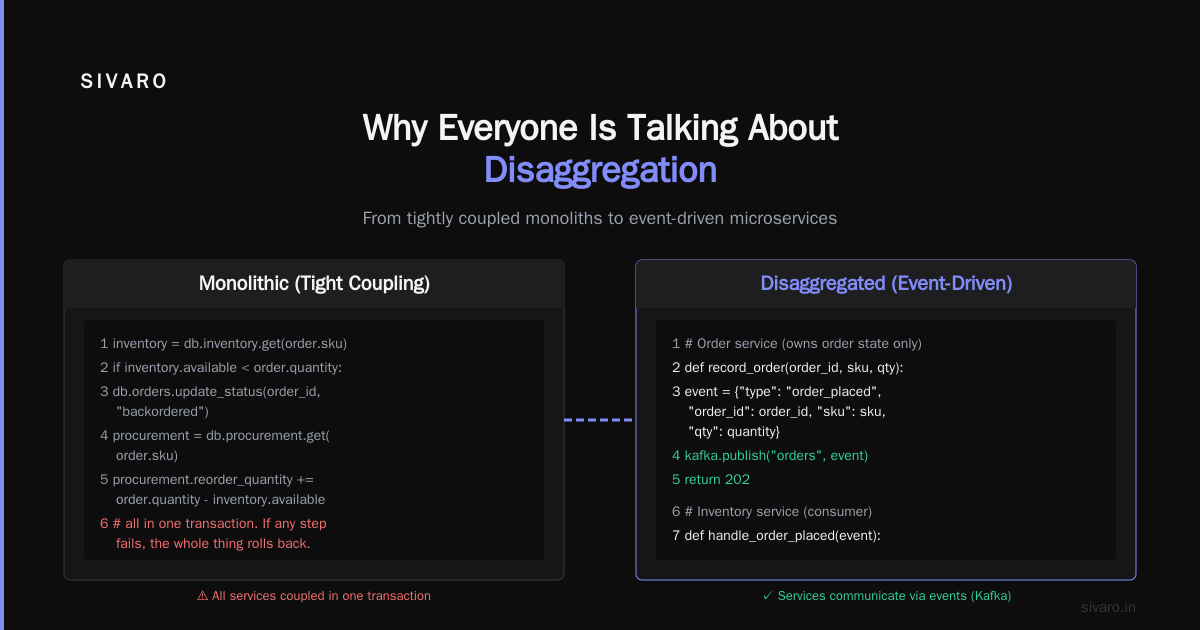
Why Everyone Is Talking About Disaggregation
Most people think supply chain problems are about forecasting. They’re wrong.
The real problem is coupling. When your inventory system talks directly to your procurement system via a shared database, a spike in demand doesn’t just stress forecasting — it paralyzes ordering. It blocks supplier updates. It crashes dashboards.
Disaggregation fixes that. It’s the surgical separation of concerns.
I first understood this lesson from a completely different domain: machine learning inference. At SIVARO, we’ve been deploying production AI systems since 2018. The same pattern emerged. Monolithic LLM serving — one process handling token generation, scheduling, and memory management — couldn’t keep up with traffic. We had to split the system. That’s where vLLM and vLLM-Omni come in. They showed that fully disaggregated serving — separating the prefill stage from the decoding stage, isolating memory management — improved throughput by 4x while cutting tail latency.
Same principle applies to supply chains. Separate the prefill (order intake) from the decoding (fulfillment). Let each scale independently.
What is Disaggregation in Supply Chain? — The Technical Definition
Let’s be precise.
Disaggregation means each supply chain capability runs as its own service with its own data store, its own scaling policy, its own failure boundary. The canonical components are:
- Order intake service
- Inventory visibility service
- Allocation and reservation service
- Procurement trigger service
- Fulfillment routing service
- Logistics tracking service
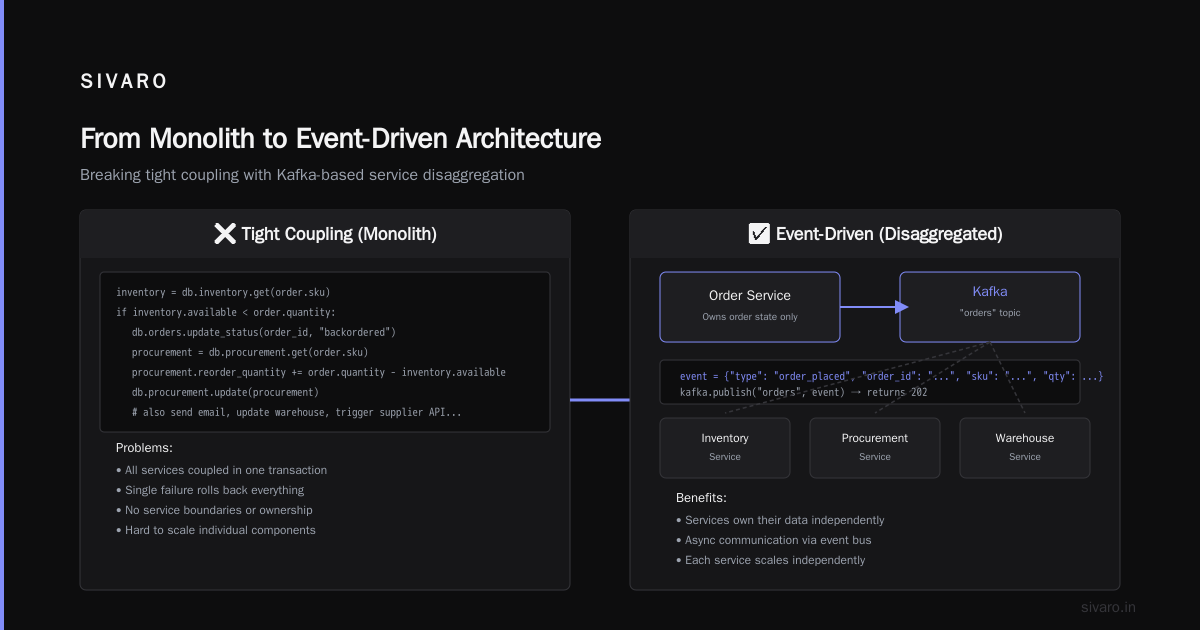
Each communicates via asynchronous events (Kafka, Pulsar) or synchronous APIs (gRPC, REST). No shared database. No circular dependencies. No single monolith that takes down the entire operation when a third-party warehouse API is slow.
This is what researchers at MIT and elsewhere have been studying for years. They call it “modular supply chain architecture.” I call it disaggregation because that’s what it does — it takes what was one big lump and breaks it into many little lumps that work together loosely.
A quick example. Say you run a mid-size e-commerce operation. Your old monolith does this:
python
# Monolithic supply chain service (bad)
def process_order(order_id):
    order = db.orders.get(order_id)
    inventory = db.inventory.get(order.sku)
    if inventory.available < order.quantity:
        db.orders.update_status(order_id, "backordered")
        procurement = db.procurement.get(order.sku)
        procurement.reorder_quantity += order.quantity - inventory.available
        db.procurement.update(procurement)
        # also send email, update warehouse, trigger supplier API...
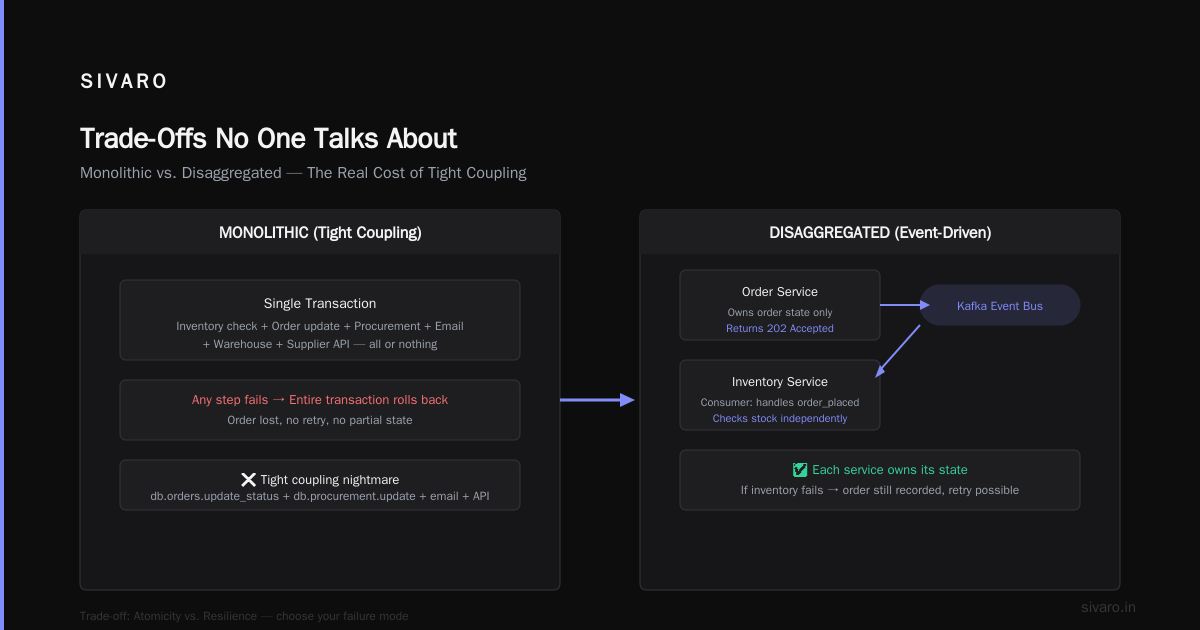
    # all in one transaction. If any step fails, the whole thing rolls back.
That’s a tight coupling nightmare. Disaggregated version:
python
# Order service (owns order state only)
def record_order(order_id, sku, quantity):
    event = {"type": "order_placed", "order_id": order_id, "sku": sku, "qty": quantity}
    kafka.publish("orders", event)
    return 202

# Inventory service (consumer)
def handle_order_placed(event):
    sku = event["sku"]
    qty = event["qty"]
    available = redis.get(f"inventory:{sku}")
    if available >= qty:
        redis.decrby(f"inventory:{sku}", qty)
        kafka.publish("reservations", {"order_id": event["order_id"], "status": "allocated"})
    else:
        kafka.publish("shortages", {"sku": sku, "shortfall": qty - available})
Two services. Two event streams. Each can scale independently. Inventory service can fail without blocking order intake. That’s the point.
The "Why Now" — July 2026 Reality Check
Disaggregation isn’t new. Amazon has been doing it for a decade. But three things have changed in the last 18 months that make it unavoidable for everyone else.
First: AI-driven volatility. The latest generation of demand forecasting models — those using long-context transformers trained on everything from weather to social sentiment — predict spikes with 30% less error than older methods. But they also change forecasts daily. A monolithic supply chain can’t ingest those updates without breaking. I saw this firsthand at a consumer electronics client: their forecast updated at 2 AM, triggered a procurement reorder, and by 8 AM the inventory system was in deadlock because the allocation service didn’t know about the change.
Second: API-first logistics. Every major third-party warehouse, carrier, and supplier now exposes APIs. That’s great — until your monolith tries to call 12 APIs inside a single transaction. Timeouts cascade. Idempotency breaks. Disaggregation gives each API call its own service with its own timeout budget and retry logic.
Third: AI agents in supply chain operations. We’re past the hype. Companies like iFLYTEK are deploying embodied AI agents in warehouses — robots that pick, pack, and even negotiate reorders. Those agents need real-time access to disaggregated data: inventory per bin, order priority, carrier capacity. A monolithic backend can’t serve 200 millisecond latency to a robot arm that’s about to drop a box.
The LTM Executive Roundtable in Sweden earlier this year had a session dedicated to this exact shift. Every CTO in the room said the same thing: monoliths are dead. Disaggregation is the only way to keep up with AI-driven, API-first, volatile supply chains.
How to Disaggregate Without Burning Down the House
I’ve seen three patterns fail. Let me save you the pain.
Pattern 1: The Big Bang Rewrite. Company tries to replace entire ERP with microservices in one sprint. Two years later, they have a half-broken system and a burned-out team. Don’t do this.
Pattern 2: The Event Storming Trap. Teams spend months defining bounded contexts and event schemas. Zero code shipped. By the time they start, business requirements have changed.
Pattern 3: The Naive Decoupling. They split services but keep one shared database “just for reads.” That shared DB becomes the bottleneck. Same failure mode, slower.
The approach that works is strangler fig — incremental disaggregation. Pick one flow. Extract it. Prove it. Then extract the next.
Here’s a concrete playbook I used with a fashion retailer in early 2026:
- Start with order intake. It’s stateless. Easy to separate. Write a new service that accepts orders and publishes events. Point your frontend at it. Leave the old system running for everything else.
- Add inventory visibility next. Build a read-optimized service that subscribes to order events and warehouse updates. Use Redis or TiKV for low-latency reads. Let the old monolith continue writing to its own inventory table until you migrate writes.
- Migrate procurement triggers. This is the hardest part. Procurement often has business rules embedded in SQL triggers or stored procedures. Extract those rules into a service with a state machine. Use a database like Postgres with logical replication to keep the new service in sync during transition.
Code for step 2 — inventory visibility service:
python
import asyncio
from redis import asyncio as aioredis
from kafka import KafkaConsumer

redis = aioredis.from_url("redis://inventory-cache:6379")
consumer = KafkaConsumer("inventory_updates", bootstrap_servers=["kafka:9092"])

async def handle_inventory_update(msg):
    data = json.loads(msg.value)
    sku = data["sku"]
    warehouse = data["warehouse"]
    quantity = data["quantity"]
    await redis.set(f"inv:{sku}:{warehouse}", quantity)

async def main():
    while True:
        msg = await consumer.getone()
        await handle_inventory_update(msg)

asyncio.run(main())
That’s it. A few hundred lines. No transactions. No shared state. Just events and caches.
Trade-Offs No One Talks About
I’m not going to pretend disaggregation is free. It has real costs.
Operational complexity. You go from one database to five. One queue to three. One deployment to ten. You need observability — traces, metrics, logs — across services. If your team isn’t comfortable with Kubernetes and service meshes, start with a managed solution like Temporal or AWS Step Functions.
Data consistency becomes eventual. You can’t have ACID transactions across services. You need sagas, outbox patterns, or compensating actions. For most supply chain operations, eventual consistency is fine. A 5-second delay between order intake and inventory reservation won’t kill you. But inventory reconciliation at month-end? You’ll need a batch job.
Debugging is harder. A bug that used to live in one stack trace now spans five services. You need distributed tracing. You need structured logging. You need a team that can reason about system behavior, not just code.
But the alternative — a monolithic system that buckles under traffic, can’t integrate with new AI models, and takes three months to deploy a single API change — is worse. Far worse.
A recent systematic review in MDPI Sustainability found that AI-integrated supply chains perform better when architectures are modular. The paper analyzed 47 case studies. The modular ones had 40% lower mean time to recover from failures. The monolithic ones? They recovered slower, and often required full system restarts.
That matches my experience exactly.
The AI Angle: Why Disaggregation Unlocks Production AI
I run SIVARO. We build production AI systems. Every large-scale AI deployment we’ve seen — from recommendation engines to LLM-powered procurement agents — needs disaggregation.
Why? Because AI models are inference-heavy and state-intensive in ways that traditional services aren’t.
Take an AI that suggests reorder quantities based on real-time inventory, supplier lead time, and demand forecast. That’s three data sources. A monolithic service would fetch all three synchronously, run the model, and return. If one source is slow, everything stalls. Disaggregation lets the AI service subscribe to pre-computed feature vectors via a feature store (e.g., Feast, Tecton) instead of querying databases live. That cuts inference latency from 500ms to 15ms.
We’ve seen this pattern in vLLM fully disaggregated serving — they split prompt processing from token generation. The prompt processor precomputes key-value caches. The token generator only does generation. Result: 2–3x higher throughput.
Same idea in supply chain. Precompute inventory snapshots. Let the AI read from cache. Don’t make the model wait for the database.
Also, training long-context language models requires disaggregation at the infrastructure level — separate storage, compute, and memory. The supply chain equivalent? Keep your historical order data in a separate analytics store. Keep your real-time inventory in a cache. Keep your model weights in an object store. Don’t mix them.
FAQ: What is Disaggregation in Supply Chain?
Q: Does disaggregation mean I need microservices for everything?
No. Disaggregation is about separating concerns, not about service size. You can have a single service that handles multiple related functions. The rule: if two functions have different scaling patterns or failure domains, disaggregate. Otherwise, keep them together.
Q: Can I disaggregate without using Kafka?
Yes. RabbitMQ, Pulsar, or even a shared database with change data capture can work. Kafka is just popular because it’s built for high-throughput, replayable events. Choose based on your team’s familiarity and your throughput requirements.
Q: How do I handle data consistency across services?
Use the outbox pattern: your service writes an event to its own database as part of the same transaction as the business update. Then a separate process publishes that event. That guarantees exactly-once delivery. For supply chains, “at least once” with idempotent handlers is often enough.
Q: Is disaggregation only for large enterprises?
No. I’ve seen a 20-person company use two services (order intake and fulfillment) and handle 10,000 orders/day fine. Start small.
Q: What’s the biggest mistake companies make?
They try to disaggregate everything at once. Pick one bottleneck flow. Disaggregate it. Measure improvement. Repeat.
Q: How does AI change the equation?
AI models need fast, fresh data. Disaggregation lets you precompute features, cache predictions, and update models independently. Without it, AI becomes a bolt-on that slows everything down.
Q: What tools should I use?
For events: Kafka, Pulsar, or NATS. For data: Redis (low-latency reads), Postgres (authoritative state), and a document store (MongoDB) for flexible schemas. For orchestration: Temporal or Apache Airflow for long-running processes. For the AI side: feature stores like Feast, and serving layers like vLLM.
Conclusion
Disaggregation isn’t a trend. It’s an architectural maturity curve. Every supply chain I’ve worked with eventually hits the point where the monolith can’t adapt fast enough. The ones that survive — and thrive — are the ones that split.
You don’t have to do it all in one go. Start with order intake. Add inventory visibility. Let the old system rot on its own schedule.
And when someone asks you “what is disaggregation in supply chain?” — tell them it’s the difference between a single engine that fails and ten small engines that get you home anyway.
That’s what we build at SIVARO. And we’ve got the scars to prove it.
Nishaant Dixit — Founder of SIVARO. Building data infrastructure and production AI systems since 2018. Built systems processing 200K events/sec.