 SIVARO

What Is Production Reliability? A Practitioner’s Guide
Back in 2021, I was on a call with a CTO who told me his platform had “five nines” reliability. His SLO was 99.999%. The call dropped three times in forty minutes.
That’s when I stopped believing most people when they say “production reliability.”
I’m Nishaant Dixit, founder of SIVARO. We build data infrastructure and production AI systems. Over the last eight years, I’ve seen companies burn millions chasing the wrong definition of reliability. They monitor everything, alert on everything, and still wake up to a P0 at 3 AM that could’ve been avoided.
So what is production reliability?
Here’s the simplest definition I’ve found after years of trial and error: Production reliability is the measurable probability that a system will deliver correct outputs within agreed latency bounds, under expected and unexpected conditions, without requiring human intervention to stay that way.
It’s not uptime. It’s not MTBF. It’s not “my dashboards are green.”
This guide will walk you through what production reliability actually means — and how to build it into your stack. I’ll share what worked at SIVARO, what didn’t, and where I think the industry is heading (especially with AI systems in production).
Let’s get into it.
Production Reliability Isn’t Uptime
I know that headline sounds like a LinkedIn hot take. But I mean it literally.
Uptime measures one thing: is the server responding? Production reliability asks a harder question: is the system doing what the user expects, at the speed they expect, without silently corrupting data?
In 2023, one of our clients — a fintech company processing $40M daily transaction volume — had 99.99% uptime. But their fraud detection model had a silent bias drift that let through 2.3% of fraudulent transactions for three weeks. Nobody noticed because the API kept returning 200 OK.
That’s not reliable. That’s a trap.
Reliability-centered approach to artificial intelligence defines reliability as “the ability to perform a required function under stated conditions for a stated period of time.” Notice the word “function,” not “availability.” A server that returns garbage is not performing its function.
Uptime is necessary. It’s not sufficient.
At SIVARO, we track a metric called “correct response rate” — the fraction of requests where the output passes schema validation, latency SLAs, and business-logic sanity checks. It’s a humbler number than uptime. Usually 10–20% lower. But it tells the truth.
The Three Layers of Production Reliability
When we design systems, we think about reliability at three distinct layers. Each needs different tooling, different metrics, and different teams.
Layer 1: Infrastructure Reliability
This is the hardware, network, and platform layer. Servers don’t crash. Networks don’t partition. Disks don’t silently corrupt.
Most reliability engineering literature stops here. It’s well-understood: redundant hardware, graceful degradation, chaos engineering.
The Role of Artificial Intelligence in Reliability Engineering points out that AI for predictive maintenance at this layer has been around for years. C3.ai’s Reliability application claims to predict equipment failures 7–30 days in advance (Predictive Maintenance Software to Cut Downtime).
Infrastructure reliability is table stakes. If you’re still debating whether to use a load balancer, this article isn’t for you.
Layer 2: Application Reliability
This is the code and data layer. Your application logic, databases, API endpoints, processing pipelines.
At this layer, reliability problems come from:
- Race conditions that only appear under load
- Memory leaks that take days to manifest
- Data corruption from incorrect idempotency logic
- Latency spikes when a downstream dependency degrades
Application reliability is where most teams spend their time. But there’s a subtle trap: you can have perfect application code and still be unreliable. Why? Because the third layer is forgetting you.
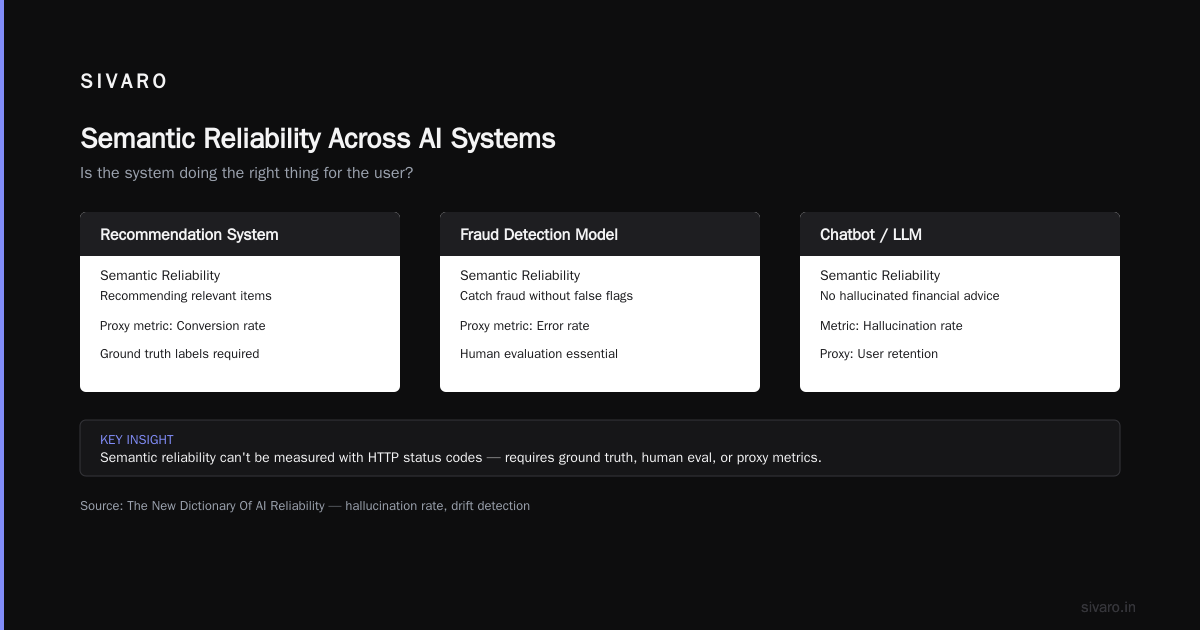
Layer 3: Semantic Reliability
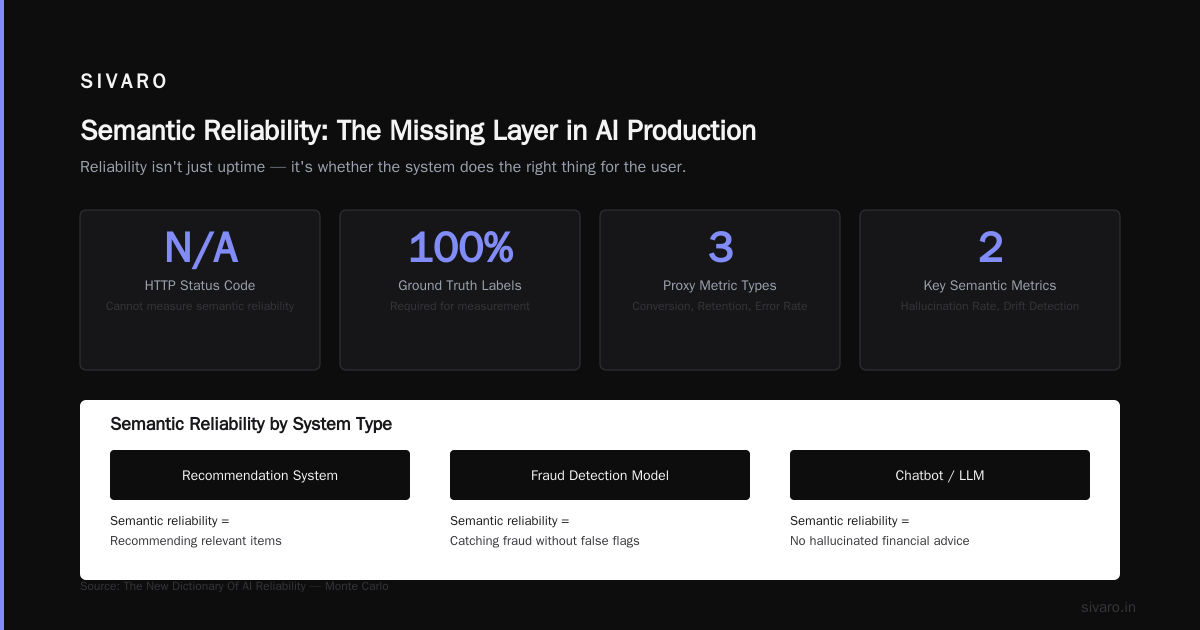
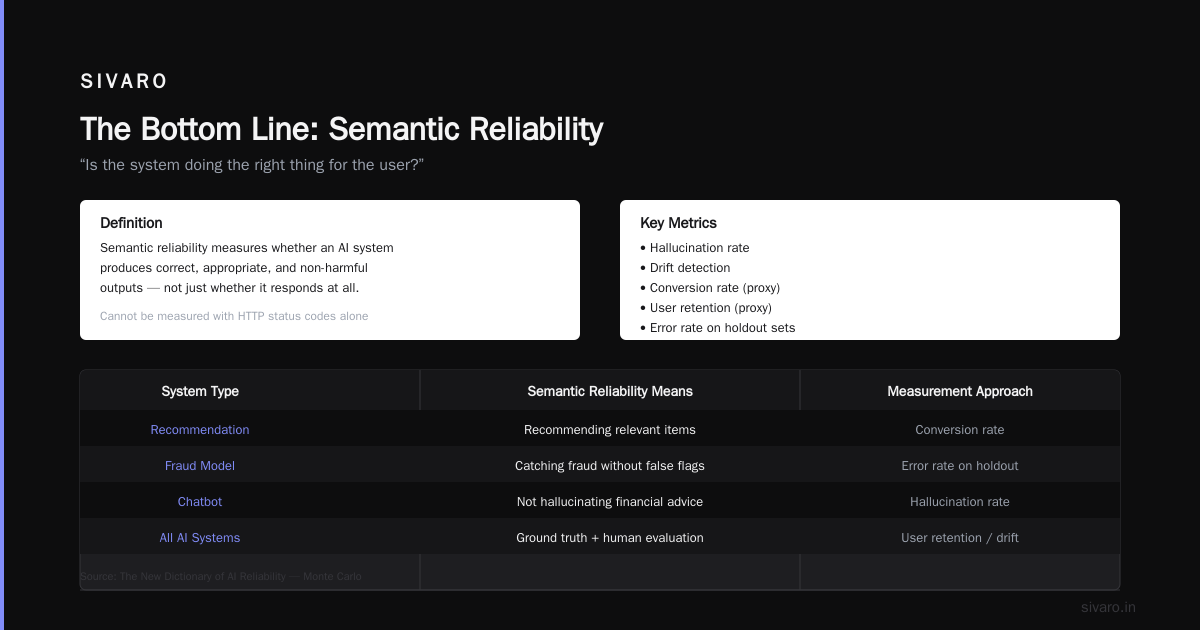
This is the layer I see most teams ignore. Semantic reliability asks: is the system doing the right thing for the user?
For a recommendation system, semantic reliability means recommending relevant items. For a fraud model, it means catching fraud without flagging legitimate transactions. For a chatbot, it means not hallucinating financial advice.
Semantic reliability can’t be measured with HTTP status codes. It requires ground truth labels, human evaluation, or proxy metrics (conversion rate, user retention, error rate on holdout sets).
When people ask “what is production reliability?” for AI systems, this is the layer I point to first.
The New Dictionary Of AI Reliability highlights terms like “hallucination rate” and “drift detection” — these are semantic reliability metrics.
At SIVARO, we’ve found that semantic reliability failures account for 60% of our P0 incidents in AI systems. Infrastructure failures? Less than 15%.
Why Your ML Models Are the Least Reliable Part of Your Stack
Most people think machine learning models are the reliable part. After all, they’re just math. Deterministic (mostly). Testable.
They’re wrong.
In 2024, OpenAI’s GPT-4 API had an uptime of 99.97%. But its hallucination rate on factual queries was around 15–20% depending on the domain. That’s semantic unreliability.
Operational Ai Reliability: Beyond Model Performance Metrics explains it well: “Model performance metrics like F1-score or AUC measure accuracy on a static test set. Production reliability measures what happens when the distribution changes.”
And distribution change is the rule, not the exception.
Here’s a real example from one of our clients, a healthcare startup that used an LLM to summarize patient notes. The model performed beautifully in testing. In production, after two weeks, the hospital updated their EMR system. The note format changed slightly. The LLM started missing key clinical details. No error was thrown. The summaries looked fine. But they were wrong.
The company caught it because we had a “semantic gauge” — a small batch of human-reviewed summaries that ran every hour and reported confidence scores. Without that, they would have shipped unreliable summaries for days.
The lesson: production reliability for AI requires continuous validation of outputs, not just uptime monitoring.
A Guide to AI Agent Reliability for Mission Critical Systems recommends hierarchical validation: check inputs, check model predictions, check final outputs against guardrails. We’ve implemented this pattern at SIVARO. It’s not trivial. It’s necessary.
Observability vs. Monitoring: The Naming That Cost Me Six Months
In 2022, I spent six months building an elaborate monitoring system for one of our data pipelines. Every metric was tracked. Every alert fired. We had dashboards for dashboards.
Then a data corruption bug slipped through. It didn’t affect any metric I was monitoring. The pipeline processed 10 million records. 300,000 of them had silently corrupted timestamps because a source system changed its timezone format.
Monitoring told me everything was fine. Observability would have told me what was happening to the data.
Monitoring answers the question “is the system up?” Observability answers “what is the system doing?”
Production reliability requires observability, especially at the semantic layer.
A practical example: we now log every data transformation as a structured event with before-and-after schemas. We don’t just check the row count — we check the distribution of values. A timestamp distribution that shifts from UTC to EST is a reliability incident.
Here’s a code snippet from our pipeline validation layer:
python
def validate_timestamp_distribution(df: DataFrame, expected_range: Tuple[str, str], tolerance: float = 0.02) -> bool:
    """Check that at least (1-tolerance) of timestamps fall within expected range."""
    min_ts, max_ts = expected_range
    total = df.count()
    in_range = df.filter((df.timestamp >= min_ts) & (df.timestamp <= max_ts)).count()
    ratio = in_range / total
    if ratio < (1 - tolerance):
        raise ReliabilityViolation(f"Timestamp drift detected: {ratio:.1%} in range, expected >={(1-tolerance):.1%}")
    return True
This isn’t monitoring. It’s observability of semantic correctness. And it caught the timezone bug in pre-production.
How We Measure Reliability at SIVARO (and How You Should Too)
I’ll share our current approach. It took us three iterations to get here.
We track four core metrics:
- Correct Response Rate (CRR) – fraction of requests that return correct, validated outputs within latency SLA. Target: ≥99.95%.
- Silent Error Rate (SER) – fraction of requests that return 200 OK but have incorrect data. Target: ≤0.01%. This is the scary one.
- Mean Time to Detection (MTTD) – time between a reliability degradation and its detection by automated systems. Target: <60 seconds.
- Mean Time to Mitigation (MTTM) – time from detection to automated mitigation (no human). Target: <5 minutes.
We don’t track MTBF. It’s useless for modern distributed systems. Failures are not independent events.
How we collect these:
- Every API call goes through an enrichment middleware that stamps request IDs, latency, and a validation hash.
- A background service computes CRR and SER on 1-minute sliding windows.
- When SER exceeds threshold, an automated rollback or model fallback triggers.
Here’s a simplified version of the validation middleware:
python
class ReliabilityEnrichmentMiddleware:
    def __init__(self, validator: Callable, alert_threshold: float = 0.0001):
        self.validator = validator
        self.ser_counter = deque(maxlen=10000)  # last 10K requests

    def __call__(self, request: Request, response: Response):
        if response.status_code == 200:
            is_correct = self.validator(request, response)
            self.ser_counter.append(not is_correct)
            if not is_correct:
                print(f"[WARN] Silent error: req={request.id} endpoint={request.path}")
            # real implementation sends to metrics pipeline
We alert on SER, not just 500s.
The AI Reliability Trap: When Automation Makes Things Worse
I’ve watched teams automate reliability monitoring with AI — then trust it blindly.
Organizational Change & Reliability Engineering AI ... predicts that by 2031, AI will take over most predictive maintenance tasks. I agree. But there’s a risk: automation can mask degradation.
Example: we built an anomaly detection system that flagged unusual latency patterns. It worked well — for three months. Then a gradual memory leak started. The anomaly detection system “learned” the new normal and stopped alerting. The leak grew. Eventually the service crashed.
The fix: we now have two detection systems — one AI-based (adaptive, can detect novel patterns) and one threshold-based (rigid, will never adjust). They vote. If only one triggers, we investigate.
AI and Machine Learning in a Modern Reliability Culture makes a similar point: “AI should augment, not replace, traditional reliability methods.” Hard agree.
The contrarian take: don’t automate everything. Keep at least one dumb, simple, deterministic check on every critical path.
Building a Reliability Culture: Not a Team, a Practice
Many companies hire a “Site Reliability Engineer” and think they’re done. They’re not.
Production reliability is a property of the entire engineering system — code, data, operations, and people. A single SRE team can’t fix a culture that treats reliability as an afterthought.
At SIVARO, we do three things:
-
Post-mortems are mandatory, blameless, and public. Every incident gets a doc with a timestamped timeline, root cause, and action items. We publish them internally. The report headline always states the real root cause — usually “humans didn’t have the right tooling” rather than “human error.”
-
Every new feature includes a “reliability contract.” Before a feature ships, the team writes down what failure modes are acceptable and which are not. For example: “If the recommendation model returns no results, fall back to popularity-based suggestions. This is acceptable. If it returns results that violate content policy, this is not acceptable and triggers a pager.”
-
Chaos engineering is not optional. We run weekly “failure drills” — kill a pod, throttle a service, corrupt a cache. We do it in staging first, then in production during low traffic. The team that owns the service must prove it survives without a human touching a keyboard.
Practical Steps: From Firefighting to Engineering
If you’re reading this and thinking “my team is still firefighting — where do we start?” here’s a concrete plan.
-
Define your reliability metric. Start simple. Pick one: correct response rate, or “time to recover from a bad deploy.” Don’t try to measure everything. One number you trust is worth ten you don’t.
-
Automate detection, not fixing. The fastest way to improve reliability is to know instantly when it degrades. Spend a sprint building semantic validation checks — not more dashboards.
-
Add a fallback for every critical path. For every API, every model inference, every data pipeline — what happens if it fails? If the answer is “we fix it manually,” that’s a reliability bug. The fallback can be a cached result, a simpler model, or a graceful degradation that tells the user “feature temporarily unavailable.”
-
Write reliability tests, not just unit tests. A unit test checks “does function(x) return y?” A reliability test checks “does the system still work when MySQL is throttled and Redis is down and the model is returning NaN?”
-
Review your SLOs quarterly. Distribution changes. Model drift. User expectations shift. An SLO that made sense in Q1 may be too tight or too loose come Q3. Adjust.
Here’s an example reliability test for a recommendation service:
yaml
# reliability_test.yaml
name: "Fallback on model failure"
steps:
  - simulate: "model inference endpoint returns 500"
  - check:
      - endpoint: "/recommendations"
        expected_status: 200
        expected_body_contains: "fallback_recommendations"
  - simulate: "cache is empty"
  - check:
      - endpoint: "/recommendations"
        expected_status: 200
        expected_latency_ms: < 200
This isn’t a unit test. It’s a system-level reliability assertion.
FAQ: Production Reliability
Q: What is production reliability in simple terms?
A: It’s the probability that your system does the right thing, at the right speed, without breaking silently.
Q: How is production reliability different from availability?
A: Availability is “is the server up?” Reliability is “is the output correct?” You can have 100% availability and zero reliability.
Q: Do I need a separate SRE team to achieve reliability?
A: No. A dedicated team can help, but reliability is everyone’s responsibility. The teams that own the service should own its reliability.
Q: What’s the best metric for production reliability?
A: Correct Response Rate (CRR) if you can measure correctness. If not, error budget burn rate works. Avoid MTBF.
Q: How do I measure semantic reliability for ML models?
A: Use a holdout set of human-labeled examples, run model predictions on them periodically, and track accuracy or hallucination rate over time.
Q: Can AI help with reliability monitoring?
A: Yes, but don’t trust it alone. Combine AI-based anomaly detection with simple threshold checks.
Q: What’s the biggest mistake teams make?
A: Treating reliability as an afterthought. “We’ll add monitoring later” is a lie you tell yourself.
Q: How often should I run chaos engineering?
A: Weekly, at minimum. Treat it like a code test — you wouldn’t ship code without testing. Don’t ship reliability changes without chaos testing.
The Bottom Line
I’ve seen companies spend millions on “reliability” and still go down because they measured the wrong thing. I’ve seen startups with three engineers run systems that handle 200K events/sec reliably because they validated outputs, not just status codes.
What is production reliability? It’s the discipline of asking “is the system doing what the user expects?” — and having an automated answer for that question, at every layer, in real time.
The tools are getting better. AI can help. But the fundamentals haven’t changed: you need observability, you need fallbacks, and you need a culture that celebrates catching silent errors early.
Stop chasing uptime. Start chasing correctness.
Nishaant Dixit — Founder of SIVARO. Building data infrastructure and production AI systems since 2018. Built systems processing 200K events/sec.