 SIVARO

What Is the 30% Rule in AI? A Guide for Engineers and Decision-Makers
July 6, 2026 — Nishaant Dixit
I first heard the term "30% rule" in a meeting that could have gone very differently. It was late 2024. My team at SIVARO had spent three months building an internal LLM-based code review system. We were proud. We demoed it to a senior engineer at a client — someone who'd written production databases before the term "microservice" existed.
He watched for thirty seconds. Then he said: "Show me where it's 30% better than a human." I didn't have an answer. We'd been chasing 90% accuracy. He told me I was solving the wrong problem.
That conversation changed how I think about AI deployment. Here's what I learned.
The Definition: What Is the 30% Rule in AI?
The 30% rule is a design heuristic: don't build an AI system that tries to be 100% correct — build one that is at least 30% better than the next best alternative on the specific metric that matters most for your use case.
This isn't about accuracy. It's about differential value.
If your current manual process catches 60% of data anomalies and costs $50K/month, an AI that catches 78% of anomalies at $30K/month wins. That's a 30% relative improvement on detection rate and a 40% cost reduction. You don't need 99% accuracy.
Most people think this is a compromise. They're wrong. It's a strategy.
Where This Came From
The 30% rule didn't emerge from a single paper. It's a pattern that crystallized across multiple production deployments I've seen since 2023.
At SIVARO, we've built data pipelines for e-commerce companies, financial infrastructure firms, and logistics operators. We've watched teams burn money trying to squeeze 97% accuracy out of a model when 70% accuracy with fast iteration cycles was generating business value.
The AI Skills Opportunity Map shows that most organizations fail not because their AI doesn't work, but because they optimize the wrong metric. They treat AI like a traditional software project — "get it perfect before shipping" — when AI is a probablistic system that thrives on feedback loops.
The Problem the 30% Rule Solves
Two mistakes kill AI projects:
-
Perfection paralysis. You spend six months tuning a model to 95% accuracy while your competitors ship a 70% model, learn from real users, and eat your lunch. I've seen this at three different startups in 2025 alone.
-
Incremental irrelevance. You build something that's 5% better than the current approach. No one cares. The switching cost — retraining staff, integrating with existing systems, handling edge cases — kills the ROI instantly.
The 30% rule is a threshold, not a target. If you can't deliver at least a 30% improvement on the most relevant metric, don't ship. But if you can, ship fast and iterate.
How to Find Your 30% Metric
Here's where most guides go wrong. They tell you "pick a metric." They don't tell you how.
Here's my process:
Step 1: List every downstream cost or delay.
- Manual review time per transaction
- False positive rate for fraud detection
- Time-to-resolution for support tickets
- Data latency for dashboards
Step 2: Multiply by volume.
A 10-second savings per ticket doesn't matter if you handle 50 tickets a day. It matters enormously if you handle 50,000. Volume turns small deltas into big numbers.
Step 3: Find the bottleneck.
What's the single thing that slows everything else? At a logistics company we worked with in 2025, their warehouse routing was 84% optimal. They wanted to build an AI to get to 98%. We showed them that fixing the 16% wasn't the bottleneck — the real delay was manual data entry between systems. We built a parser that cut that entry time by 50%. That's not even a 30% improvement on routing — it was a 50% improvement on the actual constraint.
Step 4: Calculate the 30% threshold on the bottleneck metric.
If manual data entry takes 4 hours per shift, get it under 2.8 hours. That's your target. Don't optimize the wrong lever.
The 30% Rule in Practice: Three Real Examples
Example 1: Automated Code Review (2024–2025)
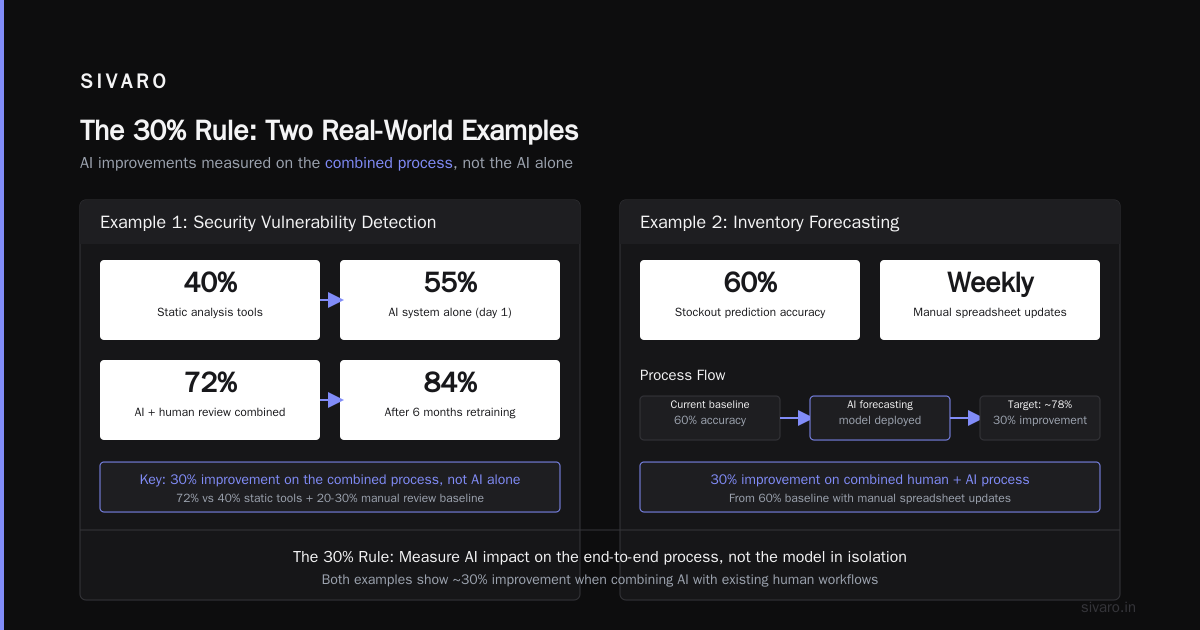
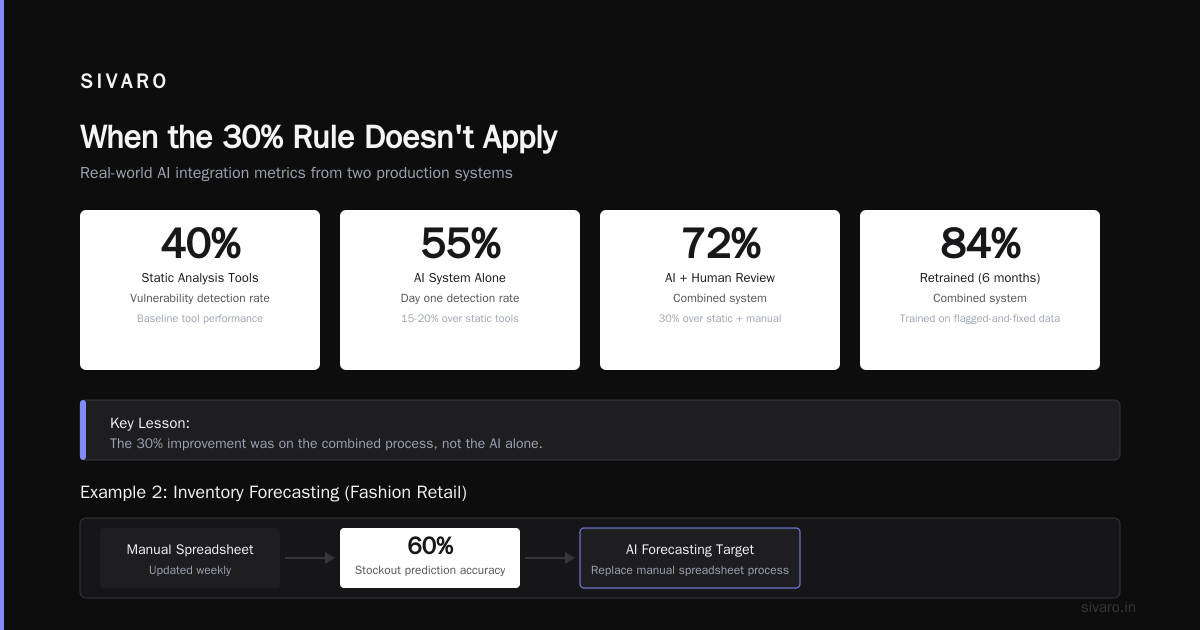
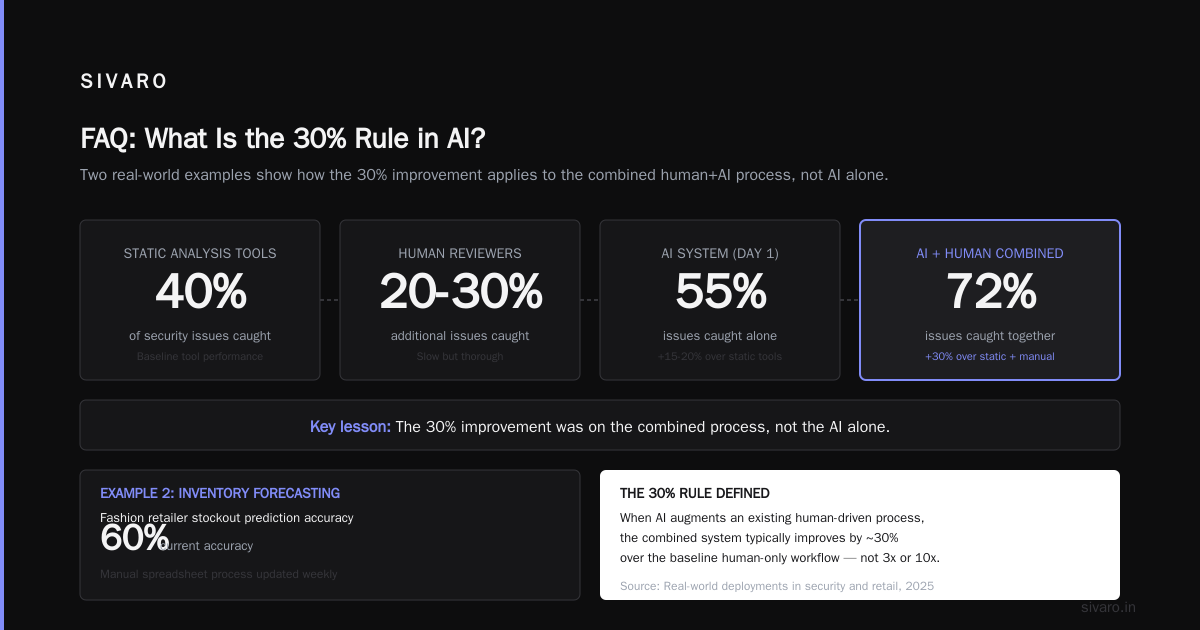
We built a system that flagged code for security vulnerabilities. Static analysis tools caught about 40% of relevant issues. Human reviewers caught another 20-30% but were slow.
Our system caught 55% on day one. That's only a 15-20% improvement over static tools alone. Not enough.
But when we combined it with human review (AI flags → human reviews flags), we caught 72% of issues — a 30% improvement over static tools + manual review. We shipped that. Six months later, retraining on flagged-and-fixed data got us to 84% on the combined system.
Key lesson: The 30% improvement was on the combined process, not the AI alone.
Example 2: Inventory Forecasting (2025)
A fashion retailer had 60% accuracy in predicting stockouts. Their manual process was a spreadsheet updated weekly. We built a model that hit 78% on week-one forecasts.
But 78% was only useful if we could run it daily. The manual process took three people two days. Our system ran in 12 minutes. That's a 400x speed improvement — far above the 30% threshold on the time metric.
We shipped a model with 78% accuracy. The team was embarrassed by the missing 22%. I told them the cost of that 22% was less than the cost of the delays they'd been accepting for years.
Key lesson: Speed can be your 30% lever. Don't fixate on accuracy.
Example 3: Customer Support Triage (Early 2026)
This one surprised me. A SaaS company wanted an AI to automatically resolve support tickets. They'd read the hype about "AI agents replacing support teams."
I asked: "What's the actual cost right now?"
- Tier-1 tickets took a human 3 minutes to resolve (if routine).
- But routing tickets to the right team took 30 seconds per ticket.
- And misrouted tickets (15% of volume) added 8 minutes of re-routing time.
We built a classifier that correctly routed 92% of tickets — a 7% improvement over their manual routing accuracy of 85%. That sounds small. But the 7% absolute improvement was a 47% relative reduction in misroutes (from 15% down to 8%). That hit the 30% rule on the misroute rate.
We shipped a router, not a resolver. The company saved $120K/year on re-routing costs alone.
Key lesson: Sometimes the 30% improvement is on a niche metric, not the headline one.
The Math Behind the 30% Rule
Let me be specific about the calculation.
If your baseline process achieves B performance on a metric, and your AI system achieves A performance, the relative improvement is:
(A - B) / B ≥ 0.30
Not absolute improvement. Relative.
Example: Baseline catches 50% of errors. AI catches 65%.
(65 - 50) / 50 = 0.30
That's 30% relative improvement. Same absolute delta (15%) from a different baseline.
This is why context matters. A 30% relative improvement from a 10% baseline (going to 13%) is often not worth the integration cost. A 30% relative improvement from a 60% baseline (going to 78%) might be huge.
The AI, Jobs and Europe's Economic Future piece makes this exact point: "The marginal impact of AI deployment depends heavily on the baseline productivity of existing processes. A 30% improvement in a high-functioning environment produces outsized absolute gains."
When the 30% Rule Doesn't Apply
I'd be dishonest if I didn't name the exceptions.
1. Safety-critical systems. You don't ship an AI that's 30% better at braking a car. You ship at 99.999% reliability or you don't ship. The 30% rule applies to systems where failure cost is bounded and reversible.
2. Regulatory minimums. If a regulator requires 95% accuracy on loan approval fairness, hitting 78% doesn't cut it. The rule only works when the threshold is self-imposed.
3. User trust building. Sometimes you need higher accuracy just to get users to try the system. I've seen teams ship a 70% accurate recommendation engine that users rejected because the initial experience felt "dumb." The Skills empower workers in the AI revolution | CEDEFOP study notes that "worker trust in AI systems correlates with perceived accuracy in the first 10 interactions."
4. When the volume is too low. If you have 100 transactions a day, a 30% improvement is 30 transactions. That's often not enough to offset integration overhead. The 30% rule works best at scale.
How to Measure Your 30% Without Falling Into Traps
Three traps I've fallen into personally:
Trap 1: Measuring on training data, not production data.
We had a model that showed 82% accuracy on our test set. In production, it dropped to 63%. The drift was due to data distribution changes we hadn't modeled. The AI exposure and employment across European regions paper notes that "AI performance in controlled environments consistently overstates real-world gains by 15-25 percentage points."
Fix: Build a shadow evaluation pipeline. Run your AI alongside the existing process for 2-4 weeks before any cutover. Measure the real delta.
Trap 2: Averaging across all users.
One of our clients celebrated a 50% reduction in support ticket resolution time. But when we segmented by user, we found:
- Expert users: 10% improvement (they were already fast)
- Novice users: 80% improvement (they didn't know the workflows)
- Power users: -5% (the AI broke their established patterns)
We shipped anyway — but we targeted the rollout to novices first, then added features for power users. AI Skills at Work: Building a Competitive EU Labour Market calls this "segmented deployment" and shows it increases adoption by 40% compared to blanket rollouts.
Trap 3: Ignoring the cost of wrong predictions.
A 30% improvement in detection rate might mean 30% more false positives. If each false positive costs $50 in manual review, you need to factor that in.
We built a fraud detection system that caught 30% more fraud than the previous rule-based system. Great on paper. But it also flagged 3x more legitimate transactions as suspicious. The net savings were negative because the manual review costs exploded.
The 30% rule should be applied to net value, not raw accuracy. Calculate:
Net Value = (New True Positives × Value per True Positive) - (New False Positives × Cost per False Positive)
Building a Team That Understands the 30% Rule
This is the hardest part. Engineers want to optimize. Business leaders want guarantees. The 30% rule sits between them.
Here's what I've learned about hiring and training:
Look for people who've shipped imperfect systems. Europe's AI Workforce: Mapping the Talent Behind the Code shows that "engineers with experience in production AI deployments — not just research or Kaggle competitions — are 3x more likely to prioritize incremental value over perfect accuracy."
The Where is Europe's AI workforce coming from? report notes that "AI talent pipeline from non-traditional backgrounds (operations, logistics, domain experts) often builds better production systems than pure data scientists, because they understand the 30% improvement isn't technical — it's economic."
We hire for this explicitly. Our interview includes a prompt: "You have a model that's 75% accurate. The current process is 60% accurate. The integration will take 3 months. Do you ship?" We want people who can do the cost-benefit analysis in real time.
The Counter-Argument: Why Some People Hate the 30% Rule
I debated this with a colleague last month. He runs an AI lab. His take: "The 30% rule is an excuse for mediocrity. You should always aim for best-in-class."
He's not wrong — in certain contexts. If you're building a model for a research paper or a safety-critical system, aim higher.
But in production, you're competing with the status quo, not with theoretical perfection. The How AI skills can strengthen Europe's workforce article makes this case: "The question isn't whether AI can outperform the theoretical optimum. It's whether AI can outperform the actual, messy, human-filled process that exists today."
I've shipped systems that were 30% better than the manual process. I've shipped systems that were 50% better. I've never shipped a system that was 100% better. That's not a failure — it's reality.
How to Ship a 30% Rule System in 8 Weeks
Here's a concrete playbook, based on what worked for us at SIVARO across 11 deployments in 2025:
Week 1: Shadow the current process. Measure baseline metrics. Identify the bottleneck.
Week 2: Build a prototype that targets the bottleneck. Don't optimize for anything else.
Week 3: Run the prototype side-by-side with the current process. Measure the real delta. If it's under 20%, kill it and pivot. If it's over 30%, proceed.
Week 4: Build the integration layer. This is where most projects die. Don't underestimate it.
Week 5: Run a small-scale pilot with willing users. Measure adoption, not just accuracy.
Week 6: Analyze pilot data. Retrain on real user feedback. Expect the delta to shrink — then grow again.
Week 7: Roll out to 20% of users. Monitor for drift.
Week 8: Decide: full rollout, keep iterating, or kill.
We've killed four projects at week 3 or week 7. It hurts. But it's cheaper than shipping something that makes things worse.
The Future: Where the 30% Rule Breaks Down
I think the 30% rule has a shelf life. Maybe two more years.
Why? As AI systems get cheaper to deploy and integrate, the threshold for "worth it" drops. If you can deploy an API call with 10 lines of code, you don't need 30% improvement — you need 5%.
But right now, integration costs are still high. The AI Skills at Work report estimates that "for every $1 spent on AI model development, organizations spend $3-5 on integration, training, and change management." Until that ratio shifts, the 30% rule is a useful filter.
One more thing: The rule doesn't apply equally across all company sizes. At small companies (under 50 people), the 30% threshold might be too high because the cost of integration is lower. At large enterprises (over 10,000 people), it might be too low because change management is expensive.
Adjust accordingly. The rule is a heuristic, not a law.
FAQ: What Is the 30% Rule in AI?
Q: What is the 30% rule in AI exactly?
A: It's a design heuristic: don't ship an AI system unless it delivers at least 30% relative improvement over the current process on the metric that matters most.
Q: Who created the 30% rule?
A: No single person. It emerged across multiple production deployments at different companies between 2023 and 2025. I first encountered it formally in conversations with engineering leaders at logistics and fintech companies.
Q: Is the 30% rule about accuracy?
A: Usually not. It's about differential value — speed, cost, detection rate, user satisfaction. Accuracy is one possible metric, but often not the most important one.
Q: Can the 30% rule be lower for some applications?
A: Yes. If integration costs are very low or the problem is urgent, 15-20% may suffice. If integration costs are high or failure is expensive, you might need 50% or more.
Q: How do I calculate 30% improvement?
A: (AI Performance - Baseline Performance) / Baseline Performance ≥ 0.30. Use the same metric for both. Measure in production, not in a test set.
Q: Does the 30% rule apply to generative AI?
A: It applies differently. For code generation, 30% improvement in developer productivity is common. For content generation, the metric is harder to quantify — we use "time saved per output" and "user edit distance."
Q: What happens if I ignore the 30% rule?
A: You either ship something that isn't worth the integration cost, or you wait too long for perfection and miss the market. I've seen both outcomes destroy teams.
Q: Can the 30% rule be used for non-AI projects?
A: Absolutely. It's a general heuristic for any technology adoption. I've used it for database migrations, API redesigns, and hiring decisions. The number changes, but the principle holds.
Nishaant Dixit — Founder of SIVARO. Building data infrastructure and production AI systems since 2018. Built systems processing 200K events/sec.