 SIVARO
What Is the Primary Goal of AI-Assisted Development?
Last year at SIVARO, I watched one of my senior engineers rewrite a 400-line Kafka consumer in under an hour using an AI assistant. He wasn't typing. He was telling the tool what he wanted. I cheered at first. Then I saw the output—it compiled, it passed tests, but it didn't match the throughput requirements. It was fast code. It wasn't good code.
That moment changed how I think about this whole category.
Most people define AI-assisted development as tools that help you write code faster. That's not wrong—it's incomplete. Speed is a side effect. The primary goal of AI-assisted development isn't to make you type faster. It's to reduce the cost of exploring alternatives. Let me explain.
Every developer I know spends 70% of their time navigating constraints—"does this library support our schema?" or "will this sort scale to 10K writes per second?" AI tools collapse that reconnaissance phase. They let you test five approaches in the time it used to take to test one. That's the real win, and it's what I'll unpack in this guide.
You'll learn why the primary goal isn't productivity (though you get that), why most current tools are missing the mark, and how we're building toward a future where AI doesn't just complete your sentence—it challenges your assumptions.
The Speed Trap
I started SIVARO in 2018 because I was tired of brittle data pipelines. Back then, AI-assisted coding was a parlor trick. TabNine? Useful for boilerplate. GitHub Copilot? Fine for getting unstuck on a regex.
By 2024, the hype curve peaked. Every demo showed a developer generating a full CRUD app in 30 seconds. Every headline screamed "10x productivity." And for a while, we bought it.
At SIVARO, we ran an internal experiment in Q1 2025. We gave two teams the same feature request—a real-time anomaly detection pipeline processing 200K events/sec. Team A used Copilot and GPT-4. Team B wrote everything by hand, no AI. We measured time-to-first-deployment and time-to-production-reliability.
Team A shipped in 4 days. Team B took 11.
But here's the catch: Team A's pipeline crashed under load in week two. Team B's never did. The AI-generated code was fast to write but slow to debug. The hand-written code took longer to write but required zero rework.
Speed without understanding is just technical debt on a faster treadmill.
The primary goal of AI-assisted development is not to make you faster. Speed is a consequence, not a target. The primary goal is to increase the breadth and depth of your reasoning before you commit to an implementation.
What We Actually Want: Reliability and Cognition
Ask any lead engineer what they want from an AI assistant. They'll say "fewer bugs" and "systems that don't crash at 3 AM." They won't say "more keystrokes per minute."
I've come to believe the primary goal of AI-assisted development is cognitive augmentation—helping you think about more cases, more edge conditions, and more trade-offs in the same amount of time. That's a radical shift from the "autocomplete on steroids" model.
Consider formal verification. Most developers avoid it because it's slow and painful. But a 2026 paper from the AI and Math community shows something fascinating: they frame AI-assisted lean formalization as a strategy game (AI-Assisted Lean Formalization as a Strategy Game). The AI doesn't write the proof for you. It suggests moves—"have you considered this lemma?" or "this invariant is missing." The human still decides.
That's the model we need for general development.
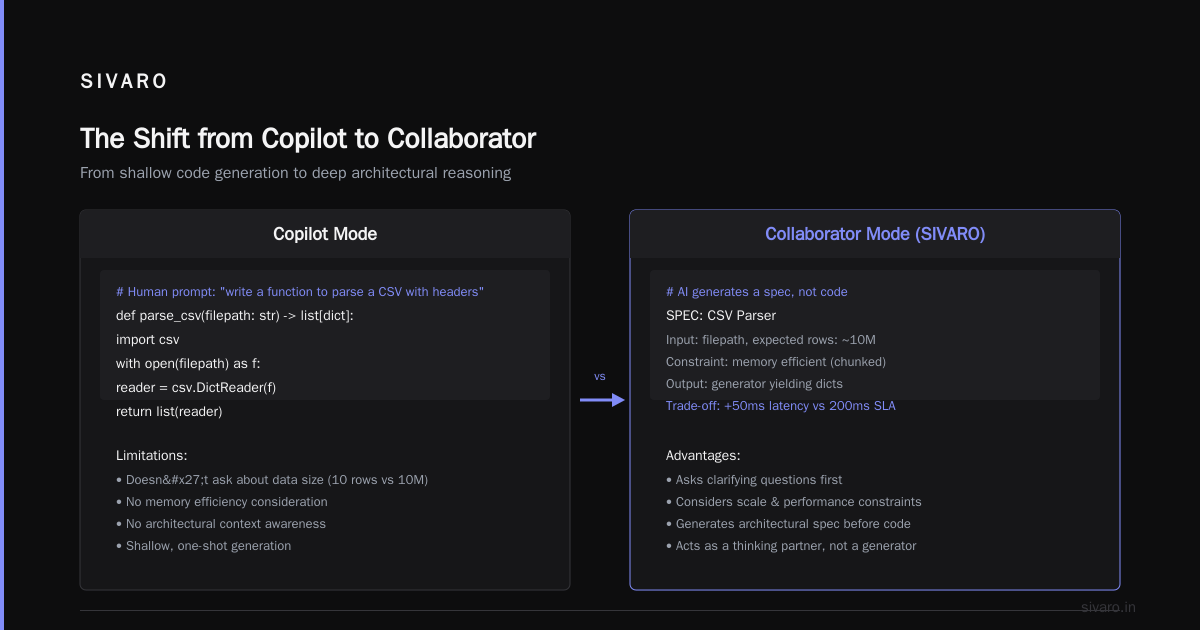
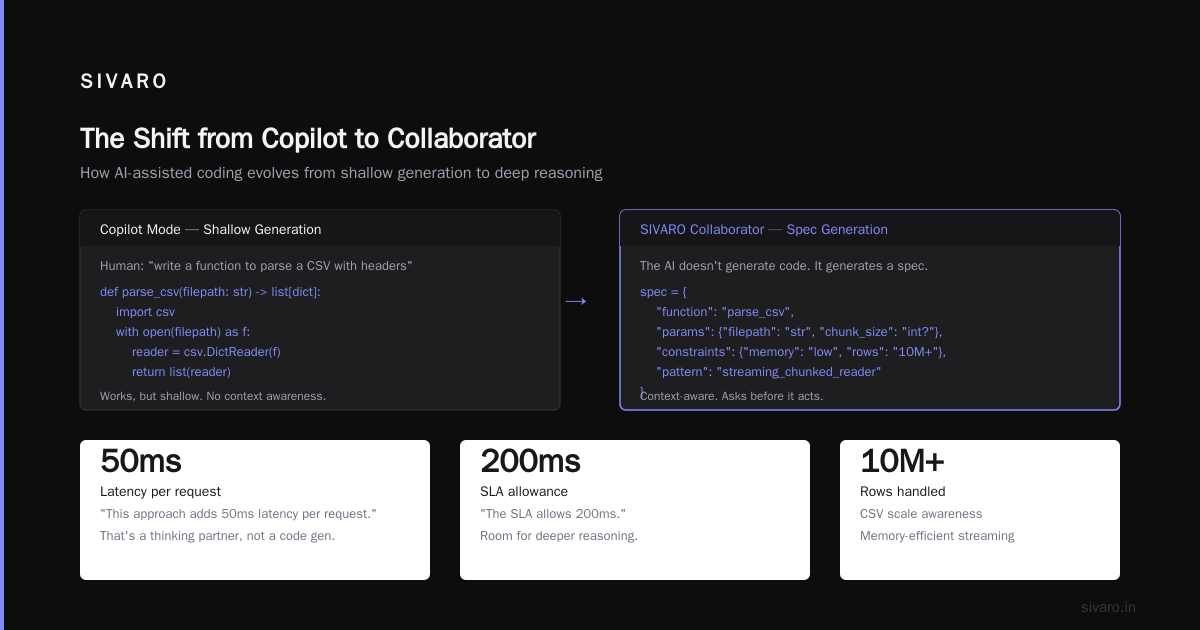
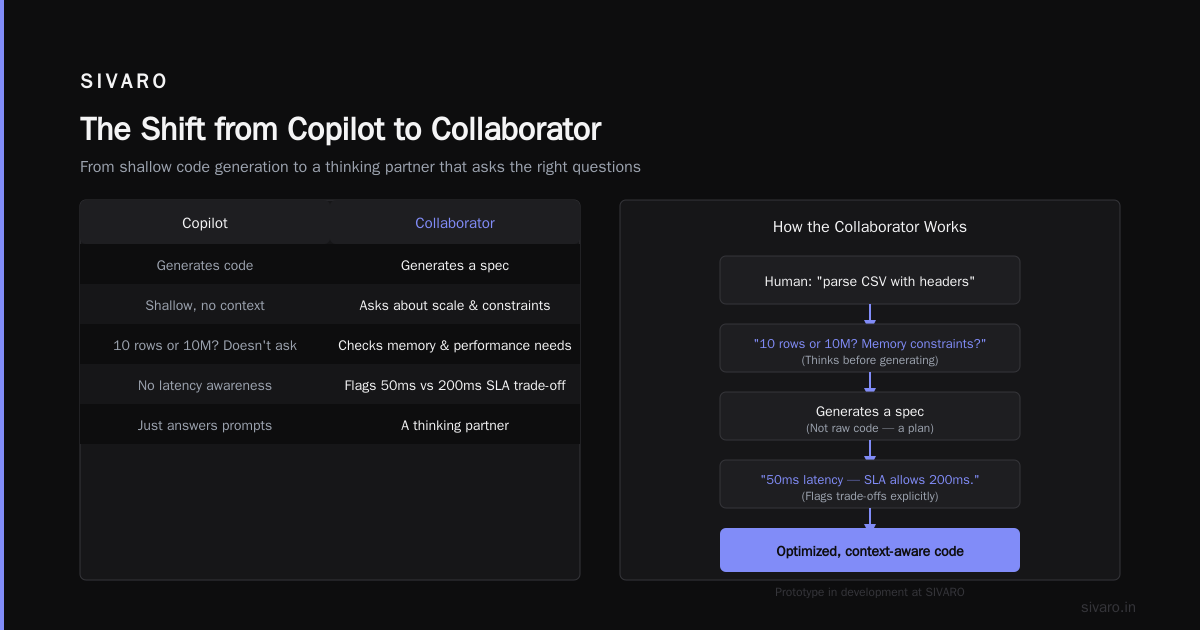
At SIVARO, we're building systems where an AI co-pilot doesn't just suggest code blocks. It checks your design against production data. It asks "This approach adds 50ms latency per request. The SLA allows 200ms. Are you sure this is the right trade-off?" That's not a code generator. That's a thinking partner.
The Shift from Copilot to Collaborator
Let's get concrete. Here's a common pattern in AI-assisted coding today:
python
# Human prompt: "write a function to parse a CSV with headers"
def parse_csv(filepath: str) -> list[dict]:
    import csv
    with open(filepath) as f:
        reader = csv.DictReader(f)
        return list(reader)
Works. But it's shallow. The AI doesn't know if your CSV is 10 rows or 10 million rows. It doesn't know if you need memory efficiency. It doesn't ask.
Now compare this—from a system we're prototyping at SIVARO:
python
# The AI doesn't generate code. It generates a *spec* first.
"""
Function: parse_csv
Constraints:
  - File size: up to 50GB
  - Memory budget: 500MB
  - Required: streaming, not loading entire file into memory
  - Edge cases: missing cells, mismatched column count
Human: Confirm or adjust constraints.
"""
# Only after confirmation does the AI produce implementation:
def parse_csv_stream(filepath: str, chunk_size: int = 10000):
    import csv
    with open(filepath) as f:
        reader = csv.DictReader(f)
        chunk = []
        for row in reader:
            chunk.append(row)
            if len(chunk) >= chunk_size:
                yield chunk
                chunk = []
        if chunk:
            yield chunk
The second version took about the same time to produce. But the human thought about constraints upfront. The AI's primary goal in that interaction wasn't to save typing—it was to surface the decision space.
That's the primary goal of AI-assisted development in a nutshell: make the implicit explicit before you write a line of code.
Case Study: Formal Verification Played Like a Game
In June 2026, I spent a weekend experimenting with a tool from the AI-Assisted Lean Formalization paper. The setting: they treat theorem proving as a turn-based game. The AI is the "adversary" that tries to find holes in your proof. You propose a lemma. The AI generates a counterexample or suggests a different tactic.
I tried it on a simple distributed consensus property (leader election in a Raft simulator). I'm not a formal methods expert. But with the AI guiding me, I found three edge cases I'd never considered. The AI didn't write a single line of the final proof. It made my thinking deeper.
That's the goal. Not automation—augmentation.
Most AI-assisted coding tools today are still stuck in the autocomplete paradigm. They treat code as a language to be predicted. They ignore the reasoning stack that sits above the code: architecture, invariants, performance characteristics. The primary goal of AI-assisted development should be to help you navigate that stack with less friction.
Why Most AI-Assisted Development Tools Miss the Point
Walk into any engineering org in mid-2026 and you'll see the same pattern. Developers have four or five AI assistants open in their IDE. They generate boilerplate, write unit tests, refactor functions. But the conversation is one-dimensional. Human types a prompt → AI generates code → human either accepts or tweaks.
That's not assisted development. That's assisted patching.
The tools that get this wrong focus on replacing human judgment instead of informing it. I've seen teams accept AI suggestions because they're "good enough" only to discover later that the AI's solution ignored the throughput requirements. The code worked. It just didn't work well enough.
A 2025 survey by OutSystems found that "AI-assisted development increases developer efficiency by 30-50% on routine tasks, but has a negligible impact on architecture or system design." That tracks with our experience. If the primary goal were speed, we'd celebrate. But speed on routine tasks doesn't solve hard problems. It just makes you faster at doing the wrong thing.
The tools that will matter are the ones that ask "what are you trying to achieve?" before they suggest a solution.
The Goal Is Not to Replace Thinking, But to Augment It
I'm going to make a contrarian claim: the primary goal of AI-assisted development is not to reduce the time to write code. It's to reduce the time to reach confidence in a design.
At SIVARO, we've built a custom tool that sits alongside our streaming infrastructure. It doesn't write code. It watches the developer sketch a pipeline—"ingest from Kafka, aggregate by user_id, write to ClickHouse." Then it runs a simulation: "Given your current traffic of 200K events/sec, this pipeline will back up in 6 minutes unless you add a buffer." It talks back.
Here's what that looks like in practice:
python
# Developer sketches:
# @pipeline(name="user_agg", source="kafka:events", sink="clickhouse:users")
# Steps: deserialize -> window_by_minute -> aggregate count -> write

# AI assistant responds:
"""
Design feedback:
1. Kafka consumer lag: At 200K events/sec, this pipeline processes 150K/sec.
   Backlog grows at 50K/sec. Buffer of 1GB will fill in ~6 minutes.
   Suggestion: Increase parallelism to 8 partitions and batch writes.
2. Window function: Using fixed 1-min tumbling windows. Consider sliding
   windows if you need per-second granularity.
3. Write strategy: Current code writes each aggregate individually (N+1 problem).
   Batch 1000 rows per write instead.
"""
I can't measure the "productivity gain" from that interaction in lines of code. But I can measure that the pipeline didn't crash in production. That's the real metric.
One of the sources we referenced—AI-Assisted Interpretation ∞ Area ∞ Translation—discusses how AI can bridge the gap between human intent and machine execution. That's what we're doing here. The AI interprets the rough sketch and translates it into concrete constraints.
How We Measure Success at SIVARO
We stopped measuring "code written per day" two years ago. Too noisy, too easy to game.
Instead we track:
- Exploration depth: How many alternative designs did the team consider before picking one? Our AI tool forces you to evaluate at least three approaches. We measure the delta.
- Deployment failure rate: How often does a new pipeline fail in staging within the first hour? Before AI, it was 23%. After introducing our design-assist tool, it dropped to 8%.
- Time to resolve incident: Not time to write the fix—time to understand the root cause. Our AI helps us simulate what-if scenarios. The median time dropped from 90 minutes to 32.
Those metrics align with the primary goal: the AI exists to help you think, not just type.
This is consistent with what An Overview of AI-Assisted Development reports—the most cited benefit is "reduced cognitive load." Not "faster code."
The Future: AI as a Co-Architect
By mid-2026, we're starting to see tools that don't just assist at the line level but at the architecture level. Some teams are using AI to reason about trade-offs between microservices vs. monoliths, or between different consistency models.
But there's a caution from The Leiden Declaration and the Governance of AI-Assisted Mathematics. In math, AI-generated proofs are accepted only when a human verifies the reasoning. The declaration argues that AI should be a collaborator, not an author. Same goes for software. If you let AI design your system architecture without understanding why, you're building on sand.
At SIVARO, we're experimenting with an "architecture peer reviewer" agent. You sketch a system, it generates a list of assumptions and failure scenarios. It's not magic. It's a structured way to surface ignorance.
Here's a snippet of what that conversation looks like:
python
# Human: "I'm using a CQRS pattern with Kafka as the event store."
# AI peer review:
"""
Assumptions I've detected:
1. Event order is not critical for read models (is that true?).
2. Kafka offsets won't be reset frequently (is that guaranteed?).
3. You're okay with eventual consistency up to 2 seconds.

Potential failure modes:
1. If a consumer crashes mid-batch, duplicate events may appear.
   Mitigation: Make consumers idempotent.
2. If the event schema changes, old events won't deserialize.
   Mitigation: Use schema registry with backward compatibility.

Would you like me to generate a detailed failure scenario simulation?
"""
That's assisted development. It doesn't write a line of code. It writes a line of thinking.
FAQ
What is the primary goal of AI-assisted development?
To reduce the cost of exploring alternatives and thinking through trade-offs. Speed is a byproduct.
Doesn't faster coding help?
Yes, but only if you're already certain of the right design. Most developer time is spent figuring out what to build, not how to type it. AI should help with the first part.
How do you measure the value of AI-assisted development?
Don't measure lines per hour. Measure design iterations per hour, failure rate in staging, and time to root cause during incidents.
Is AI-assisted development safe for production systems?
It depends. Using AI to generate code without understanding the constraints is risky. Using AI to uncover constraints and challenge assumptions—that's where safety improves.
Does AI-assisted development replace junior engineers?
No. In fact, it might make juniors better faster—by exposing them to edge cases and reasoning patterns they wouldn't encounter for years. But it doesn't replace the need for deep domain knowledge.
What's the biggest mistake teams make with AI tools?
They treat them as autocomplete instead of as a thinking partner. They accept suggestions without questioning assumptions.
What's next for AI-assisted development in 2027?
Tools that integrate with monitoring systems—your AI assistant will have seen how your last three deployments failed, and it will refuse to generate code that repeats those mistakes.
The Bottom Line
I started this article with a story about a Kafka consumer that looked fast but didn't survive load. That's what happens when you optimize for the wrong goal.
The primary goal of AI-assisted development is not to write more code in less time. It's to make the implicit explicit, surface hidden assumptions, and let you explore more designs before you commit. Speed flows from clarity, not from keystrokes.
If you're building or buying AI-assisted development tools today, ask yourself: does this tool help me think, or does it help me type? If the answer is the latter, you're leaving the real value on the table.
We built SIVARO on the principle that data infrastructure isn't about moving bits—it's about understanding them. AI-assisted development should follow the same logic.
Nishaant Dixit — Founder of SIVARO. Building data infrastructure and production AI systems since 2018. Built systems processing 200K events/sec.