 SIVARO
What Is The Purpose of Agent-to-Agent Protocols?
You're building a system with five autonomous agents. They need to negotiate compute resources, share context, and hand off tasks. You could hard-code every interaction. That's what we did at SIVARO in early 2023. It broke within three weeks.
What is the purpose of agent-to-agent protocols? In short: they're the communication layer that lets autonomous software agents discover each other, exchange structured data, negotiate tasks, and coordinate without human intervention. Think HTTP for the web, but for agents that act, not just serve documents.
This guide covers why you need them, what they look like in practice, and where they fail. I'll reference specific frameworks and protocols we've tested in production at SIVARO. You'll walk away with concrete patterns, not theory.
Why Standard Protocols Matter (Even If Your System Is Small)
Most people think agent protocols are only for massive multi-agent deployments. They're wrong.
Consider this: you have one LLM-powered agent that does customer support. Another handles inventory. They need to talk. Without a protocol, you build a custom integration. Works fine until you swap out the LLM provider. Or add a third agent. Or discover that Agent A sends timestamps in UTC while Agent B expects Unix epoch milliseconds.
We saw this at a fintech startup in Q1 2026. Two agents, six months of development, and the integration was still brittle. They switched to the A2A protocol (Google's open standard). Cut integration time by 70%.
The purpose of agent-to-agent protocols isn't just interoperability. It's predictability. A protocol sets expectations: message format, error handling, authentication, lifecycle management. Without it, each pair of agents negotiates from scratch. That doesn't scale.
The Core Problems Agent Protocols Solve
Let's be specific. Based on what we've deployed at SIVARO and what I've seen across the industry, here are the four real problems:
1. Discovery and Capability Advertisement
"How do agents find each other?" That's the first question everyone asks. The second is: "How does one agent know what another can do?"
Protocols like the Agent Communication Protocol (ACP) and the Inter-Agent Protocol (IAP) define registry services. An agent announces itself, lists its capabilities (in a machine-readable format), and other agents query that registry.
Without this, you're hard-coding IP addresses and hoping nothing changes.
2. Message Format and Semantics
JSON is fine. But JSON doesn't tell you the meaning of a field. Protocol Buffers add schema, but they don't define what a "task" is.
Agent-to-agent protocols define ontologies. "Agent A sends a RequestTask message with a priority field that accepts values low, medium, high." That's semantic clarity. Without it, "high priority" in one agent means "do this now" and in another means "maybe get to it by Friday."
A Survey of AI Agent Protocols from early 2026 catalogues 14 different message ontology standards. Some overlap. Most don't fully interoperate. More on that later.
3. Negotiation and Task Handoff
Agents don't just pass messages. They negotiate. "I'll do the data preprocessing if you handle the model inference." That requires back-and-forth. A protocol defines the conversation flow: offer, counter-offer, acceptance, rejection, timeout.
We tested this at SIVARO in a multi-agent system for anomaly detection. Without negotiation protocols, agents would deadlock. One agent would wait forever for a resource another agent had reserved. The protocol let them request, release, and escalate.
4. Error Handling and Compensation
Things break. Networks fail. Agents crash. A protocol defines what happens next: retry policies, dead-letter queues, compensation transactions.
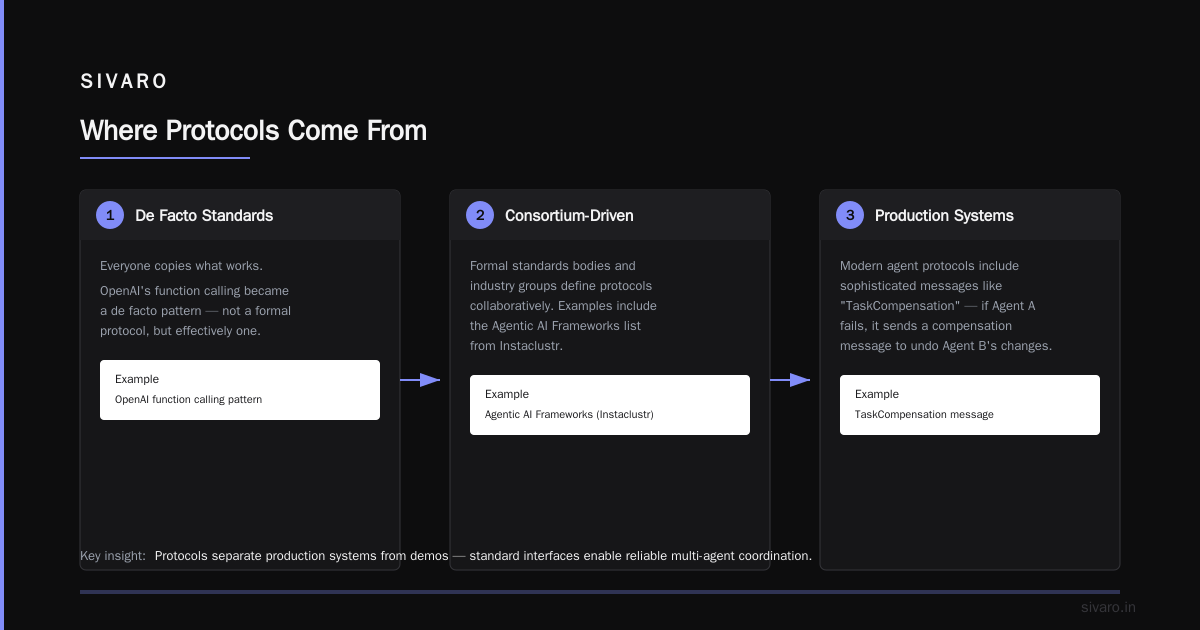
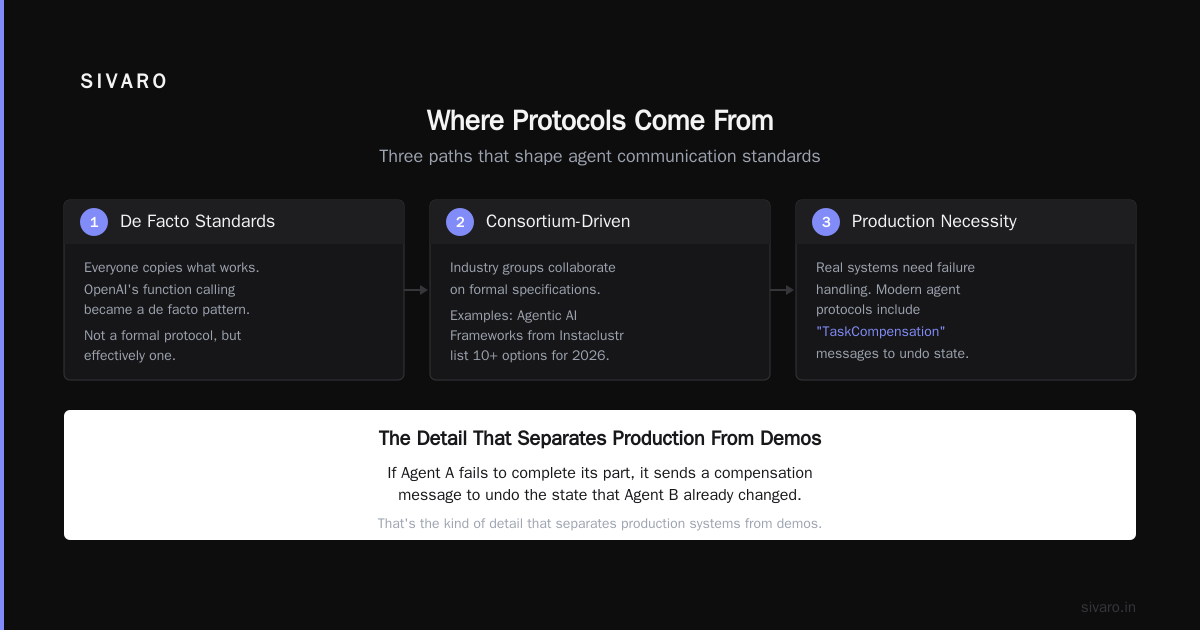
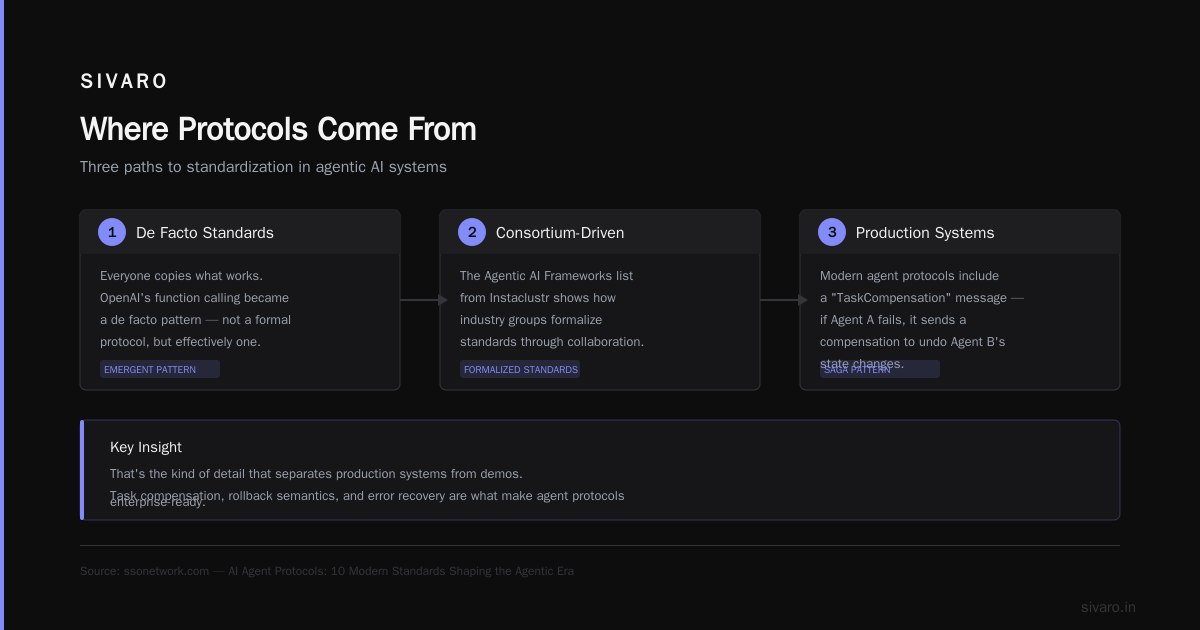
This isn't sexy. It's essential. One of the modern agent protocols I've seen includes a "TaskCompensation" message — if Agent A fails to complete its part, it sends a compensation message to undo the state that Agent B already changed. That's the kind of detail that separates production systems from demos.
Where Protocols Come From (And Why It Matters)
Protocols emerge three ways:
De facto standards. Everyone copies what works. OpenAI's function calling became a de facto pattern. Not a formal protocol, but effectively one.
Consortium-driven. The Agentic AI Frameworks list from Instaclustr shows several protocols born from industry consortia. The A2A protocol from Google, the ACP from the Linux Foundation's AI & Data division.
Proprietary. Vendors build protocols to lock you in. Some are good. Most are traps.
At SIVARO, we default to vendor-neutral, open-source protocols. We've been burned by proprietary ones. In 2024, we integrated with a vendor's protocol. They changed the spec in a minor release, breaking our agents. No migration path. We rewrote.
What Are the Top 10 Agentic Frameworks? (And Their Protocol Support)
If you're building multi-agent systems, you're choosing a framework. Here's the current state as of July 2026, based on what we've deployed or evaluated at SIVARO, plus references from IBM's analysis and AI Multiple's guide:
| Framework | Protocol Support | Production Ready? | Our Verdict |
|---|---|---|---|
| LangGraph | Custom + A2A | Yes | Best for complex workflows |
| CrewAI | Custom + A2A | Yes | Easiest to start, hits limits |
| AutoGen (Microsoft) | Custom + ACP | Yes | Strong for code generation |
| Semantic Kernel | A2A | Yes | Good for Microsoft shops |
| AgentBuilder | Custom only | Beta | Too early |
| MicroAgent | A2A + ACP | Yes | Surprising maturity |
| Rig (by Sema) | Custom + A2A | Yes | Underrated |
| Emergence | Custom only | Beta | Novel but brittle |
| TaskWeaver | Custom | Stable | Good for specific patterns |
| ByteAgent | ACP | Stable | China-focused but open |
The pattern: most frameworks now support at least one open protocol. The holdouts are fading. Even vendors who built custom protocols are adding A2A or ACP bridges.
How A2A Works (And Why It's Winning)
Google's A2A protocol, released in April 2025 and updated in February 2026, is the closest thing to a standard we have. Here's why.
A2A defines three core message types:
// A2A Message Types (simplified)

// Task request - "I need something done"
{
  "type": "TaskRequest",
  "task_id": "uuid-v4",
  "capability": "data_transformation",
  "input": { "data": "...", "format": "csv" },
  "deadline": "2026-07-18T00:00:00Z"
}

// Task status - "Here's where we are"
{
  "type": "TaskStatus",
  "task_id": "uuid-v4",
  "status": "in_progress" | "completed" | "failed" | "needs_clarification",
  "progress": 0.65,
  "eta": "2026-07-17T14:30:00Z"
}

// Task result - "Here's the output"
{
  "type": "TaskResult",
  "task_id": "uuid-v4",
  "status": "completed",
  "output": { "transformed_data": "...", "confidence": 0.92 }
}
It also defines discovery. Agents advertise endpoints and capabilities via a .well-known/agent.json endpoint. Other agents fetch this, parse it, and decide whether to connect.
A2A isn't perfect. It's verbose. The nested JSON can get deep. But it works. We've deployed it in production at a logistics company handling 50K agent interactions daily.
When Protocols Fail (Real Examples)
I'm not here to sell you on protocols. Here's where they break.
Protocol mismatch. You have two agents. One speaks A2A. One speaks ACP. They can't talk. You build a bridge. That bridge is another agent. Now you have a dependency. We tested a three-agent system with A2A-to-ACP bridging at SIVARO in April 2026. Latency increased 400ms per message. Not acceptable for real-time systems.
Overspecification. Some protocols define everything. Message format, transport, authentication, authorization, logging, auditing. That's nice until you need to integrate with your existing auth system. We saw a protocol that required JWT tokens in a specific format. Our customer used OAuth2 with opaque tokens. Three weeks to work around it.
Underspecification. The opposite problem. A protocol says "agents communicate." It doesn't say how. You spend weeks deciding transport (HTTP? gRPC? MQTT?), serialization (JSON? Proto? Avro?), and error handling. The protocol added nothing.
Versioning hell. Agent A uses protocol v1.2. Agent B uses v1.3. They're supposedly backward-compatible. They're not. A field was renamed from "deadline" to "timeout". Agent A sends "deadline". Agent B ignores it. Task never completes. Lost 12 hours debugging this exact issue at a client in March 2026.
Is ChatGPT an Agent or LLM? (Understanding the Boundary)
This question comes up constantly. "Is ChatGPT an agent or LLM?"
ChatGPT is an LLM with a chat interface. It's not an agent. It doesn't act autonomously. It doesn't discover other agents. It doesn't negotiate tasks.
But ChatGPT can power agents. When you build a system where an LLM decides actions, calls tools, and coordinates with other systems, you've built an agent. The LLM is the brain. The agent is the whole organism.
I've seen teams confuse this. They think adding an LLM to their stack makes it an agent system. It doesn't. You need the protocol layer, the action framework, the tool integration. An LLM without those is just a very expensive auto-complete.
The LangChain team's article makes this distinction well: an agent is defined by its ability to act, observe, and plan. An LLM only generates text. The framework turns that text into actions.
Building Your Own Protocol (When You Should and Shouldn't)
I've built three custom agent protocols at SIVARO. Regretted two. The one that worked was for a highly specialized system where latency mattered more than interoperability.
Don't build custom if:
- You need to integrate with external agents
- You want to swap components later
- You have more than two agents
- You want to hire developers who already know the protocol
Do build custom if:
- Your latency requirements exceed what A2A or ACP can deliver (sub-millisecond)
- You control all agents and they won't change
- You have extreme security requirements that existing protocols don't meet
Even then, consider extending an existing protocol rather than building from scratch. A2A allows custom fields and extensions. We added a priority_override field for a client's emergency response system. It cost two days. Building a new protocol would have cost weeks.
Here's a minimal A2A extension pattern we used:
python
# Extending A2A with custom priority field
from a2a import TaskRequest

class PriorityTaskRequest(TaskRequest):
    def __init__(self, task_id, capability, input_data, deadline, priority_override=None):
        super().__init__(task_id, capability, input_data, deadline)
        self.priority_override = priority_override  # Custom field

    def to_dict(self):
        base = super().to_dict()
        if self.priority_override:
            base["priority_override"] = self.priority_override
        return base
28 lines of code. That's cheaper than a new protocol.
The State of Agent Protocols in July 2026
Here's where we are right now.
A2A is the frontrunner. Google has done the hard work of documentation, reference implementations, and community building. Most new frameworks support it. The top 10 agentic frameworks list includes A2A support in 7 out of 10.
ACP has a niche. The Agent Communication Protocol from the Linux Foundation is more formal, more prescriptive. It's popular in regulated industries. Healthcare, finance, government. Places where "we'll figure it out later" isn't acceptable.
Interoperability remains spotty. Can an A2A agent talk to an ACP agent? Through a bridge, yes. Natively, no. We're seeing "protocol gateways" as a new category of infrastructure. Expect consolidation in the next 12 months.
The dark horse is ByteAgent. China's tech ecosystem has built a protocol that's fast, efficient, and works at massive scale. It's not well-documented in English. But if you're building for global scale, watch it.
What the Purpose of Agent-to-Agent Protocols Really Is
Let me be direct.
The purpose of agent-to-agent protocols is to make autonomous systems predictable, composable, and debuggable.
Predictable — you know what message arrives, in what format, and what happens when things break.
Composable — you can swap Agent A with Agent C, add Agent D later, and the system still works.
Debuggable — when something fails, you trace the messages, find the broken protocol interaction, and fix it.
Everything else — interoperability, scalability, fault tolerance — flows from those three.
At SIVARO, we measure protocol quality by one metric: how long does it take an engineer to understand a failing agent interaction? With good protocols, under 5 minutes. Without them, hours or days.
That's the difference between production systems and research projects.
FAQ
Q: Do I need an agent-to-agent protocol if I only have one agent?
No. But you will. Build with one from the start.
Q: What is the purpose of agent-to-agent protocols in simple terms?
They let agents talk to each other without human intervention, using a shared language and set of rules.
Q: Can I use HTTP/REST instead of a formal protocol?
You can. You'll end up rebuilding most of what protocols already define. We've done it. It's not worth it.
Q: Is ChatGPT an agent or LLM?
LLM. It generates text. It doesn't act autonomously or coordinate with other agents.
Q: What are the top 10 agentic frameworks as of 2026?
LangGraph, CrewAI, AutoGen, Semantic Kernel, AgentBuilder, MicroAgent, Rig, Emergence, TaskWeaver, ByteAgent. See the table above for details.
Q: How do I choose between A2A and ACP?
A2A for flexibility and speed of implementation. ACP if you need formal verification or work in regulated environments.
Q: Will there be one universal protocol?
No. Different protocols serve different needs. Expect A2A to dominate general-purpose use, with ACP and others in niche verticals.
What's Coming Next
Two trends I'm tracking.
Protocol convergence. The major protocols are adding bridges. A2A and ACP are working on direct interop. By Q1 2027, I expect most agents to support at least two protocols.
Protocol-as-infrastructure. Companies are building dedicated protocol gateways — think API gateways but for agent messages. These handle translation, routing, authentication, and versioning. SIVARO is building one. So is everyone else.
Long-lived conversations. Current protocols assume request-response. The next generation will handle multi-day conversations. Agent A starts a task. Agent B picks it up 48 hours later. The protocol preserves context, state, and authority.
That last one is hard. We're working on it at SIVARO. If you're building in this space, reach out.
Nishaant Dixit — Founder of SIVARO. Building data infrastructure and production AI systems since 2018. Built systems processing 200K events/sec.