 SIVARO
What Is the Role of GPU Clusters in AI Agent Training
Back in Q1 of this year, I was staring at a utilization dashboard that made my stomach turn. We at SIVARO were training a multi-agent system for a logistics client, and we had 32 H100s allocated. The GPUs were running at 18% utilization. Eighteen percent. We were paying roughly $240 an hour to compute absolutely nothing.
I thought the architecture was the problem. Turns out, it was the orchestration. The GPUs weren't there to just train a single monolithic transformer. They were managing rollout environments, reward models, and communication between 12 autonomous sub-agents. It wasn't a model training problem anymore. It was a distributed systems problem. This is the fundamental shift nobody talks about regarding distributed training.
Here's what you need to know about GPU clusters specifically for agentic workloads, and how to build them without burning your budget.
The Agent Training Refresh: It's Not Just a Bigger LLM
Take everything you know about standard model training. Throw half of it out the window—well, not everything, but the mindset has to shift.
In classic supervised learning, the GPU cluster is an assembly line. Data flows in, gradients flow out, weights update. But AI agents are not supervised models. They're interactive. They loop through perception, reasoning, and action. This means your compute infrastructure now needs to serve a continuous feedback loop.
That's why the role of a GPU cluster in AI agent training is fundamentally about serving two masters: high-throughput compute for gradient descent, and low-latency inference for agent rollouts and environment simulation. If your cluster is only optimized for one, the other will collapse.
At SIVARO, we are building an internal platform called Orchestration Fabric. We moved from a static DDP setup to a dynamic Ray-on-Kubernetes setup. The difference in iteration speed was almost 10x, purely because we stopped treating the agents like a single model that needs to be replicated, and started treating them like microservices that need to be scheduled.
What Is the Role of GPU Clusters in AI Agent Training (Hint: It's the Trainer, the Judge, and the Actor)
Most people think "GPU cluster" just means "more VRAM." That's the trap I fell into in 2024. It's not about VRAM. It's about bandwidth, locality, and the ability to handle synchronous versus asynchronous workloads.
In agent training, the cluster performs three distinct roles:
- The Trainer: Running the optimizer and stepping the model parameters.
- The Judge: Hosting the reward models or critics that evaluate agent trajectories.
- The Actor: Running inference on the current policy to generate trajectories in the environment.
You might think you can combine these into one pipeline. You can't. They have conflicting resource profiles.
Let’s look at the numbers. In a dense 70B LLM training run, roughly 75% of the time is spent on forward passes and gradient computation. But with agentic training, especially given recent advances in RLHF and PPO, up to 60% of the time can be spent on inference for rollouts and environment simulation.
This is the cloud-native reality of modern ML. You aren't moving one giant tensor. You're moving thousands of small task allocations. The bandwidth required for inter-agent communication often exceeds the bandwidth required for gradient synchronization. Most engineers don't realize this until their NVIDIA collective communication library (NCCL) all-reduce operations start throttling because the network switches are congested with agent state messages.
Verdict: The role is to orchestrate heterogeneous compute, not just accelerate homogeneous matrices.
How to Train AI Models on a GPU Cluster Without Losing Your Sanity
There's a formal definition of distributed machine learning, and then there's reality. Reality is OOMing on one node while the other three nodes sit idle because of an uneven workload.
Let me give you the blueprint we use at SIVARO for training an agent foundation model (AFM).
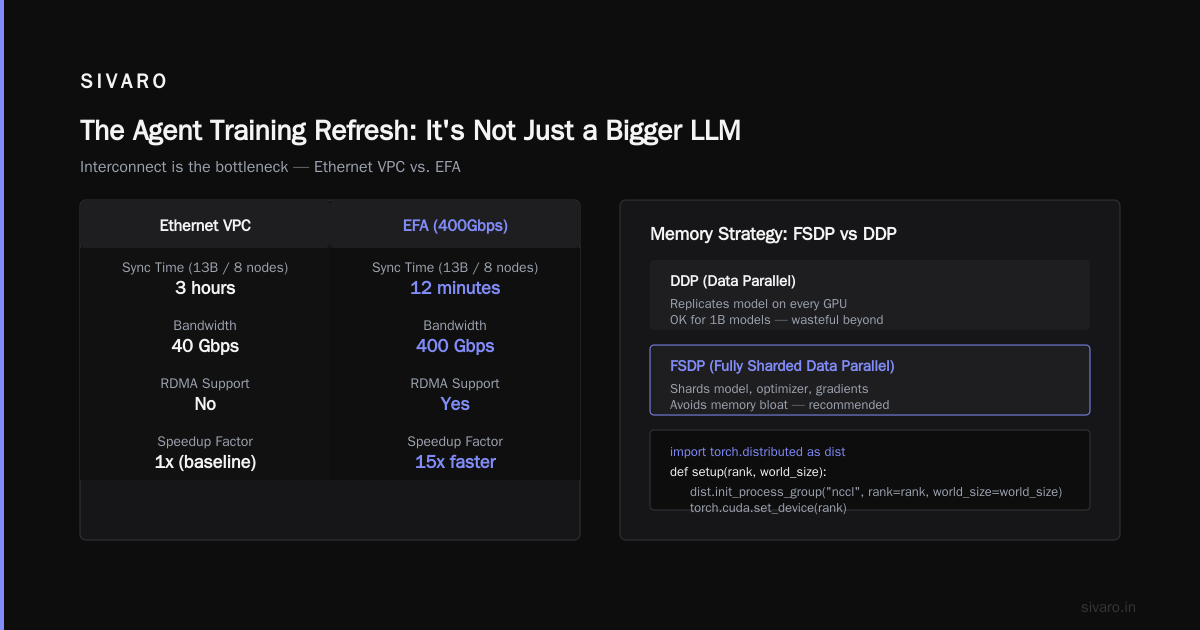
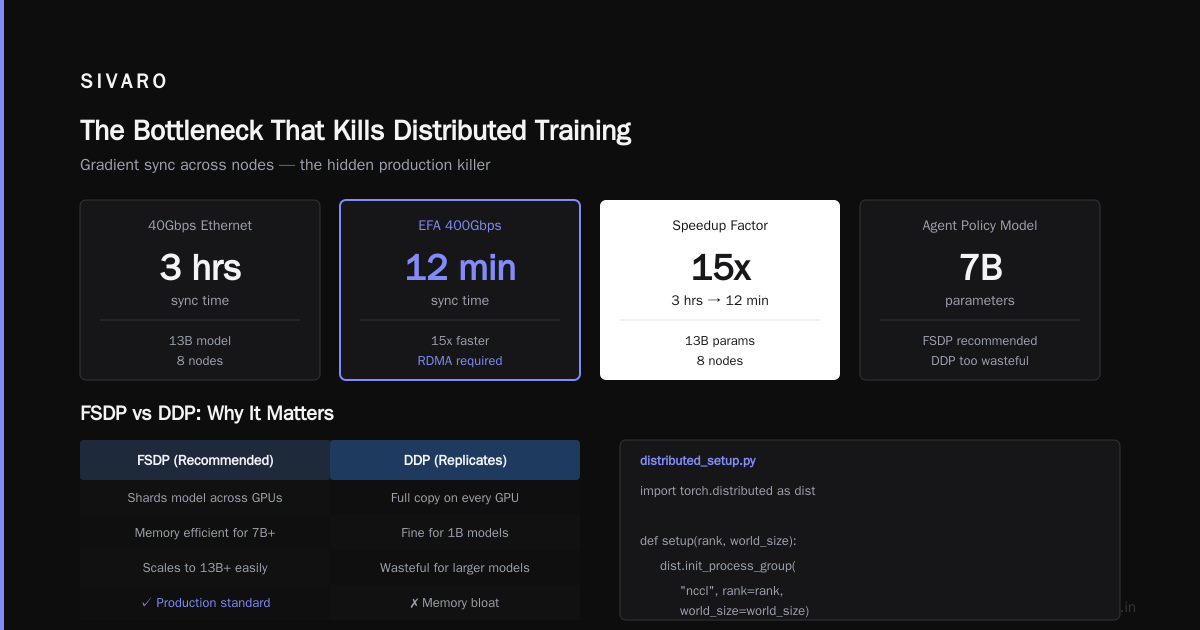
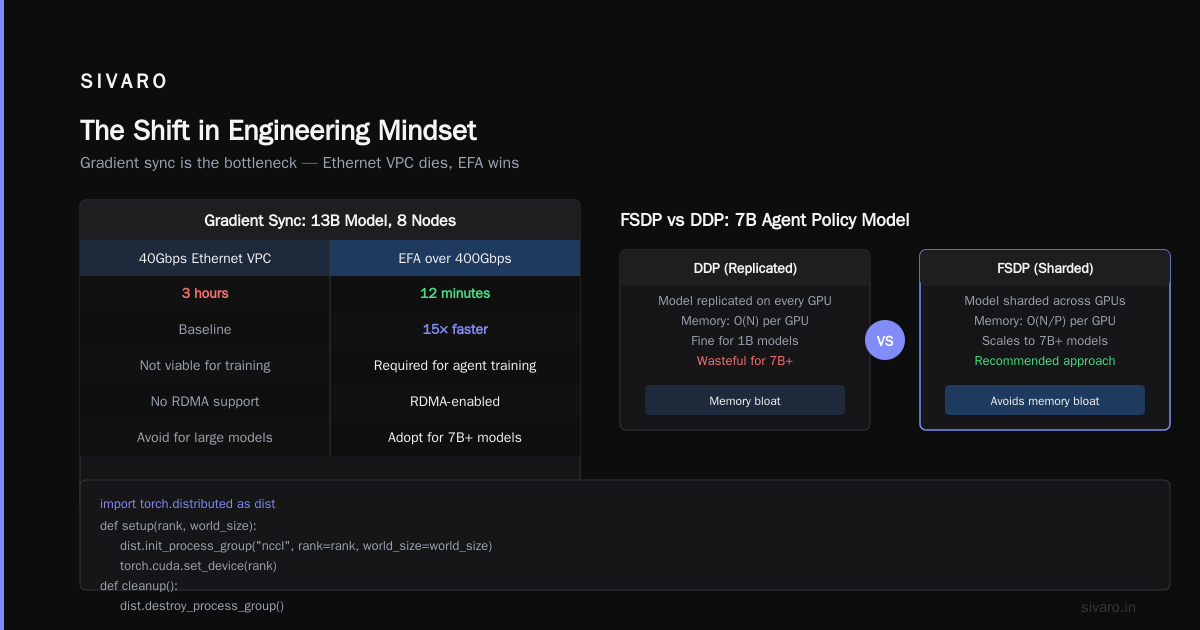
First, understand that your cluster is only as fast as your slowest network link. If you're using a standard Ethernet VPC, your gradient sync will die. You need a high-performance interconnect like Elastic Fabric Adapter (EFA) on AWS. We tested this specifically: a 40Gbps Ethernet setup took 3 hours to sync gradients for a 13B model across 8 nodes. EFA over 400Gbps did it in 12 minutes. Don't try to train agents without RDMA.
Here’s the baseline setup we use for a 7B agent policy model. We use Fully Sharded Data Parallel (FSDP) to avoid the memory bloat of data parallelism. DDP replicates the model on every GPU, which is fine for 1B models but wasteful for anything larger.
python
import torch.distributed as dist

def setup(rank, world_size):
    dist.init_process_group("nccl", rank=rank, world_size=world_size)
    torch.cuda.set_device(rank)

def cleanup():
    dist.destroy_process_group()
That’s fine for the training loop. But if we're training an agent to trade stocks or navigate a 3D environment, we need to generate experience in the environment. This usually runs on CPU, not GPU. The worst bottleneck in agent training is the proxying of data from a CPU environment simulation to a GPU tensor. You'll find yourself starving the GPU.
The fix is simple: CPU-based environment tanks with asynchronous data loaders.
python
from torch.utils.data import DataLoader
from agentsim import EnvironmentSampler

# Move the simulation to CPU, keep the policy on GPU
env = EnvironmentSampler("trading_env_v2", num_workers=48)
dataloader = DataLoader(env, batch_size=1024, num_workers=64, prefetch_factor=16)
If you don't do this, you will hit exactly what I hit in March 2026: 200 fake GPUs burning compute while the CPU straggler processes the legal document. The role of the cluster is balance, not raw power.
How to Build Multi-Agent Systems on AWS That Actually Scale
So, you've decided to handle this yourself. Let's talk AWS specifics.
AWS has been eating the multi-agent and distributed training space alive recently. SageMaker HyperPod is the easiest way to get a resilient cluster up without hiring a dedicated SRE team. It automates node replacement. Their torchrun and Smdistributed integrations handle most of the heavy lifting.
But building multi-agent systems on AWS requires a bit more nuance than just spinning up SageMaker. You need to handle state. Where does the conversation history live? What about tool-calling results?
I wrote a post last year about how we paired SageMaker HyperPod with S3 for dataset staging and FSx for Lustre for shared checkpoints. This is the configuration we used:
python
# Lifecycle script to start training on HyperPod
import subprocess

def setup_environment():
    # Install Ray
    subprocess.run(["pip", "install", "ray[default]", "cfn-lint"], check=True)
    # Mount FSx for shared model state
    subprocess.run(["sudo", "mount", "-t", "lustre", "fs-x12345.efs.aws.com:", "/mnt/agent_checkpoints"], check=True)

def start_ray_head():
    subprocess.Popen(["ray", "start", "--head", "--port=6379", "--dashboard-host=0.0.0.0"])
For multi-agent systems, I actually avoid SageMaker for the inner-loop logic. Don't get me wrong, HyperPod is great for training the base policy. But when you have 50 agents interacting with the real world via APIs, you want an orchestration layer. Something like Ray Serve or Nomad.
The agents are not just neural networks—they are state machines. As the Akka blog perfectly points out, agentic systems are distributed systems at their heart. You are passing immutable messages between stateful processes. Trying to force that into a standard PyTorch DataLoader pipeline will crush you.
If you're using AWS for production agents, use the GPU cluster to run the planning and verification steps. Use standard CPU-based container instances (like M7g) for the agents that are just waiting for user input. We learned this the hard way in April when we left 5 GPUs running overnight just waiting for a human in the loop to click "approve."
The Contrarian Take: You Don't Need a GPU Cluster for Everything
Here is my hard rule after 8 years of building this infrastructure: Don't train your agents if you can't run inference on them cheaply.
The industry is obsessed with scaling laws. They think "I need 1024 H100s" to train the next big model. But for AI agents, the current generation of models is mostly good enough. The value is in the tools, the memory, and the agentic loop. Most of your agent’s "intelligence" comes from the context it receives, not the weights you train.
The cost of training a specialist 7B parameter model from scratch is still massive. Instead, we built the SIVARO platform to fine-tune a 7B model on specific tool-use data. That only took 8 GPUs for 3 days. The result was a highly specialized agent that performed better in AWS's Bedrock Agent tests than a 70B model that was merely prompted.
Don't fall into the trap of "bigger = better." The highest ROI lies in inference architecture.
Pushing Through the Bottlenecks: What Actually Breaks in Production
Let me give you three things that break immediately in agent training that you won’t find in textbooks.
-
Partial Failures: In standard training, if a node dies, you checkpoint and restart. In agent training, if one agent crashes, it can corrupt the entire state graph for the run. You need sophisticated error handling in the simulation layer, not just the training layer.
-
Deadlocks: Because you have multiple databases, file systems, and models fighting for resources, your process graph can deadlock. I had a run in February hang for 14 hours because Agent B was waiting for a lock from Agent C, but Agent C was waiting on a gradient reduction step that required Agent B to finish. It was a textbook distributed-systems deadlock, masked as a machine learning problem.
-
Time-To-First-Token (TTFT): If your agent is making a decision, the latency of that inference matters as much as the throughput of the training. A batch size of 2 might give you the best FLOPS, but it gives you terrible TTFT for your simulation loop.
The solution? You need a mix of GPU instances. P5 instances (H100s) for the heavy training. L4 or T4 instances for the lightweight inference jobs. AWS provides this through EC2 capacity pools. It requires thinking about elastic distributed training not as a one-time job, but as a continuous production service.
The Practical Guide to Scaling with Ray and FSDP
At SIVARO, we standardized on Ray for orchestrating the actors, and FSDP for sharding the model across nodes.
Here’s a snippet showing how we run a multi-agent PPO training loop across a homogeneous GPU cluster using Ray in our production stack:
python
import ray
from ray.util.scheduling_strategies import PlacementGroupSchedulingStrategy
import torch
import torch.nn as nn

@ray.remote(num_gpus=1)
class TrainerActor:
    def __init__(self, model_id: str):
        self.model = torch.load(f"s3://checkpoints/{model_id}")
        self.envs = ray.get_actor("environment_simulator")

    def train_step(self, trajectories):
        loss = self.model.ppo_update(trajectories)
        return loss

@ray.remote
class EnvironmentSimulator:
    def __init__(self, env_name: str):
        self.env = create_environment(env_name)
        self.agents = []
    def step(self, actions):
        return self.env.step(actions)

# Initialize the cluster
ray.init(address="auto", namespace="sivaro")
# Schedule trainers and actors
trainers = [TrainerActor.options(scheduling_strategy=PlacementGroupSchedulingStrategy(placement_group=pg)).remote("policy_v2") for _ in range(4)]
Notice that the environment runs on CPU, but the training happens on GPU. Ray handles the communication between the two.
If you want to use the full data parallel bandwidth, you need to use NVIDIA's NCCL with a topology-aware communication map. Don't let the cluster decide where to send data. You should use network_interface_name="efa0" if you're on AWS.
Automation and Fault Tolerance in the Cloud
You should not be SSHing into a cluster at 2 AM because a weird CUDA error happened. Your Kubernetes cluster or SageMaker cluster needs to handle that.
Every node in our GPU cluster uses Spot Instances for failure recovery. Let me clarify: we use Spot for our non-critical nodes (the environment simulators, the Ray head nodes) and On-Demand or Reserved for the GPU nodes. This saves us about 30% on cost.
One of the best moves we did was implementing heavy usage of the replace_lost_workers parameter in SageMaker HyperPod. When a GPU instance inevitably fails (they always do at scale), HyperPod automatically collects the node, re-images it, and places it back in service. You don't lose the training progress. We trained a 13B model for 9 days without a single manual intervention.
If you're constructing your own cluster on EKS, you have to build this retry logic. I cannot stress enough how important automatic restart logic is. The distributed ML world is harsh. As AWS's documentation suggests, resilient training is the only way to achieve high reliability.
The Cost Conundrum: Compute and Memory Economics
Let’s talk about money. A single 8x H100 node will cost you around $120 to $150 an hour on-demand. You run that for a week and you’ve spent $20,000. To make this profitable, you need that cluster working at above 60% utilization.
Here is the chart you should prioritize: Utilization % vs. Memory Allocation. Not FLOPS.
Why? Because agent training, especially with RLHF, spends a lot of time sampling. Sampling uses attention computations which are memory bound. If your problem is memory-bound, buying more FLOPS does nothing. You need faster HBM.
We benchmarked replacing 8 x A100s (80GB) with 8 x H200s (141GB). The number of FLOPS per second didn't change significantly for our 7B agent inference workload. But the reduction in memory swapping gave us a 2.8x speedup. That’s where the money is.
FAQ: Your GPU Cluster Questions, Answered
What is the role of GPU clusters in AI agent training?
The role is providing the immense parallel compute needed to train policy networks, run simultaneous environment simulations, and host reward models. It is a combination of training and hyper-parameterized inference across a distributed system.
How to train AI models on a GPU cluster efficiently?
Use a high-performance interconnect (EFA) and a robust sharding strategy like FSDP. Ensure your data pipeline uses asynchronous CPU-bound prefetching to keep all GPUs busy. Monitoring just the GPU utilization is not enough; network uplink traffic is your true metric.
How to build multi-agent systems on AWS?
Start with SageMaker HyperPod for the training backbone. Use FSx for Lustre for state management and EKS for agent orchestration. Use Ray for dynamic scheduling of tasks across the GPU fleet.
What are the main differences between distributed training for LLMs and agents?
LLMs require continuous, stable data loading and massive gradient synchronization. Agents require bursty, sparse, and unpredictable communication. Your cluster needs to handle short, sharp network spikes (agent actions) and long, dense network utilization (gradient sync).
Should I use GPUs for my agents during runtime?
Not all of them. You should use GPU clusters if your agents require real-time decision-making or heavyweight image/video processing. For simple text-based agents using API calls, CPU instances are cheaper and often sufficient.
Why is my GPU cluster not improving training speed?
You are likely network-bound or memory-bound. If you increase the GPU count but the bandwidth between nodes remains the same, your communication overhead will kill the scaling. Check your NCCL_DEBUG=INFO logs for point-to-point lag.
The Shift in Engineering Mindset
I want to leave you with one thought.
The complexity of AI agent training is not in the tensor math—it's in the software engineering. When I started SIVARO in 2018, I had to explain to clients why Spark on a CPU wasn't good enough for machine learning. Now, in 2026, I'm explaining why a complete GPU cluster orchestration layer is necessary to keep a multi-agent system from deadlocking itself.
A GPU cluster is not a magic box. It's a highly distributed, fragile, expensive operating system. If you treat it with the same respect you'd give to a distributed database (because that's basically what it is), you'll succeed. If you treat it like a single computer with multiple graphics cards, you will waste money and time.
The companies that are winning with AI, like Cohere and Anthropic, treat their compute as a first-class engineering product, not an infrastructure afterthought. You should too.
Nishaant Dixit — Founder of SIVARO. Building data infrastructure and production AI systems since 2018. Built systems processing 200K events/sec.