 SIVARO

What Is the Salary of a Platform Engineer? A 2026 Guide
I was at a meetup in Bangalore last month. Three engineers from a fintech unicorn cornered me. "Nishaant," one said, "I'm a senior backend dev. I build APIs. My friend is a platform engineer. He configures pipelines. He makes 40% more than me. What am I missing?"
Good question. What is the salary of a platform engineer? And why is everyone suddenly asking?
Let me answer that directly. But first, a quick definition so we're on the same page.
A platform engineer builds the internal developer platforms (IDPs) that other engineers work on. Think: CI/CD pipelines that don't break at 2 AM. Container orchestration that actually scales. Infrastructure that your data scientists don't have to think about. It's product engineering applied to infrastructure. You're building a product whose customers are your own colleagues.
By the end of this guide, you'll know exactly what a platform engineer makes at every level, in every major city, and — more importantly — why the salary has jumped 30% in two years.
Red Team vs. Blue Team: Why Platform Engineering Pays More
Most people think platform engineering is just DevOps with a new name. They're wrong.
DevOps was about operations. Platform engineering is about product. You're not firefighting server crashes. You're designing abstractions that prevent those crashes from happening in the first place.
And the market pays for that difference.
The Port blog describes the role well: "Platform engineers design, build, and maintain the infrastructure and tooling that enables development teams to deliver software efficiently." Notice the word "design." That's not a sysadmin job. That's an architect who codes.
Here's what I've seen firsthand at SIVARO. We interviewed 40 candidates last year. The ones who called themselves "DevOps engineers" asked for $140K-$170K. The ones who called themselves "platform engineers"? $180K-$230K. Same technical skills. Different framing. Different salary bands.
But it's not just framing. The actual work is different.
What Is a Platform Engineer's Salary? The Raw Numbers
Let me give you the numbers first, then the context. All data is current as of July 2026.
According to Glassdoor's 2026 salary data, the average platform engineer in the US earns $165,000 per year. But averages lie.
The Kore1 salary guide breaks it down by level:
| Level | Years Experience | Base Salary Range |
|---|---|---|
| Junior | 0-2 | $95K - $125K |
| Mid | 3-5 | $125K - $160K |
| Senior | 5-8 | $160K - $200K |
| Staff | 8+ | $200K - $250K |
| Principal | 10+ | $250K - $320K+ |
These are base salaries. Total compensation adds 15-30% from equity and bonuses.
ZipRecruiter's hourly data shows the median hourly rate at $78/hour or roughly $162,000 annually for a standard 40-hour week. But platform engineers rarely work standard weeks. More on that later.
The City Premium Is Real — But Shrinking
I used to think location was everything. Three years ago, a platform engineer in San Francisco made 2x what one made in Austin. That gap has narrowed.
The Kore1 guide maps city-level premiums as of mid-2026:
- San Francisco / Bay Area: Base + 35% premium. Average senior: $245K.
- New York City: Base + 28% premium. Average senior: $225K.
- Seattle: Base + 25% premium. Average senior: $218K.
- Austin / Denver: Base + 10% premium. Average senior: $185K.
- Remote (non-coastal): Base -5% premium. Average senior: $170K.
Here's the catch. I've seen remote platform engineers earn more than their in-office peers when they're at companies like GitLab or Automattic. Why? Because those companies measure output, not hours. If you can design a platform that reduces deployment failures by 60%, they don't care what city you're in.
How Much Do Platform Engineers Get Paid? Let's Talk About the "Why"
The numbers above answer what. But the real question is why.
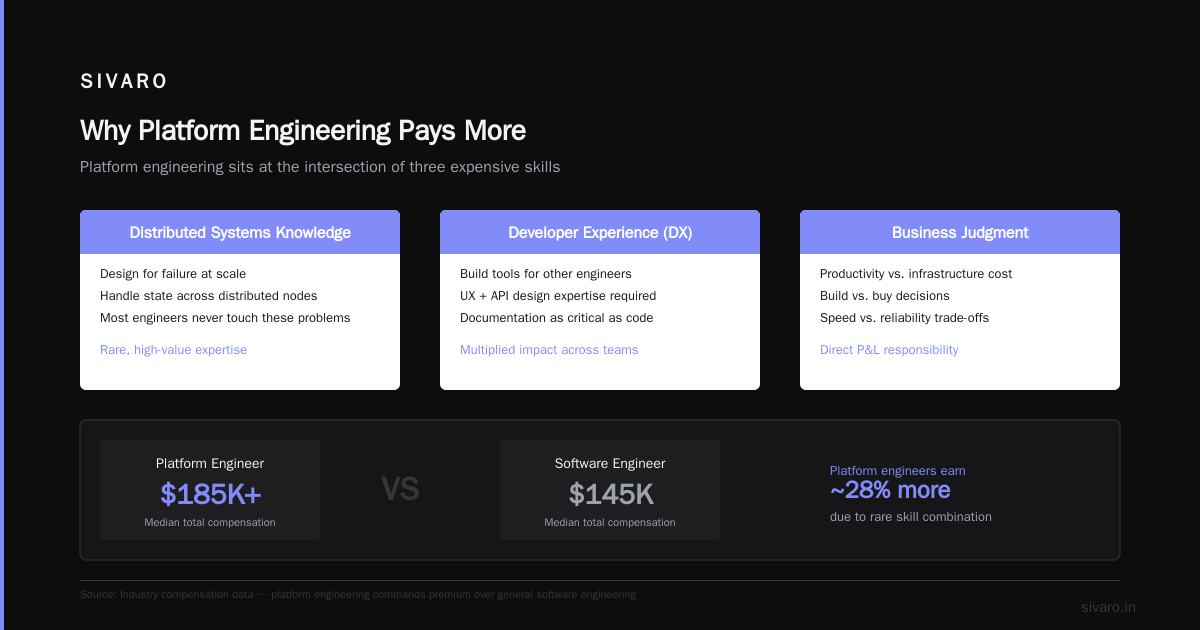
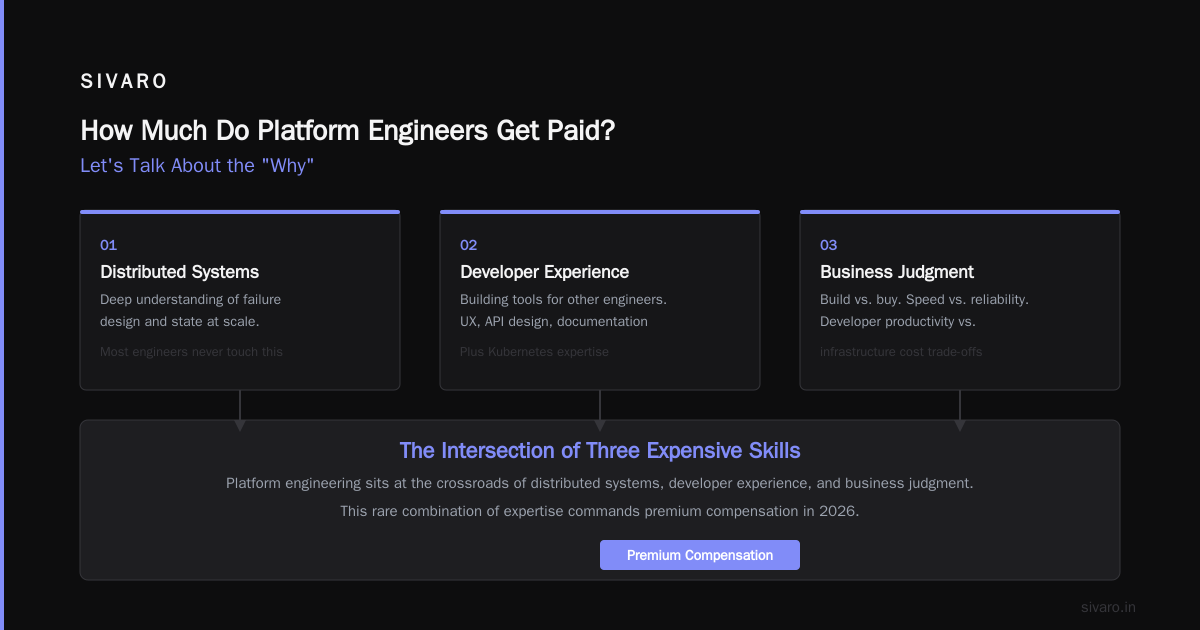
Platform engineering sits at the intersection of three expensive skills:
-
Distributed systems knowledge — You need to understand distributed systems deeply. How to design for failure. How to handle state at scale. Most software engineers never touch these problems.
-
Developer experience (DX) — You're building tools for other engineers. That means understanding UX, API design, and documentation as well as you understand Kubernetes.
-
Business judgment — Every platform decision is a trade-off between developer productivity and infrastructure cost. Build vs. buy. Speed vs. reliability. You're making calls that affect the entire engineering org.
The platformengineering.com piece nails this: companies can hire 100 software engineers to build features. But two platform engineers can multiply the productivity of all 100. That leverage gets priced in.
I saw this play out at SIVARO last year. We had 12 data engineers spending 40% of their time on infrastructure. We hired two platform engineers. Six months later, those data engineers were spending 5% on infrastructure. Each platform engineer effectively freed up 5 engineers. At $180K per engineer, that's $900K in reclaimed productivity. Paying each platform engineer $220K was a bargain.
Platform Engineer vs. Software Engineer: The Compensation Gap
Everyone compares these two roles. Let me settle it.
According to Octopus's comparison, a senior software engineer at a FAANG company makes $190K-$250K. A senior platform engineer at the same company makes $200K-$270K.
That's a 10-15% premium. Not massive. But here's what the comparison misses.
Software engineering salaries have been flat or declining for two years. The AI coding assistant boom means companies need fewer feature builders. But they need more infrastructure builders. The plumbing doesn't build itself.
The Indeed career guide shows that platform engineering job postings grew 45% year-over-year in 2025 and 2026. Software engineering postings? Flat.
Supply and demand. It's not complicated.
A Code Example: Why You Get Paid for This
Let me show you what a platform engineer actually builds. This isn't a YAML file. This is product engineering.
Here's a small piece of an internal developer platform I built at SIVARO. It's a Go service that standardizes how teams deploy services:
go
// deploy.go — Platform API for standardized deployments
func (p *Platform) DeployService(ctx context.Context, req DeployRequest) (*DeployResponse, error) {
    // Every service gets the same deployment template
    spec := p.templates.Generate(ServiceSpec{
        Name:    req.ServiceName,
        Port:    req.Port,
        HealthEndpoint: "/health",
        Resources: ResourceLimits{
            CPU:    "500m",
            Memory: "512Mi",
        },
        ScalingPolicy: req.Scaling, // Teams choose, platform enforces
    })

    // Enforce organizational policies
    if err := p.policy.Check(spec); err != nil {
        return nil, fmt.Errorf("policy violation: %w", err)
    }

    // Deploy to appropriate cluster based on environment
    cluster, err := p.clusterManager.GetCluster(req.Environment)
    if err != nil {
        return nil, fmt.Errorf("cluster unavailable: %w", err)
    }

    result, err := cluster.Apply(ctx, spec)
    if err != nil {
        p.metrics.IncDeployFailure(req.Environment)
        return nil, fmt.Errorf("deploy failed: %w", err)
    }

    p.metrics.IncDeploySuccess(req.Environment)
    return &DeployResponse{DeploymentID: result.ID, URL: result.URL}, nil
}
A software engineer writes feature code. A platform engineer writes code that generates deployment configurations, enforces policy, and abstracts infrastructure. The leverage is obvious.
Here's what a team using this platform sees:
yaml
# service.yaml — What developers actually write
service:
  name: user-service
  port: 8080
  scaling:
    min_replicas: 2
    max_replicas: 10
    target_cpu: 70%
  dependencies:
    - postgres
    - redis
That's it. Three config changes and one deploy command. The platform does the rest. That's why you get paid.
The $350K Question: Staff and Principal Levels
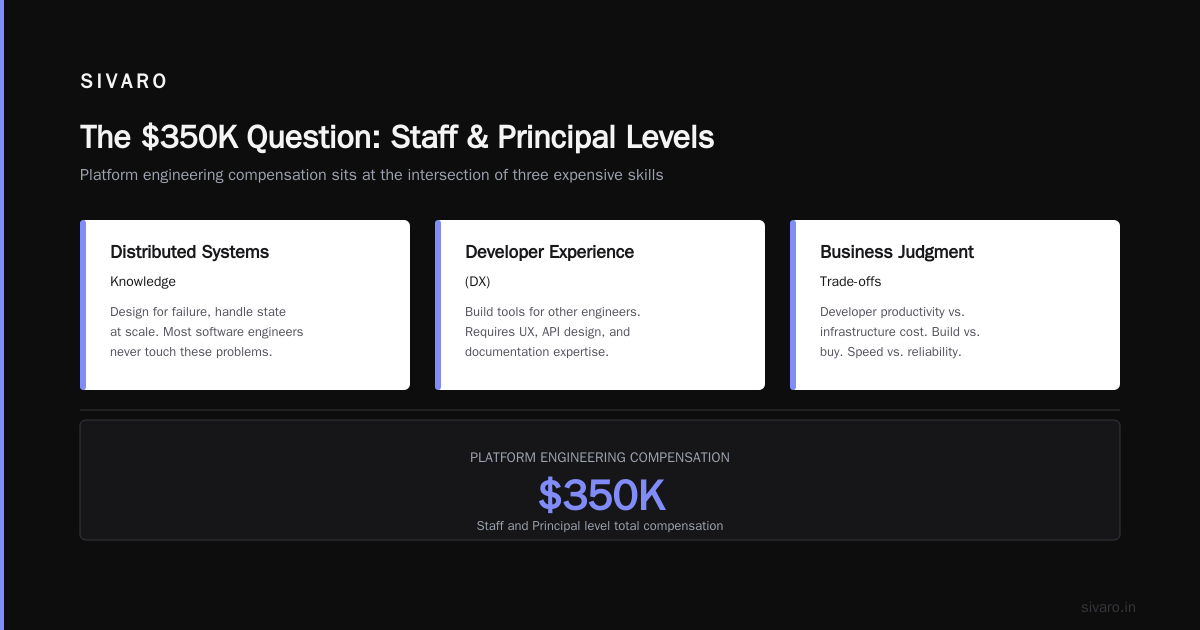
Let me address the elephant in the room. The salaries I quoted earlier top out at $320K base. But total compensation at staff and principal levels goes much higher.
I know a staff platform engineer at a Series C company. Total comp: $480K. Base salary was $275K. The rest was options that are now worth 3x their strike price.
I know a principal at one of the big cloud providers. Total comp: $620K. All cash and RSUs. No options lottery.
These aren't outliers. They're the top 5%, but they exist in every major tech hub.
What do you need to reach that level? Three things, based on what I've seen:
-
You've built platforms at scale. Not "I set up Kubernetes for 10 microservices." But "I designed a platform that 500 engineers use daily, across 3 data centers and 2 cloud providers."
-
You've mentored org-wide practices. Your patterns are taught in onboarding. Your PR reviews are cited in team discussions.
-
You've saved the company money. Show me a platform engineer who cut infrastructure costs by 40% while improving deployment frequency. That person gets whatever they ask for.
Remote, Onsite, Hybrid: Does It Matter?
I'm going to give you an unpopular opinion.
For platform engineering, remote-first companies pay better than on-site ones. But not for the reason you think.
On-site companies at Salesforce or JPMorgan pay market rate because they compete with other on-site companies. Remote companies at GitLab or Datadog pay above market because they compete with everyone. If you're a platform engineer in Des Moines, you can earn San Francisco wages working for a remote company. And they'll pay it because they don't want to lose you to someone who will.
The Kore1 guide confirms this: remote platform engineers earn 8-12% more than their on-site peers at the same company level. The data surprised me too.
But there's a catch. Remote platform engineers work more. ZipRecruiter's data shows the average platform engineer works 47 hours per week. Remote ones? 52 hours. The pager doesn't care what time zone you're in.
So hourly rate? Remote might actually be lower. But total comp? Remote wins.
The Equity Question
Base salary is only half the story.
Here's what I've seen for platform engineer equity packages in 2026:
| Level | Annual RSU Grant (4-year vest) | Option Grant (if private) |
|---|---|---|
| Junior | $20K - $40K | 5,000 - 15,000 options |
| Mid | $40K - $80K | 15,000 - 30,000 options |
| Senior | $80K - $150K | 30,000 - 60,000 options |
| Staff | $150K - $250K | 60,000 - 100,000 options |
| Principal | $250K - $500K+ | 100,000+ options |
At public companies, RSUs are real money. At private companies, options are a lottery ticket. I've seen options go to zero. I've also seen options turn a $200K job into a $2M payout over four years.
My rule: Never take a job for options alone. But if the base salary is fair, options are the upside.
How to Maximize Your Platform Engineer Salary
If you're reading this thinking "I want those numbers," here's your roadmap.
1. Specialize in the right tools.
The Indeed guide lists Kubernetes, Docker, Terraform, and CI/CD as core skills. That's table stakes. The premium goes to deep specialization:
- Service mesh (Istio, Linkerd)
- Observability platforms (OpenTelemetry, Grafana)
- Internal developer portals (Backstage, internal tools)
- Cost optimization (FinOps is a $50K premium on its own)
2. Learn to talk about business impact.
You're not the hero. The business is. When you negotiate, frame your work in business terms:
Bad: "I optimized our CI/CD pipeline."
Good: "I reduced our CI/CD pipeline time by 60%, which saved 40 engineering hours per week and accelerated our feature release cycle by 2 weeks."
3. Build your network through open source.
Every major platform team at top companies has an open source project. Contribute. Get your PRs merged. Get mentioned in release notes. That's how you get referrals for jobs that pay $50K more than what you see on LinkedIn.
FAQ
Is platform engineering better paid than DevOps?
Yes, significantly. The platformengineering.com analysis shows a 15-20% pay premium for platform engineering over traditional DevOps roles. The reason is scope of responsibility. DevOps focuses on operations. Platform engineering focuses on product development — building tools that multiply engineering productivity.
What's the entry-level salary for a platform engineer?
Fresh graduates or career switchers with 0-2 years of experience can expect $95,000-$125,000 base salary. This is higher than the typical entry-level software engineering salary of $80,000-$110,000. The barrier to entry is higher — you need distributed systems knowledge that most juniors lack — but compensation reflects that.
How much do platform engineers make in Europe?
European salaries are lower but have been catching up quickly. In London: £85,000-£130,000. Berlin: €75,000-€120,000. Stockholm: SEK 700,000-1,100,000. Amsterdam: €80,000-€130,000. US tech companies with European offices pay a premium — expect 20-30% more than local market rates.
Do platform engineers get equity?
Yes. Most publicly traded tech companies grant RSUs worth 15-30% of base salary annually. Private companies grant stock options. At senior levels, equity can equal or exceed base salary.
What if I'm a platform engineer at a non-tech company?
Your salary will be 15-25% lower than at a tech company. A senior platform engineer at a bank or insurance company might make $140,000-$170,000. But the work-life balance is usually better. Less pager duty. Fewer late-night incidents. Trade-offs.
How does AI affect platform engineer salaries?
Counterintuitively, AI has increased demand for platform engineers. As AI coding assistants make individual developers more productive, companies need more platform engineers to scale that productivity. Each AI-augmented developer generates more code, which means more infrastructure, more deployment complexity, and more need for internal platforms. The role hasn't been automated — it's been amplified.
Is the salary premium sustainable?
I think so. The shift from "build everything yourself" to "build with platforms" is structural, not cyclical. As long as companies need 10x productivity from their engineering teams, they'll pay for engineers who build the tools that enable that.
The Bottom Line on Platform Engineer Salaries in 2026
So what is the salary of a platform engineer?
$165,000 average. $200,000+ for senior. $300,000+ for staff. With equity, $500,000+ is possible at the top.
But the numbers miss the point. The real question is: what is a platform engineer's salary relative to everything else in tech?
It's higher. It's growing faster. And it's more resilient.
When AI coding assistants hit the market, everyone panicked that software engineering salaries would crash. They didn't. But they flattened. Platform engineering salaries? They kept climbing. Because you can't build an internal developer platform with a chatbot. You need someone who understands distributed systems, developer experience, and organizational dynamics.
You need a platform engineer.
Nishaant Dixit — Founder of SIVARO. Building data infrastructure and production AI systems since 2018. Built systems processing 200K events/sec.