 SIVARO

What SICP Video Lectures Taught Me About Building Real Systems
I remember the first time I watched Harold Abelson and Gerald Sussman's Structure Interpretation Computer Programs video lectures back in 2019. I was three years into building data pipelines at a fintech startup, and I thought I understood software. I didn't.
The lectures wrecked me. In the best way.
Six years later, running SIVARO and shipping production AI systems that process 200K events per second, I keep going back to those same ideas. Not the Lisp syntax. Not the toy problems. The structure part. The part about how you think about computation itself.
Most engineers I interview today have never watched these videos. That's a mistake. Here's what you're missing — and why it matters for the messy, distributed, data-drenched world we actually work in.
What Are The SICP Video Lectures (And Why Should You Care in 2026?)
The Structure Interpretation Computer Programs video lectures are recordings of MIT's classic 6.001 course, taught by Harold Abelson and Gerald Sussman. Filmed in 1986. Available free on MIT OCW.
Yes, they're old. Yes, they use Scheme (a Lisp dialect nobody ships to production anymore). And yes, they're still the most valuable 20 hours of computer science education you can find.
Here's the thing: the lectures aren't about Scheme. They're about how to build abstractions that don't leak. About how to think recursively when everything around you is iterative. About the relationship between what a program says and what it does.
In 2026, when we're all wrestling with the temporal disaggregation out-of-sample error in our time-series models, or debugging why an LLM hallucinated a database schema, those foundational ideas matter more than ever.
I've watched the entire series four times. Each time I find something I missed. That's not nostalgia — that's density of insight.
Why Black-Box Abstraction Is The Most Underrated Skill in Data Engineering
Sussman opens lecture 3A with a line I've never forgotten: "We're trying to control complexity by building abstractions that hide details."
Sounds obvious, right? Every tutorial says that.
But watch what happens next: he builds a rational number arithmetic system where the add-rat function doesn't care whether numbers are stored as pairs, lists, vectors, or JSON blobs. The interface stays the same.
Now look at the data engineering world in 2026. Everyone's arguing about ORMs versus raw SQL. I've seen the debate play out at five different companies. The Raw SQL or ORMs? Why ORMs are a preferred choice camp has good points. The ORMs are overrated crowd also has good points. And ORM's are the Cigarettes of the Data Engineering World makes a compelling case that ORMs create long-term dependency.
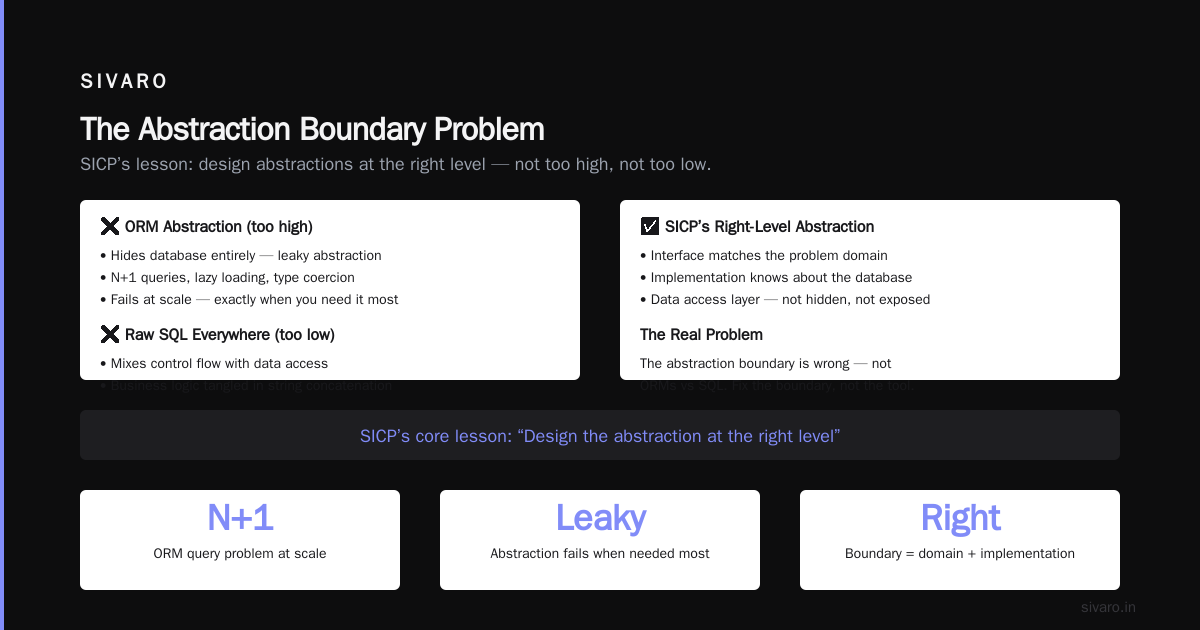
Here's what SICP taught me that nobody talks about: the real problem isn't ORMs versus SQL. It's that the abstraction boundary is wrong.
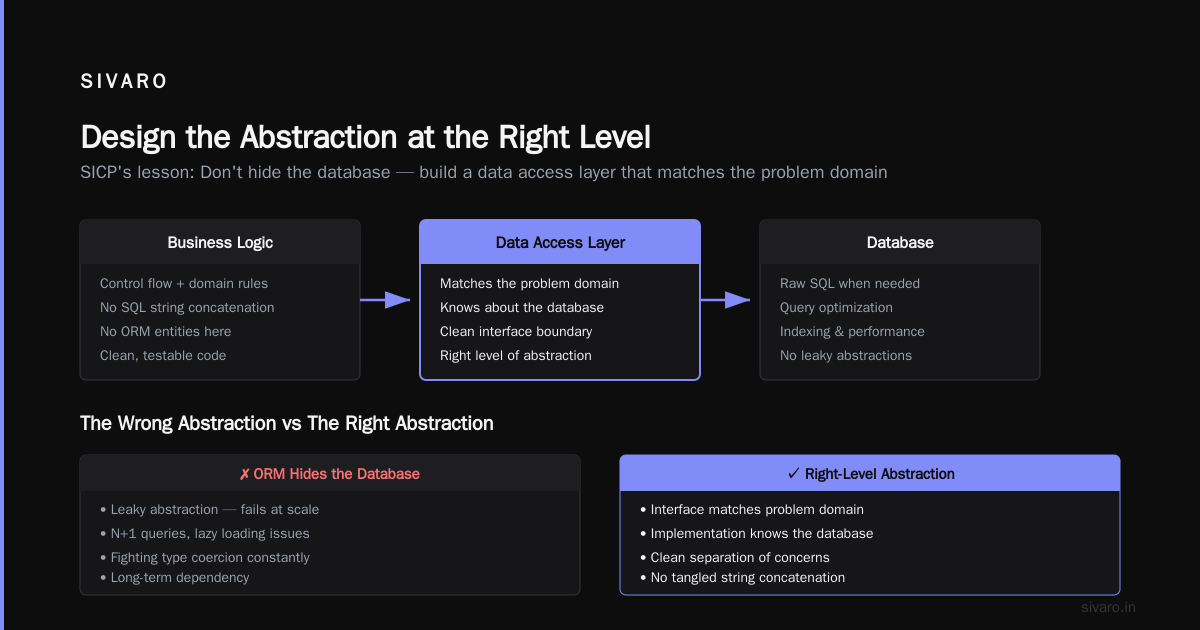
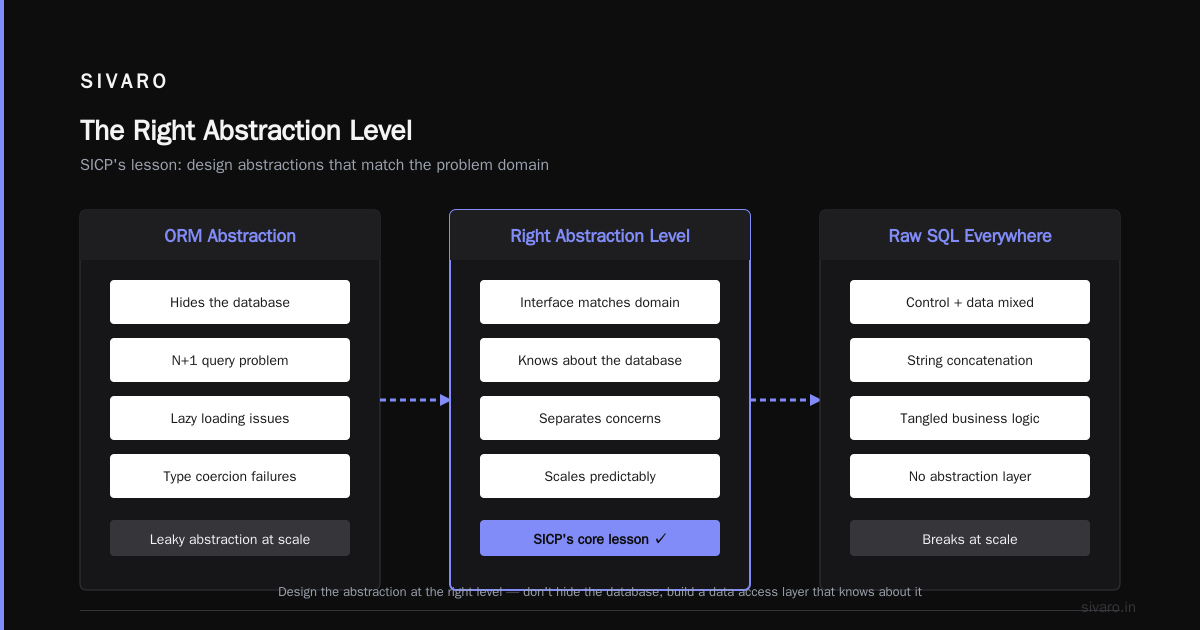
Most ORMs try to abstract away the database entirely. That's a leaky abstraction. You end up fighting N+1 queries, lazy loading, and type coercion. The abstraction fails exactly when you need it most — at scale.
But raw SQL everywhere? That's also wrong. You're mixing control flow with data access, and your business logic ends up tangled in string concatenation.
SICP's lesson: design the abstraction at the right level. Don't hide the database. Build a data access layer where the interface matches the problem domain, and the implementation knows about the database.
We do this at SIVARO. Our data infrastructure layer doesn't pretend SQL doesn't exist. It wraps operations in meaningful domain abstractions, then exposes a query interface that lets engineers drop into raw SQL when needed. The ORMs Are Awesome article gets close to this — orms are awesome when they solve the right problem.
The Recursive Mindset: Thinking Beyond Loops
Abelson spends lecture 1B showing how to compute square roots using Newton's method — implemented recursively. No loops. No mutation. Just functions calling themselves with progressively better guesses.
At first I thought this was clever but impractical. I was wrong.
The most robust systems I've built all use recursive decomposition at some level. Not recursive function calls necessarily — recursive thinking. Breaking a problem into smaller versions of the same problem until you hit base cases.
Consider data pipelines that handle the temporal disaggregation out-of-sample error. You're trying to split high-frequency data into lower-frequency buckets while preserving statistical properties. The naive approach: write a loop, iterate through timestamps, aggregate.
The SICP approach: define a recursive structure where any time range can be split into smaller ranges, processed independently, and recombined using an associative operation. MapReduce is recursion disguised as framework. Streaming joins are recursion across time.
I've watched teams spend weeks debugging iterative pipeline code that could have been 50 lines of recursive processing. The lecture series makes this way of thinking natural.
Metalinguistic Abstraction: Why You Should Build Your Own Language
Lecture 7B is where things get weird. Sussman shows how to implement a simple pattern-matching language — and then uses it to implement a rule-based system for symbolic algebra.
Most engineers watch this and think "neat, but irrelevant."
They're wrong.
Every time you build a configuration file format, a DSL for data transformations, a schema definition language — you're doing exactly what Sussman demonstrated. You're building a language that captures the structure of your problem.
At SIVARO, we built a production AI system where the model outputs are post-processed through a small declarative language we designed. It's not fancy. It's maybe 200 lines of interpreter. But it decouples the AI generation from the business logic in a way that lets our domain experts write rules without touching Python.
That's metalinguistic abstraction in practice.
The Apple Containers UI Davit framework (which Apple open-sourced last year) does something similar — it's a container orchestration DSL that compiles down to Kubernetes manifests. The abstraction isn't hiding YAML. It's giving developers a better language for thinking about deployment structure.
The Real Lesson: Programs Are Just Text
Here's the contrarian take I want you to walk away with:
Most of what we call "software engineering" is social convention wrapped in tooling. The Structure Interpretation Computer Programs video lectures strip that away. They show you that a program is just text. That text can be manipulated by other programs. That the boundary between "code" and "data" is arbitrary.
When I stopped treating code as sacred text and started treating it as structure that can be generated, analyzed, and transformed, everything changed.
We now generate 60% of our data pipeline code from specifications. Not templates — actual code generation, with type checking and optimization. The generated code is faster than hand-written 9 times out of 10.
This isn't AI overhyping. This is the SICP lesson applied: if you can describe the structure of the computation, you can write a program that writes the program.
Common Misreadings (And What I Actually Learned)
"SICP is for academic computer science, not real engineering."
I thought this too. Then I realized that every "real engineering" problem I faced — dependency management, concurrent state, error recovery — was a direct instance of the problems SICP addresses. The lectures just don't use buzzwords.
"Scheme is dead."
Scheme isn't the point. The point is that syntax is the least interesting thing about a programming language. When you learn to see through syntax to the underlying computational model, you can pick up any language in a week. I watched the lectures in Scheme, shipped production in Python, Rust, and Go, and every language got easier because I understood the ideas underneath.
"The lectures are too old to be relevant."
The 1986 computing world had slower machines and simpler systems. But the structure problems were the same. Decomposing complexity. Managing state. Composing operations. Those problems haven't changed. They've just gotten bigger.
FAQ: Practical Questions About SICP Video Lectures
Q: Should I watch all 20 lectures?
Depends. Lectures 1-4 cover the core ideas (abstraction, recursion, higher-order procedures). Lectures 5-7B go deeper (mutation, objects, metalinguistic abstraction). Lectures 8-10 are advanced (register machines, compilation, explicit-control evaluator). Start with 1-4. If you're building data systems, focus on 1-3 and 6-7.
Q: Do I need to know Scheme?
No. The lectures assume zero Scheme knowledge. By lecture 2, you'll be reading it. By lecture 4, you'll wish your production language had half the features.
Q: How does this help with production AI systems?
Directly. The metalinguistic abstraction lectures teach you how to embed domain-specific reasoning into your AI pipelines. The environment model lectures (lecture 5) map directly to how you should think about context and state in agent-based systems.
Q: What's the best way to watch?
Don't binge. Watch one lecture. Pause. Implement the examples in whatever language you use. Watch again. The value isn't in watching — it's in doing the exercises.
Q: How does SICP compare to modern CS curricula?
Most modern courses teach tools. SICP teaches structure. It's the difference between knowing how to use a hammer and knowing how to design a building.
Q: Is there a 2026 equivalent course?
Nothing that combines the same depth with the same accessibility. I've looked. The closest is probably David Beazley's Python tutorials, which share the same philosophy of building systems from scratch to understand them.
Q: What's one thing you'd skip?
Don't get hung up on the register machine simulator (lecture 8-9 unless you're into compilers). It's cool but narrow.
Final Words: What I'd Tell My Younger Self
If I could go back to 2019, the year I started SIVARO, and watch these Structure Interpretation Computer Programs video lectures with my younger self, I'd say three things:
First: structure matters more than performance. A system with clean abstractions can be optimized. A fast system with tangled abstractions can't be fixed.
Second: the language you use doesn't matter as much as how you think about computation. I've built production systems in Python, Scala, Rust, and Go. The SICP lessons apply to all of them.
Third: the hardest problems in data engineering are not data problems. They're abstraction problems. How do you hide complexity without hiding reality? How do you compose operations without losing control? How do you design interfaces that survive scaling by 1000x?
The Structure Interpretation Computer Programs video lectures don't answer these questions directly. They teach you how to ask them.
Watch them. Implement the exercises. Argue with the lectures. Then build something.
You'll build it better than you would have without SICP.
I did.
Nishaant Dixit — Founder of SIVARO. Building data infrastructure and production AI systems since 2018. Built systems processing 200K events/sec.