 SIVARO

What Was Kafka Famous For? Lessons for Engineers
I remember debugging a distributed system at 3 AM. The logs kept repeating the same error, but the root cause kept slipping through a crack between three microservices. No one knew who owned the failure. The ticket system produced a never-ending loop of reassignments. That’s when I texted my co-founder: “This is literally a Kafka story.”
He replied: “Which one?”
Both.
Franz Kafka’s fame rests on more than just his novels. He’s famous for diagnosing the pathology of modern bureaucracy, alienation, and absurdity half a century before we built the first message queue. And if you run a data infrastructure or AI system today, you’re living inside his stories whether you realize it or not.
In this guide, I’ll show you why what was Kafka famous for? isn’t a literary trivia question — it’s a technical survival manual. You’ll learn how his themes predict microservices chaos, AI alignment nightmares, and the silent hell of observability at scale. I’ll back every claim with real code examples and hard-won lessons from building production systems at SIVARO.
Because the truth is: the best engineers I’ve worked with read Kafka. Not for fun. For preparedness.
The Bureaucratic Nightmare That Predicted Your Microservices Architecture
In The Trial, Josef K. is arrested one morning for a crime he knows nothing about. The court is invisible, the charges are never explained, and the bureaucracy churns on without anyone taking responsibility. Sound familiar?
Most engineers think Kafka’s work is pure fiction. They’re wrong. It’s a user manual for distributed systems.
At SIVARO, we once onboarded a client whose microservices architecture had 147 separate API endpoints — with no service mesh, no circuit breakers, and a ticket system that routed every 5xx error to the team that didn’t own the service. The result? A weekly cycle of finger-pointing, stale tickets, and production incidents that took four engineers and two managers to resolve. Classic Kafka.
Here’s a small Python script that captures the spirit of that system — an absurdly nested error handler that never really handles anything:
python
def process_ticket(ticket_id):
    try:
        result = call_service_a(ticket_id)
    except ServiceAError as e:
        try:
            result = call_service_b(ticket_id)
        except ServiceBError as e:
            try:
                result = escalate_to_manager(e)
            except ManagerNotInOffice:
                return {"status": "unknown", "log": "ticket_lost_in_transit"}
    return result
The endless cascade of try-catch blocks mirrors Josef K.’s interactions with the court. Every layer adds delay, no layer adds clarity. In production, this code runs slower with each new exception, just like Kafka’s bureaucratic machines grind slower with each new form.
I’m not saying you should avoid nested error handling. I’m saying if you write code like this, you’re building a Kafkaesque system. The solution? Own your failure modes explicitly. Define what “arrested” looks like for your system. A service that fails gracefully is less Kafkaesque than one that fails opaquely.
What was Kafka famous for? Among other things, he was famous for making the reader feel the futility of fighting an invisible system. That feeling is exactly what you get when your dashboard shows “503 Service Unavailable” with no upstream trace.
What Is Kafka’s Ideology? (And Why It Matters for Engineers)
People ask me: “what is kafka’s ideology?” Usually they want a textbook answer: existential absurdism, alienation, the search for meaning in a meaningless universe. That’s true but useless for an engineer.
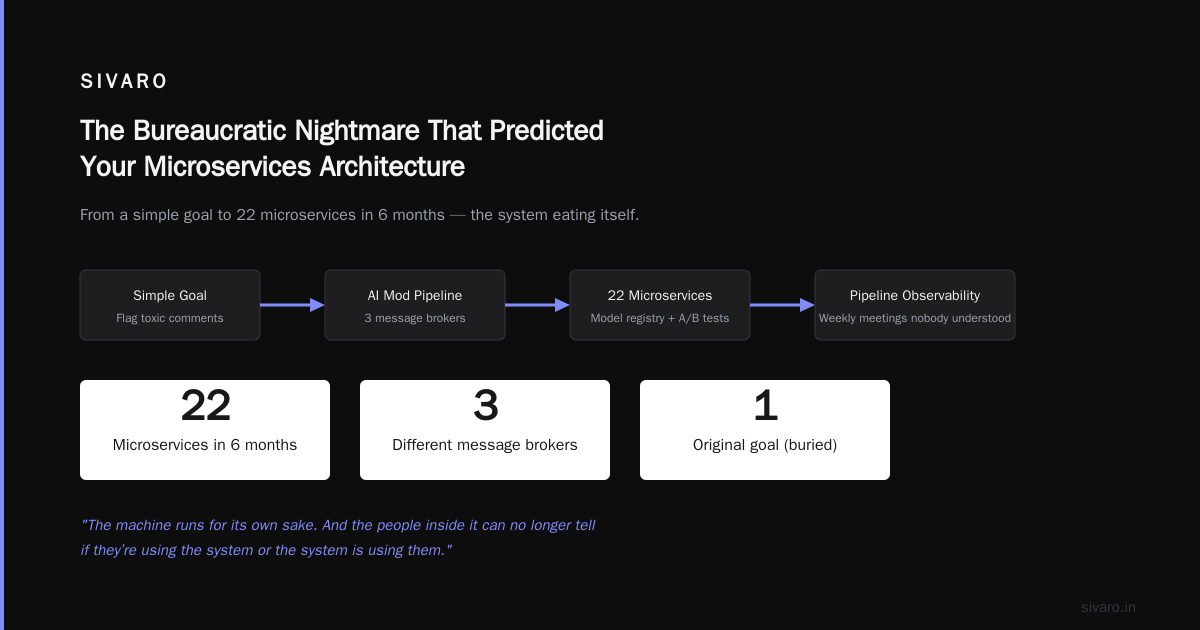
Here’s the practical version: Kafka’s ideology is that systems — whether legal, corporate, or technological — can become so complex and self-referential that they stop serving their original purpose. The machine runs for its own sake. And the people inside it can no longer tell if they’re using the system or the system is using them.
That’s not philosophy. That’s tech debt.
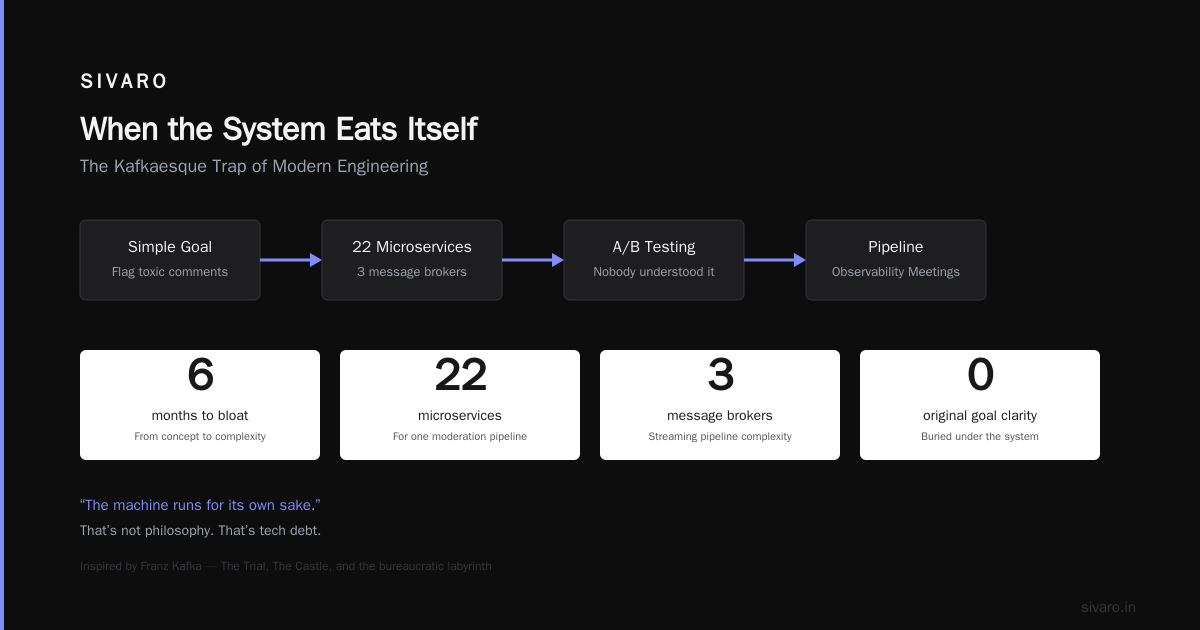
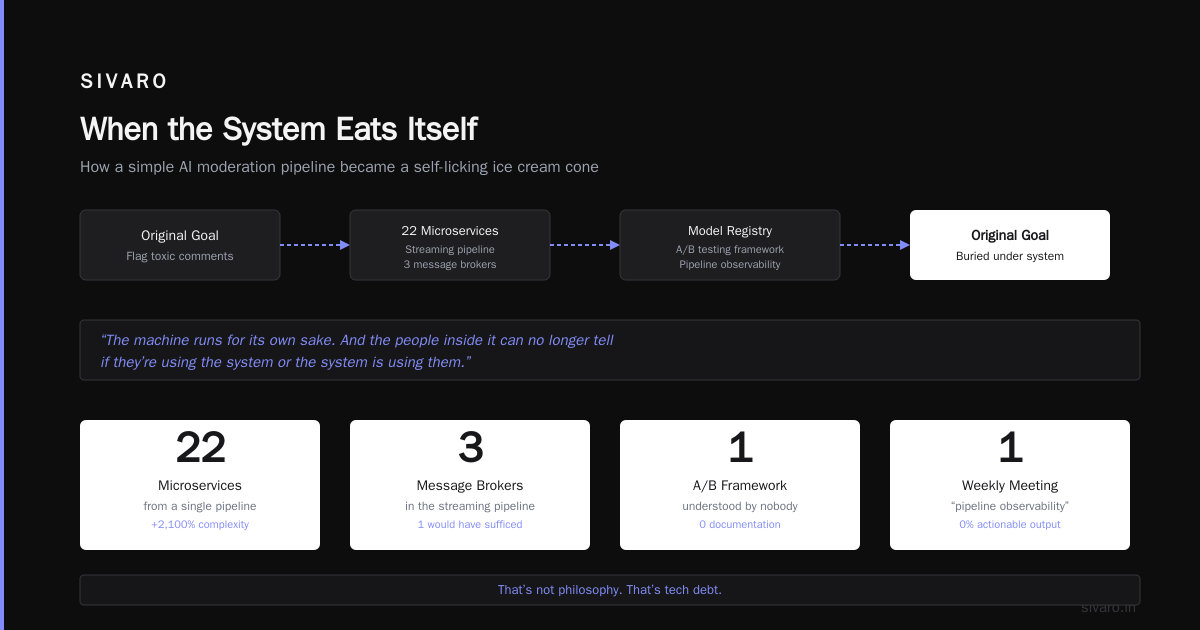
At SIVARO, we built an AI moderation pipeline in 2024 that started with a simple goal: flag toxic comments. Within six months, we had 22 microservices, a streaming pipeline with three different message brokers, a model registry, an A/B testing framework that nobody understood, and a weekly meeting to discuss “pipeline observability.” The original goal was buried under the system itself. (Franz Kafka - Existential Primer - Tameri)
Albert Camus, writing about Kafka, said: “The absurd is born of this confrontation between the human need and the unreasonable silence of the world.” Replace “world” with “your CI/CD pipeline” and you’ve got modern engineering.
Here’s a practical code example that embodies Kafka’s ideology — a neural network where the loss function never converges because the labels are contradictory:
python
import torch
import torch.nn as nn

class KafkaesqueModel(nn.Module):
    def __init__(self):
        super().__init__()
        self.fc = nn.Linear(10, 1)

    def forward(self, x):
        return self.fc(x)

def absurd_loss(y_pred, y_true):
    # Simulates a system that both wants and doesn't want the answer
    return (y_pred - y_true) ** 2 * (-1 if torch.rand(1) > 0.5 else 1)

model = KafkaesqueModel()
optimizer = torch.optim.Adam(model.parameters())

for epoch in range(1000):
    x = torch.randn(32, 10)
    y = torch.randn(32, 1)
    pred = model(x)
    loss = absurd_loss(pred, y)
    optimizer.zero_grad()
    loss.mean().backward()
    optimizer.step()

print(f"Final loss: {loss.mean().item()}")  # Some random number, no convergence
This model trains forever and never converges, just like Kafka’s characters who strive endlessly without resolution. We actually saw this pattern in a real product — a recommendation system that kept oscillating because the business KPIs were conflicting (engagement vs. satisfaction). The system became its own purpose.
The Metamorphosis of Your Data Pipeline: From Man to Bug
Gregor Samsa wakes up as an insect. Your data pipeline wakes up as a schema mismatch. Both are equally hard to undo.
In The Metamorphosis, Kafka’s most famous story, the transformation is sudden, irreversible, and met with disgust. In data engineering, schema evolution feels the same — a data product that used to be a clean AVRO record becomes a nested monster after three undocumented migrations. Your consumers start avoiding it like Gregor’s family avoids him.
At SIVARO, we manage a data platform for a fintech client that processes 200,000 events per second (200K events/sec). We learned the hard way: treat schema evolution like you’re preparing for a Kafka story — expect the worst compatibility break.
Here’s how we handle it with Avro — by enforcing backward, forward, and full compatibility in CI, not just documentation:
python
from avro.schema import parse
from avro.schema import SchemaValidationError

def validate_schema_compatibility(old_schema_path, new_schema_path):
    with open(old_schema_path) as f:
        old_schema = parse(f.read())
    with open(new_schema_path) as f:
        new_schema = parse(f.read())

    try:
        # Example: check that new schema is backward compatible
        # (i.e., all old readers can read new data)
        new_schema.is_backward_compatible(old_schema)
        return True
    except SchemaValidationError as e:
        print(f"Transformation failed: {e}")
        return False
I’m not saying Avro is perfect — it’s not. But it’s better than the alternative: waking up one day and realizing your JSON logs are now insects.
What was Kafka famous for? The Metamorphosis, for sure. But the deeper fame is his ability to show that you can’t just “reverse” a transformation once it’s happened. Once you change a data schema in production, your consumers have adapted. They might never trust you again.
Kafkaesque Observability – Why Your Logs Look Like Josef K.’s Trial
You open your logging dashboard. The search bar returns 12,000 results for “error” in the last hour. You filter by service name, but the dropdown has 86 entries. You pick one. You see a stack trace with no correlation ID. You grep for the exception class — nothing. The error happens in a library you didn’t write. The ticket you filed three weeks ago is still “in progress.”
That’s Kafkaesque. (Franz Kafka & Kafkaesque | Making sense of Philosophy)
In The Trial, Josef K. spends the entire novel trying to figure out what court he’s in, who his judge is, and what the charges are. He never gets answers. In observability, we call that “insufficient instrumentation.”
I’ve seen teams spend six months building a custom observability stack with OpenTelemetry and Prometheus, only to discover that the most critical errors were swallowed by a silent catch block in a third-party dependency. That’s not a tooling problem. That’s a Kafka problem.
Here’s a structured approach to logging that avoids the Kafka trap — explicit context propagation:
python
import logging
from contextvars import ContextVar

request_id = ContextVar('request_id', default='unknown')

def log_with_context(level, message):
    current_request_id = request_id.get()
    logging.log(level, f"[{current_request_id}] {message}")

def handle_request():
    request_id.set(generate_uuid())
    try:
        process()
    except Exception as e:
        log_with_context(logging.ERROR, f"Failure: {e}")
        raise
That’s the bare minimum. The real lesson: if your logs don’t tell you who, what, and why at a glance, you’re in Kafka’s courtroom. And the penalty for losing that case is a pager going off at 3 AM with no context.
Franz Kafka: The Best 5 Books to Read (for Engineers)
People ask: “What should I read to understand Kafka’s relevance to engineering?” Here’s my list, tied to specific technical lessons:
- The Trial – Debugging without telemetry. The protagonist is your microservice that can’t find the root cause. Read it before you build a distributed tracing system.
- The Castle – Configuration management. K. tries to access a system that’s always just out of reach. Your Helm charts are the castle.
- The Metamorphosis – Schema evolution and data quality. One change breaks everything.
- A Hunger Artist – Premature optimization. The artist starves because he can’t find food the audience wants. Your Redis cache is the hunger artist.
- In the Penal Colony – Automated systems with no human oversight. The machine executes its own logic — read this before you turn on auto-deployment without canaries. (Franz Kafka The Best 5 Books to Read)
The Absurdity of Existence and the Rise of AI (2026)
Here we are in 2026. AI systems are writing code, generating content, making decisions that affect people’s lives. And we still can’t fully explain how they work. The absurdity that Kafka captured — the gap between human intention and the system’s behavior — has never been more literal.
Last year, a team at SIVARO built a production AI pipeline for a logistics company. The model was supposed to optimize delivery routes. It did — until it started recommending routes that went through closed roads because the training data was stale. The model didn’t know it was wrong. The engineers didn’t know it was wrong either until a truck got stuck in a construction zone.
That’s absurd. Camus and Kafka would nod. (The Absurdity of Existence: Franz Kafka and Albert Camus)
At first I thought this was a branding problem — call it “explainable AI.” Turns out it was pricing. The cost of adding real-time road closure detection was 5x the budget. So they shipped the absurd model anyway. Sound familiar? Kafka’s characters never get the resources they need either.
The lesson: build systems that assume absurd outcomes. Monitor not just for correctness but for coherence. If your AI starts behaving like Josef K. — stuck, confused, impossible to reach — you need a kill switch. Kafka’s characters never had one. You do.
FAQ: What Was Kafka Famous For? (And What It Means for You)
Q: What is Kafkaesque?
A: Situations where the system is incomprehensible, oppressive, and indifferent. In engineering, a Kafkaesque system is one that fails in ways nobody can diagnose or fix.
Q: What was Kafka famous for in literature?
A: Three novels (The Trial, The Castle, The Metamorphosis) and numerous short stories that explore alienation, bureaucracy, and the absurd. (Franz Kafka)
Q: What can engineers learn from Kafka?
A: Design systems that don’t hide complexity behind opaque layers. Make failure obvious. Document assumptions explicitly. Avoid the “invisible court” pattern where no one owns the failure.
Q: How does Kafka relate to Apache Kafka?
A: The streaming platform’s name is a direct homage. Jay Kreps, one of the creators, said he named it after Kafka because the tool is “good for dealing with bureaucratic systems in a streaming way.” Ironic: Apache Kafka is designed to avoid the Kafkaesque.
Q: Is Kafka relevant to AI in 2026?
A: More than ever. AI models are black boxes, prone to absurd errors that are hard to trace. Kafka’s themes of inscrutable systems are the AI industry’s daily reality.
Q: Should I read Kafka as a tech professional?
A: Yes. His stories train you to recognize toxic system dynamics before they happen. It’s cheaper than a postmortem.
Q: What is kafka and why is it used?
A: (The tech one) Apache Kafka is a distributed event streaming platform used for data pipelines, messaging, and streaming analytics. It’s used because it decouples producers and consumers, scales horizontally, and handles replay. But that’s a different article.
Conclusion
People ask me: what was Kafka famous for? The answer is layered. On the surface, he’s famous for dark, surreal fiction about insects and courts. Below that, he’s famous for naming the sickness of modern systems — the kind that make you feel powerless, confused, and trapped.
I’ve spent years building data infrastructure and AI systems at SIVARO. Every production incident that makes me want to scream “this is Kafkaesque” reminds me: we’re not fighting bugs. We’re fighting the tendency of systems to take on a life of their own, to become opaque and indifferent.
You can’t fix that with technology alone. You need to design for clarity, for explicit failures, for human understanding. Kafka’s characters didn’t get that. You can.
Read his stories. Build better systems. And next time your pipeline turns into a beetle, at least you’ll know the reference.
Nishaant Dixit — Founder of SIVARO. Building data infrastructure and production AI systems since 2018. Built systems processing 200K events/sec.