 SIVARO

What Will a Platform Engineer Do? A 2026 Guide
So I’m sitting in a coffee shop in Bangalore in 2021, talking to a VP of Engineering from a Series B fintech. He’s proud of his team. “We make our own CI/CD pipelines,” he says. “We’re so fast.”
I ask him who maintains them. Long pause. “Everyone? A few ops guys?”
That team was running 150 microservices on raw Kubernetes clusters wired together with shell scripts. Velocity was dying. The ops guys were drowning. No one owned the platform. That’s what happens when you don’t have a platform engineer.
Fast forward to 2026. Every serious product engineering company has a platform team. But what will a platform engineer do? If you’re hiring for one — or becoming one — you need the real answer. Not the buzzword version.
I’ve been building data infrastructure and production AI systems since 2018 at SIVARO. I’ve seen platform engineering evolve from a side gig into a distinct discipline with its own salaries, tools, and career track. Here’s what I know.
The Role Isn’t What You Think
Most people think a platform engineer is just a DevOps rebrand. They’re wrong. DevOps was about culture and pipelines. Platform engineering is about productizing internal infrastructure.
A platform engineer doesn’t “manage servers.” They build abstractions. Internal developer platforms (IDPs). Self-service tools. Golden paths that let application engineers deploy, observe, and debug without needing a ticket to infrastructure.
At first I thought this was a branding problem — turns out it was a compensation problem. Companies that treat platform engineers as glorified sysadmins pay like sysadmins. Companies that treat them as product builders pay like staff engineers. The Platform Engineer Salary Guide 2026 shows a senior platform engineer in San Francisco clearing $220K base. In San Diego, Indeed reports a median of $152K as of July 2026. That’s not DevOps money.
Why the premium? Because you’re not just running YAML. You’re designing a product whose users are your colleagues. You’re making decisions that affect the entire engineering org’s velocity. That’s leverage.
Core Responsibilities: What Will a Platform Engineer Do Every Day?
Let’s get concrete. Based on my experience and the Port.io job description, here are the six things a platform engineer does in 2026:
1. Build and Maintain Internal Developer Platforms
You own the control plane. Your customers are developers who want to deploy a new microservice without reading 20 pages of runbooks.
yaml
# Example: Backstage template for a new Go service
apiVersion: scaffolder.backstage.io/v1beta3
kind: Template
metadata:
  name: go-service-template
  title: Go Microservice with PostgreSQL
spec:
  owner: platform-team
  parameters:
    - title: Service Name
      properties:
        serviceName:
          type: string
          pattern: '^[a-z0-9-]+$'
  steps:
    - id: fetch
      name: Fetch Skeleton
      action: fetch:template
      input:
        url: ./skeleton
        values:
          serviceName: '${{ parameters.serviceName }}'
    - id: create-repo
      name: Create GitHub Repo
      action: github:repo:create
      input:
        repoUrl: 'github.com?repo=${{ parameters.serviceName }}'
That template took me two hours to write. It eliminated six hours of manual work per new service. Multiply by 50 services a year. That’s 300 hours saved — for the entire org.
2. Design Golden Paths and Reference Architectures
Golden paths aren’t constraints. They’re liberating defaults. You pick the stack: Go or Kotlin, Skaffold or Tilt, Cloud SQL or Aurora. You document why. You keep them updated.
If an application team wants to go off-path, that’s fine — but they own the maintenance cost. Platform engineers don’t gatekeep; they align incentives.
3. Automate Everything That Hurts
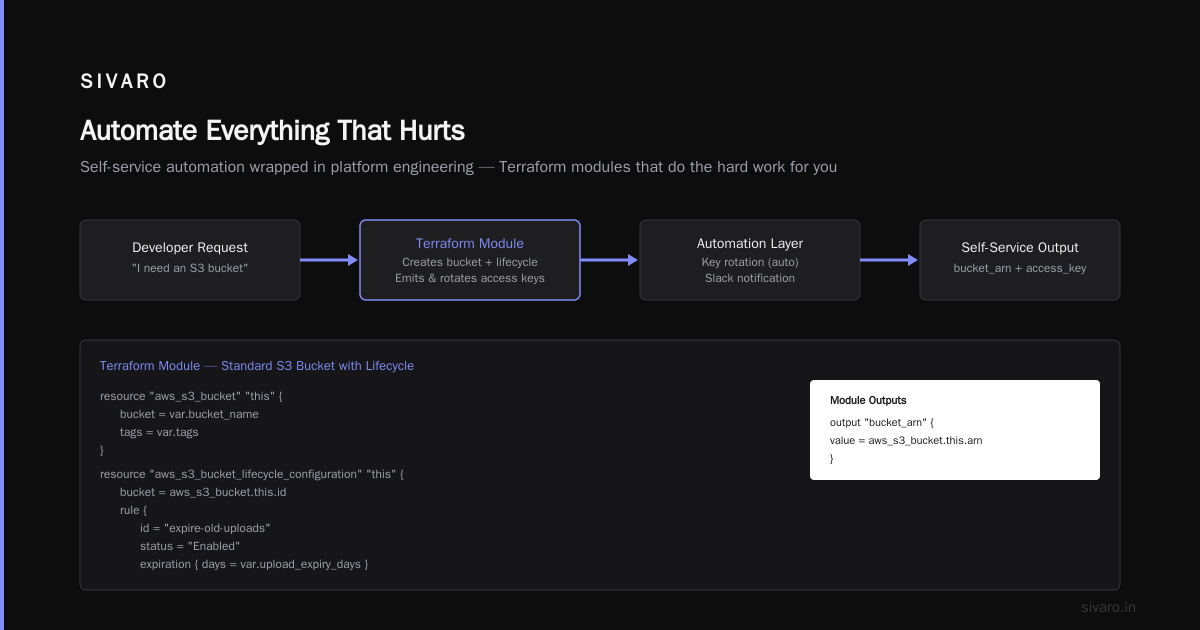
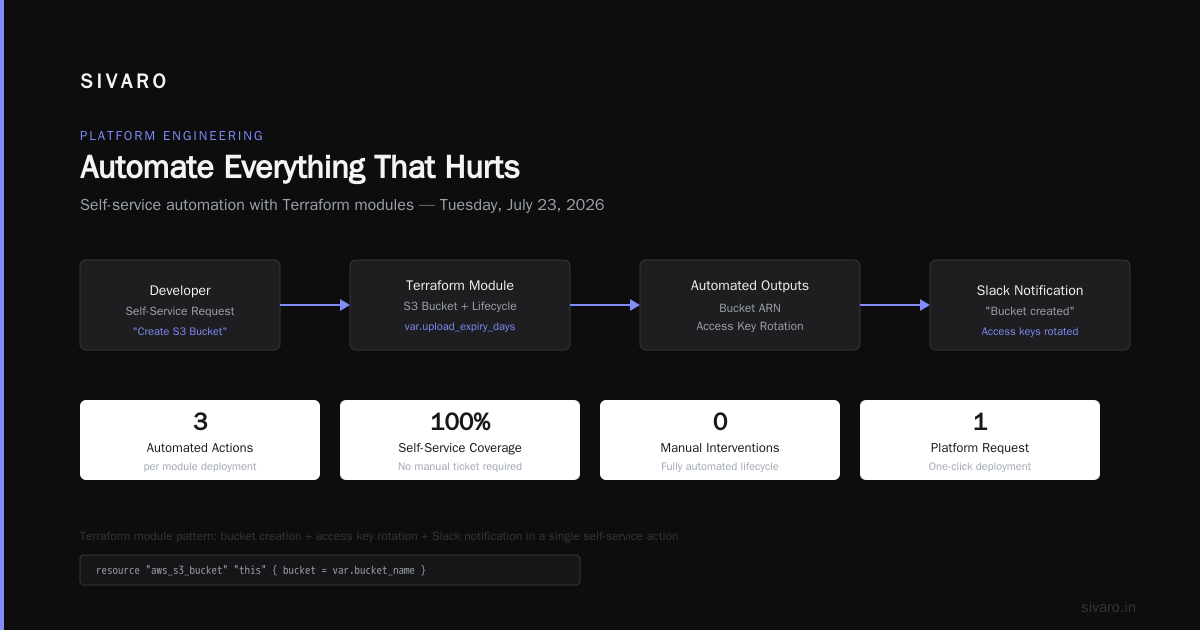
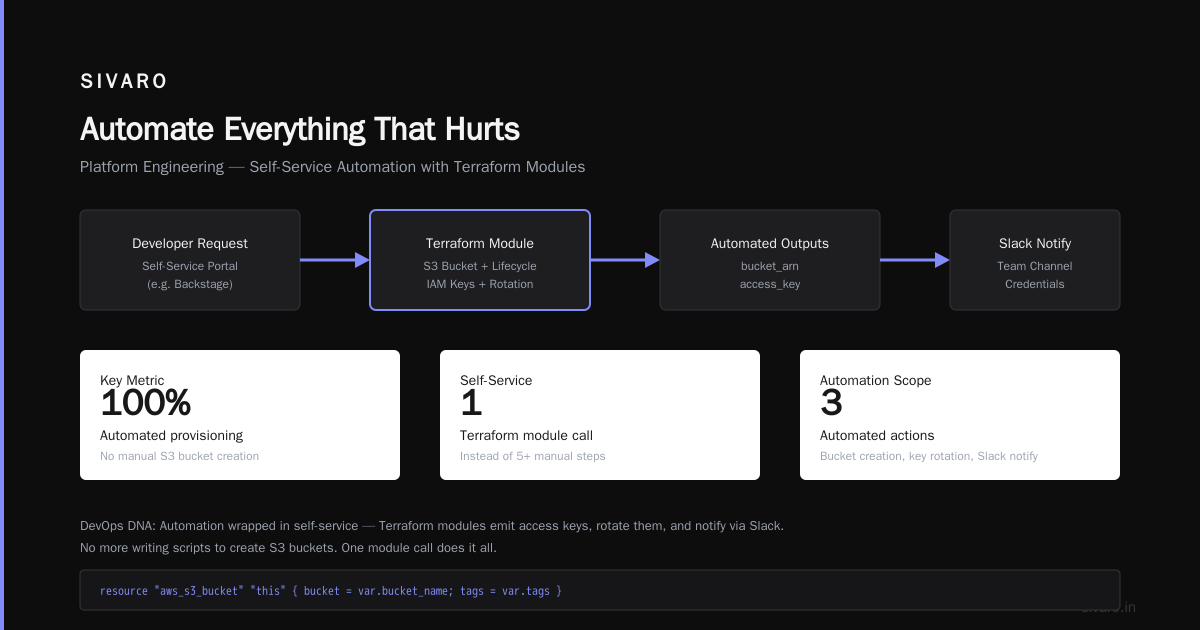
This is the DevOps DNA. But in platform engineering, automation is wrapped in self-service. You don’t write a script to create S3 buckets. You write a Terraform module that creates the bucket and emits the access keys and rotates them and sends a Slack notification.
hcl
# Example: Terraform module for a standard S3 bucket with lifecycle
resource "aws_s3_bucket" "this" {
  bucket = var.bucket_name
  tags   = var.tags
}

resource "aws_s3_bucket_lifecycle_configuration" "this" {
  bucket = aws_s3_bucket.this.id

  rule {
    id     = "expire-old-uploads"
    status = "Enabled"
    expiration {
      days = var.upload_expiry_days
    }
  }
}

output "bucket_arn" {
  value = aws_s3_bucket.this.arn
}

output "access_key" {
  value     = aws_iam_access_key.this.id
  sensitive = true
}
Platform engineers don’t pass the hat for every new storage request. They say “use module v3.2.0, fill in a YAML, done.”
4. Maintain the Developer Experience (DX) Backbone
CI/CD pipelines, container registries, artifact repositories, Secret stores, observability stacks — you make these work reliably. When a developer says “the build is slow,” you profile the pod resource limits, not the code. When they ask “why is my latency spiking,” you add a RED metrics dashboard, not a prayer.
5. Manage Infrastructure as Code (IaC) at Scale
You own the main.tf or the ArgoCD app-of-apps. You review pull requests that change production networking. You enforce policies: no public S3 buckets, mandatory encryption, cost tags.
In 2026, we also see AI-powered IaC generators. But the platform engineer still validates them. I tested Copilot for Terraform in 2024. It generated a resource block that would have exposed a database publicly. You still need humans who understand blast radius.
6. Onboard and Educate
This is the part most job descriptions miss. Platform engineers write docs. They give brown bags. They answer questions in Slack. They fight the friction.
If you hate teaching, platform engineering is not for you. You will spend 30% of your time enabling other engineers. That’s the product part.
The Shift Left — Platform as Product
In 2023, a Gartner report said 80% of large enterprises would have platform teams by 2026. That prediction looks conservative. I see it happening across startups too.
But here’s the catch: building a platform doesn’t automatically improve velocity. You have to treat it like a product. That means:
- User research: Interview 10 developers. Find their biggest friction points.
- Roadmap: What ships this quarter? (Hint: not the fancy service mesh — the simple image builder that’s broken.)
- SLAs: Uptime of the build pipeline, response time for deployments, time to resolve common issues.
- Metrics: Time from commit to production, onboarding time for new engineers, number of support tickets for the platform team.
Without product thinking, you build a complex internal tool that nobody uses. We saw that at a client in 2022: they spent six months building a custom deployment portal with a gorgeous React frontend. Developers hated it because it required more clicks than kubectl apply. The platform team ignored their own users.
Don’t be that team.
Skills That Matter in 2026
Based on what I hire for and what Port.io’s job description lists, here’s the real stack:
- Kubernetes: Still the assembly language of infrastructure. You need to understand scheduling, networking, storage, and operators. Not just kubectl, but how admission controllers work.
- Terraform/OpenTofu: IaC is table stakes. Bonus for Pulumi (I prefer it for stateful applications).
- CI/CD: GitHub Actions, GitLab CI, ArgoCD. Know the difference between push and pull models.
- Observability: Prometheus, Grafana, Datadog, or open telemetry. You need to answer “is the system healthy?” in under 30 seconds.
- Developer portals: Backstage, Port, or internal tools. This is the 2026 differentiator.
- Programming: Go or Python for tooling. You’ll write operators, controllers, and automation scripts daily.
- Security basics: IAM least privilege, Secret management (Vault, AWS Secrets Manager), SBOM generation.
- Communication: The softest skill with the hardest ROI. Explain why you’re deprecating DockerHub in favor of ECR so that the frontend team understands.
Compensation Reality Check
Let’s talk money. The Glassdoor average for a platform engineer in the US is $136K as of mid-2026. But averages lie.
- Entry-level (0-2 years): $90K–$115K
- Mid-level (3-5 years): $130K–$165K
- Senior (5-8 years): $170K–$220K
- Staff/Principal (8+): $220K–$300K+
The ZipRecruiter hourly rate shows $72/hour median — about $150K annualized. The Kore1 guide breaks it by city: New York $160K, Austin $145K, Seattle $175K.
Why the range? Because some companies still think platform engineering is “DevOps with better title.” Others know it’s a force multiplier. Here’s an article that explains why top-tier platform engineers out-earn senior software engineers at the same level. The leverage is real.
A Day in the Life (Tuesday, July 23, 2026)
9:30 AM — Standup. Three people on my team. One is unblocking a deployment that failed because of a misconfigured Helm chart. One is migrating our CI/CD from GitHub Actions to Tekton (company mandate). I’m reviewing a Pull Request for a new Backstage plugin that shows cost per service.
11:00 AM — Pairing session with a backend team. They want to expose a custom metric from their service so the platform’s auto-scaler can use it. We add a sidecar that emits Prometheus metrics. No code change on their side.
1:00 PM — Lunch. I read a thread about AI-generated Kubernetes controllers. Interesting, but not production-ready for us.
2:30 PM — Incident review. Yesterday, the container registry went down for 12 minutes because a certificate expired. The runbook didn’t cover automated renewal. I update the Terraform to use cert-manager. Patch the runbook.
4:00 PM — Write documentation for the new internal developer portal. Explain how to request a Postgres database via the self-service UI. Record a 3-minute Loom.
5:30 PM — Code review. A junior platform engineer submitted a PR adding a new CI pipeline template. I suggest using a matrix strategy instead of duplicating steps. She asks why. I explain build parallelism and dependency caching.
6:30 PM — Wrap up. Log off.
How to Become a Platform Engineer in 2026
Two paths:
Path A: From DevOps/SRE. You already have the infrastructure chops. Learn developer empathy. Stop optimizing for uptime alone. Start optimizing for developer time. Learn Backstage or Port.
Path B: From backend engineering. You know the pain of bad infrastructure. Learn Kubernetes, Terraform, and observability. Build a small internal tool for your current team — something that makes their deploy better. That becomes your portfolio.
Either way, you need a systems mindset. You’re not writing features. You’re writing products for other engineers. The Port.io article calls this “the product engineering of infrastructure.” I agree.
Common Mistakes I’ve Seen
- Building before listening. The team spent 3 months on a self-service dashboard. Nobody used it because the real pain was slow database migrations. Five interviews would have revealed that.
- Golden path as golden handcuffs. Too strict, and developers rebel. Too loose, and you have snowflake clusters everywhere. Find the 80/20 sweet spot.
- Ignoring cost. Platform engineering can increase cloud spend by making it easier to spin up resources. You must enforce cost controls from day one. I learned this the hard way at SIVARO in 2022 — our self-service cluster provisioning tripled AWS bills in a month.
- Not measuring. If you can’t show that your platform reduced deploy time from 45 minutes to 12, you’ll struggle to get budget for the next quarter.
FAQ
What will a platform engineer do on a typical day?
They’ll build interfaces between developers and infrastructure. That means writing code (Go, Python, Terraform), triaging build failures, reviewing developer pull requests that touch the platform, writing internal documentation, and occasionally debugging production issues that the application team can’t solve alone.
Is platform engineering just DevOps with a new name?
No. DevOps is a culture of collaboration between devs and ops. Platform engineering is a distinct role that productizes internal infrastructure. DevOps tells teams to share responsibility; platform engineering gives them the tools to do it effectively.
What’s the difference between a platform engineer and an SRE?
SREs focus on reliability of the production system — SLIs, SLOs, error budgets, incident response. Platform engineers focus on developer velocity — tooling, automation, self-service, golden paths. Overlap exists, but the primary customers differ.
Do I need to know Kubernetes to be a platform engineer?
Yes. In 2026, almost every company runs containers on Kubernetes. You don’t need to be a CNCF contributor, but you must understand pods, services, ingress, configmaps, and how to debug a crash loop.
How much do platform engineers earn?
$130K–$220K base in major US cities, depending on level and company. ZipRecruiter shows $72/hour as a median national hourly rate. More in San Francisco, New York, Seattle.
What’s the future of platform engineering in 2027 and beyond?
Platform teams will absorb AI tooling — LLM-generated IaC, automated incident response, self-healing infrastructure. But they’ll also need to manage the complexity of AI workloads: GPU sharing, model serving pipelines, data versioning. The role stays the same: reduce cognitive load for application engineers. The tools change.
Can a junior engineer become a platform engineer?
It’s tough without a few years of experience. You need to understand the full software development lifecycle: how developers think, how infra fails, how observability works. Most platform engineers have 3-5 years of backend or Ops experience first.
What’s the most important skill?
Listening. You can learn Kubernetes in a month. Learning to understand your coworkers’ frustrations takes years. Platform engineering is as much a social job as a technical one.
Conclusion
So what will a platform engineer do? They’ll build the invisible scaffolding that makes your product team fast. They’ll write templates that prevent production outages. They’ll automate the drudgery so every developer can focus on what matters — delivering value to users.
If you’re a company that hasn’t invested in platform engineering, 2026 is late. The gap between teams that own their developer experience and those that don’t is widening. The good news: it’s never too late to start. Hire one platform engineer before you hire the next backend team. The ROI is faster shipping, fewer outages, and higher engineer retention.
If you’re an engineer considering this path, do it. The work is hard but rewarding. You’ll be the person other engineers thank in Slack. You’ll see your impact multiplied across the entire organization. And you’ll earn well while doing it.
Now go build something that makes your teammates faster.
Nishaant Dixit — Founder of SIVARO. Building data infrastructure and production AI systems since 2018. Built systems processing 200K events/sec.