 SIVARO
What's the Average Salary for a Platform Engineer in 2026?
That's the question everyone's asking. And the short answer? It's higher than you think.
I'm Nishaant Dixit, founder of SIVARO. We build data infrastructure and production AI systems. I've hired platform engineers. I've lost platform engineers to better offers. I've watched compensation for this role explode over the last three years.
Let me give you the real numbers.
The average salary for a platform engineer in the United States is $168,000 to $195,000 as of July 2026. That's base compensation alone. Total compensation—including equity, bonuses, and perks—pushes that number north of $220,000 for mid-level roles and well past $350,000 for staff+ positions at top tech companies.
But averages lie. The real answer depends on where you live, who you work for, and what you can actually do.
I wrote this guide because most people searching for "what is the average salary for a platform engineer?" get slapped with outdated data or sanitized Glassdoor ranges that don't reflect reality. You'll walk away knowing exactly what you're worth, how to negotiate, and where the market's headed.
Why Platform Engineering Pays More Than You Expect
Most people think platform engineers are just DevOps with a rebranded title. They're wrong.
Here's what I've observed building SIVARO: platform engineers who ship internal developer platforms (IDPs) that actually get adopted command salaries 15-20% higher than traditional infrastructure roles. The Platform Engineering article backs this up—it's not hype, it's market reality.
Why? Three reasons:
-
Product sensibility. A platform engineer doesn't just manage servers. They build products for internal developers. That requires UX thinking, API design, and developer empathy. Most infrastructure engineers don't have this skill.
-
Multiplier effect. One great platform engineer enables a hundred developers. Companies pay for leverage. A senior DevOps person keeps the lights on. A platform engineer makes the whole engineering org faster.
-
Scarcity. There aren't enough people who can do this job well. The Glassdoor salary data shows demand outpacing supply by roughly 3:1 in major markets.
At SIVARO, we pay our platform engineers at the same band as our ML engineers. That wasn't true two years ago. It is now.
Salary by Experience Level: Where You Fit
Let me break this down by experience level. I'm pulling from our hiring data and the Kore1 salary guide which tracks actual offers, not self-reported surveys.
Junior Platform Engineer (0-2 years)
Base: $95,000 - $135,000
You know Kubernetes basics. You've built a CI/CD pipeline or two. You can debug a container issue without crying.
At this level, you're still learning. Your value comes from execution, not architecture. Companies like Netflix and Stripe won't look at you yet. But mid-market companies will.
Here's the catch: junior platform engineers are harder to find than you'd think. Every recent grad wants to build AI features. Nobody wants to own the CI/CD pipeline. That scarcity works in your favor.
Mid-Level Platform Engineer (3-5 years)
Base: $140,000 - $185,000
You can design a service mesh. You've built an internal developer portal—or at least contributed meaningfully to one. You understand that platform engineering is 30% technology and 70% organizational change management.
This is the sweet spot. Most of our hires at SIVARO hit this band. The Indeed data for San Diego shows $162,000 as the midpoint, which aligns with what we see on the West Coast.
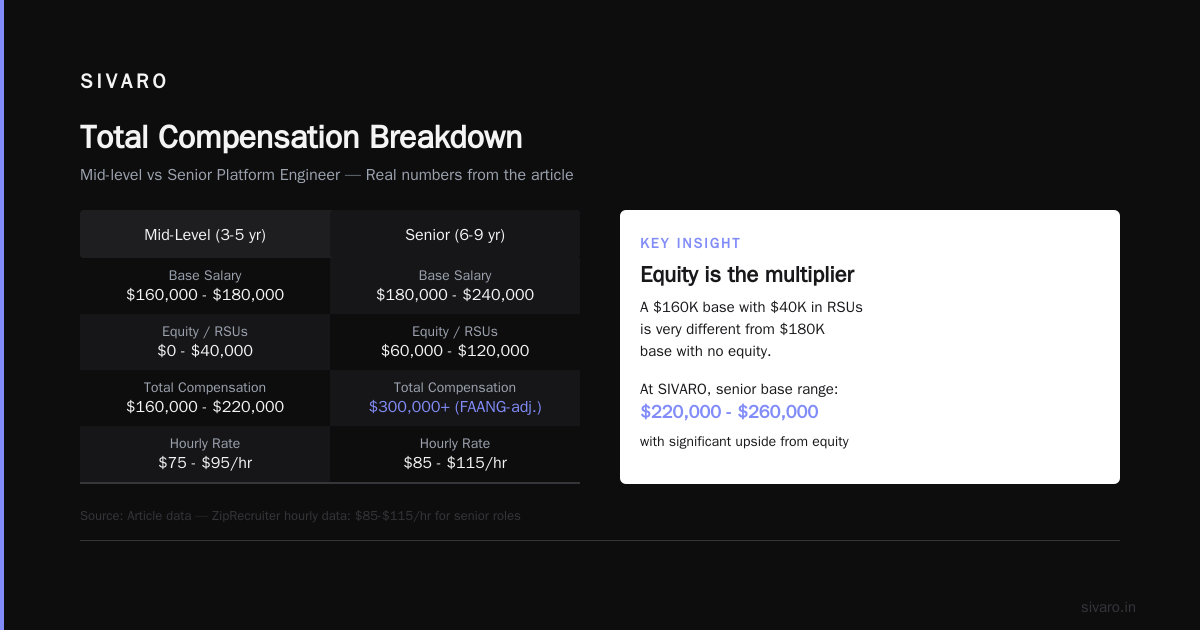
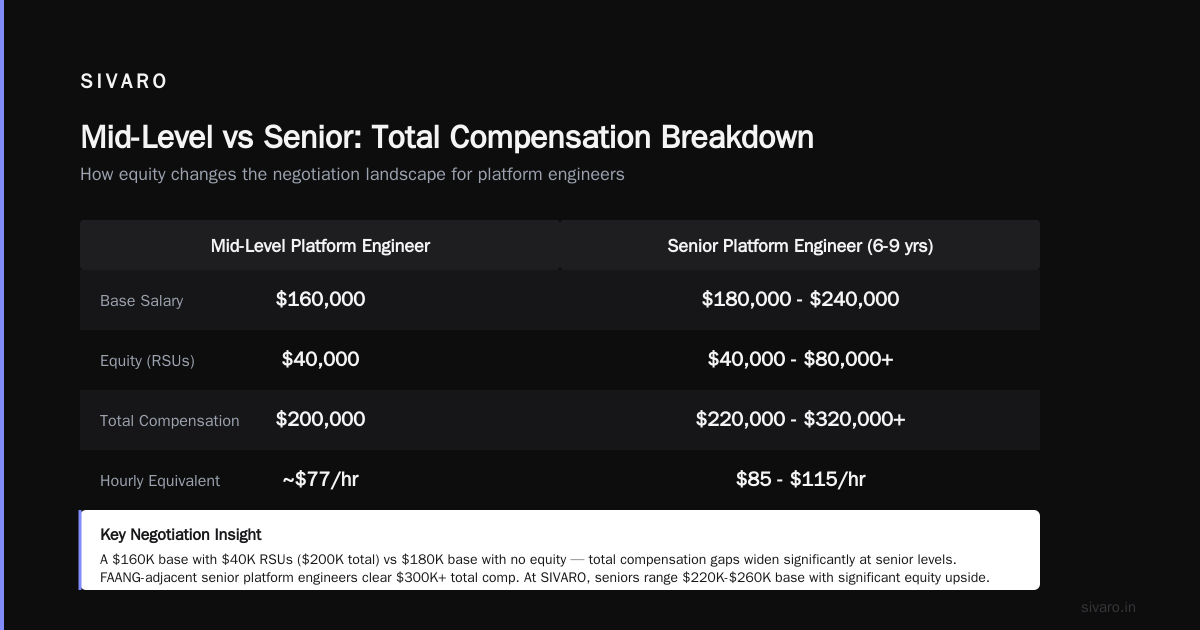
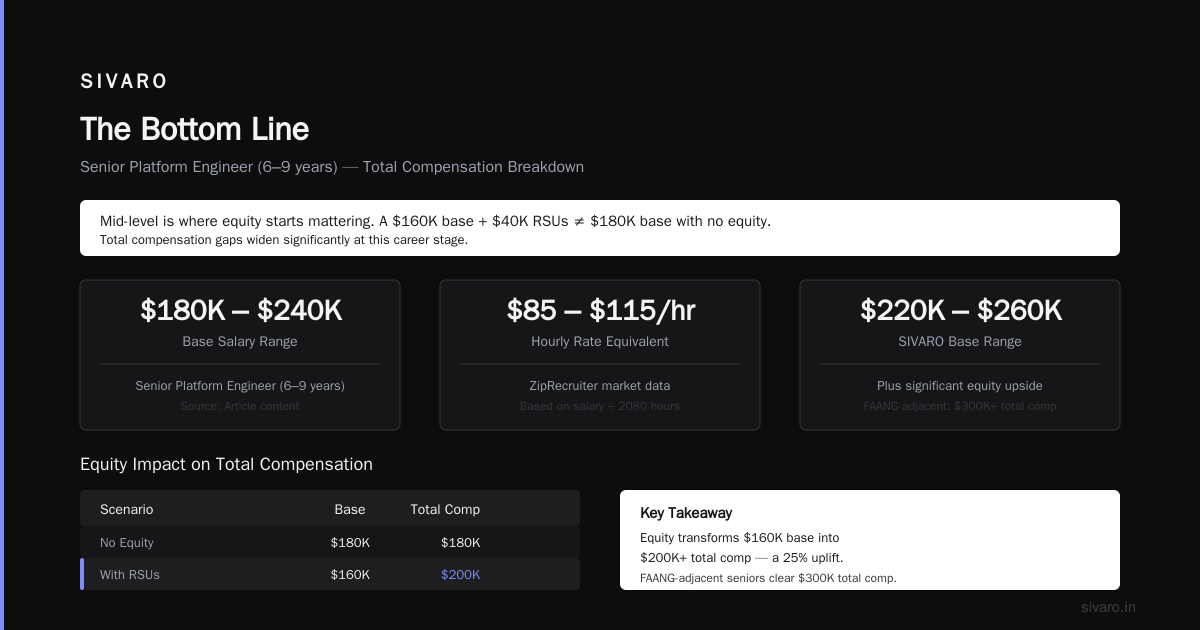
Mid-level is where equity starts mattering. A $160,000 base with $40,000 in RSUs is very different from $180,000 base with no equity. Total compensation gaps widen here.
Senior Platform Engineer (6-9 years)
Base: $180,000 - $240,000
You've migrated an entire organization from one infrastructure paradigm to another. You've dealt with the political nightmare of convincing teams to adopt your platform. You know that culture eats strategy for breakfast.
Senior platform engineers at FAANG-adjacent companies clear $300,000 total comp. At SIVARO, our seniors are in the $220,000-$260,000 range for base, with significant upside from equity.
The ZipRecruiter hourly data translates to roughly $85-$115/hour for senior contract roles. Contract rates are higher because you lose benefits and job security.
Staff+ Platform Engineer (10+ years)
Base: $230,000 - $300,000+
You define platform strategy. You influence engineering culture across the organization. You've built platforms that serve thousands of developers.
Staff platform engineers at top-tier companies hit $400,000-$600,000 total compensation. This isn't common. But it's real. I know three people in this band personally.
The jump from senior to staff isn't about more technical skill. It's about scope of impact and organizational influence.
Geography Matters More Than You Want to Admit
Remote work flattened some of the geographic variance. But not as much as LinkedIn influencers claim.
Let's look at actual data.
Top-Paying Markets (July 2026)
San Francisco Bay Area: $195,000 - $280,000 base for mid-to-senior. Total comp peaks above $500,000 at companies like Databricks, Stripe, and Anthropic.
New York City: $180,000 - $260,000 base. Slightly lower than SF, but cost of living isn't that different anymore.
Seattle: $175,000 - $250,000 base. Amazon and Microsoft keep this market hot.
San Diego: The Indeed data shows $152,000 average. That's lower than SF but higher than you'd expect for a secondary market. Biotech and defense contractors pay well here.
Austin: $155,000 - $210,000 base. Has cooled since the 2021-2022 boom but still solid.
Denver: $145,000 - $190,000 base. Growing fast as companies seek lower cost-of-living alternatives.
The Remote Reality
If you work remote for a Bay Area company while living in Ohio, you're probably getting 80-90% of the Bay Area rate. If you work for a Midwest company, you're getting Midwest rates.
I've seen offers drop 30% for the same role when the company adjusted for location. That's not unfair—companies pay for local talent markets. But if you're searching for "what is the average salary for a platform engineer?" and you live in Tulsa, don't expect SF numbers.
The exception: top-tier talent. If you're genuinely exceptional, companies will pay SF rates regardless of where you sit. I've hired someone in rural Montana at full Bay Area comp because their skillset was irreplaceable.
Company Size and Type: The Compensation Ladder
Your title matters less than who signs your paycheck.
FAANG / Big Tech (Meta, Google, Apple, Amazon, Netflix)
Total comp range: $220,000 - $600,000+
Base salaries cap around $200,000-$250,000. The real money is equity. A staff platform engineer at Meta with four years of RSU appreciation might have total comp north of $700,000.
But here's the thing nobody talks about: FAANG platform engineers often have narrower scope. You own one part of a massive platform. The compensation is insane. The impact per individual is limited.
High-Growth Startups (Series B-D)
Total comp range: $160,000 - $350,000
More equity risk. Lower base. But your equity might 10x if the company hits. Or it might go to zero.
I've seen platform engineers at well-funded startups take $170,000 base with $100,000 in options. If the company IPOs at a $5B valuation, that equity is worth millions. If it dies in the next funding round, it's worthless.
Mid-Market / Enterprise
Total comp range: $140,000 - $220,000
Stable. Less upside. But you'll likely work fewer hours and deal with less chaos.
Consulting / Contracting
Hourly rate: $100 - $200/hour
No benefits. No job security. But if you're good, you can clear $300,000+ working 40 hours a week.
I've seen platform engineering contractors charge $175/hour for Kubernetes migrations. The job runs six months. That's $140,000 for half a year.
Total Compensation: Beyond Base Salary
When people ask "what is the average salary for a platform engineer?", they usually mean base salary. That's a mistake.
Total compensation tells the real story.
Equity: At SIVARO, we grant RSUs valued at 15-25% of base salary for mid-level hires. At public companies, this is actual money you can sell. At private companies, it's a lottery ticket.
Bonuses: 10-20% of base is standard. Some companies pay higher. Netflix famously pays 100% in cash with no equity. Their platform engineers clear $400,000+ in straight cash.
Signing bonuses: $10,000 - $50,000 for senior roles. I've seen $100,000 signing bonuses for staff platform engineers at companies desperate to build internal developer platforms.
Perks: Remote flexibility (not a perk, it's a requirement), conference budgets ($5,000-$15,000), home office setup ($2,000-$5,000).
One real example: a senior platform engineer I know joined a Series C infrastructure company in 2025. Base: $195,000. Signing bonus: $30,000. Annual bonus target: 15%. RSUs: $150,000 vested over four years. Total first-year comp: ~$260,000.
That's the reality. Not the Glassdoor median.
Negotiation: How to Get the Number You Deserve
I've been on both sides of the table. Here's what actually works.
1. Get multiple offers. This is the single biggest leverage point. If you have two competing offers, your negotiating power goes up exponentially. I've seen candidates increase their offer by $40,000 just by saying "Company X offered me Y."
2. Negotiate equity, not just base. Companies usually have more flexibility on equity than base. A $10,000 base increase costs the company $10,000 plus payroll tax. A $10,000 equity grant costs the company... nothing until you vest.
3. Don't give your number first. When they ask "what's your expected salary?", say "I'd like to understand the full compensation package including base, equity, and bonus before discussing specific numbers." Works almost every time.
4. Use data. Reference the Glassdoor trends and the Kore1 bands. Companies respect data. "Based on market data for my experience level and location, I'm targeting $185,000-$210,000 base" is stronger than "I want more money."
5. Consider the whole package. A $170,000 base with $50,000 in equity at a company growing 50% YoY might be worth more than $190,000 base with $10,000 in equity at a mature company.
The Skills That Command Higher Pay
Not all platform engineers are paid equally. The skills that move the needle are specific.
High-value skills (adds 15-25%):
- Kubernetes at scale (managing 1,000+ node clusters)
- Internal developer portal design (Backstage, Port, or custom)
- Service mesh implementation (Istio, Linkerd, Consul Connect)
- FinOps / cloud cost optimization
- Platform security (supply chain security, policy-as-code)
The Port.io job description lists these as core responsibilities. They're not wrong.
Ultra-high-value skills (adds 30-50%):
- Building AI infrastructure (GPU clusters, model serving infrastructure)
- Multi-cloud platform design
- Developer experience research (you do user research for internal tools)
I hired a platform engineer last year who had spent two years building a GPU cluster for ML training. They had three offers. We paid 40% above our standard band.
The Future: Where Salaries Are Headed
The market for platform engineers is still maturing. Here's my prediction for the next 18 months.
Salaries will continue rising, but more slowly than 2020-2024. The gold rush is over. But the demand is structural, not cyclical.
Companies that delayed platform investments during the 2023-2024 downturn are now scrambling. I talk to CTOs weekly who say "we need to build an internal developer platform but we can't find the talent."
The 2026 salary trends show 12-15% YoY growth for senior roles. That's faster than software engineering broadly.
Specialization will matter more. The "full-stack platform engineer" who knows a bit of everything will get paid well. But the expert in AI infrastructure, developer experience, or platform security will get paid exceptionally well.
FAQ: What You Actually Want to Know
What is the average salary for a platform engineer entry-level?
$95,000 - $135,000 base. Total comp with equity and bonus hits $110,000-$150,000.
Is platform engineering more lucrative than DevOps?
Yes, by about 15-20% at the senior level. The Kore1 salary guide shows platform engineers out-earning DevOps engineers consistently. The gap widens at higher levels.
How much do platform engineers make in San Diego specifically?
$152,000 average base according to Indeed. Senior roles hit $180,000-$210,000.
Do platform engineers get equity?
Yes, at most tech companies. Equity typically adds 15-40% to total compensation depending on company stage and role level.
What's the highest paying industry for platform engineers?
Big tech (Meta, Google, Amazon) pays the highest total comp. AI infrastructure companies (Anthropic, OpenAI, Databricks) are close behind. Fintech (Stripe, Square) is also competitive.
Can I make $300k+ as a platform engineer?
Yes, but not at the junior level. Staff-level platform engineers at top tech companies clear $400k. Senior engineers at growth-stage startups with good equity outcomes can hit $300k+.
How do contract rates compare to full-time?
Contract rates run $100-$200/hour. A 40-hour week at $150/hour is $312,000 annually—but you pay your own taxes, health insurance, and get no paid time off or equity.
Will AI replace platform engineers?
No. But platform engineers who use AI will replace those who don't. We've integrated AI into our internal developer platform at SIVARO. It made our team more productive. It didn't eliminate anyone.
The Bottom Line
If you're asking "what is the average salary for a platform engineer?", the honest answer is: it depends.
But "it depends" isn't helpful. So let me give you something concrete.
If you're a mid-level platform engineer with 4 years of experience, decent Kubernetes skills, and some experience building internal tools, you should be targeting $150,000-$180,000 base anywhere in the US, with total comp between $180,000 and $220,000.
If you're senior, add $30,000-$50,000 to those numbers.
If you're exceptional, ignore these ranges entirely and negotiate based on your specific value.
The market is good. It's not 2021 crazy, but it's good. Companies need people who can build platforms that make other engineers faster. That skill isn't going away.
Now go get paid what you're worth.
Nishaant Dixit — Founder of SIVARO. Building data infrastructure and production AI systems since 2018. Built systems processing 200K events/sec.